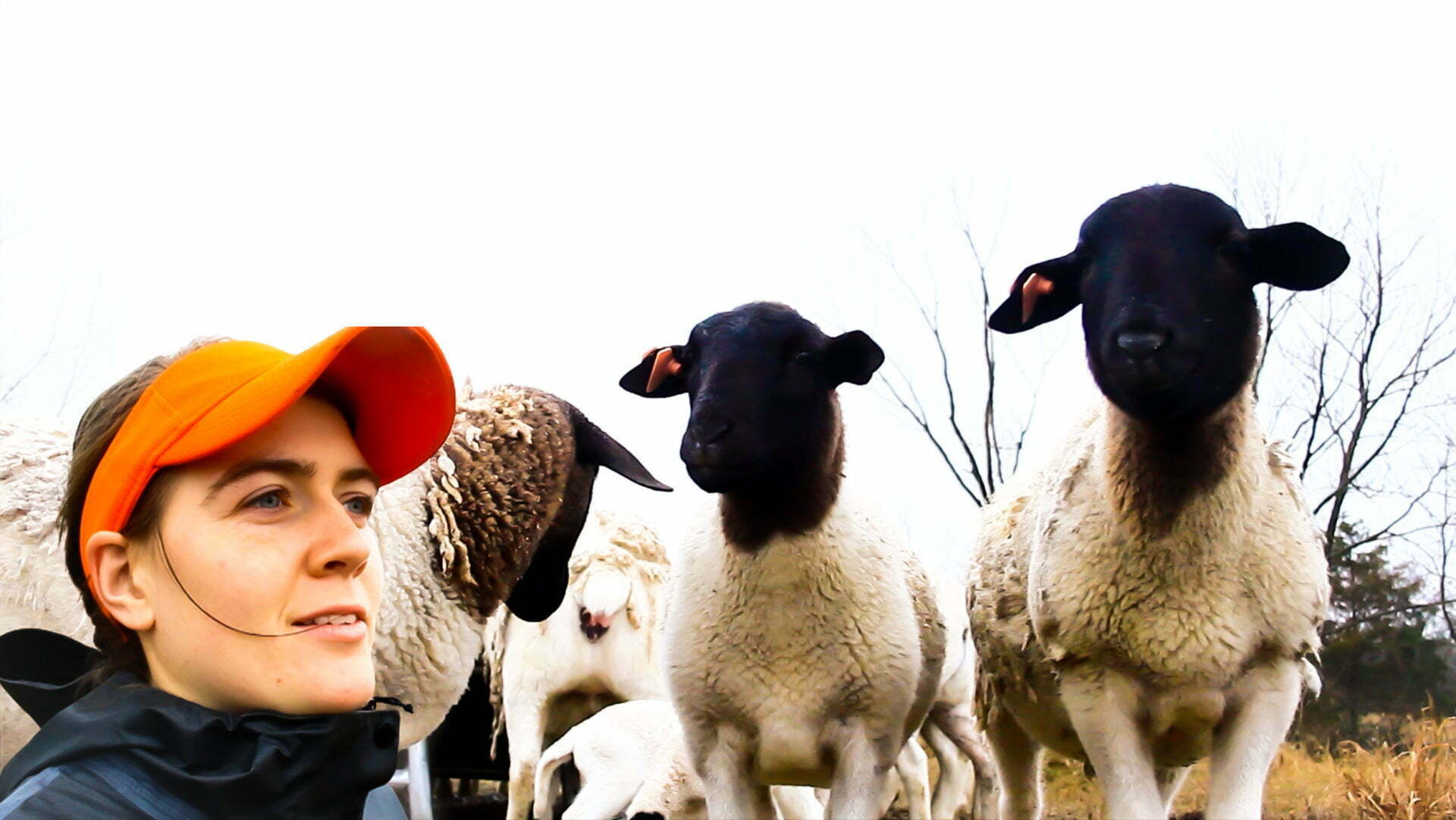
Hello friends, It is time for my monthly farm update! This one includes a failure story and a happy new beginning :). Some of you have followed the 6 year saga, but here is a recap for those who are new…
6 years ago I bought my flock and began my journey on pasture. I was rotating and leaving my sheep in the field 24/7. Predators were a concern, so I bought the first Great Pyrenees puppy I came across.
He arrived at my farm, he loved me, he loved chasing sheep, he loved chewing on lambs, and he loved plucking chicken feathers… not a very good start.
Over the next 6 mos I read books, I spanked him with the dead chickens, I made him a special necklace, and more. Until, one night his love for chasing put him under the wheels of a truck. And that was the (very, very sad) end of his story. 5 years passed and I honestly could not approach the idea of starting the puppy training process all over again. Mercifully, predator pressure wasn’t much of an issue in the years that followed. My fencing was tight, I avoided high risk areas when lambs were tiny, and we had a large pet dog (GP/German Shepherd mix) that roamed our 30 acres.
Predator losses were negligible… until this year – when our pet dog died. At that point I realized I had undervalued her surveillance. Lambs began quietly vanishing and losses became overwhelming. So I prayed. I simply asked the Lord for the right dog if I needed one. Then I waited and watched for the right dog (note, I did not say “puppy”😄).
And she showed up last month. She is 5 year old Great Pyrenees with a great track-record. Her former owners had just sold their sheep and she needed a new flock.
She doesn’t like chicken feathers, and she doesn’t chase sheep, and she’s indifferent toward me (the perfect inversion of my last pup😂). I knew that half the work with a new dog would be acclimating my sheep to it… and I was right. The flock was super flighty upon her arrival; but she was never triggered to chase. Within a few days the sheep had quit running and were sharing shade with her. I will need to introduce a younger dog at some point, but at that point the flock should be much more at ease with a dog present. While I can’t give you a five-step process for turning a puppy into the perfect flock guardian, I hope to encourage you with this testimony: the Lord is able to supply everything you need. Sometimes it’s just a matter of realizing you can’t, then asking if He will. Until next month, -the Shepherdess p.s. If you are new, check out my book: the Basics of Raising Sheep on Pasture. “But my God shall supply all your need according to his riches in glory by Christ Jesus.” Phil. 4:19 |
EVERYTHING YOU WANT TO KNOW ABOUT SHEEP FARMING (Live Audience Q&A)
Hi friends,
If you have a list of sheep questions a mile long, this episode is for you. I hosted a live Q&A through my Virtual Small Farmer Meetup, and we worked through dozens of questions from shepherds in every stage of farming.
We cover the basics of getting started beginners, like how much land you need, what size flock to start with, and how to prep your pasture before your first sheep arrives. I also dive further into the differences between sheep breeds, why I chose dairy goats over dairy sheep, and what it costs to keep a flock fed and healthy.
No matter what stage of shepherding you are in, my hope is that this episode saves you some trial and error.
-the Shepherdess
TRANSCRIPT
the Shepherdess All right, guys, thank you for being here. We are going to be talking about everything sheep Q&A. Now, I want to encourage you guys towards preparedness, but one of the things I do not want to do is encourage you towards tinfoil hats and concrete bunkers. Those are things typically associated with homesteading and really getting back to this way of life. The context of it is typically doomsday. We’re prepping for some type of end of the world, but the reality is that what we’re trying to do here is getting back to just a little bit of self-sufficiency, a little bit of back to the land which was a way of life 60 years ago. You know, until 60 years ago, what is labeled prepping or apocalyptic now was a way of life for thousands of years. The way we’ve been living for the past 60 years is not normal, OK? Relying on a farming population of 2% to feed an entire nation and beyond is not normal. Having 80% of our meat supply completely controlled by four companies, that is not normal. Losing soil at a rate 10 times faster than that of replenishment is not normal. Having a food system that relies on the use of one billion pounds worth of cancer causing pesticides is not normal. And having 300 million people tied to a single power grid is not normal. So today, we are meeting up to encourage each other back to a sense of normalcy.
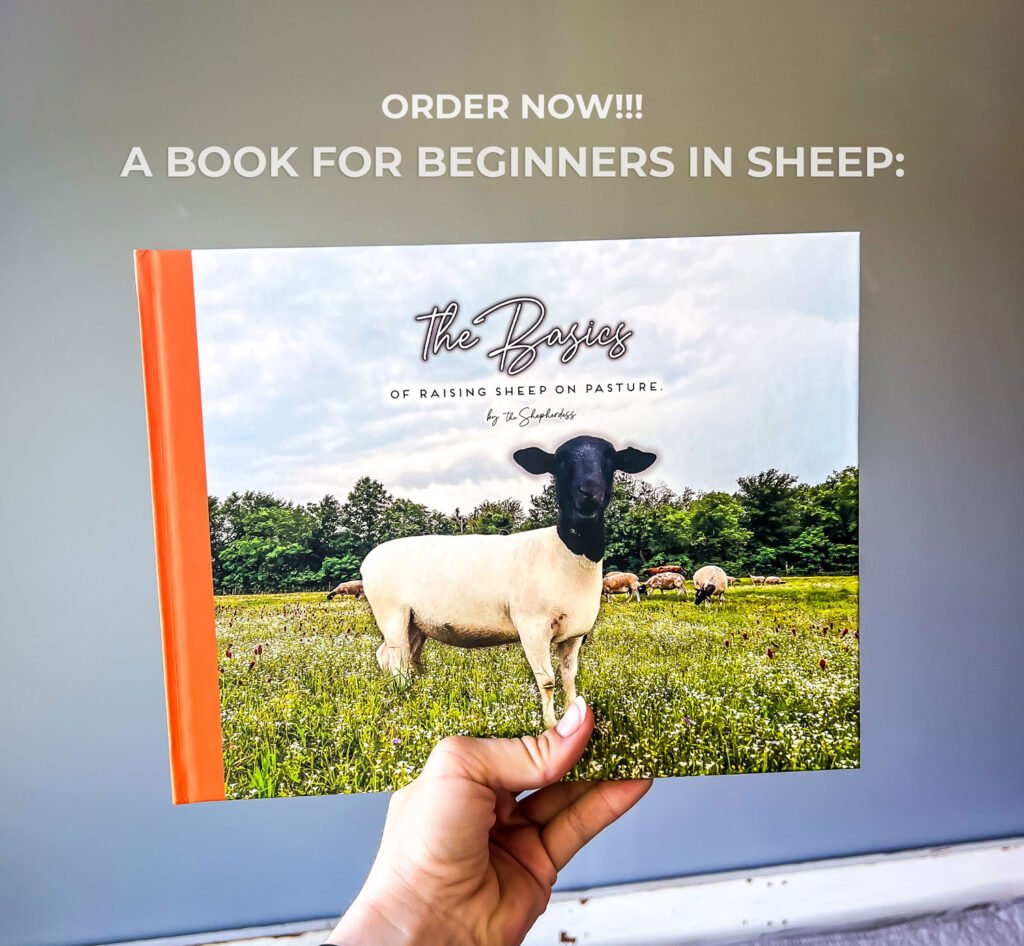
If you’re a beginner shepherd on 30 acres or less, then I wrote a book for you: The Basics of Raising Sheep on Pasture. Available at Shepherdess.com with free shipping. Raising sheep on pasture requires a basic understanding of pasture management, breeding and lambing, and mitigation methods for common disease. I walk the beginner shepherd through each aspect, sharing through this book vivid pictures, easy-to-follow instructions, and personalized stories from my own journey with sheep. Available with free shipping at Shepherdess.com; you’ll find a direct link in the description.
I’m going to go ahead and jump right into it because I have about 30 questions, and I hope to get through them all, but we will see how far we get. All right, Jason’s in Louisiana with ten chickens and one livestock guardian dog, which for you guys who have been following the underlying livestock guardian dog drama at my farm—the reality that I haven’t had one for five years and also the reality that it’s been a bad year for lamb losses because of it—I am now the owner of a livestock guardian dog. This was the most amazing thing that has happened to me in I don’t know, I’m going to say at least in the last four months, but I was really, really, really not wanting to get a puppy again as a livestock guardian dog. I got a puppy last time. He was a chaser. He was relentlessly chasing my flock, and then he decided to chase traffic one night, and we tragically lost him. And after that happened, I realized I just probably needed to do a middle-aged dog next time. Something that was not going to ruin my life.
And last month, I was just praying about it, and a five-year-old Great Pyrenees pops onto my Facebook feed. She had been with a flock, and I went and I picked that thing up. She walks right into the middle of the sheep, sits down as though she’s been… Well, obviously she’s been doing this her whole life, but it was such an exciting moment for me because she is absolutely perfect. She’s huge. She’s calm in temperament. So for those following the drama, I do now have a livestock guardian dog, and it is a very, very happy day for me. So she’s like, I don’t know. Right now, I just feel like she’s the best dog ever. I’m going to be sharing a Facebook post about her, but she likes my sheep more than she likes me. That’s the thing. And my first livestock guardian dog, it liked me more than it liked my sheep, which was initially flattering, but when it comes to a livestock guardian dog, that gets really old. They’re on your back porch instead of in the middle of the flock taking care of things. So anyways, that was the update.
Preparing your pasture, shade, and water systems
All right, let’s go ahead and get into it. I’ve got the first question of the night here from Keith Curry. He says, “I’m in Alabama. I have two and a half acres right now, and I was wanting to raise just a few sheep for meat production. The pasture has been cut like a lawn up until now. Do I need to let the grass grow taller before introducing my first ewe?” So Keith, if the grass has been basically mowed as a result of overgrazing too many animals on there for too long, if it was me, I think a season of rest would be absolutely fine and only advantageous for that land base. If it’s been mowed simply mechanically or just with a lawnmower, within just a couple of months, you should have plenty of grazeable forage. So Keith, I would go at it from this perspective: I would go at it essentially prioritizing finding just the right sheep. So take your time in doing that. It sounds like you don’t need to rush into this process, so take you time in finding a good set of sheep.
But if your land base was mechanically mown versus overgrazed with animals, it’s going to be in a better condition than if it was overgrazed with animals for this reason: when you mow mechanically, the forage goes back into the land base as essentially mulch. So you will get essentially 25% of the value of that forage that was chopped off goes directly back into the ground rather than going into the animals and being removed from that land. So mechanically mowing leaves a lot more nutrition on the land than overgrazing with livestock with the caveat being the livestock leave manure behind, but even if you are overgrazing with livestock, they don’t leave enough manure behind to compensate for overgrazing pretty much ever. So keep that in mind.
All right. New Valhams Farm asks, “What do you do for shade in the summer? Portable, affordable, or go all in? And what about a watering system?” So for shade and the summer, if you guys want to go to YouTube—and if you’re making notes tonight, I’m going to be referencing a lot of YouTube videos because I’ve made full length videos on a lot these topics—but if you go to youtube and search sheep shade DIY, this is a portable, affordable option for you that we kind of invented here to solve our shade structure need. Now, I’ve seen some people take this idea and really ramp it up. They have taken the shade structure that you’ll see on that video, which is very portable, a little bit flimsy, and they have put it on a wooden frame. So this is a great option to kind of upgrade and get something midway between affordable and a little more reliable. But shade structure DIY is what you want to search on YouTube and you’ll find my video there for it.
And then what about watering systems? And I’m going to go ahead and drop a resource if I’ve got it here on a watering system. But my watering system is pretty simple. I actually don’t have the resource, but it’s polyethylene tubing in 250 foot lengths from DripDepot.com. So Drip Depot has 250 foot lengths of polyethylene tubing. I will buy it in tandem with the plastic hose fittings, and it’s super cheap. I’ve got main spigots at my house and my land base is 30 acres, so it’s pretty small comparably. I’m not sure what you’re working on. But it allows me just to set up those 250 foot lengths and get them going all over my property into the various paddocks from the spigots that I have at basically the center of this land base because my home and the spigots are placed just right in the center and therefore, can branch out like that. So DripDepot.com. 500 foot lengths of polyethylene tubing with the associated fittings to make them essentially extra long hoses. They’re very cheap. It’s worked so well for me.
All right, so Gareth Curtis asks, “When you first started, how did you find land? And did it have a house on it, or did you live someplace else? So Gareth, if you know my story, and if you guys have been on my channel for a while, you know that I am actually working with family land. So I’m living on the property itself. We moved from the city to the country in 2017, and we bought 30 acres. It was originally uninhabited, but fenced very well. We fenced it for sheep, bought sheep, and you really need to probably go watch the rest of the videos for what happened after that because there were a lot of highs and lows. But we do live on the land, and I don’t know that I would be able to raise sheep unless I lived in some proximity to where I could check on them at least once a day. A lot of people will email me and ask about land leases, the fact that they have maybe the opportunity to lease 100, 250 acres, but it’s maybe 20 minutes from their home. They’ll ask me, “Should I buy sheep, or should I buy cattle for that lease?” My answer is always buy cattle. You’ve got any kind of a 20 or 30 minute drive to get to the land base, always buy cattle in my opinion.
The reason being is that cattle can fend for themselves in terms of predators. Cattle will get out. They’ll get on to the road sometimes, but sheep will probably at some point definitely get out onto the road. And if you’re 20 minutes or 30 minutes away from a sheep break, it’s going to cause a lot of problems for you, and you’ll probably lose your lease. I don’t know, speculative, but it’s a pretty big potential if you ask me. So that’s a long answer to whether you live on the farm or someplace else because Gareth, I’m guessing that you are potentially considering living remote from your sheep. Crystal Kristoff asks, “How would a setup for 10 sheep look different from a setup for 100 sheep?” Crystal, not a lot different. In fact, when you watch my videos—especially the ones on electric fencing or rotational grazing, installs like that—they’re scalable. So I’m doing it on 30 acres, and the tools that I use, the way that I’ve set it up, can be scaled down to three acres. It can be scaled up to 300 acres.
So in terms of the setup, you’re just looking at quantities of materials. If you’re raising 100 sheep by yourself, you probably want to get a little bit smart about handling systems. If you’ve got 10 sheep, a small pen is going to be just fine. So setup is not a whole lot different. I’ve got a lot of videos on my channel about electric fencing setup. I’m working on a huge one. I hope to post it in the next month and a half in terms of setting up an electric fencing system overall, but watch that video and understand that it is scalable in terms whether you’re working on three acres or 300. This was one of my favorite questions of the night, and The Bariatric Travelers asks, “What is your favorite way to eat sheep?” OK. Wait for it. This is literally my favorite way to eat sheep. This is sheep liver. And this is my all-time favorite way to eat sheep. I eat six capsules every morning with my coffee. If you are on my email list, go back and find the email called Hair Sheep for Hair Growth. Sheep liver is far above beef liver in a lot of the… I don’t know if you call it micronutrients. Nutrient-density-wise, it is exceedingly higher than beef liver in iron, selenium, B vitamins. So my favorite way to eat sheep is their livers.
I have a Five Ways to Cook Lamb video, and it’s delicious every other way. But in terms of everyday consumption, I love their livers. Hair growth has been incredible, skin quality, and nails since I started that. But a year and a half ago I started eating sheep liver every single day, and it’s become like a religious ritual for me. I’ve been sharing the sheep liver with my balding friends, and they’re like, “My hair is growing back.” It’s not even a joke. So try it out. I freeze dry my own livers and I fill my own capsules because it’s super hard to find sheep liver. There’s only one source that I have found for sheep liver and it’s not raw. I freeze dry my sheep livers and encapsulate them myself, and I do it raw. So this is full of raw, uncooked liver. I can do that because it’s for personal use. I don’t sell these. I just do it personally for personal use myself, but having the raw material and source there… I don’t know. Raw food has benefits.
“What is the best for milk?” That was Norman Kirby’s question, and I thought it was funny because somebody replied to this question on social media and they said, “A goat.” I would have to agree with that person who replied to Norman when he asked what is the best for milk. The reason being is that I raise dairy goats alongside my sheep rather than having added to my flock some dairy sheep. And this is because the milk yield in dairy goats is higher, the breed and genetic pool are wider for dairy goats over sheep. Essentially, I can get the same yield off of one really good goat that you would off of two or three dairy sheep. So that is why I’ve chosen to do dairy goats. But if you are looking for information on dairy sheep, they have their own unique advantages. Go to YouTube and search Dairy Sheep. I’ve got about four or five videos. I’m going to drop a couple of breed suggestions here for the dairy options. You’re going to be looking at Awassi as a dairy sheep breed, Finn Sheep, and then Lacaune. And those are the top three breeds that you’re going to want to research and potentially look into yourself if you’re looking for dairy sheep breeds.
Selecting breeds that fit your farm and budget
And I just put a video up on my podcast channel, which is Shepherdess Live on YouTube. I’ve created a separate channel for some of the long-form live stream replays. And I go through the sheep-versus-goats advantages and management nuances that you’re looking at in terms of those two different types. And then I walk through a little bit more in detail in that one hour presentation why I chose goat milk over just simply raising dairy sheep. So if you want to kind of deep dive on that, search sheep versus goats, and you’re going to find that. All right, White Dorper versus Black-headed Dorper. This is a question that I get a lot. Essentially they are the same animal, but every single place that I’ve been to that has raised both side by side have the same answer in terms of the general difference between White Dorper versus Black Dorper. The White Dorper has just a slightly larger carcass and a slightly lower fertility.
People are going to counter that statement about lower fertility saying that sheep fertility is a management issue, and I would largely agree, but in asking people who have owned both, it’s a general consensus that it takes less to make a more fertile Black-headed Dorper than it does a White Dorper entirely. But they’ll also say the White Dorper has just a slightly meatier carcass. So keep that in mind as you’re shopping for yourself and considering those options. Okay, this was a question from OCC Plumbing and Restorations. And this is a difficult question to answer, but I’m going to do my best. It says, “How much does it cost per year to care for your sheep?” So now that infrastructure is in place, the ongoing expenses for sheep involve feed, it involves human resource, and it involves basically vet care. Whether I do it myself or I take them somewhere to get their problems addressed. And when I say problems, I’m looking at things that primarily I’ve learned to take care of myself.
But all of that is factored in, and the wide and broad range is it takes anything between $50 and $250 to raise a sheep over the course of a year. I know that’s super, super broad, but feed inputs—some years I can graze pretty much entirely through the winter. We have such a surplus that I’m hardly buying hay at all. This year we’re looking at a drought and I’m not entirely sure what I’m going to be looking at in terms of feed inputs. If we don’t get any rain here by the end of September, I’m probably looking at a significantly higher amount. So, $50 to $250. And I know that probably does not help or answer your question in any specifics, but again, I’m going to reference a video that I made called The 15 Costs of Raising Sheep. And in that video, I go through not necessarily the dollars and cents, but I go through the costs that you’re going to need to put on a piece of paper and find your own unique costs, whether it’s land costs, handling systems, veterinary care, medical supplies, whatever you decide to do. I give you the 15 costs associated with everything from infrastructure to annual maintenance on a flock, and those are going to be things you need to put your pencil to in your region and get an idea regionally.
But having an understanding, you’re going to find through that video, are the 15 different costs there. But ongoing, your biggest ones are going to be feed and if you’re me, feed and vet care whether you hire a vet or do it yourself. And I know that there’s a lot of people that may not resonate with the reality that there are veterinary-style expenses is probably what I need to say more. But veterinary-style expenses just simply means if your sheep needs a dewormer, if your sheep breaks a leg and you need to set it, whether you do it yourself or you take it somewhere. You can set a leg at your own farm, just get some education. This was a gross one, but this is actually in my book, The Basics of Raising Sheep on Pasture, which I have not plugged yet tonight, but free shipping for the book at Shepherdess.com.
In chapter 12, which covers the gross things I’ve seen as a shepherdess, this one was an absolute doozy and this was a rectal prolapse. And let me tell you, I tried to address this one at home. I did my best. My dad was there. He had the sheep held down, and I tried to try to go at it and stitch her up all by myself. I’m sorry if this is too graphic for YouTube. You’re going to have to go to the private live stream and get some more details on this or buy the book. But you’re going to have little random things like that. And if your flock is big enough, sometimes the sheep will die before you can get it and treat it. That’s totally fine. There’s no judgment for that. But when you have a small flock on 30 acres, you’re essentially doing dishes looking out your back window at a sheep with rectal prolapse, and it’s super hard to ignore that until it dies. So I had to just go out and try to fix it as best I could. Didn’t really work. I took it to the vet for about $140. They put a fix in. And because that’s not a heritable issue, she was back to producing, and thankfully did produce a lamb the next year that covered that cost pretty good.
So those are kind of a little bit of a long answer to that. But there are going to be things that pop up and whether you decide to treat them yourself, let nature take its course and it dies, or you take it to a vet and decide that that’s going to be the cost of a learning experience, you’re going to have to budget in a little bit for that into your annual expenses. All right. I’ve got one more question from the pre-submitted questions, which are getting priority tonight, and then I’ll hop over here to the comments in the live stream. OK, so the last one is from Savage Mark, and he asks, “What are your thoughts on Australian whites?” And again, I was able to go to Australia and actually film an operation with some excellent Australian White sheep. She runs the direct-to-consumer meat business with this breed. She absolutely loves them. She says that the meat is softer in the Australian white sheep than the Dorper. She’s raised both, so her flock is really a Dorper base and she bred up and ultimately bred a primarily Australian white flock through crossbreeding.
So the carcass on those things was excellent. It was just slightly smaller than a Dorper but still very, very suitable for a direct-to-consumer meat sales business. So from what I saw, go to YouTube and type in Australian White sheep, and one of my videos should pop up there. Watch that for yourself. That’s going to kind of really give an objective look because she raised both, and she outlines why she likes one better than the other. And it was primarily meat quality. So I’ve never tasted or had it firsthand myself. The only thing I would add is that it was Australia, and I was filming Australian Whites in Australia. The genetic pool over there is going to be really, really good because that’s where the breed originated, has been developed, et cetera. I don’t know that the genetic pool of Australian Whites in the United States is broad enough yet to get the kind of sheep I saw over there.
So go watch that. It’s Macyntire Brooke Lamb on YouTube. But keep that in mind. The only drawback is because that breed is native to Australia, you may hit some limitations in terms of just how well it’s been developed or rather not been developed in the United States so far. But if you want to jump into that process and develop the breed and be part of that, then that may be an option for you here. Elizabeth says, “What size of a flock would be good for a beginner? For example, how many ewes and a ram?” And I always say start with three ewes and one ram. I know that’s really small, but in your first year, if you manage them well, it’ll double or triple. And in the second year, you can keep all your replacements. You’ll immediately have a flock of six or nine. In the third year, fourth year, the math adds up.
But what happens when you do the reverse? You buy 30 sheep as a beginner, unaware mostly of the challenges associated. That flock doubles or triples from 30 to 60 or 90. You’re suddenly swimming in lambs, you have more losses than you want to admit, and you get burnt out, decide to quit farming sheep. That was our experience, except for the last part of deciding to quit. But essentially, I say buy three to four ewes and a ram as a beginner, no matter how much land you have, because that’s going to be the best way to learn without the burnout. You can always buy 10 more the next year if you really love it and you have no problems.
But when we started, we started as a family who had never really raised anything beyond chickens before. We bought about 30 or 40 sheep. They rolled out of the trailer. It was a beautiful experience probably for the first four months. At five months, lambs started dropping, absolutely beautiful. Lambs started growing up and getting worms. We had no idea in terms of rotational grazing or managing parasites, et cetera. Almost all of our lambs died the first year. Almost all would probably be an exaggeration. I’d say maybe 40% or 50%. It was really discouraging, and we had to kind of walk uphill to learn a lot of the principles that would have been far easier learned with a flock of maybe 10 or less. I’m not saying you have to start as small as three or four, but 10 or less if you’re an absolute beginner.
How to handle dry spells, land limits, and shearing
All right. Ai says, “What is the lowest amount of land that you would recommend for a small flock?” Six or eight sheep. You asked that question in the perfect timing because I just posted a video on YouTube about how one of my friends, Nancy Andrews, raises six dairy sheep, and all of their lambs—so a flock that swells to about 12 head—on an acre and a half in the suburbs. So she does a great job. She’s working this acre and a half with plantings and pasture improvements and she’s raising dairy sheep, six of them, on an acre and a half. She is probably doing the most on an acre and a half in terms of sheep in a healthy way that I’ve ever seen. So go to that YouTube video that is published and live right now. Nancy really unpacks her pasture management system and how she keeps six sheep on an acre and a half. But that’s about what I would look at: maybe an acre or acre and a half as the minimum.
All right. So Nidia asks, “With the drought in Northeast Texas, the grass is pretty much dead and not recovered from earlier grazing. Should I continue to rotate my sheep or is it better to dry lot and provide hay until we get some rain and the pasture recovers?” So Nidia, if you are going to feed hay, I would feed it in a bale grazing fashion. So I would keep rotating them, but I would just feed hay across the pasture that you’re rotating them, and keep that fertility on the land. Then once your rain does return, the extra fertility from that hay that you are buying is going to be absolutely maximized because you have fed it to them across your land rather than in a single dry lot where that fertility may go largely to waste.
We had the huge mega drought of 2022 in Texas, and when I would bale graze, it was so dry and there was so little forage that I didn’t have to hardly set up the poly tape, you know, electric fencing paddocks. They would just migrate to where those new bales were. So I just set out the bales at intervals across the property during that drought, and that’s how I bale grazed. It was very low maintenance, and I was so much more grateful that I kept them moving and kept that fertility moving across the land base than if I would have just had them on a dry lot and had all the nutrients kind of going to waste there. So I hope that helps.
Picture this: you are looking out over your 5, 10, maybe 20-plus acres. The sun is setting, and your flock is grazing across a green pasture. Something inside you affirms this is real wealth—at least when it comes to material things. You know how to take care of your sheep, your grazing system is improving your land, and you have a way to direct market each lamb that is born. This is how I feel when I look at my flock, and I want the same for you. So, I put together a free one-hour class that answers some of your most frequently asked questions concerning how I raise, rotational graze, and market my sheep for $480 per head. Go to Shepherdess.com/480, or simply click the first link in the show notes of this podcast to sign up and receive the free on-demand class. What’s more is that I will follow up over the course of three days, providing you with even more free resources—including a free ebook, a free grazing sheep kickstart guide, and a free marketing sheep kickstart guide. This information is worth paying for, but I’m giving it to you for free. Just go to Shepherdess.com/480, or simply click the first link in the show notes of this podcast for how I raise, graze, and market my sheep for $480 each.
Ai says, “Do you recommend that new owners shear their own sheep—learn from a professional first, then give it a crack—or just always hire a pro?” So I raise a hair sheep, but I do have about eight that I just like to give a little bit of a haircut every year. I just went to YouTube and watched probably six hours worth of shearing videos. I watched those guys do it over and over again. I got a little of an idea of where they started with the shears and where they ended. It was pretty ugly the first couple of times I did it, but now I can shear a sheep pretty efficiently in my own opinion for somebody who’s never been at professional classes. So get a good pair of shears, watch a lot of videos, and do your best as a beginner at your own risk. The first time I did shear a sheep, I nearly cut my own finger off, so you do need to understand that there are some risks associated with that. I lost a bit of blood that day, but it was the first and only time. So it’s worth it to me to be able to have that skill and to know how to do it. And it really feels satisfying to know how to do it, despite the fact that the first one took me like an hour to shear. It’s a lot faster now, but just knowing how to do it yourself is worth it in my opinion.
All right. Tasha asks, “Is there a recipe for the sheep liver capsules in the email?” Tasha, it’s not really a recipe. It’s just straight liver. And I make these myself. I have a freeze dryer, which I love, and I will freeze dry the raw liver, I’ll grind it in the Magic Bullet, and I use a capsule maker from All-In Capsules. And I can do anywhere from 500 to 1,000 capsules a day, which I calculated was upwards of $700. So it’s fun. It’s a little bit of a Sunday afternoon hobby for me—decompressing through pill making of the healthy type. But there’s really no recipe. It’s 100% freeze dried liver. And it is one of the best things I’ve ever added to my health regime. I eat it raw. I freeze dry it raw. A lot of people cook it before they eat it and consume it, and that would be my recommendation here to the public, but I eat mine raw at my own risk, and it’s absolutely fantastic. So many nutrients in that, it’s not even funny.
All right, Ethan Johnson says, “If people would please tag me or whatever. I can’t read the comments at the moment since I’m at school.” He says, “I lost a ewe to her choking on feed. I know that you run on only pasture, but is there a solution that you know of? I’m honestly terrified of feeding without watching them like a hawk now.” Ethan, I’ve never had one that’s died of choking. I have had them foam at the mouth when I do give them feed, and it’s been more in the ones that I haven’t vaccinated for the CDNT, which is kind of the bacterial overgrowth that happens when rich feed is introduced really quickly. So they have choked a lot and they have foamed at the mouth quite a lot, but nothing’s ever died. This may or may not be something you want to do, but do try to give them that CDNT vaccine if you want to continue to feed them because that will really subdue a lot of the bacteria that is boiling over.
If you watch it and it chokes and it just appears as though it choked from just having that frothy reaction in its gut and died of that, the CDNT vaccine will probably subdue that reaction. So give that a thought. Guys, tag Ethan if you’ve ever had a spontaneous choking death on your farm, which actually sounds tragic. So, I’m sorry about that, but you are not alone. Rebecca says, “I’m still working on getting sheep. I live in McAllister, Oklahoma. I’m new to the state, and I’m hearing it’s going to be really cold this winter. What is the lowest temperature that a Dorper can manage? I have a barn if needed.” So Dorpers, in my experience, are not really temperature sensitive. Mine at least will grow a little bit of a thicker hair coat over the winter. And as long as they’re in a largish group, let’s say 10, 20 or more, they can group together and really withstand a lot of the cold. So Dorpers, in my experience, have not been extremely temperature sensitive. I’ve left mine out on pasture in the low teens and I’ve seen people leave them out on pasture in snow.
Processing meat at home and choosing heritage breeds
The thing that you want to watch out for, Rebecca, is freezing rain or exceptionally sleety, wet snow because while they are really, really resilient to cold and dry cold, the wet is probably what gets them and hits them. So if you have a barn and you can see on the forecast there’s going to be freezing rain, I just move them into that barn overnight just to cut your losses and probably avoid… You know, you may not lose a sheep, but you may have some problems with secondary things like infections, pneumonia, or just a weakened immune system from that kind of exposure. Edmar says, “Do you process your own sheep when needed? Do you have a tutorial?” So Edmar, on my YouTube channel, I do have a video called Butchering a Lamb for the First Time. I’ve since done it several times, and I will butcher things like culled ewes and things that I will be eating personally. However, if I’m going to sell to the front end, I need to have a USDA inspection. And so that’s when I will take them and have them processed at a USDA inspector.
And it’s really non-negotiable. I can’t process on-farm and then sell the meat to other people. I can sell the lamb to other people and then if they want to, you know, privately hire me to do that slaughter process, they can. I don’t offer that or don’t do that, but that’s a loophole that you can be a custom butcher of sorts on a private treaty basis. But I do know how to process my own sheep, and I will process for personal consumption. So go on to YouTube. And that is another one in the pipeline in terms of posting is just a closer look at how it goes for me now. I still don’t have a ton of experience, but I think that helps people sometimes in terms of seeing that you don’t have to have a ton of experience to skin and get a living animal into an edible product. So I’ll keep that one in the pipeline as priority.
All right. Angela says, “Do you have any feedback in regards to the Barbados Blackbelly and crossing with Dorpers?” I don’t have any personal or firsthand experience. I do know the Barbados Blackbelly is a very, very hardy heritage breed, and that’s going to contribute a ton of hardiness to anything that you cross it with. The black belly is one of those breeds that people will really have a lot of success with if they don’t want to deworm or if they want a very, very low-maintenance flock. The carcass size is a lot smaller. So if you were to cross it with Dorper, you might get something right in the middle, meaning something with a bit of a thicker carcass and a less parasite-sensitive sheep. So it would be an interesting cross worth giving a try, Angela, if you have the opportunity. If you don’t like it, you just breed up or choose the one that you do like for the long term.
Kim says, “Do you breed registered Dorpers to sell as seed stock plus the commercial Dorpers that sell for meat only?” Kim, I used to do this. But I have found for myself, personally, the commercial Dorper and just running a commercial operation is a better route for me to go. The registered operation was great for boosting the bottom line in terms of registered sheep selling for up to five times more than a commercial sheep. However, my commercial sheep do have a reputation now and I am able to earn a premium on commercial breeding stock just through marketing, meat sales, and diversity there. Personally, it’s just more profitable for me to focus on really having a good commercial line given all the diversity that I’ve woven into my marketing. That’s within my specific context. So that’s a little bit of an explanation on where I’m at. I used to, and it was a great way to boost the bottom line, especially in those early years. But now I have transitioned pretty exclusively to just running a quality commercial line.
Manji says, “Do you think frozen tubes taken from the US to Morocco would be usable for AI? This is a 14-hour trip plus the extra two hours to my farm. I’m trying to breed the Blackbelly…” Yeah. Manji, I don’t have any experience with artificial insemination, so maybe somebody who does and they could tag you with information. But I do know people import stuff from worlds away, so I don’t know that the distance would be an issue. Christina says, “In reference to the shears, do you use the electric shears for shearing your sheep or the scissor looking shears?” I will use the electric shears. I use Premier One, I think it’s the 4000 shearing machine. It plugs into an outlet, so I do have to bring the sheep a little bit closer or use a generator to shear those sheep at the shed. And then I use the Spitfire cutters and a nine-tooth comb. I think it’s the Apache comb. If you’re going to Premiere One to shop right now, just keep those things in mind if you want my setup: 4,000 shearing machine, the Apache, nine-tooth comb, and the Spitfire cutter. I think I got it right there.
And it’s very important that you do that specific combination, especially if your sheep are not a fine-wool sheep. Typically when I go to shear my sheep, I’m just getting the ugly off of them. So it’s often a really matted coat, very, very bad. So that nine-tooth comb—it shears through really, really poor-quality fuzz, essentially. If you were to get any smaller of a comb or cutter, it’s going to get jammed up, gunked up, and stop after about a sheep and a half. So, take my advice on that. Jessica Jones-Carson says, “How do you separate the rams from the young and older ewes? How do you introduce a breeder ram to the young males?” Separating a ram from the young and older ewes during off-season, I will put him in a clean pen with hay, minerals, and a buddy. And that’s his prison while he’s not in production. And then in terms of separating the young and older ewes, right now, I have a group of older ewes that are on one side of the property breeding with one specific ram. And I have a set of younger ewes on the opposite side of the property in a paddock breeding with their ram, at least they will be. And that’s just how I separate my two groups.
I’ll keep them at a distance in two different paddocks. And I can do that pretty easily on 30 acres with no problems. In terms of how to introduce a breeder ram to young males, this is a good question because the older ones can become very aggressive towards anything male and anything new in that respect. A piece of advice that I got from an older shepherd was whenever you introduce a new ram or you put rams back together, put them in a very, very small pen to where they can’t get a running head start at one another. So put them on a really tight pen. And if they butt each other around, they’re going to butt each other around, but they won’t have the running head start that is often necessary to kill each other. I’ve heard of rams killing each other, so, small pen.
Lynn says, “My acreage is mostly forested with about four acres of open pasture. I’m in New Hampshire. Can sheep utilize a forest area?” Yes, sheep will utilize a forest area exceptionally well. They are grazers as well as browsers. Oh, Richard asks, “If it’s OK to ask Grace, how are those newlyweds?” Richard is asking about my sister, who was married in April. And she is doing very well. They are doing very well. They’re very grateful for the 30 plus coffees that you guys bought them in celebration of their wedding. And I think it’s okay to say this now, but she is expecting her first baby. So I did let the cat out of the bag on that one. I hope she’s okay with it, but she’s very excited. Pregnancy is going very, very well, so if you guys would just keep her in prayers for a safe and healthy delivery. We’re all so excited, but that’s how it’s going.
Christina asks, “Do you keep the skin like a cow in terms of when you butcher them? Christina, I’ve never kept the skins of animals that I have butchered, but I want to. I’m about to do a couple of culled ewes. We actually have a really good looking pelt, and I want to learn how to process the hides. So I may in the future, but I don’t have any experience processing the hides quite yet. All right, guys, coming to the end here on the private live stream. And then I’ll hop over and see if anybody has questions on YouTube and get to a couple of those before we close out. Ray says, “If I’m doing an accelerated breeding schedule (three lambing cycles in two years), do you give CDNT annually or in sync with the breeding cycles?” Ray, just give it annually, but that is a good question because I know that some people do give CDNT in tandem with the birth of the lamb (the boosters at least) so that the moms will administer sort of those antibodies to the baby.
Breeding challenges, ram care, and parasite control
So Ray, I do not vaccinate my sheep anymore. I used to, but I’ve taken that out of my program. Not because I think that it is evil to vaccinate for tetanus and overeaters disease. In a lot of contexts, it’s very advantageous, especially if you’re feeding a lot of rich feed, but mine just have not needed it. So go to White Clover Sheep Farms, and he is a pasture-based shepherd who gives the CDNT, and he gives them in time to get those antibodies to the new lamb. And if anybody has specific advice for Ray, tag him in terms of if he’s going to be lambing three times in two years, when he ought to give the CDNT and boosters to be most advantageous. Mitchell says, “I’m interested in getting quality Dorpers, but I’m in Virginia. Is it too much of a risk to go to a different state and a different climate to find stocks?” Yes, Mitchell, if you’re going to buy Dorpers from West Texas and you’re going to take them to Virginia, those sheep are probably going to shrivel up and die on you.
It’s always advisable, whenever you buy sheep, to take them either from a climate that is parallel to yours or from a climate that is wetter than yours. That’s when you’re going to have your highest success. Do not bring a sheep into a wet and humid climate from a dry and low rainfall climate, or they’re going to struggle quite a lot to adapt. And it may even take a couple of generations to get them to adapt to your humid climate. So if you’re buying Dorpers in Virginia, I would look for breeders close to Virginia. There is a breeder in upstate New York: the White Clover Sheep Farm. He breeds White Dorper. It may be quite a drive for you from Virginia, but if I was in Virginia, I’d probably make the drive for his sheep. They’re very, very good looking sheep. So maybe that’s a starting place for you.
All right. Veronica says, “When breeding Dorpers, do you recommend breeding the same type, or do you recommend another breed like St. Croix or any other? I’ve noticed that my Dorpers have trouble during delivery when they are pure Dorpers.” Veronica, that’s a good question. It really depends on your objectives. I’m pretty transparent about the fact that my Dorpers are more high maintenance, but they really meet my marketing objectives very, very well. They’re highly marketable, the carcass grows fast, and on grass I can get a good meat product for my meat business. If I was raising sheep, however, just for personal use or homestead use, and I wanted something that I could be a lot less hands on with in terms of making sure the parasites don’t overtake them or other things like that, maybe some lambing issues, I’d probably go for maybe a lower maintenance breed like the St. Croix or the Katahdin.
Another thing that you want to keep in mind when you’re going for these smaller breeds is an understanding of processing costs and fees. It’s anywhere in my area from $140 to $200 to process a single lamb. If you’re processing something like a St. Croix with a carcass size of 30 pounds and meat in the package of 20 pounds, and you are looking at a processing fee of $140, that’s $14 a pound just for processing costs. If you’re going to be processing at home and by yourself, the St. Croix is a good option. But if you’re going to think about even budgeting in processing costs for personal consumption, you’re going to be very burnt out with the small carcass size. But again, if you just learn those simple home butchery skills and you want a lower maintenance animal, the St. Croix, the Katahdin, or a cross of some of those more native heritage breeds, that’s going to be probably what I would recommend.
But for me, in my operation, I’m running a meat business; I’m running a breeding stock business. I’m super, super happy with my carcass sizes for the market and marketing that I’m trying to do. It’d be very hard to get those in any other hair breed at the moment. So I kind of eat the extra maintenance that Dorpers actually are. They’re more parasite sensitive and sometimes they do have more lambing problems, but I would argue that the lambing issues are probably things that you just need to cull out rather than tolerating and could be mitigated that way. But I do take a little extra care of them because they pay me back on the back end.
All right. Kirk says, “My processing fee is 75 to dispatch and dispose and 70 cents a pound for the cuts.” And Kirk, is that USDA or is that just a custom butcher? Okay, looks like that is all. We’ve got one more question here privately, and then I’ll hop over to YouTube real quick and answer a couple of those. But if you’re on YouTube and you’re watching this right now, just know that I am hosting my monthly live stream. You can register at FarmerMeetUp.com to join. You’re going to get priority in the Q&A, but tonight I’m streaming double to bring sort of awareness to this monthly meetup. All right. Annalise asks, “Does the Shepherdess have a Facebook group?” And yes, I do have a facebook page where I share a lot of these questions and answers over and throughout the month. And you’re just going to need to search Harmony Farms Dorpers or The Shepherdess on Facebook, and that’s where you’re going to find me.
Ai says, “Do you keep breeding rams together?” And the answer is yes. One will typically dominate and the others will fall in line behind him. Not had any kill each other yet. Came pretty… Well, it appeared pretty close. They just kind of knocked each other until they started to stagger, but no death yet. All right, guys, I’m going to come over here to YouTube really quick before we close out tonight. Mont Gerber says, “We are trying to deworm our feeder lambs with lye. I know the adjusted rate is a half teaspoon per gallon of feed, but I was wondering if there’s also a suggested rate per animal.” Mont Gerber, the maximum that I’ve given is about a third of a teaspoon per animal in a single dosage. That’s about the maximum I’ve given, so maybe that’ll help you with your 200 lambs. I’ve never dosed that many with it though. I pretty well just confined my use of lye to my goat herd, which is still less than 10. And I like to do that because I drink the milk, obviously, and I don’t want to chemically deworm and then drink the chemicals in my milk.
Two Crazy Kitos says, “Can you talk about the copper bolus? We have nine five- to six-month-old Katadins. We move them every four to five days, but we struggled with the barber’s pole worm a few weeks ago. One of the lambs had a fecal egg count of 13,000.” And for context here, a fecal egg count of 13,000, the vet will tell you to deworm at 800 or above. I guess you could look on the bright side and say that’s a very tolerant sheep, but it could pretty much pop off and die of worms at any time. So the copper bolus, I’m going to go ahead and grab one for you. I will give one of these to my adult sheep, but I have to really make clear on that. I will use a copper bolus on my adult Black-headed Dorper ewes, and every year, I’m going to give them a copper bolus. It’s going to just go in the back of their throat, straight down their throat, through the usage of this balling gun. And this is super good for parasites.
Black-headed sheep do need more copper than regular sheep. The reason the copper bolus is very specifically helpful, especially in contrast to the copper sulfate. The reason that you want to do the oxide wire particles is because this dissolves at a much slower rate and goes into the system over the course of months, rather than the blue stuff just goes straight in and it’s way easier to overdose. Another thing I want to mention to you: when you’re talking about giving this copper oxide wire particle bolus to Katahdins, number one, make sure that they’re not lambs because I think—just under the suspicion—I, for the first time this year, gave the copper oxide wire particle bolus to some lambs that were still around 60 pounds, so pretty small, and I think a couple of them actually died from this. I think I gave them copper toxicity.
It was a perfect storm because what happens is when a sheep has excess copper in its system, it will store it in the liver until a stressful event occurs and when a stressful event occurs, it will just pump that copper into its system. So, what happened was I gave this to some lambs. We had a very, very stressful season in terms of weather, and I think a couple of them died as a result of this. So don’t give it to lambs. And if you’re giving it to sheep, just make sure they’re fully adults. Savage Mark asks about my livestock guardian dog and says, “Can the livestock guardian dog get in and out of your paddocks since you’re keeping two flocks right now for breeding?” No. And that’s a really great question, Savage Mark. But the way that my land is set up, I have three cross-fenced pastures, and one of them is just exceptionally predator prone. And so I’m putting the dog in that one. And then the two front pastures are… I’m not going to say predator proof because when you say that, I’ll probably wake up to a dead sheep tomorrow.
But I’ve never had a sheep killed in those two front pastures. So I’m going to put the dog in the back pasture, which is the most dangerous, and then put that second group in a safe pasture. But the dog cannot get out of the paddocks. All right, HappyHomesteaders3282 asks, “Can you tell me the website for unpasteurized milk in my area? I got it from one of your past videos.” RealMilk.com is going to be the directory for raw milk suppliers nationwide. And that’s going to be the last question, guys. Thank you for those watching here on YouTube. I’m going to end the live stream for YouTube, goodbye. Join me at FarmerMeetup.com next time, and I’ll look forward to seeing you then. Thank you all so much for coming out tonight. I appreciate you, and I’ll look forward to seeing you guys next month.
August Farm Update
“If you make it through July without giving up, you know you really love it.” 🐑 I can’t remember where I heard this (or if these were the exact words), but I think of it every year. June and July are always exhausting (way beyond any other month of the year for me). Then August rolls around and things suddenly break. Lambs are weaned and on their feet, it’s easier to breath, and I find myself making plans for the next season That’s where I’m at this month and it feels so good. Here’s a look at what is happening behind the scenes!
Right now I am prepping the flock for breeding. I join my flock in September for lambs in Feb/Mar. (Click here for a 17min video on my breeding prep) Prep involves shoring up body condition and mineral deficiencies, in addition to making sure worms are under control. Again, check out this video for a deeper dive on breeding prep!
I keep a handful of goats for personal use (dairy). This month I made them do yard-work for me. I was pretty impressed (and glad to retire the weed-eater for a few weeks)!
🎉🐑📚 REMINDER: 2 MORE DAYS TO ORDER DURING BOOK BIRTHDAY WEEK!! 🎉🐑📚 The following bonuses are included with every order (through midnight on 8/20):
And as always shipping is FREE within the USA!
-the Shepherdess “The Lord is near to all who call upon Him, Psalm 145:18-19 |
Recession.
|
The word strikes fear in many, but I actually started my first home-business during the Great Recession of 2008.
I was in 9th grade. I used a $14 allowance and supplies from around my house to get started. By the time I graduated high school, that side-hustle had become (by God’s grace) a full time income for me. I outline the planning process for a side-hustle in my $30k Side-Hustle Planner (+Video Class) — which is my GIFT with every order for the Basics of Raising Sheep on Pasture, while supplies last!
I am including the $30k Side Hustle Planner (+Video Class) with each copy of the Basics of Raising Sheep on Pasture (while supplies last).
|
|
|
I believe God gives the increase, so I am not promoting any income guarantees… This planner designed to help you apply wisdom to the planning process :)!
| BUY THE BOOK, RECEIVE the $30K PLANNER BONUS! |
Thanks for helping me celebrate Birthday Week for my book!! 🥳
I so appreciate you all,
-the Shepherdess
“Thus saith the Lord, thy Redeemer, the Holy One of Israel: “I am the Lord thy God who teacheth thee to profit, who leadeth thee by the way that thou shouldest go.” Isaiah 48:18
🥳LIVE NOW!! (bonus for first 20)
|
🎉📚 MY BOOK’S 3rd BIRTHDAY EVENT IS LIVE!! (Shepherdess Dorpers Ceramic Mug to the first 20 book orders, and the $30k Side Hustle Planner comes WITH EVERY BOOK*!!)
Birthday week bonuses:🎉 (Bonuses start in for all orders after 8am CST on 8/15 and are granted on a first-come basis)
Keep in mind, the first 20 orders will receive all of the above in ONE MEGA BUNDLE… there are some serious perks this year!!!🎉🎉🎉
Already own the book, but want access to the $30k Side Hustle Planner?
|
| LEAVE a Review |
*Offer runs while supplies last or until 8/21.
For a look at how the book came together, watch this video!
The Basics of Raising Sheep Book is 100% printed and constructed in the USA!⬇️⬇️
|
|
-the Shepherdess
“So then neither is he that planteth any thing, neither he that watereth; but God that giveth the increase.” 1 Cor. 3:7
COMPARING SHEEP AND GOATS (find out which is best for you)
Hi friends,
If you’ve wondered whether to raise sheep, goats, or both, I wanted to walk you through how I’ve made these decisions on my own farm. I currently run purebred Dorper sheep as my primary enterprise, but I also keep dairy goats for my own personal use.
In this episode, I’m breaking down how sheep and goats behave differently on the land, their different mineral needs, common health issues, and the best meat and dairy breeds for each. I’m also sharing why I prefer sheep for meat and goats for milk.
Whether you’re just beginning your farming endeavor or deciding if it’s time to diversify the livestock on your land, my hope is that this discussion gets you started in the right direction.
-the Shepherdess
TRANSCRIPT
the Shepherdess Thank you so much for being here tonight at Sheep vs. Goats. Tonight’s theme is Sheep vs. Goats. I’m going to be breaking down from my experience and from my time raising both some of the differences—some of the pros, some of the cons, and some of the reasons why you might choose one over the other for your farm or homestead. If you’re in the decision-making phase thinking, should I raise sheep? Should I raise goats? Should I raise a little bit of both? Tonight we’re going to be discussing it from four different angles. We’re going to be talking about sheep versus goats in respect to health, in respect to your land base—what is the best fit for your landbase—and even at the end, we’re going to be discussing some breeds for both milk and meat sheep.
Building a livestock system with scalable principles
So thank you guys so much for being here. Tonight I’ve got a very specific theme which is sheep versus goats, but there are a lot of veterans in the comments section. This is really a networking event, so if you have a question connected to anything farming or homesteading, we have a lot of really experienced people here who are very interactive in the comments section. So drop your questions throughout, whether it’s connected to the slideshow that I’m getting ready to pop up regarding sheep and goats or not. And if I can just ask the people that are watching: be watching for comments that you can respond to. Be watching for questions that you can answer yourself. I’m going to be staying pretty focused on the content. I’m going to be focusing on getting through the slides, so if you could help me in the comment section by answering those questions, that would be great.
All right, Sheep vs. Goats for a homestead or farming operation. I’m going to be breaking it down for you tonight in four different sections.
Number one, I’m going to be talking about sheep versus goats on the land from my experience—what they eat, what they utilize, and what land bases or what areas of your land fit sheep better and what fits goats better. Then section number two, I’m going to be tackling nutrition—talking about some specific nutritional needs connected to each species. And then in number three, I’m going to be doing the same thing with health—talking about common health issues you may encounter and some variances between sheep versus goats. And then at the very end, I’m going to be talking about breeds: meat sheep breeds, meat goat breeds, milk sheep breeds, and milk goat or dairy goat breeds. So we’re going to really be covering it all tonight. And if you have any questions throughout, just make sure to leave them in the live chat, and I will do my best to get to you.
If you’re a beginner shepherd on 30 acres or less, then I wrote a book for you: The Basics of Raising Sheep on Pasture. Available at Shepherdess.com with free shipping. Raising sheep on pasture requires a basic understanding of pasture management, breeding and lambing, and mitigation methods for common disease. I walk the beginner shepherd through each aspect, sharing through this book vivid pictures, easy-to-follow instructions, and personalized stories from my own journey with sheep. Available with free shipping at Shepherdess.com; you’ll find a direct link in the description.
But a quick about my farm. A lot of you guys have been with me for quite a long time, but some of you are new in the room. As a primary enterprise, I raise purebred Dorper sheep, which are a meat sheep. But on the side, I do have a small herd of dairy goats. I use these primarily for personal use and for sort of small scale land clearing needs as we’re going to get ready to talk about in the slides upcoming. Goats are really unique and powerful in terms of how they utilize certain parts of the land. I am working small scale on 30 acres of leased land. Which is small scale for most, but larger scale for a lot of you who are in here. Some of you guys are working on maybe two, three, some of them as little as one acre, seven acres, and it’s really my goal to present principles that are scalable, meaning principles that can apply to whether you’re working on 300 or 3000 acres, or you are working on as little three acres. A lot of the principles and a lot of the things that I present in my live streams are what is called scalable, and that they’ll apply really no matter what scale that you are working on.
But I’m working on 30 acres of leased land and drop in the comment section, guys, what is the size of your land base that you’re working on right now? I’d be curious to know what we’re looking at tonight. But I am here in Northeast Texas and we have about 45 inches of annual rainfall. It is a subtropical climate. So I love the rainfall, I love the resource, but it also does come with some of its own challenges in terms of managing parasites and being really careful with the grazing rotation to keep animals healthy, hooves healthy, and parasites at a minimum. I operate within a regenerative pasture based rotational grazing system for some of those previously mentioned reasons, and also, this system means for me little or no feed input. That’s really my goal overall in farming is to have as little input as possible—working as close to the land resource as possible so that I don’t have to feed my animals out of a brown paper bag because in my experience, once that starts, it becomes very hard to make any money at farming at all.
Beginner learning curve and finding mentors
So I started farming in 2020, and at that point I had absolutely no background in agriculture. I was actually coming from a background in digital marketing and retail management, but I really felt compelled to get back to the land. I sort of challenged myself and I wanted it to be a full-time gig, but I told myself that no matter if it became an opportunity to earn a full time income or not, I needed to generate some sort of food source for myself, for my family, and to really focus on food security. So at the base level, that is my heart. That is my motive. And as a beginner, I hit a lot of learning curves. I think as a beginning and especially going into agriculture, you’ve got a lot of people coming in from four and five generations back. And a lot of the things that are known are coming as a result of generational knowledge.
So when I jumped into farming, I felt like I was trying to climb a ladder but the first five rungs were essentially not there. People in agriculture just assumed that I knew too much. They were unwilling to explain things to me, for the most part, at the very, very base level. I have to say I found a few really amazing friends and wonderful mentors who were able to kind of baby step me in those first five rungs and provide that education for me. But when I jumped into creating resources online for people, it was my goal and my heart to just be the first five rungs of the ladder to help people into this arena because we need more farmers. That is really, really what I believe. I actually wrote a book: The Basics of Raising Sheep on Pasture available at Shepherdess.com, really intending to be the first five runs of the latter for anybody jumping into sheep. And as a side note, the book, a lot of it also applies to goats as you’re going to find out. You can buy the book at Shepherdess.com. I am signing the first 10 copies that sell after the live stream tonight, so make sure to jump in if you have not already bought the book, and get a signed copy tonight.
But that is a bit of an intro on me. And Eric says he’s working on 35 acres. Cassie is just shy of four acres. Veronica is working on 300 acres. William is working 80 acres in Texas. Lois is working on three and a half acres. Brad is working 508 acres. This is excellent. We’ve got a good broad spectrum here. All right. Timothy says, “How did you find a mentor?” I just really have to give God the glory for putting those people in my life. My mentor literally came to my doorstep. And I share a lot in terms of my testimony as a Christian in agriculture, and somebody jumping into this believing that it was what I was supposed to do but not knowing how to do it. The first mentor that really was someone who pointed me in a regenerative path was a book, and it was Joel Salatin’s Salad Bar Beef. I went to Google and I looked up how to raise grass-fed beef. Because when I first started—it’s a bit of a rabbit trail, I’ll get back on topic here soon—but I wanted to raise grass-feed beef. So I went to Google and searched how to raise grass-fed beef, and found the book Salad Bar Beef by Joel Salatin.
The second mentor that I had was my neighbor. Literally, he was 15 miles up the road, and his wife and his son just came to the door. We had just moved here, and came to the door and had a welcome gift for us, and we exchanged numbers. I knew he raised cattle, and he found out that I was a young person who had an interest in livestock, and he just immediately started pouring into me. Not in a rude or imposing way, but every time I had a question, he was there to answer it. And so that was the second mentor, a neighbor. And then from there, Timothy, anytime I heard that people raised animals—whether they raised them regeneratively or not—I just go and find a way to sit at their feet, ask them questions, and I didn’t discriminate in terms of what the systems were they were working in, whether conventional or regenerative. I’m very regeneratively minded in my systems, but that was how I started. I just asked questions of anyone and everyone who would give me their time, so that was it.
A bit of a long story, but I know there’s a lot of beginners in here. And then that was really the heart behind a lot of the resources that I started to create myself, just knowing that there was a gap. The first five rungs were missing, and I tried to be that as much as I could. I told my sister the other day—again I’m going to jump into the slides I promise—but I feel like what I’m doing is I’ve just tried to run a relay race. So as soon as I receive information, I try to make it available to others as a means of sharing. So I’m going to get back to it. Thank you guys for being here. We are going to go ahead and jump back into the slides. But here’s a little bit about my goats. A lot of you guys may or may not know that I do raise goats alongside my sheep. The goats are really just for personal use, but my goats are a French Alpine base. They are dairy goats, and I love to have the raw milk source for myself, my family, and the orphan lambs as well. Any extra goats will be slaughtered for personal consumption. Sometimes I will sell the extra kids as live animals as well, just depending on the season.
And every generation, I will cross a new dairy breed into the flock. It’s not necessarily a deliberate strategy. It’s essentially based on what I have available to me in terms of male goats in the area, but the hybrid vigor that this has contributed to the herd has made my goat herd very, very hardy. They’re not purebred by any means, but I do try to keep it dairy entirely, and so that is the context in which I am speaking from experience. And I am sharing based on personal experience here. Every context, guys, is going to be different, and you’re going to get into goats, and it may look different for you. You’re going to look different if you jump into sheep. But really tonight, my goal is to provide insight on sheep versus goats from my farm. And I want to give you a launch pad for your own decision-making process with some of what I share here, because it’s very generic and it’s a very broad spectrum application. Again, live question and answers will be at the end, so leave your comments and I will be answering them throughout.
Grazing habits, land clearing, and containment
All right, so section number one is goats on the land. I’m going to be talking about preferred forages, grazing habits and patterns, as well as containment that I use at my farm. So in my experience, sheep are very heavy grazers and moderate browsers. So if you’re thinking on a spectrum, you have cows, which are almost exclusively grazers. Then you have the sheep, which are a sort of a half and half. They will graze very heavily and they will browse very, very moderately. Goats, from my experience, are exceptionally heavy browsers and very light grazers. When I put my goats into a new paddock, the first thing that they’re going to do is they’re going to find invasive bushes or trees like this and they’re to strip them. As high as they can reach. They’re going to eat those things out of the paddock first. They’re going to go to things like blackberry vines, they’re going to do things like fence lines, clear the fence lines. And they are going to then graze after they have stripped everything else out in terms of the woody, browse-y substance on your pasture or on your fence lines.
And when I say browse, I’m referring to bushy weeds and really dense wooded areas. So you can see in this photo, this is a paddock that I created for my goat herd. It is exceptionally dense with bushes, shrubs, and vines. I could get in here with a chainsaw and clear this out, but it would take an awfully long time to manually clear this out, so I put my goats on it. And within just about a week, they had stripped every piece of green vegetation from the ground floor to what they could reach. A couple of them were actually standing on each other’s backs to reach the leaves at a higher level. But that’s just how aggressive they are, and that’s why I love to keep goats alongside the sheep. The sheep with enough pressure will probably—I’m going to say based on my flock—going to eat about 70% with enough pressure. The goats, as you can see, have probably eaten 98%. I mean, I would say 100, but nothing’s ever 100. That is really the advantage of goats on really brushy, really woody landscapes.
So I actually do not graze my goat herd and my sheep flock together. I graze my goat herds separately from my sheep, and I use them to put really intense pressure on brushy corners and edges of my land base. Brush piles like this. They’ve grazed all the green vegetation. If I want to continue to clear it, I can probably burn their residual wood there. But I will just use them to clean the fence lines, clean the corners, and graze the brushy areas. I absolutely love them for that. Sheep are very good, but again, they’re very balanced in terms of they really like their pasture, as well as their browse. So I will pressure my goat herd using electric netting. So again, I love this before and after once again, of how they’ll just absolutely strip everything. In this paddock particularly, there is a lot of, I think it’s called smart weed where I’m at. I don’t know if that’s like a slang term for it or not, but this is just a really invasive weed that comes in in boggy areas.
My goats went in, again, stripped everything from top to bottom, and I pressured them using electric netting. At my farm, that is very much a necessity. When I’m going to pressure my goats to eat everything on their plate, I’ve got to use the netting because they become very much desirous to move on, but the netting keeps them contained until I am satisfied with what they’ve done. The only thing, ironically, that my goats do not eat 100% of are the goatweed. It’s called wooly croton, nightshade in some contexts. Unfortunately, that’s just a weed I can’t get anything to eat except for bugs, but that is it. So, in summary of what we just looked at in terms of a land base, on pasture, if you have a lot of open pasture—rolling hills, not a lot trees, not a lot of brush, not lot of browse—your sheep are going to do really well on a pasture with maybe a little bit of weed pressure, maybe a bit of browse. But if you have dense brush, and you have a lot of brush encroachment, goats, from my experience, are going to absolutely clean you out of that brush and really, really thrive on that kind of a land base and in that kind of a context.
All right. I’m going to slip over here to the questions. Brad says, “Do you have issues with coyotes?” Brad, yes. So my 30 acres is cross fenced into three different pastures, and basically the pasture that is furthest from my dwelling is where I will have the coyote pressure. Typically it is in seasons where the coyotes do not have bunnies and wild things to eat. So in the dead of winter, I really have to avoid keeping my sheep back there or predators will start to encroach. I also refrain from using that pasture when lambs are very, very small. So my sheep are grazing back there right now because we’re mid-summer, there’s not a lot of predator pressure, and my sheep and my lambs are much larger. And in general, that is my rule. I should have a livestock guardian dog bye all estimations and by all suggestions, but I have tried the livestock guardian dog route a couple of times. I live pretty close to a fairly busy highway, and I’ve unfortunately lost too many dogs to the highway, and I’m not ready to commit to another dog until I can make sure he’s not going to get run over by a truck.
So that is that. I just manage my predator pressure by strategically keeping my animals in safe zones and using those riskier areas when it’s a better idea. All right, Lisa asks, “How many goats would it take to clear that in a week?” So I think you’re referring to this back here. Lisa, this was about one week, and I think it was around, I want to say 10 goats, but that was including the babies as well. So it really does not take a lot of goats to do work like this. And again, if you had a larger acreage, you could easily scale up this kind of land clearing just with a few more sets of electric netting and obviously a few more dozen goats, but they just are absolutely incredible. All right. Another thing that you want to be really considerate of is that when goats are browsing over grazing, it really mitigates the parasite pressure.
We’re going to talk about it in the health section, but with goats and sheep, small ruminants in general, parasites are going to be one of your primary management challenges. But with respect to goats, if you can keep them on a lot of browse where their head is up and grazing on things up above their shoulder level, they’re not eating on their parasites. Parasites come out of manure, and manure lays on the open pasture and crawls up the grass blades there. But when you have browse and you have goats and sheep eating a lot of browse, the parasite pressure is going to go down with that. So it’s something to keep in mind that if you put your goats on a pasture, if you opt for goats even on a more pasture oriented land base, you’re going to have to watch for parasites a little bit more than if you were to utilize them on a brushy or a woody area.
I want to talk a little about containment in this section. Again, in the context of my farm, I have a very tight perimeter fence that really keeps sheep and goats in both. It’s a six-by-six inch woven wire perimeter fence around my 30 acres. I mentioned predators just a bit back, and really this is so tight that it keeps a lot of my predators out. Not all of them, they can dig under, but essentially, if it keeps sheep and goats in, it keeps a lot of your predators out, and that’s what we found at least. But this is the perimeter fence of my 30 acres. It’s six-by-six inch woven wire, and we just installed it incrementally as our budget allowed. We did our first pasture, which was 10 acres, our second pasture, which was another 10 acres, and as we could afford it, we did our third pasture. Eventually all 30 acres were fenced in for sheep and goats.
In terms of the portable fencing for goats to move them around and utilize those brushier areas and pressure them into eating, electric netting is my go-to for goats, especially when I’m going to be putting a lot of intense pressure on them, like I have shown in those previous photos where they absolutely cleared that brush out. For me, it has to be electric netting. I’ve seen some people have success with maybe three strands of electric wire for goats. I’m not one of those people, but to me it’s absolutely worth it to set up some netting in order for them to get the job done. For my sheep, it’s a different story: I have them trained to two strands of poly tape, and that’s what I use for my sheep paddock. With these poly tape paddocks, they are much easier to put up and take down. I put one at about 6 to 8 inches, which is essentially in my mind—I like to think like a sheep when I’m laying these—it’s too low to sneak under or they’re going to get it in the nose, and too high to comfortably jump over. So for my sheep, that’s about 24 to 30 inches. So 8 inches, and 24 to 30 inches approximately on these two lines. And for sheep, two strands of poly tape typically does it for me.
And that is because in my experience, sheep have been much, much easier to contain than goats. That’s a major pro in terms of my sheep. And this is both in the context of electric fencing and hard fencing. There have been some days where I have found my goats out—if I’m honest, in the neighbor’s yard or on the road—and I’m like, how in the world did you get out? And my sheep would have never found the hole or climbed over the patch of fence that my goats did. So in the context of containment, when it comes to hard and electric fencing, my goats have been harder to contain than my sheep. For those who have raised both species and can confirm or deny my assessment there, comment in the comment section with what your experience has been. But for me, at least, I’ve got to basically put my goats on lockdown wherever they’re at.
Picture this: you are looking out over your 5, 10, maybe 20-plus acres. The sun is setting, and your flock is grazing across a green pasture. Something inside you affirms this is real wealth—at least when it comes to material things. You know how to take care of your sheep, your grazing system is improving your land, and you have a way to direct market each lamb that is born. This is how I feel when I look at my flock, and I want the same for you. So, I put together a free one-hour class that answers some of your most frequently asked questions concerning how I raise, rotational graze, and market my sheep for $480 per head. Go to Shepherdess.com/480, or simply click the first link in the show notes of this podcast to sign up and receive the free on-demand class. What’s more is that I will follow up over the course of three days, providing you with even more free resources—including a free ebook, a free grazing sheep kickstart guide, and a free marketing sheep kickstart guide. This information is worth paying for, but I’m giving it to you for free. Just go to Shepherdess.com/480, or simply click the first link in the show notes of this podcast for how I raise, graze, and market my sheep for $480 each.
All right, I’m going to scan here and see if I’ve got any questions before I jump into the next section. Theresa asks, “How do you balance the copper requirements between goats and sheep?” Great question. It is actually coming up in section three. I’ve got the full scale answer there. Christina asks, “Will the land that the goats cleared grow back, and will you repeat the grazing process?” Yes, and Christina, that’s a great question that actually brings up a really good topic connected to goats and the browse. Browse is not as resilient in the face of intense grazing pressure. So if you want to beat back the browse on your place, you take the goats in and strip it. And very, very shortly thereafter, take them back, and strip it. And very, very shortly thereafter, take them back, and strip it. So where you want to give pasture adequate time for rest and recovery, if you want to mitigate or eliminate browse and bushes and weeds and woody areas on your farm, you overgraze it with your goats. You just overgraze whatever you want to get rid of.
But when it comes to using goats to clear land long-term of these browse-y woody species, take them back. Hit it again and again and as fast as you possibly can. And the browse-y woody species really do not respond well at all to overgrazing. It’s very easy to beat them back just through continuous grazing pressure. It’s not something you want to do on a regular pasture, but for those bushy woody areas, that’s exactly what you want to do. You want to overgraze it until it’s entirely been beat back. Slade asks if I have concerns about screwworms. Not yet. Michael asks, “What about donkeys as livestock guardians?” No donkeys for me. I had a really good word from a veteran shepherd. He had been raising sheep for 20 years. He said, “I had donkeys for a while, and they got really lazy and I started losing lambs.” And he said, “In one season, I lost, you know, 10 lambs overnight and realized my donkeys had gotten way lazier than I was happy to admit. I realized at that point in time, I needed to fight predators with predators, and I have not gone back to donkeys. I got myself two livestock guardian dogs, and didn’t go back to donkeys.” That was his advice to me. He said, “You have to fight predators with predators.”.
So that was very, very good advice. I had a miniature horse with the sheep for two years and, to be honest, he kind of abused the sheep. I would just see him out there biting, harassing, and messing with the lambs. And I think there’s even a viral video of a donkey actually picking up a kid in its mouth and just shaking it around. So donkeys do get aggressive kind of towards your livestock insofar as I’ve experienced with my mini horse and seen on the internet, and I’d rather take the advice and invest in a predator to fight predators. It’s not to say there are no success stories though, but that is my take on it. Jackie asks, “Do some breeds of sheep eat more weeds than others?” Absolutely yes, Jackie. I can’t say this from firsthand experience, but I’ve heard a lot of people say that heritage breeds like St. Croix, and there was one other, it’s on the tip of my tongue, but essentially they are better and heartier browsers. And breed to breed will have different browsing strengths, but generally sheep are less aggressive browsers than goats on whole.
Okay, Levi says, “How hard are goats and sheep to maintain versus chickens?” Levi, let’s say if chickens were level one, goats and sheeps are something like level three or four in terms of how much you’re going to step up in workload, management, and effort there, as well as fragility. If you don’t know what you’re doing, you can get chickens and they’re pretty hardy, pretty resilient; you’re not going to lose a lot of them very fast. But if you get a lot of sheep and goats and you have no clue what you’re doing, at least in our experience, you’re going to have losses and they are less forgiving than a chicken. All right. Lois asks, “What if any food supplement do you use?” I’m going to go ahead and get back to the slides because you guys are asking some really good questions that I’m actually going to answer upcoming which is section two: Feed and Nutrition. I’m going to be talking about nutritional needs unique to both sheep and goats.
Nutrition, minerals, and parasite management
All right, top of the list is copper. Now, sheep and goats, as I’m going to reiterate here soon, are very similar in terms of their nutritional requirements. Very similar. But there are some key differences you need to pay attention to if you’re going to raise one or the other or both together, and copper would be at the top of the list. A goat’s need for copper far exceeds that of sheep. For example, I will give each of my dairy goats copper bolus about two to three times per year. Now that has a lot to do with my region as well. I believe we’re a little bit copper deficient here where we’re at, so two to 3 boluses per year. Some of you guys may need only one in your area, but look for symptoms of copper deficiency to know when you need to supplement your goats and do it as necessary. I do give my sheep, my Dorper hair sheep one copper bolus per year as a matter of something I decided to do. It’s a whole different story, but just as sort of a parallel and an example here, my goats need about two to three per year. That’s just how much they need copper.
And I will administer these boluses with a balling gun. Let me get a real life example here for you so that you can see. Meanwhile, raise your hand if you already have used one of these in your flock or in your herd. I’m going to try to get a little close up for some of you who are watching. So these are what I will give. These are four gram Copasure Goat Boluses. I actually have these available for sale at my supply shop at Shepherdess.com. I also have the balling gun available for sale at my supplies shop at Shepherdess.com This one’s definitely had a few miles put on it, hence the teeth marks. But this is going to be something that you administer orally. And you need to be prepared to do this for your goats unless you’re heavily supplementing their minerals, and even then, you can often face deficiencies and they’ll need a bolus like this. But this is just a little pill or quite a large pill actually. It’s full of copper particles, and I will give it to my animals using a balling gun. And I’m going to put it down the left side of the mouth and it’s going to go just straight in.
And as you can tell by the marks here, they like to chew on it a little bit as it goes down, but just put it far enough back in there just to kind of go over the tongue with it. And then you want to squish it out just like that. And that was the demo live. But you can find these at Shepherdess.com. I also give these to my sheep as an anti-parasitic measure, also due to the reality that black sheep do need more copper, characteristically than the wooly white versions. It’s just a breed thing that I started doing for my flock and it’s helped a ton with parasites. But that is a great way to get your copper in. Carla says she also uses a piece of a banana to get those copper pills down her goat’s throat. All right. Minerals are another difference between sheep and goats. Typically, the minerals for goats will, again, have a much higher copper content than sheep.
And what I do for my flock, since I am running a mixed flock and providing one mineral to all, I just feed a sheep mineral, and I will supplement for additional copper needs with those copper boluses. So my goats get a sheep mineral, and my sheep get a sheet mineral to avoid excess copper for the sheep. And if my goats need extra copper, I will just give it through an extra bolus. This is a personal management decision that I have made, so make your own decision for yourself. But this works really well because if you’re raising sheep, copper toxicity is a thing, and feeding the minerals with really high levels of copper in it probably could end up in some dead sheep. So for the minerals, if you are raising only goats, it’s very advisable to make sure you get a goat specific mineral. I use Redmond for sheep, and then they have a really excellent goat mineral as well. So keep that in mind. Those are your options for minerals, but copper is a consideration in the minerals for sheep and goats.
Otherwise, similar feed requirements for both breeds. Aside from the copper and that browse versus forage preference in grazing, goats and sheep’s nutritional needs are very similar. In fact, I actually feed my goats and sheep the same when I do have to provide feed supplements for them. Another thing I will mention just really quickly: I mentioned I am forage based, but occasionally I will buy a feed supplement if it’s an emergency situation. Just know that, again, a lot of goat feed is going to have a lot of copper in it, and it will not be suitable for sheep, and you need to pay attention to that. Make sure your feed is sighted as suitable for sheep and goats, or else you could hit some toxicity issues when you are feeding.
All right, so here’s a bit of a caveat: feed requirements are the same, but because my goats are dairy goats, they will receive a supplement at the stanchion. So my goats will receive, when I’m milking them, about three quarters to a pound and a half of feed supplement in addition to the pasture that they’re grazing. And they’ll be given this at the milking stanchions. It helps them to stand still. It also keeps them in good condition so that they continue to provide an abundance of amazing milk for me. This mix, this three quarters to one and a half pounds of feed, it is a mix of 40% goat feed pellets, 40% alfalfa pellets, and 20% black sunflower seeds. That’s my personal dairy mix, and this is in addition to the full-time access to forage. This just really has to do with the reality that dairy animals do have a much higher nutritional requirement. If you do forage only, your yield is going to be a lot lower, and your animal’s body condition—especially for those high yielding dairy breeds in the goat arena—will potentially wane. So it’s going to your decision. If you want to go forage-only, you can do that, but I do choose to supplement my dairy goats at the stanchion. But for my sheep—they are meat sheep—they do not receive any supplement as a rule. My flock lives on pasture, eats grass, and is supplemented only in case of an emergency.
All right. Katrina has a question here. She says, “If the land you have is predominantly pasture, is there a way to do this successfully without the preferred browse option?” So Katrina, if you have predominantly pasture, you may be looking at a land base that is better suited for sheep than it is for goats. But if you want to raise goats, they will eat grass. You’re going to have to watch for more parasite problems in those goats because, again, like I mentioned earlier, when they’re browsing, their heads are eating above their shoulders, so they’re not grazing on their parasites. When an animal’s head is to the ground, eating off the ground, it’s going to be eating parasites. So keep that in mind. Your parasite pressure is going to be higher. A lot of times people will also say that the sugar content in grass can mess with the goats hoof structure and quality of the hooves long-term. So keep all that in mind. It’s not that you cannot raise goats on predominantly all pasture. It’s just that sheep are a better fit.
And my friend, Karl Ebel, who was my first mentor, he launched into ranching raising goats because he had nothing but woody, brushy land. And he said, “My goats eventually ate themselves out of a habitat.” And he downsized his goat herd because they had eaten and beaten back that brush to an extent where his pasture was opening up. And he also started to encounter more health problems with those goats once they had eaten all the brush off of his land. They started grazing more and he started having really, really big problems with parasites. So what he did was he downsized his goat herd and increased his cow herd, which was his plan all along. But once they ran out of the browse, their health problems started to elevate. So that was a bit of a testimonial from my rancher friend there that may help you make your decision, Katrina. Timothy says, “I thought I saw on your website that there was a price for one hour of consulting, but I don’t see it now. Do you do that anymore?” I never did offer that, no, and still don’t. I try to provide these live streams, but at this time I don’t offer any one-to-one consulting.
Levi says, “Would you say that you’re happy with your dairy goats, or would you want to get a dairy cow after raising 10 plus dairy goats?” Levi, I’m actually so happy with my dairy goats, and it’s for reasons I’m going to explain at the very end. But I’ve considered getting a dairy cow, but there’s too much milk in a dairy cow for me to use. A dairy cow puts out somewhere between two and four gallons a day. I know that’s a lot of milk to handle. My dairy goats put out anywhere from a quarter to a half gallon a day, it’s a much more manageable amount. So while I’ve considered it, I just don’t think so. And plus if I was to get a dairy cow, it’s a much larger animal. If it starts to have health problems, I would need special equipment to handle those things. If my dairy goat has a health problem, I flip it on its back, I treat it, I get it up and going. So it’s just a much more manageable animal size-wise. And the way that I process the milk now, I mean, it is so good. Now, the first time I tasted goat’s milk and experienced the full fledge of it, I did want to kind of throw up, to be honest. So everybody who’s sitting there saying it tastes rancid, you’re right to an extent, but I’ve gotten my processing down and it is absolutely sweet and delicious. I love goat’s milk, so we’ll be talking a little bit more about it at the end, but that’s your answer to your question there, Timothy.
All right, so we’re going to talk about health here. When it comes to health between sheep versus goats, both goats and sheep are susceptible to the same parasites. The same worms. The two primary worms that you want to watch out for are the barber’s pole worm and coccidia. Those are going to be your two primary challenges. As a technicality, coccidia is an oocyst and not a parasite, but it’s treated and managed much the way. So when you’re dealing with sheep and goats together, they share parasites, and they trade parasites. They are not at all helpful to one another in terms of parasites. I know that a lot of people will graze cows behind sheep to minimize the parasite loads. Sheep and goats really have no benefit to one another when they’re grazing together. Now, I have often heard that goats are more sensitive to parasites and coccidiosis than sheep. And what I have found personally firsthand, is that as a rule, if my goats are on a pasture-only setting—again, no browse—they are more sensitive to parasites than sheep. However, with plenty of browse and when I use my goats really as land clearing in those woody areas, they thrive and I don’t have a lot of parasite problems in them above the sheep at all.
Meat and dairy breed selection
Another thing is that my goat herd is really, really hardy as a result of essentially just being mutts, so as a rule, they’re hardy because of all the hybrid vigor that is in them from constantly cross breeding. Hoves on sheep versus goats. I will trim my goat’s hooves annually, and I will turn my sheep’s hooves maybe once in three years. My sheep’s hooves really don’t need a lot of maintenance, thankfully, at all. My goats do need that once a year trimming. And keep in mind, this is because I do supplement them at the stanchion. They are dairy goats and so that grain and the feed that I do give them there, I suppose does increase that hoof growth because that’s really the only factor between my sheep and goats that is different. But hooves are something you need to consider, especially if you’re going to be giving feed supplements. Okay. We’re going to round the corner here. Section number four, to breed and product. We’re going to be talking about breeds, and the two products we’re going to be dealing with here are meat and milk. So we’re going to be talking about breeds for meat and breeds for milk when it comes to sheep and goats.
So when it comes to dairy goats, common breeds are French Alpine, Nigerian Dwarf goats, Nubian, and Saanen. Now these are four really, really well developed breeds here in the United States. These are not the only dairy goat breed available, but these are the dairy goat breeds where the genetics are plentiful, well developed, and really, really good. I mentioned personally, I have French Alpine as my base, and I have crossed in Nubian. If I’m a hundred percent honest, I first crossed in Boer goats in that first generation simply because it was the only buck that I could find, and I actually really liked the kids out of them. The does produced a lot less milk, but it was super high butterfat content and it was actually pretty good milk overall. But I wouldn’t necessarily advise crossing a meat goat over a milk goat if you want a really high-yielding milk breed. But, I did it and it’s great.
Common meat goat breeds are the Boer, the Kiko, the Savanna, and the Spanish goat. These are going to be ones you want to take note of in terms of doing your research for bringing meat goats into your operation. Again, these breeds are really well developed, and really well utilized here in the United States. One of the things that was really fun for me in terms of that first generation—I crossed the Boer goat over my dairy herd simply because I did not have bucks available in any dairy breeds—but those kids were absolutely the funnest personalities ever. The Boer goat is just the funniest personality in terms of animal. Just so, so funny. So when I brought it all back to dairy and I had those kids out of the pure dairy, I mean, they were just not as fun. So, I don’t know if you guys have noticed that in terms of the Boer goat just being a fun breed to raise overall. A little bit of a side note.
All right, if you are shopping for meat sheep, common meat sheep breeds will be the Dorper, the Katahdin, the St. Croix, and I have left out the wool varieties. There’s a lot of really well-developed wool varieties that are great for meat. And some of those would be things like… I want to say the Cheviot would be a good one. The Merino sheep—that’s primarily for its wool. With the wool breeds, most of them have been bred for wool production, as well as meat production. Not all of them. It would be too broad sweeping to say that. But a lot of times, and especially nowadays, the hair sheep are getting popular if you have no use for the wool whatsoever. All right. Common dairy sheep breeds. I did not want to overlook this one. Common dairy sheep breeds that you can access genetics here in the United States would be the Finn sheep, the Awassi sheep, and the Lacaune sheep.
The struggle with the dairy sheep in the United States is that the gene pool is very, very narrow as of yet. You can find some really good genetics in the Finn sheep and the Awassi, but the Lacaune, which I think I’m pronouncing correctly, it’s very narrow. A lot of Canadian genetics, but it’s difficult to find them here in the States. Harmony Heritage Farm is a farm out of Washington State, and she has some of the best looking dairy sheep I think I’ve ever seen. So if you are looking for dairy sheep, get in touch with Lydia at Harmony Heritage Farm. I have a video on my YouTube channel featuring her. She ships all over the country. And given that it is very difficult to find dairy sheep of excellent quality, Lydia’s would be worth shipping to your farm.
A question I get a lot is: “Why do I raise dairy goats instead of dairy sheep?” And there are four reasons. Number one, genetics. As I just mentioned, the genetics in terms of dairy sheep are a bit narrow, especially in relation to the broad gene pool and options that we have in terms of the dairy goats. So, essentially, I have more options when I’m looking at dairy goats. Number two is shearing. The goats have that hair coat, and as of yet, all of the dairy breeds for sheep have wool, so that’s a maintenance issue. Number three is milk yield. As of yet, again, dairy sheep have a much lower yield than dairy goats. Dairy goats are bred for production. So you can get some top genetics where you’ve got bucket-busting dairy goats where one can provide you anywhere from half a gallon to a gallon a day. The dairy sheep, we’re still looking at maybe a quarter of a gallon, maybe more, but still the yield is much, much lower.
Number four would be the nutritional profile of sheep milk versus goat’s milk. Sheep milk is the highest fat content milk of any dairy animal. Not any mammal, period, but if you’re thinking cows, sheep, and goats, dairy sheep milk is high, high fat. Which is excellent, it’s great, but it’s not necessarily what I prefer. The nutritional profile of goat’s milk very much matches. It is very high in vitamin K. Its fat content is a little bit higher than cow’s milk, but not exceptionally higher. So just for me personally, these are the four reasons, and nutritional profile is one of them. And fun fact of the night—but major disclaimer is that I do not want you to try this at home—but dairy goats and dairy from goats is as close to the nutritional profile of human milk. So I do know where this picture came from. It is not AI. This is not an AI photo, but it’s a photo of someone supplementing an infant, which looks like in South America, with goat’s milk. And this is and was a very, very common practice to just keep goats on hand and utilize the milk as a supplement for human milk. But the nutritional profile and digestibility of goat’s milk is very, very close to that of human milk.
And again, do not try this at home. I was just fascinated by this photo and thought, wow, would it be worth keeping a goat or two on hand in case you ever had an orphan dropped off on your front porch? I don’t know. Maybe I’m the only one that dreams of those kinds of things. Anyhow, that concludes it all. I’m going to go ahead and jump over here to the question and answers, and try to get you guys answered tonight before we close out here. We are at one hour, but I’m going to make sure and get your questions answered. Leonardo says, “I’m trying to buy my first Dorper sheep, but I do not have a reliable source.” Leonardo, just keep shopping. Visit the farm in person. If you can’t visit it in person, make sure it has a good Facebook page that is transparent. It’s just a really hard market in terms of livestock in general right now. Cattle prices are going through the roof, and as a result, sheep and goat prices and availability are kind of following it up because a lot of people are going for sheep goats as a cheaper option, but it’s still driving the prices and demand up. So I don’t have a lot of answers for you. Just keep shopping and don’t quit.
Timothy asks, “Do you have to milk the goat every day like you do a cow?” And the answer is yes. When I am milking my goats, I’ll make sure and do it every day. The caveat would be a kid sharing situation like you would leave a calf on the mom. You would leave the calf on the mom. You guys know what calf sharing is: essentially let the calf drink the milk and skip the milking, but if you do calf sharing exclusively and you’re not consistent with the milking, the yield will go down. So the answer is yes. When you start milking that goat, you need to be consistent with it until you dry her off. Pauline says, “Do you do raw milk?” Pauline, yes, I drink raw milk myself from my own goats. I do not sell it or offer it for sale, whatsoever. It’s personal consumption only at my farm. Timothy says, “I’ve been hearing a lot about the Australian white sheep. Is it all hype?” Timothy, I have a video on YouTube about the Australian White sheep, and I definitely would check it out because it has a lot of information about it. This woman raises them and has a direct to consumer meat sales business with her Australian White sheep, but she did start with a Dorper base. So it’s really honestly a cross between Dorper and Australian White, but they’re really beautiful animals.
Okay. Carly says, “Is there a dairy goat breed that does well in the heat of southwest Florida?” Carly, I can only say what does well for me, and basically my Alpines do really well. I crossed them with Nubians, and that cross did really well. And I’m in a very similar climate—very, very humid and hot northeast Texas. April says, “Goats and sheep’s milk have saved many babies whose mamas died.” Yes. Again, that is not a recommendation or I’ll probably get somebody after me, but I did hear that goat’s milk is the recommendation as the replacement and supplement for human milk. So it’s pretty amazing to think about. Larry says, “Thank you for providing so much valuable information in condensed time. I appreciate you sharing your experience.” Thank you, Larry, for coming tonight. Carla asks, “How often do you shear your sheep?’ Carla, my sheep are hair sheep. I’ll give them a little haircut every once in a while if somebody builds up a little bit of wool on their back, but technically you should not have to shear your hair sheep.
Andres says, “What brand of equipment do you use for your sheep’s electric netting?” I’ll use the Premier 1 Electric Netting. I use the cheapest one that they offer with the larger squares, and those seem to work out really well. Cindy says, “What’s your process to process? And do you make cheese?” Cindy, for now, I just drink it all as straight milk. I’m working on the cheese thing, but not a lot of success yet. If I had more milk than I probably would, but for now it’s what it is. Lisa says, “As a preemie, the only thing I could drink was goat’s milk.” Robert says, “With your high grass, do you have problems with ticks and chiggers? Chiggers, yes. Ticks, not as much this year as I expected. There’s been a lot of people reporting ticks epidemic across the country. I’m thankful that I don’t have a lot of ticks. I found maybe one or two on my sheep, and I’ve been checking diligently on myself and have found none yet. So that is that. Thank you guys so much for being here tonight. Again, don’t forget The Basics of Raising Sheep on Pasture is available at Shepherdess.com with free shipping. I appreciate you all so much. Thank you, guys.
Self-Sufficiency or Community? Building Food Security Without Overcomplicating Your Homestead | Angi Schneider of Creative Simple Living
Hi friends,
For homesteaders, it is tempting to believe self-sufficiency is the ultimate goal. Grow everything yourself, preserve everything yourself, no outside inputs needed. In this episode, Angi Schneider of Creative Simple Living shares a better way.
Angi has built a homestead through different seasons of life, and what struck me most was how honest she was about the limits of doing it all yourself, and how much freedom she’s found in leaning on the people around her instead.
We talk through what real food security looks like, why burnout so often comes from over-complicating things, and why starting small might be the best advice in homesteading. We also dive into the very practical details of canning the harvest in a way that supports your family and fits within your capacity.
-the Shepherdess
TRANSCRIPT
the Shepherdess All right, guys, thank you for being here today. We are here with Angi Schneider, author of Pressure Canning for Beginners and owner of the online platform, Creative Simple Living. Angi, thank you so much for being here.
Angi Schneider Thank you so much, Grace. I am excited to be here with you.
the Shepherdess So I’m kind of hosting a series of podcast interviews, really on the premise that food preservation is probably just as important as food production. I don’t know if this is fair to say—because I’m all about food production—but maybe just a little bit more important than the production, because if you have access to food and you know how to preserve it, I mean, you can put a lot back. But I’m trying to kind of bring people along in this. I just finished my first pressure canning project: I canned about 700 meals with much help from your book, Pressure Canning for Beginners, and I absolutely loved it. So, thank you for that resource.
Angi Schneider You’re welcome. Thank you. That is an amazing feat to do 700 jars.
the Shepherdess That was encouraging to hear from you. So encouraging. But I wanted to read this excerpt because when I was getting into this book and just reading it, this was something that was super, super compelling. So it’s going to take like a minute to read it, but I want people to hear it. It’s in the introduction of your book and you said: “Some of my most comforting childhood memories are from Granny’s house. It wasn’t just the food or the back room. It was also the large kitchen that seemed to be always filled with people and with conversation. Of course, food’s primary function is to give us nutrients and energy, but there is another function that’s just as important. Food builds community. As an adult, one of my favorite things to do is prepare meals with my kids, and I found that conversation flows easily when our hands are busy. Because when we’re busy, we don’t have time for intense meal prep all the time. There are some nights we just need to open a can and heat something up. Afternoons when we find out that kids have invited their friends to stay for dinner or mornings when people are packing lunch for work and want something warm. When these times come, we just open a meal in a jar, and we don’t have to rely on takeout or pre-made foods from the grocery store. To me, the driving force behind canning is not to have hundreds of jars on my shelf. The driving force is to share those jars. I get to share them with my family as we end a hectic day. I can easily take meals to someone who is sick or just had a baby. And while I have always known that canning helped me practice hospitality, it wasn’t until Hurricane Harvey hit us in 2017 that we really understood how necessary pressure canning was. Before the hurricane, I went to the store to grab more coffee, and while I was there, I saw people grabbing tons of dry goods and water. It was an absolute madhouse, one that I did not have to be part of because I had a back room full of food. And after the hurricane, our area was without electricity for eight days. And during that time, we were able to use our home-canned goods and share with others.” That was so compelling for me, just to understand the why behind the effort.
the Shepherdess If you’re a beginner shepherd on 30 acres or less, then I wrote a book for you: The Basics of Raising Sheep on Pasture. Available at Shepherdess.com with free shipping. Raising sheep on pasture requires a basic understanding of pasture management, breeding and lambing, and mitigation methods for common disease. I walk the beginner shepherd through each aspect, sharing through this book vivid pictures, easy-to-follow instructions, and personalized stories from my own journey with sheep. Available with free shipping at Shepherdess.com; you’ll find a direct link in the description.
the Shepherdess Let’s just go ahead and get to know you. I’m kind of going to walk through this interview in three steps. I’m going to get to you, I’m going to ask some beginner-level questions about food preservation, and then I am going to sort of get your strategies and systems that you have developed as someone much farther down the line. But let’s go ahead and start with it: where are you at right now? What’s a 1,000-foot view of your work, your homestead, and your efforts?
Angi Schneider Sure. We live along the Texas Gulf Coast between Houston and Corpus Christi. We have an acre and a half, and on it we grow vegetables almost year round. We have some fruit trees. I’m trying to plant more fruit trees, specifically native fruit trees, more and more every year. We have chickens and we raise bees. Those are the only livestock that we have. At one point, there were eight of us here at the house. We have six children. Five are now adults and have moved out. We’re now a family of three, so our life has changed differently. You know, we have a couple of grandkids now. And as a footnote—because it truly has impacted our life over the last six years—my husband in November of 2020 was diagnosed with stage four prostate cancer, and he will always be in treatment because there is no cure once it reaches stage four. And so it has left his mobility… The treatment is hard. So he is no longer working, he is at home, but he’s not able to do a lot of things that he used to be able to. And then last year, we moved his parents from Corpus Christi to our town so we could help take care of them. And so our life has changed dramatically since I wrote that book at the beginning of 2020. But one thing that has stayed the same is that we still grow and preserve food because it is part, in my opinion, of just being human. That’s what people do and have done since the beginning.
the Shepherdess Yeah, that’s so good. So in a lot of ways, the skills that you put back and the things that you learned up to this point—this 2020 seismic shift in your life—are still serving you.
Angi Schneider Absolutely. No skill goes unwasted. I tell my kids all the time. No skill go unwasted.
the Shepherdess Yeah, so good. So with respect to where you’re at right now—you’re on an acre and a half—how far back does sort of your homesteading journey go? When did you start in on food production, even if it was just gardening or what have you?
Overcoming pressure canning fear and building confidence
Angi Schneider Yeah, sure. So our very first food production was when my husband—when we were first married, we were actually living in Corpus Christi—and he found a dewberry patch, which is a wild blackberry here in South Texas. So he brought them home, and the only person I knew who had ever even had dewberries, the only place I’d ever had them, was at my granny’s house. She would make dewberry jelly. And so I called my granny, who lived like eight hours away, and I said, “Hey Granny, we found some dewberries. Can you tell me how to make your super-secret dewberry jam?” And she said, “Sure, honey. Just go to the store, buy a box of Sure-Jell, and follow the directions.” And I said, “That’s it? Like, there’s no other way? Like the secret, impressive way?” She said, “Well, you can add a whole bunch of sugar and just boil it forever, and do it that way, but that’s much harder.” I was just like, “Well, okay then.” So it’s a funny story, and I was disappointed at first, but as I have grown, I realized what my grandmother did for me. You know, she was kind of no-nonsense. I mean, she raised kids through the Depression, and she just was amazing. And so what she did was she gave me confidence. I can read, I can follow directions, I can do this. I don’t need some more hand holding. You’re not going to mess it up. There’s no danger—it’s a high acid food, you’re just going to water bath can it, you’re going to follow the directions, and so you just do it. You follow the directions and you do it. And so that was very liberating because then I just felt like oh, well I can can anything. Like, I can figure it out if I can read and follow directions.
the Shepherdess That was exactly true.
Angi Schneider Yeah, right? I think sometimes we make it so hard. Like we kind of gate keep it a little bit.
the Shepherdess Yeah, I interrupted you, but I am an absolute beginner just soaking in everything you’re saying, but what you just said was so true that you’ve got to just do it once and then there’s something in your brain It just kind of opens up.
Angi Schneider Yeah, yeah, I can do this. And I think it’s almost like anything—like the first time is the hardest, right? And same thing with pressure canning. I didn’t start pressure caning for a while, so after that we started growing some things a little. And over the years as our family grew, our garden grew. We didn’t give any chickens or bees until we moved to this property in 2011, but prior to that, we’d always kind of had a garden. I’ve always water bath canned. And then in 2008, my mom bought me a pressure canner. And it sat on a box for at least a year because I was petrified to can. And so the first time I did it, I walked around pacing. I made my people leave the house because I was afraid it was going to blow up, and it didn’t and it was fine. So now everyone’s comfortable with it in our house. It’s just what we do.
the Shepherdess Right. You obviously ended up writing a book about meals in a jar. What took you to that point of being terrified of pressure canning, to really seeing the value in this as being so high as to write a book about it?
Angi Schneider So I think the first thing was the first time I canned meat because we had had some venison and my husband had been hunting, so we canned the venison, and it was fantastic. Like I love jams and jellies, I love pickles, but they are not meals. They are ingredients. And I love you know canned green beans, but again, it’s not a meal. It’s something that helps you with a meal, but it’s a meal. So the first time we did meat, it was life-changing for me. At that point I realized I can do other meats too, and we can have some very easy meals—whether they’re full meals or just ingredients for meals that go together quickly—on our pantry shelves.
Shelf-life realities, food rotation, and making canned meals palatable
the Shepherdess Yeah, that’s really good. So the convenience aspect was really where it got you. So, I’m just going to walk through a couple of practical questions in terms of these meals in a jar or pressure canning in general. The first one is something that I have had a lot of questions about since I posted my video, and that is how long do these meals in a jar last?
Angi Schneider Okay, so in our house, until they’re eaten. Technically, as long as you follow a safe recipe and current safe guidelines, as long the jar is sealed, it is safe to eat. It does lose quality after about a year and a half—not anything that I think you’re going to notice unless you’re not opening it for 10 years. You know, if you’re rotating through, you’re not going to notice a quality difference, really. So as long as the jar is sealed, it is safe to eat.
the Shepherdess Now, one of the questions was—and I heard that it is good to eat for up to 10 years—it’s safe as long as it’s sealed. Is there any point in time in which the nutrients start to break down significantly?
Angi Schneider I think it’s gradual over time. You know, of course it depends on what you’re canning. Meat has different nutrients than tomatoes, so there’s nutrients in tomatoes that are actually better for you and more easily absorbed once they’re heated up, you know, the lycopene. So you are going to lose some Vitamin C and Vitamin B, but you’re not going to lose it any more than as if you had actually just cooked the food. Okay, so because it’s in an oxygen free environment, you’re also not going to lose it as fast as if it were just a green bean sitting on the counter. It’s going to lose nutrients faster because it’s an oxygen rich environment. So, to be honest, I don’t really worry too much about the nutrient value of the canned food because to me it’s all relative. We’re not only eating canned food. We’re not eating canned food that’s 10 years old. We’re eating it in a reasonable amount of time, and we also have a variety in our diet.
the Shepherdess That is a really good point. I mean, if you had to, you could, like you did for Harvey, you know, for those two weeks or whatever, but there is variety, and this is just more of a supplement in most normal cases. So with that, the rotation—do you have a strategy or a schedule in terms of rotating these meals out to make sure that you don’t have something that extends into that 10 years, unless it has to?
Angi Schneider Sure, where we keep our food… Now, we used to keep our food all over the house because every room was full of children and people. And so we used to keep it in boxes under beds and at the bottom of closets, and I had to keep an organizational list of where things were. So it was much harder then. But now I keep it all in one room, so it’s easier. When I clean that room—I probably clean the shelves twice a year—I pull things off, pull things that we’ve not eaten to the front so that we get to it, and I just rotate it like you would rotate your freezer, honestly. If you have a deep freezer, you’ve got to clean it out and defrost it once or twice a year, and I just use the same kind of method for that. And if things are not getting eaten, I do make a note. I just don’t do them again. You know, if we didn’t like it enough to eat eight jars in a year, then we’re just not going to do it again.
the Shepherdess Yeah. Right, that’s very practical, but that’ll solve a lot of your problems. When it comes to you at this season of your life, what specific strategies do you have in terms of preserving the harvest? Do you do this incrementally? Do you do this when you have time or when you catch a sale? What is kind of your strategy nowadays?
Angi Schneider Sure. I do all of the above. So if it’s coming from my garden, I try to deal with it right away. Like if we have a whole bunch of green beans come in, as soon as I have enough in the refrigerator for a load of green beans, I’ll go ahead and just do them because they kind of need to be done. Tomatoes are a little bit different in that I will usually freeze them before I can them. And the reason I do that is because it’s overwhelming because there’s so many of them. So we keep some out for fresh eating, and then we decide what we’re going to do with the rest. Usually if I can’t decide, I just take the core out, and I just throw them in the freezer. And when they start to thaw, the skin just peels right off, and it’s really fantastic. When you can them, you need to include the water that’s dripped off of them, and you can’t make diced tomatoes, but it’s fine. I usually use them for meals anyway, so it doesn’t matter if they’re softer than they would be if I had just canned them fresh.
the Shepherdess Do you have any sort of goals to have a certain number of meals put back or jars put back for a year or what have you?
Angi Schneider I do. I have loose goals. I know about how many cans of dry beans that we need, and that this is where I will do it in bulk. I’ll borrow my sister’s canner. We each have one that double stacks, and for both of our families, we’ll spend a whole day and we’ll go through and make batches and batches of a variety of pint size dry beans for the whole year. We’ll usually do that in the winter when there really isn’t a harvest to be canning. For things that come from the garden, I plant with an idea in mind, but then, like the green beans, if we don’t have enough to make it for the year, then we just go without. We just eat a different green. And so I think that as you’re working through the goal, you also should look at what you can eat fresh. So where we’re at, we can eat fresh, most of the year, something. So I really only need canned green beans for the really hot summer months and the few weeks in the winter that are between seasons in the garden. Now, if I lived up north, I would need more jars of green beans than that because we have a longer no-grow time. So I think that’s really important for people to think about what they need. So that’s what we do. We just do as we have it, and then we just go without when we don’t.
the Shepherdess That’s really good, because preservation really is, at its core, a preservation of abundance. I mean, it’s not as though you have to go out and hunt for new things or what have you. It’s just making the most of that abundance. The question, which is what I’m coming up on now—I canned 700 meals in a jar and I’ve got a little bit of prejudice in my house in terms of eating these meals because they don’t want to eat things out of a can—is there any way to get people to eat these where I don’t have to go sneak it in sideways in like a black market deal?
Angi Schneider Right. Yes, and I understand that problem. We had it too for a while. I think just starting with things that they like. So in my family, the carne asada—my family loves it. So even if I didn’t can carne asada, I can take a jar of venison or a jar of beef cubes or whatever, put it in the skillet, season it like carne asada, serve it over mashed potatoes, and my family is super happy. It’s super tender, it’s the way carne asada is supposed to be without all the time that it takes to cook that meat down all day long. So obviously we’re from Texas, we love Tex-Mex, so they also really love the chili con carne, so I’ll make small jars of that and my adult kids or teenage kids would take it to work for them. One of my sons, when he went off to college, asked me to make him that and our beef vegetable stew so that he could have it and not have to eat the dorm food. It made me feel really good as a mama. I was like, that’s all you need from me before you go to college? I was just amazed at that. “Yes, honey, absolutely.” But yeah, I think that realizing what they like, and kind of doubling down on that.
the Shepherdess That’s a good point because I think my problem is that nobody likes goat. So I’m trying to serve them canned goat, but maybe if I started differently and I made a fresh meal and used one of my cans of beef. Okay, so start that way and start small, and then start with what they love.
Angi Schneider Yeah, so I’ve never had canned goat. Does it have kind of a gamey flavor, like maybe venison would, or is it different?
the Shepherdess So I just popped one open and I can tell it’s goat, but it’s not like that nasty… It has a lot to do with how I harvest it a little bit younger, so no.
Angi Schneider Okay, because I noticed that canned venison does not have quite the same strong gamey flavor that maybe fresh venison does. I don’t think so.
the Shepherdess That’s a good point because a lot of people say that combining those gamey meats with things like garlic and onion—which is what I did some of my meats with was just the onion on top—brings down the gamey flavor. So maybe there is even an advantage to preserving those that way.
Angi Schneider Yeah, tomato will too.
the Shepherdess Oh, that’s a good one. One of the recipes I did in here was stroganoff, and I did that with the lamb. So that is really exciting to think of those ways because what I noticed with the Lamb that I canned was it was a lot more tender coming out than if I was to cook it fresh. So there was even an advantage above just cooking it fresh.
Angi Schneider And another one of my favorite ones is chicken. You can get like half a chicken in a quart size jar. I don’t even take the bone or the skin off. I just cut it up, stick it in the jar, and pour a little bit of water on it. I dry pack it—raw pack it is what it’s called. But I do add a little water because we usually use pastured hens and they’re not as fatty, so I add a little bit of water. And when you open that jar, the meat just comes right off the bone, and the skin can go to the dog. The bones snap in half. They are so tender. All that collagen has leached out into the broth in the jar, and it is fantastic. So that is another you can make into chicken salad, you can add it for a quick soup—I mean you can make anything with it. That’s another really fast one. I do like to have those kinds of things on the pantry shelves, especially as we go into hurricane season.
the Shepherdess I think that’s really something good to zero in on in terms of using specific types or specific cuts of meat. Obviously, it’s not going to be a great idea to can filet mignon. Those are better on the grill. But when you come into something like a stew hen or venison or something a little more tough, I did notice that the canning did sort of the work of a slow cooking process.
Angi Schneider Oh, absolutely. And I don’t like canned chicken breast because it’s kind of dry. I think canning is better with meat that’s a little bit more moist or fatty. If you do venison, I don’t usually, but you can add a little oil to the jar. It is an approved suggestion. Like chicken breast is just really dry, so when you can it, you put a breast and a leg and a wing and some of the back all in the jar together, and it just melds really nicely together.
Pressure canning vs. freeze drying for practical emergency preparedness
the Shepherdess That’s such a good idea. All right. Just a side note question: when I did post that video about pressure canning, people were asking me, “Do you have a freeze dryer yet?” Do you personally freeze dry anything yet?
Angi Schneider I do not have a freeze dryer. I mean, if someone wants to give me one, I am so willing to try it. I do think they’re expensive. I also don’t think that I need food on my shelf for 25 years. Now, as part of our preparedness system, we do have some freeze-dried foods that we keep back. So here’s the thing about freeze-dried foods: one is they need water to be cooked or whatever, right? So when you’re in an emergency situation, at least for us—because if we don’t have power, we don’t have water—water is at a premium. And so I would rather have jars on the shelves that already have the water added that I can just put in a pan. So for me in emergency situations, for our system, it doesn’t really work. They’re also expensive. They take maintenance, which I don’t want to do. I mean, I would be doing strawberries and bananas and candy in them. I don’t know that that would be doing eggs. I would be doing snacky foods for them, and I’m just not sure that that’s what I want to do. Anyway, those are just my thoughts on the freeze dryer. It’s kind of all the rage right now to have a freeze dryer, but I just think my hens are going to lay eggs next year, you know? I think my garden is going to produce something next year. And it may not be everything that we need, but it’ll be enough, or we’ll go without, or we will buy from the person down the road. I think that if the 2020 pandemic really taught me anything, it’s that number one, we can go without things. We don’t have to have everything all the time. And number two, we can find things locally that we truly need. If we need meat, if we need dairy, we can find it or we can go without. It’s really just not that big of a deal.
the Shepherdess Yeah, that’s so true and that’s really good. I was speaking with someone else along the same lines and they said, “One of the things you need to recognize or realize is that canning and freeze drying cannot replace community.” And at the end of the day, that’s what we need to cultivate as much as anything.
Angi Schneider Absolutely.
the Shepherdess Picture this: you are looking out over your 5, 10, maybe 20-plus acres. The sun is setting, and your flock is grazing across a green pasture. Something inside you affirms this is real wealth—at least when it comes to material things. You know how to take care of your sheep, your grazing system is improving your land, and you have a way to direct market each lamb that is born. This is how I feel when I look at my flock, and I want the same for you. So, I put together a free one-hour class that answers some of your most frequently asked questions concerning how I raise, rotational graze, and market my sheep for $480 per head. Go to Shepherdess.com/480, or simply click the first link in the show notes of this podcast to sign up and receive the free on-demand class. What’s more is that I will follow up over the course of three days, providing you with even more free resources—including a free ebook, a free grazing sheep kickstart guide, and a free marketing sheep kickstart guide. This information is worth paying for, but I’m giving it to you for free. Just go to Shepherdess.com/480, or simply click the first link in the show notes of this podcast for how I raise, graze, and market my sheep for $480 each.
Simple approaches to raised beds, fruit trees, and organic soil amendments
the Shepherdess So this does make a good segue into the gardening side of things. You helped me a lot with my first pressure canning project. I would like to start gardening. The reason I raised meat is because I’m such a bad gardener. But I’m going to ask you some absolutely basic questions that I’ve just had on my mind in terms of getting started with the garden. Just tell me, what does your garden look like right now, and how has that evolved over the years?
Angi Schneider Sure. We have about nine four-by-eight beds that we do. We have a combination. Most of our stuff is grown in what I would consider raised beds, but they’re not. They’re really tall, hugely raised beds. We still use our native soil. We don’t put barriers down in the beds. We just add stuff to it. At one point, we had 22 beds that we were maintaining when all the kids were here at the house. I had more help and I had my mouths. So we’ve kind of gone down from that. There were a few years that we only grew one or two beds because that’s all I had the capacity to do. Last year, I didn’t grow a garden at all. Well, I put it in and then we moved my husband’s parents here, and then I just let it go. I just could not deal, so we’ve been through all these different stages of gardening. And we do have fruit trees. We have some in our garden area, and we have some around the rest of the property. I really feel like if you want to grow food long-term, fruit trees are a fantastic thing to start planting. Even if you only plant one or two a year, you don’t have to plant a whole orchard, just one or two a year will be great.
the Shepherdess Quick question on the fruit trees: a lot of them take time before they’ll start producing fruit—what is that time frame, and what do you do for that?
Angi Schneider Sure. Most grafted fruit will only take a few years, you know, three to five years maybe. If you try to plant from seed, you probably are not going to know what you’re going to get, and it’ll probably take 20 years. So just buy a grafted tree. But some trees, like we have a couple of fig trees, and if you know someone who has fig trees, they can propagate them. You just cut a branch off, stick it in rooting hormones, stick it in the soil, and it’ll grow a new tree for you. And that will only take a couple of years. So some are very fast producing. Figs are fast producing. If you can grow citrus, citrus is pretty fast producing. Mulberries are really great. So if you can find native varieties, they’ll take a lot less care, which is why when we moved here, we planted like an apple tree, peach, plum, pears, and all these things, but they take a lot more work than my mulberry trees do.
the Shepherdess That’s a really good point. So you’re saying if I was to invest in grafted fruit trees, I could have fruit within three to five years versus the seedling 20-year process?
Angi Schneider Yeah.
the Shepherdess All right. So you sort of answered this a little bit: raised beds versus directly seeding into the ground—I gather that you do only raised beds, and why is this?
Angi Schneider I do just because, for me, they’re easier to maintain. I can mow in between the beds, you know, I don’t have to lay down… We’ve tried lots of different things for weed control. We’ve tried laying cardboard down and putting hay all over it, and that worked great when I had four teenage boys here. It doesn’t work so great with my almost 60 year old body, you know, so mowing is better for me to do that. I don’t think that there’s necessarily a right or a wrong way. I do think that over time if you can get to where you’re not tilling every single year, that that’s probably better for the soil. Unless you’re trying to eradicate some pests overwinter in the soil, then tilling’s great for that. So I don’t think you need to go buy $200 beds, though. If you’re just starting, you can get an inexpensive four-by-eight bed, or go get some cedar picket fence things, and some four-by-fours, stick them in the ground, and screw the fence post on there. It’ll be fine. It’ll be inexpensive. You’ll have to replace it in time. Wood, you have to place in time, but I think metal you also have to replace in time. And for full disclosure, we do some metal beds. We have a variety because my husband has trouble bending down and so we have a couple of beds that are really tall so that he can harvest some things that don’t require stooping to the ground. And as I age, we will probably move more towards those. It just depends on your season of life, but you don’t have to start big and expensive.
the Shepherdess Yeah, that’s a really good encouragement. So if somebody was starting with a little bit of ability to choose, I guess, financially, would you go for metal or wood? What would you say? Is there an advantage of one over the other?
Angi Schneider I don’t know. I have both and I like both, and I also don’t like both. Wood you have to replace probably faster. Metal in our area, it gets so hot here, so I have to be careful when I plant in the metal container. So I don’t really know. I think it’s going to depend on your climate where you’re at. I know other people who just love, love, love those metal containers. So yeah, I don’t know. I do know for accessibility, the taller metal one has been really great for us.
the Shepherdess That’s good. Now that brings me to the soil amendment strategy. Can I just go till up, you know, a bunch of soil in my yard, toss it in my bed, or would I be at an advantage to add a few things to it first?
Angi Schneider Well, you can do that first thing. You will probably grow something unless you live on the beach or in the Arctic or in the desert, or something like that, but it would probably be to your advantage to add some things. So we have a mushroom farm that’s like an hour away, and they have amazing compost. I love it when I can talk one of my boys into going with me to haul some compost. I think the best thing that I heard years ago was a quote from Cam Mather who used to write a gardening article for maybe Mother Earth News or I don’t know. Anyway, I have his book that he self published years ago, but he said, “It doesn’t matter if you have clay soil or sandy soil, the solution is the same. Just add more organic material (meaning things that break down), and it’ll eventually fix itself.” And I thought, oh, well, that’s easy enough: just start adding. So that’s what we do. So we will add leaves to our beds. We always mulch with something, you know, hay or leaves or whatever. We do have the chickens, so we do use the chicken litter. It has to be composted down. Goat does not have to be composted down, and neither does rabbit, so that’s really super handy. So sometimes I’ll just take a lot of that chicken litter, stick it in a bed, just put a tarp over it, not use it for months, and just compost it in the bed that we’re going to use next. But yeah, the more organic matter you can add to your soil, the better it’s going to be.
Avoiding homestead burnout through community and simplified systems
the Shepherdess That’s really good. Simple. All right, so as a beginner, how would you recommend that I get my garden started in a way that will prevent burnout and discouragement? I have tried to start a raised bed before, but 67 varieties and expectations are out the window. How it you coach a beginner past that kind of a pitfall?
Angi Schneider I would say: number one, start small. Smaller than you want to. Number two, just kind of figure out what your family likes. Grow what your family likes and will already eat. My family doesn’t like eggplant. I have never grown an eggplant because my family won’t eat it. Now there are some things that only grow for me. My family doesn’ t really like pickles or cucumbers, but I still grow them for me. I don’t obviously totally love eggplant, so I don’t grow it. It’s not worth growing it just for me. I think that you probably need fewer things than… How big is your family? How many?
the Shepherdess Right now I’m just single, so I’m just, you know, navigating skill acquisition.
Angi Schneider Sure, absolutely. So for tomatoes, you probably only need two tomato plants. You need a cherry tomato and a bigger tomato, right? You only need a couple of squash or a couple zucchini maybe. You only maybe need five or six green bean plants. You don’t need a lot. Now, I’m sure that you have people that you do dinner with that maybe don’t live with you, but they’re part of your larger family and friends, and so you can plant extra. But I would not do this whole, big massive garden at the beginning because it’s just too overwhelming, and I wouldn’t necessarily plan the first year on preserving any of it. I mean, if you have it at the end, then you can try your hand at preserving, but I wouldn’t grow 50 tomato plants with the idea that you’re going to put up a year’s worth of tomatoes because that would be really overwhelming. So I would just start small and focus on what you like, and once you get one or two beds done, then you just rotate them for the next season. You can kind of do this continual thing. Where we live, our break is kind of in the summer because it’s so hot. Only okra and basil really grow during the heat of the summer. So when those summer beds are kind of winding down, I add compost to them, I put mulch on them so that the soil is not bare, and then in the fall, we replant. At that point we’ll plant the cooler weather crops. Then as those start winding down in the spring is when we plant our spring and summer crops. We just pull things out and add things in. We don’t put everything to bed in the winter, and everything to bed at the end of every season. We just cover the bare soil with mulch until it’s ready to be planted.
the Shepherdess That’s a really good point, because I was about to ask, “Do you do anything to cover for the season or close your beds up?” But it sounds like you just keep them active. And is that also good for mitigating pests and so forth or not?
Angi Schneider I don’t know. I don’t know if it is or not, but it’s the climate that we live in. I think my strategy would be different if I lived up north where we would put the garden beds to rest over the winter. And we might have a hoop house over some of them so that we can extend the growing season. But I don’t do any of that.
the Shepherdess Yeah, that’s good. All right, so I’m going to transition here. We do see a lot of homestead burnout. You know, I felt some in myself just with what I’ve done, and I think it’s a result of just overcomplicating things. But ultimately, I kind of want to get your perspective on it. You’ve been in the game for a long while now. Where do you see people going wrong, maybe overcomplicating things, and what wisdom would you give to avoid that burnout trap?
Angi Schneider I think probably the main thing is that people try to do too much at one time. You know, there’s this idea in a lot of the homesteading community of being self-reliant and self-sufficient, and I think that that is a lie. I don’t think that people have ever lived that way. We’ve always lived in community and have helped each other. Last year, after 30 years of making bread, I decided that it was too much for me. I mean, I still bake, but I don’t make weekly bread anymore. And instead I buy from a little microbakery down the road. It was very freeing. It’s so silly, and it’s such a small thing, but once I made that decision and I didn’t have that pressure of, oh my gosh, I need to make bread because my daughter needs it tomorrow for her five hour long dance class, it was freeing to me. It was like this weight was lifted. And I thought, this is ridiculous that bread was weighing me down so much, but it was. So I think that as we look around our community, what can we support each other in? So I’m supporting her, right? She’s supporting me. Sometimes we barter, and sometimes I pay. I do the same thing with milk. I have no desire or capacity to raise livestock animals and have a dairy. I just don’t have the capacity within me. And so I have a friend that I support. I buy the milk from her, and I’m happy to do that. It’s fantastic. I think that we need to really realize if she’s buying milk, but I have the honey. She buys honey from us. It’s not necessarily reciprocal, but it’s community building. So I think people need to really think about not just… I mean, it was fun at the beginning. It is so fun being busy and having all these projects and these things to do, and we’re just so busy. But when you’re busy like that, 365 days out of the year, it is no longer fun, and it is burdensome. And so I think that we all have to have some margin in our life, and we have to think about our own mental capacity of what we can do. And not feel bad about it. I don’t feel bad at all about buying bread. At all. I know I could make it cheaper. I know I could make it just as good, but I don’t want to, and that’s okay.
the Shepherdess Yeah, that is really good. I mean, it’s so simple it’s often overlooked, but that is so true, because I think that you can’t really put a price tag on the freedom that it gave you—that one simple step. And it’s not to say that maybe some week you won’t choose to make your own this or that again, but for this season, it’s so needful. All right, this has been such a wonderful conversation and we could probably go on all afternoon, but I want to give you a chance to just go ahead and plug your own platforms and any way that people can stay in touch with you going forward.
Angi Schneider Sure. Grace, thank you so much. This has been so fun. I could talk food preserving and growing food all day long, every day. You can find me at CreativeSimpleLiving.com, and I’m on Facebook and Instagram at Creative Simple Living. I think there’s dots in between Creative Simple Living on Instagram. And my books: I have Pressure Canning for Beginners and Beyond, and I also have a book on preserving vegetables, which is The Ultimate Guide to Preserving Vegetables. Those can be found on Amazon, Barnes and Nobles, and wherever books are sold. If you live in the continental US, you can order from my website, and there’ll be signed copies.
the Shepherdess Wow, wonderful. And that website is CreativeSimpleLiving.com?
Angi Schneider Yep, that’s it.
the Shepherdess Perfect. All right, thank you so much.
Angi Schneider Great. Thank you, this was fantastic.
Sheep vs. Goats (LIVE tonight)!!!! 🌱🐑
Hey Friends! My monthly LIVESTREAM is TONIGHT (7pm CST)!! The theme is SHEEP vs. GOATS. Based on my own experience I am going to walk you through:
If you are in the “decision making” phase, tonight’s livestream will help you determine whether sheep or goats (or maybe a few of each) will be the best fit for your land! DO NOT MISS THIS (register for the replay if you can’t join live)!
Hope to see you tonight! -the Shepherdess p.s. There will be LIVE Q+A at the end for any sheep and goat questions you have! “The lambs are for thy clothing, and the goats are the price of the field.” Proverbs 27:26 |
Food Preservation 101 with Carolyn of Homesteading Family | What I Learned After Canning 500lbs of Meat
Hi friends,
Before sitting down to record this episode with Carolyn, I had already spent hours watching her videos while canning my first 500 pounds of meat. I learned so much from her wealth of experience, so I loved getting to chat with her in real time about all things canning, food preservation, and sustainable homesteading.
In this episode, we are diving into the different uses of water bath versus pressure canning, the small mistakes that lead to failed seals and siphoning, plus the mindset shift she recently made around food preservation as a whole. Carolyn shares why she is no longer trying to replicate a grocery store in her pantry, but is instead shaping her diet around what actually grows well on her homestead and is simple to preserve.
If you’ve ever felt overwhelmed by food preservation, or you’re just getting started, this conversation is full of tested advice to give you a clear starting point.
-the Shepherdess
TRANSCRIPT
the Shepherdess All right, so we are here today talking with Carolyn at Homesteading Family. I am so excited to have you here today, Carolyn. Thank you for joining us.
Carolyn Thomas Yeah, I’m super excited to get to be here. This is fun.
the Shepherdess So I just finished my first pressure canning project. I canned about 500 pounds worth of meat, but when I was approaching that project, I was just searching YouTube for how to pressure can meat. And I found your videos and just started binge-watching them. They were so, so helpful. So I’m excited to have you on here. I think we’re going to tackle this in sort of three phases: number one, I want to get to know you and where you are in the country, and what your operation looks like. And then I’m going to ask some beginner questions about canning. And then I’m going to go ahead and ask you about your own personal food preservation systems and processes now that you have several decades of homesteading under your belt.
Carolyn Thomas Yeah, that sounds like fun.
the Shepherdess If you’re a beginner shepherd on 30 acres or less, then I wrote a book for you: The Basics of Raising Sheep on Pasture. Available at Shepherdess.com with free shipping. Raising sheep on pasture requires a basic understanding of pasture management, breeding and lambing, and mitigation methods for common disease. I walk the beginner shepherd through each aspect, sharing through this book vivid pictures, easy-to-follow instructions, and personalized stories from my own journey with sheep. Available with free shipping at Shepherdess.com; you’ll find a direct link in the description.
A look inside a 40-acre Idaho homestead
the Shepherdess All right, so let’s go ahead and start out. Give us a 1,000-foot view of where your homestead is now, what you grow, where you’re located. Just familiarize people.
Carolyn Thomas Oh, okay. So we are up in the very far north of Idaho. We’re literally just a couple miles from the Canadian border. So we are cold. I’ll just say it. We’re cold. We’re kind of in the mountains. We are in this great little, like, river valley, so we have this microclimate that is colder than everybody else around us. So, we were colder than cold. But it’s just a gorgeous spot up here. We were on 40 acres, and I think we’ve been here for about eight years now on this piece of property. And so we have been working hard to kind of bring it up to what we need it to be for our family. We have a large family. We have 11 children. Three of them are out on their own. One of them lives in a little off-grid cabin here on the property with her husband. And the other two are very close by in a local town. And so, you know, right when I thought kids get older and they leave, I realized, yes, but if you have raised them eating really good food, they kind of don’t necessarily want to leave the food production because they’re like, yeah, we tried the grocery store. That’s not what we’re used to. So we’re still producing a lot of food and just loving it. But yeah, we kind of do a little bit of everything—we have beef cows, we do a dairy cow, we have dairy goats, we have sheep, we wave geese, turkeys, chickens, egg layers and meat. Like we just kind of do a lot of that. We do a lot of gardening, vegetables. We’ve been adding a lot of flowers to the mix and just revamping the orchard that was already here, which needed a lot of TLC. So we’re excited. The next year or two, we’re expecting to start getting a lot of fruit in. And then I do a lot of herbal medicine. So, I have my herbal gardens, and I grow a lot of what we use here on the homestead. So it’s kind of just a little bit of everything. And because we have such long winters here, we have to do a lot of food preservation on the other side if we’re going to get through the winters without having to go to the grocery store and get everything from the grocery store. So there’s always a lot of food preservation kind of happening around our house. So it’s fun. It’s a little wild with this many kids. We’re always doing something fun. There’s always something new going on. There’s a lot of, you know, rambunctiousness at our house. We’re kind of a wild group, but we just have a blast doing it.
the Shepherdess That’s neat. So going back a little bit, so you are fairly new—I guess it would be new for the homesteading timeline—on your 40 acres, but your experience goes way back before that. Where were you at before the 40 acres?
Carolyn Thomas So we had another property we were at up here in North Idaho. We were there for, I don’t know, about five years, maybe. And that was a gorgeous property, but we were just leasing that. We didn’t buy that. So we had fallen in love with the property and really hoped that we would eventually be able to buy it, but it just wasn’t going to work out that way. Before that, we were in Tennessee, and then before that, both Josh and I came from the Southern California area, the mountains of Southern California. And that’s really where our homesteading experience started. We both had family, you know, my mom used to garden. She had chickens. I was raised on horseback. So was Josh. But he was raised a little bit more on riding cattle. And being out in the countryside, I was raised a little bit more urban than that. And so it just was a great combination for us, and it made a lot of sense when we started homesteading. It was just kind of what you do—like of course we’re going to have a garden in our backyard. And I think it took a lot of years before we even thought we were doing something called homesteading. We just were doing what seemed right to do.
the Shepherdess Right, right. So you came from Southern California to the long winters of northern Idaho. It was a slow transition because you popped around from Tennessee upwards there. Talk about those long winters. And I’ve been recognizing that food preservation is probably just as important as food production. Do you have any personal goals in terms of self-sufficiency? Like what percentage of food you like to put back for that particular time period? How has that evolved for you? What did that look like?
Growing what works and preserving what matters
Carolyn Thomas Yeah, I think when a lot of us come to homesteading, we think self-sufficiency, like I want to produce everything that I need. And that’s definitely where I started when I started transitioning into a little bit more of the homestead mindset and then away from just like, oh, we just have a little garden in the backyard. I was like, oh, we’re going to live in the middle of nowhere and produce everything we need. And it took a few years for me to realize that’s not actually a picture of anything healthy. That’s what you do when you’ve been injured by society and you want to go hide from all of your fears, right? And so now Josh and I like to say that the goal for us is community sufficiency—that we don’t have to produce everything because the reality is there’s always seasons where life goes sideways for you personally. People get sick. You have an accident, you break an arm, you have a job loss—there’s all these different things, and you don’t want to be the only person you have to depend on. Like, that’s a really weak system right there. Instead, we love the idea of community sufficiency. So with that said, there are things that we’re like, hey, you know, we don’t grow this as well, and we have this great farm down the road who does. Let’s go support them. But, for the most part, we just try to do more of what we do well, and then produce more and preserve more of what we do well. But then what I’ve found to be a real key to this is instead of trying to replicate a grocery store in my basement where I can be—or my pantry, you know, my pantry’s in my basement—where I can be like, I can have whatever food I want at any given time of year. Instead of doing that, I found the number one key to good food preservation that doesn’t take over your life is to change your diet to what you can produce. And so that’s the easy thing to change: instead of when you’re meal planning, thinking, what do I want to eat this week, looking around at what you have and saying, “Hey, what do I have available that I can turn into an amazing meal?” And then learning how to be a little bit more creative cook so that you don’t end up tired of the food that you have. So with that, I feel like there’s a really balanced approach that I have found after years and years of doing all the hard things the hard way, of being able to find this method of just, like, well what do we grow really well here. I mean, we’re in Idaho, come on. We grow potatoes. Like we can grow potatoes, but also all the other root veggies—you know, carrots, parsnips, and beets—all of those things grow really well. And so instead of saying, “What do I want in the pantry?” I start going, “What do I grow well? And what is the easiest and most practical for me to preserve well?” And so then I start shaping my diet around that. Now, like I said, I spent a lot of years trying to make my pantry look like a grocery store. I preserved everything, and I exhausted myself. I got to a point where I’m like, “I don’t think I want to do this for the rest of my life. I feel like I’m a slave in my own kitchen.” And I started thinking, like, historically, they didn’t have time to make every single recipe in the Ball Blue Book, you know, and to put it up. It just didn’t work that way. So how did they do it? And it’s like, well, they could grow what they could grow, they preserved what preserved well, and then they ate everything else in season they could as long as they could. And so I said, “Hey, let’s try it that way,” and it was a game changer for me.
the Shepherdess Now I want to dial in on that really quickly, that particular shift, because I think that’s where a lot of people fail to make the transition, and they just quit instead. Can you outline what that looked like for you? Just really practically, like I used to do X, Y, and Z, and then I just dropped it for this more sustainable, kind of… More details there.
Carolyn Thomas Oh yeah, absolutely. I mean, I can remember the time that I tried to can kale because I had kale in the garden, you know, and I had extra, and I was like, “Well, you need greens in the winter, so I should can this stuff.” And it was actually a breaking point for me because I was pregnant. For something like kale, you pressure can it—it takes forever to pressure can something, and I hadn’t started it until evening. And so I was literally up at, like, 11:30 p.m.—long past my bedtime. I like evening hours, but not that late. I want to be tucked in bed with a book long before that. Then to have them finish in the pressure canner, get them out, I was so exhausted, and the next day I thought, okay, I should see what this is like. And I cracked one open and it was just this slimy, disastrous, gross mess. And I was like, “Why did I even bother?” It was so awful. So it really kicked off this mindset that there are things that aren’t worth it. We just don’t do it. So I started dropping those things out first. The things that I saw were still sitting on the shelf at the end of the season. Like, “Okay, we obviously don’t like this, and I’m working to try to use it, so why am I bothering to can it in the first place?” So I dropped those out, and then to really get down to this matrix of like, what grows well… Because, you know, all of our areas are different. You’re in Texas. You grow things well that I couldn’t even touch. I’ve tried okra here multiple times. I will get one sad little stick—we even tried it in the greenhouse one year—one sad little stick with like two little okra pods on it, which does nothing, right? And so it’s like, you can grow that well, but maybe you have problems with some of the other things. I can grow broccoli like nothing else because it loves this cool weather. So, honing in—what wants to grow here? That makes your gardening easier because you’re not fighting nature all the time when you’re like, “What’s happy here?” And then when you then cross-reference that to what’s easy to preserve, and let me say canning is not always the thing that’s the easiest method for preservation. I love canning. I still can 800-plus jars of food a year, but that number is starting to shrink now that freeze drying is on the scene. And I’m leaning more and more heavily into root cellaring and common storage where I literally don’t have to do anything besides pack it away. So for me, you know, it’s just those fussier bits—we start dropping those out, and we start looking for more practical methods. Again, shaping your diet around what you have is the key to all of this because otherwise, you’re going to find yourself just still going to the grocery store even if you have a pantry filled with food. Instead, you have to shop your pantry, shop your root cellar if you have one, shop your freezer, do that first, and then meal plan around that.
the Shepherdess Yeah, and I think that it’s so important to touch on in terms of the seasonal eating, or eating what you can grow, because we have societally adapted to this, you know, eating avocados in the middle of, you know, who knows when or where, but that is really, really, historically not how people have survived. And I think that’s a really, really good mindset to hone in on and adapt to as a sustainability mindset. I think I see a lot of homesteaders get into it, and I’ve felt it myself—it’s not what you expect because the mindsets aren’t there. And then rather than doing what you did—making those necessary adjustments to keep going—they quit. And it’s a discouraging cycle to watch or even feel, as well. But that moment of crisis you come to, and you’re really explaining it well in terms of how you transitioned.
Carolyn Thomas Well, they say that homestead burnout’s about six years, you know, and you understand that when you get into it. At first you’re excited because you’re learning all the skills and you’re like, it’s so fun to pull your first loaves of sourdough bread out of the oven. That’s so gratifying and your family loves it and then you’re, like, okay I’m going to learn food preservation, and you get into that. So you have this excitement that carries you through. But the thing that happens for so many of us is we take on this belief that when I learn a new skill, I now need to practice that skill every year. Like every year from here on forever, I am just stacking skill on top of skill on top of a skill, and maybe I’ll get more efficient at it so I won’t have to work so hard, but in general, I’m just adding more and more. And for me, I had to go, “I can’t live that way.” I literally will run out of time in a day and, you know, I want to enjoy my homestead too. I want to have tea parties with my daughters in my herb garden. I want to pick flowers. I want to spend the time making a great gourmet meal that’s totally not practical just because I love getting to do that occasionally with all these great fresh produce items that I’m producing. But if you get into this mindset of I have to do more, I have to do more, I have to do more, all of the sudden all the enjoyment factors go away, and you’re literally just starting to check off tasks. And then homesteading is not about the people. It’s not about relationship. It’s about the connection that you feel to your food, to the people, to the land. Now it’s just about getting stuff done, and none of us survive that well. Because it just is soul killing, right?
the Shepherdess Yeah.
Carolyn Thomas And so it’s like you have to figure out that, you know, hey, just because I learned the skill, there’s value in learning it. Now I know how to do it. It doesn’t mean I have to do it every year. I can still go back and go buy this thing from somebody else for the time being. And then if the world falls apart, I know how to do the skill. Right? I’ve got it in my back pocket, but I don’t have to do it all the time.
the Shepherdess Right. I mean it brings to mind an analogy, it’s a biblical one, but essentially pruning is necessary to bear more fruit. It’s so antithetical, sometimes you have to cut things out of your life or your schedule or your routine in order to bear more—to do more. And I think that is what you’re just saying here. You don’t have to do it all, in fact it’s better off if you cut some stuff out.
Carolyn Thomas Yeah, you’ll love it a lot more, and so will your family if you’re not stressed all the time.
Water bath canning, pressure canning, and food safety
the Shepherdess Right. All right, I’m going to go into just some really super practical questions, beginner level about canning. These are the kinds of questions that I was running up against myself as I was going through this process for the first time. But go ahead and explain quickly what is the difference between water bath canning and pressure canning, and use cases for both.
Carolyn Thomas Okay. So, you know, a long time ago, when canning just kind of became a thing, we used to think that it was appropriate to just put food in a jar and get that jar to seal, and then we could stick it on our shelf. What we realized over the years after that is that that is actually not enough, and the reason for that is because there are things that are alive that can get into your jar too. And when you have living things in your jar—that could be bacteria, mold, or, you know, like enzymes count in there; I know that’s not technically a living thing, but, you know, any of those things—they keep changing the food and they can grow and do things inside that jar. So what we learned is that we have to process the food when it’s inside that jar in order to sterilize it. And yes, we love our food enzymes when we’re getting fresh food, but if your food is sitting in a jar on the shelf, you don’t want the enzymes working away on it, right? It’s just breaking them down. And so we started realizing we had to process that food. Well, processing it means bringing it to a certain temperature that we can make sure that can kill off everything inside that jar. It needs to be totally sterile. But we have this other thing that’s going on, and this has to do with the pH scale of food. So when you’re thinking about the pH scale, you have this really high acid numbers—things like lemons or vinegar, pickles, or things like that. They’re really on the high acid scale. It feels a little backwards though because high acid foods are way down in low numbers. They’re like a two or a three. So when we’re talking high acid, we’re talking these really low numbers on the pH scale. And then some of your food goes up towards neutral. Almost all of our food is kind of acidic, it’s on the acidic side, but you can go all the way up to low acid foods, and those are getting closer to that seven on that scale. So what’s important to know, though, is that these other things that can be in your jar—these other living things that we don’t want in there—exist in the pH scale too. So if you have food that’s way down as acidic as something at a two, molds can survive. And so yeast can survive way down there in acid numbers too. But bacteria cannot survive an environment that is that acidic. It actually can’t survive until it starts getting to about a 4.6 on the pH scale. And by bacteria, we’re also talking about bacteria like botulism, you know, which is one of the big things we’re really concerned about because if you get botulism, you’re probably not going to walk away with just having stomach flu symptoms. You’re going to end up in the hospital or worse. And so what we need to make sure we’re doing is killing off all of these things. Molds and yeast and all of the stuff that can survive in high acid environments are really easy to kill with boiling water. They die super fast. They’re easy to kill, so all you have to do is boil them for a little bit and they die off. That’s why we have water bath canning for high acid foods because bacteria can’t even survive in those foods, so it’s not a concern. So we can just kill off everything by water bath canning the foods that are high acid. But that bacteria starts to be able to survive at a 4.6 on the pH scale or less acidic, meaning a higher number, right? Again, it’s confusing, I get that. So we need to do more to kill off bacteria than we do molds and yeast because they just don’t die as easily. So we pick it up to a higher temperature, which is about 250 degrees Fahrenheit. The only way to do that in a home setting is with pressure. So that’s why we have pressure canning, is for anything that is 4.6 or less acidic—higher on the pH scale—we have to pressure can those to be able to make sure we kill everything off that could be inside there. And then as long as you’re using the right method for the right food, you have food that’s going to sit on your shelf for years.
the Shepherdess Yeah, that’s really good. So the high acid foods being things like tomatoes, vinegar-based brines, that type of stuff, and then the low acid foods obviously being things like meat—what would be some other common low-acid canned…
Carolyn Thomas Yeah, vegetables. Any of your vegetables, and most of your sauces. Things like that. The one thing I do want to say is tomatoes, the modern variety of tomatoes, can often sit right on the edge. And so we have this other little thing for foods that want to sit way too close to that 4.6 on the pH scale for comfort. And that’s we just add acid to it. We make it acidic enough that we can water bath can them.
the Shepherdess And that’s done through what methods? Just adding a little vinegar?
Carolyn Thomas You just add lemon juice, vinegar, or citric acid. You know, any good, approved recipe is going to tell you exactly how to do that.
the Shepherdess Okay, so what are the signs that canned food has gone bad?
Carolyn Thomas Yeah, so you’re going to have the obvious ones for something like mold or yeast if that’s in there. It’s going to start bubbling, the lids going to start bulging, you’re going to mold over the top—all of that means you had a failure in your canning. That will not happen if you can it properly. The real challenge with when you’re getting into bacteria is that you can’t often tell when something has gone bad because of bacteria. Especially with botulism—you can’t see it, you can smell it, none of those things. Here’s the thing I have to say though, is that if you have followed the proper method and you followed a tested recipe, it is completely safe. You don’t have to think, is this safe? Is it not safe? I’m not sure if it’s safe. If you have an appropriate recipe, it will be safe. And so that’s something you can take a lot of comfort in, in this, it’s not hit or miss. That’s why the safety recommendations that we have through the National Center for Home Food Preservation, which is here in the United States—it’s the government office that helps us make sure we know it’s safe—those recommendations are proven safe. And so when you follow those, and you follow these tested recipes, then you can just be like, “Okay, I know it’s safe.” When it’s not safe is when your jar doesn’t seal. If you have a jar that doesn’t seal, if you have the jar that breaks, then it’s not safe. Don’t need it if it’s been sitting on your shelf. If you have a drawer that’s sitting on your shelf, and it was sealed when you put it there, and then for some reason—this can happen if your storage area gets really cold and starts to freeze—you can lose a seal. Until the moment that that jar unseals, that food is safe. And then once it does, you don’t really want to eat it after that.
the Shepherdess Picture this: you are looking out over your 5, 10, maybe 20-plus acres. The sun is setting, and your flock is grazing across a green pasture. Something inside you affirms this is real wealth—at least when it comes to material things. You know how to take care of your sheep, your grazing system is improving your land, and you have a way to direct market each lamb that is born. This is how I feel when I look at my flock, and I want the same for you. So, I put together a free one-hour class that answers some of your most frequently asked questions concerning how I raise, rotational graze, and market my sheep for $480 per head. Go to Shepherdess.com/480, or simply click the first link in the show notes of this podcast to sign up and receive the free on-demand class. What’s more is that I will follow up over the course of three days, providing you with even more free resources—including a free ebook, a free grazing sheep kickstart guide, and a free marketing sheep kickstart guide. This information is worth paying for, but I’m giving it to you for free. Just go to Shepherdess.com/480, or simply click the first link in the show notes of this podcast for how I raise, graze, and market my sheep for $480 each.
Troubleshooting common canning challenges
the Shepherdess Okay, so can food be safely recanned if that initial seal doesn’t take? So I had a batch—I think it was a particular sauce—it came out of the canner, they cooled down, and two out of five just weren’t sealed. What do I do at that point?
Carolyn Thomas Yeah, so first of all, you have 24 hours to find that your jars didn’t seal. So as long as you find those in the first 24 hours, because some of those jars, when you pull them out of the canner, they can take a couple hours to actually seal. So as long as you find them within 24 hours, they’re safe to get into the refrigerator, and then treat like a fresh food. So you can just eat them fresh if you want. In some cases the food is just fine if you re-can it. But when we’re talking recanning, we mean you have to dump it out of the jar, reheat, and you have to start from very beginning. Don’t just stick a new lid on it and pop it into a pressure canner. What you have to think about though is the quality of the food. So some food like a meat or a bone broth—it is not ruined at all by re-canning. In fact, it might even get better by that extra processing time. But if you’re talking peaches or green beans, you’re going to end up with mush. It’s going to be awful. It even starts to push canning safety in that case because you can turn it into such a thick mush that it’s like the heat can’t move around in the jar well. So I really like to say, once you understand the pH part of canning, everything else really can be pretty common sense. Look at it and go, “Is this going to turn to a mushy disaster that nobody’s going to want to eat?” If that’s the case, have it for lunch that day. And if you have a few jars, have it lunch and dinner and just eat it off in the next couple of days rather than trying to re-can it.
the Shepherdess That’s really good. All right, so another question from first hand: so I opened a can of broth yesterday and there were just these little tiny flecks of rust on the underside of that lid. Is that normal or safe?
Carolyn Thomas So, sometimes there’s things on the lid that look like rust. It’s rarely rust because of the coating that is on the lids. Not that it can’t be, but usually you’re going to see that if you have acidic pickles, and they’ve been stored for like five years. It’s rare to see that now with the new lids that they have out there, but there can be all sorts of discoloring and different things like that. And again, I go back to if you’ve used a tested recipe and the right method, then all of those little bits of discoloring, things that kind of look funny, or maybe there’s something on the lid—those are all totally safe. Things do turn color when it’s out of the liquid, and that’ll happen. Sometimes you’ll be canning—and especially with high starch foods—sometimes the foods will actually suck up the liquid so the top of those foods are no longer sitting under the liquid that they were canned in, and that’s absolutely fine. But the reality is those foods that are sticking out of the liquid can start to turn colors a little bit and they look a little funky. They’ll be fine. You just go ahead and use them like normal, and usually they taste great. And once you mix them back into the jar, you usually can’t even notice it.
the Shepherdess Okay. I’m still alive after 48 hours, so I think it was safe. I just wondered if it was a common thing, and if I needed to worry any further.
Carolyn Thomas Did you look up the symptoms of botulism poisoning? Because I can say in my early years, I definitely did that. I was like, “Am I done?”
the Shepherdess I know, I didn’t. Well, I had the feeling it was rust and—this is like a terrible admission—but I have eaten things out of rusty containers before, and not died. So, you know, it was like, I’ll take my risk. I need lunch. So another question I had was about removing the fat. So I had a lot of fat on certain cans or cuts of meat that I processed. I just left it, and so there is a pretty significant fat layer. What kind of risk do I need to be watching for in terms of those things? Is leaving that much fat too risky? What do I have to be watching for in those cans?
Carolyn Thomas Yeah, that’s a great question, and I think there’s a lot of confusion around this because sometimes when we get these national recommendations, it’s just like, “Just don’t.” That’s what it’ll say, and you’re like, “But why and what happens?” Sometimes I think it would be really helpful if they gave a little bit more explanation of the why so we could make wise decisions about things. But with the fat, this is definitely one of those areas. It is great to start by trimming your meat if you can, but even if you were to totally trim it, you’re still going to end up with some fat in there, especially if it’s a well-marbled meat, you know? And so there are two things that are issues to watch out for when we’re talking about canning meat and that fat, or even broth. The first is that if you get some of that fat on the rim of your jar, and you don’t get it off, it can interrupt the seal. So it can keep your jars from sealing properly, or you can lose a seal later when it’s on the shelf. Now, I get around this really easily by just wiping the rims with a little bit of white vinegar. It just really helps to cut that fat. And try to can cleanly. Use your funnel where you can. The other issue with it is that fat, even when it’s canned, will go rancid. And in fact, after it’s been canned, it’s more likely to go rancid quickly because it’s been through this high heat process. And so what you’re dealing with now is the potential for a food that is very safe, very healthy, there’s no bacteria in there, no anything, but the fat that’s come to the top can go rancid while it’s on your shelf. So in that case, I usually say, just try to use something like that up a lot more quickly. You know, you’re talking probably six months, depending on your storage. You know, if your pantry gets warm in the summer, that’s going to cause it to go rancid more quickly. But again, rancid—you can usually smell. You open it up and it doesn’t smell good. And it’s like, maybe I don’t want to eat this because rancid fat’s not going to make you throw up, it’s not going to give you botulism, but it is a carcinogenic material, and so you do want to minimize consuming that for sure. Plus, it doesn’t taste good.
the Shepherdess I was going to say, not pleasant. And the other thing I had was some siphoning on a couple of jars. My question was, if it’s got a lot of fat in it and it siphons and it spills over, will that increase the likelihood of disrupting the seal?
Carolyn Thomas It definitely can. Again, because you’re just lubricating your jar. And again, it might seal right off, but then three months down the line, all of a sudden, it’ll come unsealed. And this is really important to talk about because this is exactly one of the reasons why you don’t want to store your jars with the bands on, or at least, tightened. Because if that jar comes unsealed, you want to know. But there is something that’s called a false seal. And if you leave those bands on, in the right weather conditions, because it’s got the pressure down on it, it can actually reseal the jar, but you don’t know it’s been sitting on your shelf unsealed. And so it kind of gives you this false sense of security. So when they’re out of the pressure canner and they’re cooled, just pop those bands off, and that’s going to just give you this whole level of safety and security. And if they are the thing that’s holding your lids on at that point, then you’ve done something wrong in canning because those lids are on there so securely after you’ve canned it that they’re not going to come off.
the Shepherdess That’s good. So I’ve heard this mostly from freeze-dryer advocates, but I’ve heard people argue that there’s just this significant nutrient loss when it comes to canned food. Is that true? Is there a point, you know, if it’s been on your shelf for two years or what have you, at which you’re at more risk of losing those nutrients? Build that out if you have any information on it.
Carolyn Thomas Definitely. Yeah, they like to say in the food preservation world that after you can food, you’ve got about 60% of nutrients left. After you dehydrate it, you have about 40% of nutrients left. Of course, after you freeze dry it, they say you’ve got about 99% of nutrients left. I actually looked into all the studies in freeze drying, and I’d like to say it’s a little more accurate to say maybe 95% to 96%, but it is higher. But there is significant nutrient loss when you can something. People are always asking me, “How long does canned food last?” And I always say, “There’s two issues here: there’s how long it lasts safely, and then there’s how long it is nutrient-dense.” And these are two very distinct issues. Your jars of food will last, safely, as long as you have an intact seal on your lid. And I have had people tell me they’ve eaten food that’s 40 years old from their grandma’s pantry that was still safely canned. You can do that. The reality is though, you know, after about a year, that you’re starting to lose nutrition really quickly. So yeah, it’ll fill your belly. It might even still taste good, but there’s probably not going to be a lot of nutrition left when you get to those 30 year-old canned peaches. Probably let’s aim for about a year, maybe max two years.
the Shepherdess That’s actually really good information there. You can eat canned food that’s decades old, but your optimal time period is probably two to three years if you were to be generous?
Carolyn Thomas Yeah, definitely. You know, a lot of that depends on the storage. If it’s stored somewhere where sunlight is hitting it every day, you’re going to lose your nutrition in probably a month. If it is back in a dark pantry somewhere, then you’re going to extend that a lot longer.
the Shepherdess That’s really good to know. That transitions me into my next question: for you personally, what’s your rotation schedule look like? How are you deliberate about getting those foods rotated?
Carolyn Thomas Yeah, for us, the first part of rotation is labeling, and this is so easy not to do. I’m always talking to my kids about this. Yes, we can tell they’re green beans without writing what they are on there. I get it. But you have to at least write the year, and that is so that we know how old it is. For us it’s really simple: if I already have a year’s worth on the shelf, I’m not going to preserve anymore. We’re going to use that up first. If we have some left from last year and we’re putting a new batch on, we’re always going to make sure what’s left of the old batch is up front, and we are just going to use that first. So I just try to make it really practical. This is not where you’re going to put up your pantry for the apocalypse, right? Don’t do it with canning. It doesn’t make sense. It’s too much work for one. Plus, if the apocalypse happens, you need all that nutrition, right? That’s when you go buy a freeze dryer if you’re trying to put away that kind of a pantry. For me, my goal is just to make sure that we’ve got enough food until the next growing season comes around. So that makes it pretty easy because I’m always saying, “What did I preserve too much of this last year and I can do less of?” And so I’m always trying to find that sweet spot where I am starting to run out of food in the pantry right as the fresh food comes in. That is like key number one, and then number two: label it with the year, and then make sure you put the oldest one up front.
the Shepherdess So essentially, it’s pretty simple: label it, and then if you have something left over from last year, make note of it, and don’t do more of it than you need for the year to come.
Carolyn Thomas Yeah, unless you have a very specific reason. I know like years where I’ve had babies on the way. You know, I’m going to put up more applesauce. I’m going to put up some of the things that the baby’s going to be eating a little bit of. So sometimes you have a specific reason, but in general, the goal—and again, this goes back to the conversation we were having earlier—the goal is not more, and more, and more every year. The goal is enough. The goal is to make sure I have enough to take care of me, and maybe enough to help out some friends or some family. But if the goal is just more, and more, and more, you’re going to work more, but you’re also going to waste more because nobody really wants your extra pickles that you didn’t eat last year. Right? It’s just the reality. It’s not particularly a gift. Like, “Here are my old pickles that I didn’t eat. You want them?” So there are other ways if you need to put up food for hedging against the future, which we do. But a lot of that looks a little bit more like bulk grains, beans, and some freeze-dried food that’ll last a little longer. But canning really isn’t your best method for that.
Balancing canning, freeze drying, and food storage
the Shepherdess That’s very, very good information. The next question will be in terms of actually getting this stuff into cans, and preserving this stuff: do you batch it or do you harvest incrementally? What does it look like to put those 800 jars on the shelf every year?
Carolyn Thomas Yeah, we tend to do large canning days on the weekends or preserving days—whatever it is we’re going to do—and then smaller batches in between. So once you get proficient at canning and you’re not having to focus on it so much, now I’ll be like, hey, I’m just going to run a batch in the pressure canner before breakfast. You know, I can get the jars filled and in there. For us, green beans are another one we do can every year. We have a real divide in my household: you’re either a canned green bean person, or you’re a freeze-dried green bean person. And everyone in my house has very strong opinions, so we still do both. But sometimes you can run those really quickly because they’re a pretty simple project. And so I’ll do small batches through the week, but usually I’m kind of gearing up for like, hey, this is going to be the plum jam day, you know? And the plums are all ripe. Let’s do 90 jars of plum jam. Usually I am not planning. I’m just like, how much can we get done in a day? Either we run out of plums or we run out of time. So I like to kind of semi-batch it, but I don’t want to do days where I’m trying to do a huge amount of winter preserving all in one day. It’s like one or maybe two foods in a day, and then we’re done. And we wait until the next week.
the Shepherdess Just a practical question here: what is your favorite pressure canner to use on a regular basis?
Carolyn Thomas I love my All Americans. I love them so much. But I will say that I just finally broke down and tried the Presto electric pressure canner because they have finally come out with actual safe methods which I’ve been a real stickler for because, like we talked about, the importance of that temperature to kill off bacteria, right? And if you don’t know what temperature your machine is pressure canning at, then you really don’t know that your food is safe. So I’ve been very slow to adopt the new electric pressure caning methods until they could prove to me that their methods were totally safe. Presto and Nesco have both come out with machines that I’m like, okay, I feel good about these. I’m okay with these, and I’m good to recommend them. And I will say that if you are nervous about pressure canning, that Presto electric canner makes it so easy because it literally says, “Now do this, now do that.” It walks you through every step and it does mean that you don’t have to babysit your canner in the kitchen too. So I do like that. That’s good.
the Shepherdess I did that. I had both, but I bought an electric canner and it just felt like training wheels. I was like, I can do this. I’m just taking like little tiny baby steps forward, so that was a really neat little tool. What size and capacity do you use for your All American? Do you use that for the larger batches or what?
Carolyn Thomas Oh yeah. I think I have seven different pressure canners, so I have all different ones. I guess I’m a junkie, I collect them. But I have the giant 941 where I can literally fit 19 quart jars inside of it, and can them all at once. So we use that when we’re doing big batches. I love that thing. But in general, I use one of the smaller ones that just holds seven quart jars at a time, and that works really well. What I have found is that having multiple smaller canners running at the same time is actually better for the workflow because it gives you time to prep your jars and keep them warm instead of having to do a giant batch.
the Shepherdess That’s a good one. All right, a couple more practical questions here and then we’ll close it out. I’ll let you plug some of your resources. But the next question is liquid loss in jars—most common causes. Let people know upfront what they might be doing wrong if they experience that.
Carolyn Thomas Oh yeah. So that’s called siphoning, usually, when that happens, and that’s where the liquid that’s inside your jar—where it’s supposed to be—comes out of the jar in canning. You know, the most common reason that that happens that I have found is too quickly taking your jars out of the canner. And this is a step that a lot of people forget, but whether you’re using a pressure canner or a water bath canner, when your time goes off, and you take the lid off, you need to let your canner sit for five minutes with the jars in there. And what’s happening is that you’ve just created this really pressurized system inside your jar, and you need to give it a moment to equalize with the outside pressure once you get it out of that canner. Otherwise, it creates a system where it’s literally pushing the liquid out of the jar. So just let it sit for 5 minutes in the canner—no heat, no lid, let it just sit there, and then remove them to the counter. So that is the one thing that I see the most. The other, though, is your head space. That is important. Actually make sure you’re getting your headspace correct. Good resources and good recipes will always tell you what the head space should be. And head space, for anybody who’s brand new, is the space that is inside your jar, but it’s above the food. So it’s that empty space that’s in your jar. And that is important so that you don’t end up having the siphoning problem, but it is also important to make sure you get a really strong seal on that lid.
the Shepherdess That’s really good. Do you find that it’s too much or too little headspace that causes the problem more frequently?
Carolyn Thomas It’s actually both. It’s pretty obvious to understand why too much is just too full, and so it’s like pushing it out because it’s too full, but actually, sometimes too little can also create the problem because again, you end up with this different pressure thing going on.
the Shepherdess Okay, so coming to the question that everybody’s probably going to be asking in the comments already, and that is freeze drying. So what do you freeze dry now that you used to can? What will you never return to in terms of the convenience of freeze drying over canning?
Carolyn Thomas Oh, wow. Okay. There are quite a few things for us. Well, I never canned them, but eggs. I freeze dry eggs like crazy. They are so amazing in the winter. They are great, and they’re just really easy to do. They’re a great way to preserve them, and they preserve them really well for a long time. As far as what I’m not canning or freezing would be berries. Those go in the freeze dryer every single time now. We just love them. I can sprinkle them into cakes, into muffins, into just about anything, and they just come back to life. They are amazing that way. And I love that we can preserve them without a lot of sugar, because usually, you know, if you were going to can berries, you’d be really talking jams or preserves. Yes, you can do those low sugar, but they require lots of off-the-homestead items, like you need to get a fruit concentrate or something else. I just love this because it’s not adding sugar, and it just gives us this great quality product. But then another thing that I now split between canning and freeze drying that I used to do entirely in canning is convenience meals. I do love having some that have been canned because they’re instant ready. You know, you just dump them into a pot and heat them up. So I love that. We do loaded baked potato soup. We do a salsa verde chicken. Like, we have all of these amazing recipes that we do canned, but it is really nice to have things in the freeze dryer too, because they are so lightweight and they’re not stored in glass. So if you’re going to go camping, or you want to send something for lunch to the kids who are going into work or something like that, the freeze-dried food is just amazing for that.
the Shepherdess That is really good. Okay, so you just referenced—and this will segue into you plugging your resources—but you just referenced recipes like those convenience meals. Do you offer those yourself and where can people find them? And then just feel free to plug any other resources from there.
Carolyn Thomas Oh, awesome. Yeah, well we have a full canning class that actually walks you through every single step of doing this—both the water bath canning, all the safety stuff, and all the pressure canning. But what’s really fun in that class is I actually do over 20 video walkthrough recipes where I’m like literally in the kitchen doing every single step on video so you do not get lost anywhere, and we do a whole bunch of these convenience meals. I think there’s like eight convenience meals or something that we do. When you say convenience meals, that kind of denotes, like, cheap fast. These are the kind that your family is going to beg for. They are so delicious. So we have that, and then also one thing is that we do put out a monthly magazine. It’s actually physical, like it gets mailed to your mailbox. If you’re in the United States, that’s the Homestead Kitchen Magazine. And what I love about it is in every single one, we have a whole section of new preserving recipes, but what’s really cool is that every single recipe is tested by a master preserver to certify that it is a safe, tested, approved recipe, and all the methodology is approved so that you can be 100% sure that it’s safe. So, that’s a lot of fun. That’s Homestead Kitchen Magazine, and we’ll get you all the links so that we can get you guys direct access to any of those things.
the Shepherdess All right. I’m going to close it out here before I have another allergy attack. This is ridiculous. But this was so wonderful, and let people know about your YouTube channel as well. Did you plug that because that has been a huge resource for me in my beginner canning journey.
Carolyn Thomas Oh yeah. There’s like over 600 videos on the YouTube channel now, and that’s just Homesteading Family, if you look it up on YouTube. And yeah, there is education on everything over there. We just talk about all sorts of things.
the Shepherdess All right. Well, this has been such a pleasure. Thank you so much for joining us. It answered so many of my questions. I know it’s going to be a huge resource for others. So thank you.
Carolyn Thomas Thank you.
HAIR SHEEP VS. GOATS, AND WHY YOUR LIVESTOCK IS WORTH ITS WEIGHT IN GOLD (w/ Bowen Troyer of Rational Ranchers)
Hi friends,
This week I’m talking with Bowen Troyer of the Rational Ranchers. He runs commercial Katahdin ewes, registered South Poll cattle, and a new batch of Royal White sheep across two ranches in Arkansas and Missouri. We get into his take on hair sheep vs. goats, why he doesn’t run a blanket deworming program, and how rotational grazing shapes his approach to parasite resistance.
We also dig into something a little different: Bowen compares the price of livestock to silver and gold throughout history, and what that means for where he sees the market headed today.
If you’re curious about hair sheep, low-input parasite management, or what your flock might be worth in gold, I hope you’ll give this episode a listen.
-the Shepherdess
TRANSCRIPT
the Shepherdess All right, guys, we are here with the Rational Rancher, Bowen Troyer. Did I just pronounce that name right?
Bowen Troyer You did. Perfect.
the Shepherdess All right. I have seen this guy popping up all over the place. He’s got me thinking about chickens, silver, sheep, and—well, I’m already thinking about sheep—cows. I’m excited to talk to him today. We’re going to be talking through three different things, just getting to know you. We’re going to be talking about Katahdin sheep, some of the breeds that you raise, and then we’re going to be talking about these ratio videos that I’ve seen all over the place, and just a little bit of a summary on them. So thank you for being here.
Bowen Troyer No problem, thank you for inviting me.
Overview of the Ozark ranching operation
the Shepherdess All right, so go ahead and give us just a quick overview: let’s just start with where in the world that you are. Where are you ranching?
Bowen Troyer Right now, we’re in north-central Arkansas around the lakes areas. We’re by Bull Shoals Lake up here, and then we also have 140 acres in southern Missouri. We’re kind of spread out over two states.
the Shepherdess Now, are you on the border of Arkansas and Missouri to where that’s accessible, the land basis?
Bowen Troyer They’re about an hour and 15 minutes apart, the two ranches. So ideally, it would be a little nicer to be closer together.
the Shepherdess Am I getting my geography right in that Missouri and Arkansas do border one another?
Bowen Troyer Yes.
the Shepherdess All right. Okay, good. So go ahead and give us a 1,000-foot view of your ranching operation.
Bowen Troyer Yeah, we bought our ranch here in Arkansas four years ago, and we moved from central Kentucky down here. It’s about a 300-acre ranch. It is very rocky and poor soil like most of the Ozarks. We run South Poll cattle and Katahdin hair sheep, and then we actually just bought 20 Royal White ewes. We’re really excited about them, we’ll see how they do. And then on our ranch in Missouri, right now we’re just running cattle.
the Shepherdess And that ranch in Missouri is the one that’s a little bit more of a distance, so the cattle fit well there?
Bowen Troyer Yeah, we’re not brave enough to stick the sheep up there without somebody up there 24/7.
the Shepherdess Yeah, that makes a lot of sense.
the Shepherdess Picture this: you are looking out over your 5, 10, maybe 20-plus acres. The sun is setting, and your flock is grazing across a green pasture. Something inside you affirms this is real wealth—at least when it comes to material things. You know how to take care of your sheep, your grazing system is improving your land, and you have a way to direct market each lamb that is born. This is how I feel when I look at my flock, and I want the same for you. So, I put together a free one-hour class that answers some of your most frequently asked questions concerning how I raise, rotational graze, and market my sheep for $480 per head. Go to Shepherdess.com/480, or simply click the first link in the show notes of this podcast to sign up and receive the free on-demand class. What’s more is that I will follow up over the course of three days, providing you with even more free resources—including a free ebook, a free grazing sheep kickstart guide, and a free marketing sheep kickstart guide. This information is worth paying for, but I’m giving it to you for free. Just go to Shepherdess.com/480, or simply click the first link in the show notes of this podcast for how I raise, graze, and market my sheep for $480 each.
the Shepherdess So with the sheep, you kind of answered the question a little bit, but tell us a little about the breed or breeds that you run.
Bowen Troyer Yeah. The main herd is a hundred just commercial Katahdin ewes. We’ve been really impressed with them as far as parasite resistance and good sheep. We’ve had them now for four years. We did some heavy culling the first two years to kind of get where we wanted to be. We just started lambing, and we have three sets of twins on the round right now, so we’re pretty excited about that. We’ll be busy for the next few days, and then we just purchased 20 Royal Whites. They’re only three months old, so we’re going to see how those do. I know you’re big into Dorpers.
the Shepherdess That’s why I had you on. We’re going to have a little bit of a feud here starting soon in a couple of minutes. But yeah, we’ll talk about that later. With the Katahdin ewes you started, what is your primary sales stream? Do you just do commodity? Do you do anything direct? What’s your outlet there?
Bowen Troyer We’ve been fortunate enough to sell all the ewes as breeding stock right off the farm. There was a local butcher in town that we were supplying the rams to, but he got shut down. He might not have been quite above board with the USDA. But we also have Salem Stockyards, which is about 40 minutes away, and they have one of the biggest sheep and goat sales around these parts. So if we have some we can’t sell on the farm, we take them there.
the Shepherdess That’s good. So oftentimes when I am talking to people about Dorper versus Katahdin, I obviously don’t have the first hand experience with Katahdins. So I’m just going to ask you for some stats on your flock. I know every flock is different, and genetics are different, but about what is the size of the Katahdin ewes that you’re working with?
Bowen Troyer Generally, a good size one is going to be about 100 to 120 pounds for ours.
the Shepherdess And then you were talking about that you had sort of a relationship with a butcher. What are the size of the lambs, and how long does it take them to get up to a weight that’s actually profitable to slaughter? I mean, it’s not profitable to slaughter a 40 pound lamb. What size are you looking at, and what time does it take to get there?
Bowen Troyer We generally lamb this time of year, so in April, and then we start marketing our lambs for meat in November, and sell the majority of them in December and January. So seven to eight months for us to get them up to… Last year we averaged 90 pounds. So they are on the small side. I would love them to be a little bigger, but we’re also 100% grass-based and don’t use any grain, so that’s just all on pasture.
the Shepherdess That’s really good. That’s actually very good—90 pounds consistently from April to November. Now, that would be slaughter weight. Do you do the same with respect to just selling the commodity? To back up a little bit, you said you sell your ewes primarily through a private treaty.
Bowen Troyer Yes, ma’am.
the Shepherdess And then the excess males, you will use that commodity outlet. Am I right?
Bowen Troyer Yes.
the Shepherdess And then about what weight will you aim for to move those rams to the commodity?
Bowen Troyer The rams are about right around that 90 pound range. That seems to be the sweet spot for what people are wanting around here. They would probably go bigger, but once the grasses stop growing, we want to get them off the farm as soon as we can.
the Shepherdess Yeah, that makes a lot of sense. So even at the commodity level, you find it is most profitable for you to grow them out to that 90 pounds.
Bowen Troyer Yes.
the Shepherdess That’s neat. Okay, so when did you start ranching? Just to get a little bit of your history.
From hobby farm to full-time ranching
Bowen Troyer My wife and I purchased our first farm in 2008. I was working full-time, and she was raising the kids—she works harder than me. But in 2012, we moved to Kentucky and that’s when we started full-time.
the Shepherdess And the ranching?
Bowen Troyer Yes ma’am. We started with just commercial Angus and Kiko goats in Kentucky.
the Shepherdess So you went full-time ranching in 2012. In order to make that transition to full-time, what was required? Is there a background? Did you have to build up a nest egg? Did you have to make strategic decisions about expanding your land base and choosing specific animals? Walk through that specific journey.
Bowen Troyer Yes, so like I said, in 2008, we bought 66 acres in Ohio, and I was working for the government then. So I had a very good job, and we were saving up, and we bought a very dilapidated farm and put a lot of sweat equity in it. That was kind of our nest egg that we were able to sell that, and we had to move to Kentucky to find cheaper pasture. We partnered with my folks who were out in Arizona at the time, and we were able to buy that farm. It was 286 acres. We ran 100 commercial cows, and then at the peak, we were running 300 Kiko goats.
the Shepherdess And you bought in on the cattle in 2012?
Bowen Troyer Yes, ma’am. Well, from 2008, we had cows. On our farm in Ohio, we were hobby farming, just getting all our hard knocks out of the way.
the Shepherdess So you probably went through the big cattle boom of ’14 and ’15, am I right? Where everybody wanted to be a cowboy and was doing well?
Bowen Troyer Yes. We were running a bunch of feeder calves at that time, and we made a whole lot of money on the way up and lost a whole lot of money on the way down.
the Shepherdess Okay, that’s interesting. What’s that story there?
Bowen Troyer The short version is that I had an infertile bull, and the first year that we were full-time ranching in Kentucky, I had to sell off half of my cows to pay all the bills because we weren’t going to have a calf crop. So then I had a buddy that was doing feeders, and so I kind of joined him. That one year we ran 1,200 feeder calves through the farm. We kept doing it as we grew our cow-calf operation. And so by 2015 or 2016, we got out of the feeder calf business and just did cow-calf.
the Shepherdess Okay, so you basically supplemented for that infertile bull by bringing in those feeders and getting cash flow that way.
Bowen Troyer Yeah, we had to sell half of our cows to generate the money. I had just quit my job, and I was like, “What are we going to do?” So we just rolled the dice with feeders, and fortunately, it paid off. And the Kiko goats helped a lot through that time.
the Shepherdess So feeders and Kiko goats. At what point did the sheep come in?
Bowen Troyer We didn’t buy sheep until we moved here to Arkansas in ’22.
The goat versus sheep debate and parasite realities
the Shepherdess Okay, 2022. Now, you had been running small ruminants up to that point. Most people do either sheep or goats? What made you do both?
Bowen Troyer Our farm in Kentucky was very brushy and overgrown, and so the goats fit it perfectly. They really helped us clear the land and get the pastures back in shape. Whereas, when we moved here to Arkansas, it’s very open, with not much brush, and so we thought we’d try hair sheep. And if I had to vote, I would pick hair sheep every time.
the Shepherdess Now, what are the primary differences? This is a question I get a lot, and I don’t have the first hand of raising both. When it comes to raising sheep or goats, what are the primary differences you’d cite?
Bowen Troyer Sheep give up. Like, when you go to catch one to trim its feet and flip it on its back, for the most part, they kind of just relax and submit. Goats are absolutely… They will fight till they die. As far as fencing goes, I don’t know if we just had really good Kikos—they didn’t really pressure the fences much. We didn’t have much trouble with that. But whenever it came to working them, it was a wrestling match. We like the laid-backness of the sheep a lot more.
the Shepherdess So temperament would be the primary thing that you say.
Bowen Troyer Yes.
That’s interesting. Okay, so I know that hair sheep are better browsers on whole than the wool sheep. Do you notice any difference in how those Kiko goats and the Katahdins utilize your natural resource. Is one better or one worse than the other?
Bowen Troyer Yeah, I would say if you have any type of brush, raspberry bushes, you know, or saplings coming up, the goats did a tremendous job of just going to a tree or going to a thorn bush and clearing every leaf off of it. They’ll stand on their back two legs and graze anything up to six feet tall, whereas the sheep, from our experience, pretty much whatever they can get from knee-high down is what they are more foraging on. I’d say for clearing land, I’d recommend the goats, but if you have good pasture and everything’s kind of knee-high or lower, the sheep do a great job.
the Shepherdess Say somebody’s coming and looking for the answer for themselves—would there be any context in which you would choose goats over sheep or sheep over goats? They can only do one.
Bowen Troyer I would say just solely based on your land, what kind of forage you have for them, like the thorny, thick, dense brush, for sure go with goats. In my opinion, they’ll clear it up six feet tall. And if you’re open, not so much brush, I would go with the sheep.
the Shepherdess If you’re a beginner shepherd on 30 acres or less, then I wrote a book for you: The Basics of Raising Sheep on Pasture. Available at Shepherdess.com with free shipping. Raising sheep on pasture requires a basic understanding of pasture management, breeding and lambing, and mitigation methods for common disease. I walk the beginner shepherd through each aspect, sharing through this book vivid pictures, easy-to-follow instructions, and personalized stories from my own journey with sheep. Available with free shipping at Shepherdess.com; you’ll find a direct link in the description.
the Shepherdess All right, let’s talk about parasite resistance really quickly. A lot of people will opt for Katahdins over Dorper because of that one factor, but then they get the Katahdins and think that means that they’re never going to have worms. I get people emailing me saying, “I bought Katahdins because they’re more resistant, but they still died of worms.” How would you speak to that person and encourage them with some ways that they can keep their resistant sheep alive?
Bowen Troyer First of all, I would say every sheep I’ve ever had, no matter the breed, is going to get worms. There’s no perfect one. I think as a rancher, it’s more your responsibility to manage them properly, it doesn’t matter if it was the most amazing parasite resistant sheep in the world—you’re going to kill it if you don’t manage it, right? So for us, we use rotational grazing systems and that seems to be the best for us. Just keep those sheep moving, and the parasites really don’t seem to affect them as bad. There’s still going to be some with parasites, but it seems to help a lot.
the Shepherdess So, what is your parasite management protocol? Are you no-dewormer? Do you use it just strategically at lambing, things like that? Where are you at, and what’s your allowance?
Bowen Troyer For our flock, where we are right now, we don’t worm anything in general. We just rotate them around. When we have that lamb or ewe that comes down with parasites, we’ll catch them, and put them in a lot. We use Cydectin which works really well where we’re at. And then we keep them locked up in the lot, get the weight back on them, get them healthy, and then take them to the sale.
the Shepherdess So you just cull them, but strategically, so you’re not looking at a dead animal on pasture. That’s good.
Bowen Troyer Yeah, we don’t worm the whole flock or anything, just whatever animal needs it, and then they get a one-way ticket off the ranch.
Capitalizing on niche cattle market trends
the Shepherdess Right. So remind me one more time, I think you said it earlier in the video: your full-time and your primary land base—where you’re at, not the one in Missouri that you have to travel an hour and a half to—is what size?
Bowen Troyer It’s 310 acres.
the Shepherdess Okay, and on that 310 acres, you just run your 100 sheep, or are you running some cattle on there as well?
Bowen Troyer We run the 100 ewes and then about 40 head of registered South Polls.
the Shepherdess Okay. Now tell me about the registered South Polls. What made you go registered?
Bowen Troyer In Kentucky, we started with some South Polls, and we really liked their dispositions and how good of a mom they were. They’re kind of a niche market. A lot of grass farmers and small homesteads are really looking for them. And when we moved here, we were able to buy a whole herd of full-bloods, and they’ve done extremely well for us as far as the marketing and selling side goes.
the Shepherdess When were you able to buy in on that herd?
Bowen Troyer I put my order in I think 2020, and then in 2022, we finally got the heifers. So it was a long process.
the Shepherdess Yeah, but it was probably a better time to buy obviously than right now.
Bowen Troyer It was extremely—like a third of the price.
the Shepherdess So, for perspective, if you’re willing to share, you bought in 2022 at what price, and then where are they at right now?
Bowen Troyer Yeah, we paid $1,800 a head for our heifers, and last year on our farm, we sold our heifers for $6,000.
the Shepherdess Yeah, that’s crazy. Now, you’re going on two decades, sort of, in the market. Where do you see where we’re at currently? Just, you know, off the cuff perspective. I won’t quote you or make you take responsibility for anybody’s financial downfall, but where do you see the market going in the next couple of years?
Bowen Troyer We’re actually making a video on it and going to put it out probably next week, but I really think the market’s going to stay up. With the age of the average rancher, and the herd size here in the US is shrinking, I don’t think there’s a short-term fix for the cattle prices. And even if we expand the herd greatly, it’s going to take three years for those animals to make it into the market. So my bet is that it’s going to stay high and maybe even go a little higher in the next few years.
the Shepherdess What are your thoughts on imports and the capacity for, you know, that particular policy to water down the market? Do you think there’s any risk there?
Bowen Troyer There’s always a risk. If I tried to guess what the government was going to do, I’d be wrong 100% of the time. Especially with our South Poll, that’s kind of why I stayed in a purebred niche kind of market. There’s a bigger buffer for us as far as that goes. Purebreds are always going to bring more money than a commercial animal. That’s kind of my thought. I think the commercial market will keep going up, but we’re kind of hedging our bet with the registered stock.
Tracking livestock value through precious metals
the Shepherdess Yeah, I think that’s very, very true. So I guess that segues into talking about these ratio videos. Give me some context on what they are, and what kind of encouraged you to make them, and give people perspective that way.
Bowen Troyer Yeah, probably since, I don’t know… My great grandfather was Amish, and I didn’t get to know him real well, but the stories I’ve heard about him, he was always a saver, and he liked silver. And so growing up in my early thirties, I started stacking silver and gold, and it just seemed like a fun thing to do. And then one day I was out with my sheep—I think my sheep to silver ratio video was the first one I did—and I was looking at the sheep and I’m like, “I wonder what they used to cost in silver.” So it was more of just the experiment and research on my end. And I just thought it was super cool that sheep, cattle, chickens—they all cost about the same in silver, no matter how far back you go. And the dollar value forum has gone through the roof, but in physical precious metals, especially in gold, it’s very consistent throughout thousands of years that one gold coin always bought a productive cow. And right now, gold’s about $4,800, and a good productive cow is right around the same. So it kind of just piqued my interest, and youTube seemed to like it so we went with it.
the Shepherdess And so with that, the thing I wondered was, have they gone up in ratio? I know silver’s gone through the roof quite suddenly. Gold has also been steadily, you know, ascending. Have they gone out in equal ratio or has it been a situation where at one point in time, they were severely off?
Bowen Troyer Yeah, as of right now, silver is actually undervalued compared to sheep or cows. I can’t remember off the top of my head. I think if the sheep price in silver would equal historical averages, silver would have to be like almost $600 an ounce. And for cattle, it was like $300 an ounce to get back to the historical equilibrium. So as a silver stacker, I like that because it looks like silver prices will go up.
the Shepherdess Well, the question that was going to come next: if somebody gave you $10,000 and you could only spend it on one thing, would it be silver, sheep, or cows?
Bowen Troyer Right now, I’d probably buy sheep. I think the potential is great, especially here in the Ozark. The demand for sheep is just insatiable. Since we started the YouTube channel, I’ve gotten emails every day asking if I have any ewes to sell. I did a video last week that the US imports 300 million pounds of lamb a year, and my best bet today would be to dive deeper into the sheep market and sheep business.
the Shepherdess What do you think—for you personally, just answer firsthand—what is driving demand? Is it homesteaders? Is it ethnic groups? Where do you see that the demand is going up for you?
Bowen Troyer For us, I would say for breeding stock, it would be the small homesteaders—people wanting 10 to 20 ewes on their ranch. But meat sales, 100%, it’s the ethnics that are buying all of our sheep for meat, and I think that’s pretty standard across the US.
the Shepherdess Alright, what does the future look like? Are you in ranching for the long haul? Do you have a plan to give it so many years and then get out? What are your thoughts for the future?
Bowen Troyer I love goals. My wife and I set goals every year. For our ranching goals, we are in it for the long haul. With that said, as long as our children want to participate in it. Our whole goal is to build a multi-generational ranch, and when our kids become adults, if they want to join, that’s great. If they decide they want to go be a plumber somewhere or something different, then we’re going to support them as best we can. And we might have to slow down and downsize the ranch a little bit once we lose all our help.
the Shepherdess Alright, well this has been a really fun conversation. Go ahead and plug your resources, whether it’s a website, your YouTube channel, or wherever people can get in touch with more of your content, and find you there.
Bowen Troyer We are the Rational Ranchers on YouTube, and like Grace said, we specialize in sheep, cattle, and goats here in the Ozarks, and then we throw in some precious metal talk every once in a while. So if you want to see some 40-year-old hillbillies making YouTube videos, watch our channel.
the Shepherdess All right, this has been a lot of fun. Thank you so much for joining me today, and I look forward to chatting more into the future.
Bowen Troyer Yes, thank you very much for having me.
Rotational Grazing Sheep for Beginners
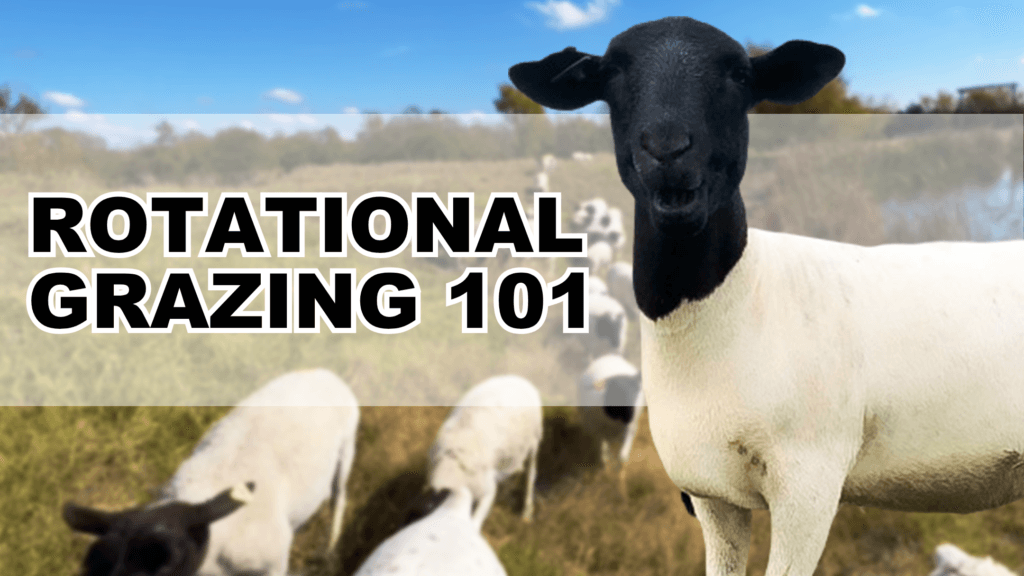
Hi friends,
If you’ve ever felt discouraged by parasite losses in your flock, I want you to know there’s hope. For me, it came down to rotational grazing. It’s the single change that made the biggest difference in my flock’s health, and it’s close to a silver bullet when it comes to managing parasites.
In this episode, I share why I believe so strongly in rotational grazing and walk through the practical framework I use on my own 30 acres. Then I’m tackling a batch of your questions on everything from fencing to minerals.
If you’ve been wanting to get rotational grazing off the ground on your own farm, my hope is that this episode gives you the confidence to finally make it happen.
-the Shepherdess
TRANSCRIPT
the Shepherdess All right, guys. Good evening. I am so excited to be with you tonight. We are going to be discussing all things grazing sheep tonight, specifically rotational grazing sheep. I’m going to be walking you through my system, giving you a bit of a 1,000-foot view on things like fencing, cross-fencing, electric fencing, and permanent fencing. We’re going to be talking paddock rotations—how frequently—and answering some of your most frequently asked questions. They’re all coming up today in this grazing sheep overview. But my goal is to pack as much as I can in for you to learn on grazing sheep. And there’s also going to be a Q&A afterward.
All right. Grazing Sheep 101 here. One of the things I want to do is just introduce myself here. A lot of you do know me and a lot of you are familiar with my story, but I jumped into flock management after the sheep had been on our place for about two years solidly. And lamb losses to parasites in those early years was probably one of the biggest discouragements for us, but grazing management and getting a rotational grazing system in place was like… There really is no silver bullet, but it was close to a silver bullet as could be found in terms of managing parasites, mitigating parasites, and eliminating parasite losses. And that’s really where my passion for agriculture came in, oddly enough. It came in not necessarily in the realms of sheep or in the context of raising sheep or livestock, period. My awakening and my love for agriculture came as I discovered the principles of rotational grazing, and understood that you’re looking at a resource. When you look out on a pasture, you’re looking at a resource, and you’re working with that resource to evaluate it and to figure out what livestock is going to pair best to most efficiently utilize that resource. And the big light bulb moment for me when I went into farming was that realization and that reality.
And so as I go into this Grazing Sheep 101, that is why I am a shepherdess—because I have such a passion for grazing management. And I saw firsthand within our own flock how that grazing management just cut death losses down like crazy in terms of the internal parasites, and how it really improved pasture quality. So as much as I’m a shepherdess who raises sheep, I’m a shepherdess because I love shepherding in the context of this grazing management. It’s really beautiful because the grazing management I’m getting ready to unpack for you isn’t just ideal, but it is really necessary if you go into raising sheep because the rotational grazing management really mimics what shepherding is in its truth: it’s moving and shepherding your flocks across a landscape, whether you have a small property like mine—30 acres, which is small in the context of most ranchers in the world—and some of you guys are working on even smaller parcels. People with two and three acres are implementing the system I’m getting ready to unpack for you. But this grazing system is critical to being a shepherd because it is shepherding in its very essence. It is moving animals across the landscape in tandem with forage availability, and matching their needs to your resource.
If you’re a beginner shepherd on 30 acres or less, then I wrote a book for you: The Basics of Raising Sheep on Pasture. Available at Shepherdess.com with free shipping. Raising sheep on pasture requires a basic understanding of pasture management, breeding and lambing, and mitigation methods for common disease. I walk the beginner shepherd through each aspect, sharing through this book vivid pictures, easy-to-follow instructions, and personalized stories from my own journey with sheep. Available with free shipping at Shepherdess.com; you’ll find a direct link in the description.
How food insecurity drove my commitment to land stewardship
So upcoming are just a couple of facts about me. I raise purebred Dorper sheep, which are a meat sheep. And I raise them on 30 acres of leased land in Northeast Texas. I’d love to be a landowner someday, but for today I’m just leasing 30 acres of family land here in Northeast, Texas where the rainfall is about 45 inches annually. So it is a subtropical climate. And people are surprised when they hear that about Texas, they think Texas tumbleweeds, probably West Texas kind of stuff. But essentially I am closer to the Louisiana-Arkansas border than I am to the typical Texas climate, so I am really grazing in high rainfall. I manage my sheep, most obviously, in a regenerative pasture-based rotational grazing system. I love this system because it means little or no feed input if I manage my pasture properly and profitably. I have enough excess to get me through most of the winter in terms of grazing only.
I started farming actually back in 2020. I’m in my sixth, almost going into my seventh year of farming, and I started with no background in agriculture. Just a super deeply rooted conviction that stewardship was something I needed to undertake with the resource in front of me. There were 30 acres of family land, largely unutilized or underutilized, and I realized as I was beginning to learn these principles of grazing, land stewardship, and regenerative management that there could be a lot more that could be done with the land that was in front of me. I felt compelled for the good of my family and for the good of the community at large to make the most of the 30 acres that were in front me—to produce a food source and to establish a food source in the wake of a lot of what we did see in 2020 with respect to food insecurity.
A little bit of a side rail here: I launched these meetings—these live streams—in the wake of my understanding and my existing conviction that food insecurity is a real problem. We are up against probably another wave or another time, another set of circumstances that we will see like we did in 2020—just a massive amount of food insecurity. I don’t say that to scare you guys, but I’ve been running these live streams for six years straight. I’ve been producing videos on YouTube for six years straight. I’ve been engaging with my email community for six years straight. Yes, because I like sheep, yes, I’m passionate about land management, but also because I recognize that we are in a generation that is not only experiencing, but promoting food insecurity through the fact that we’ve just neglected and left behind a lot of the lifestyles and a lot of the practices that our grandparents and great-grandparents considered just a way of life for them. So in that context, 2020 was a wake up call for me personally. And I kept having this feeling in 2020, like this is a drill, this is drill, this is the drill. And I don’t say that to be eerie or anything of that nature, but I knew that we were being given a glimpse at what really could have been a much bigger problem than it ended up being. But it was essentially just the opportunity for us to see and have no excuse if we do enter the next season or the next crisis as unprepared as we were in 2020.
So my goal in all of this really is just to relay simple information to beginners—the beginner that I was back in 2020—from firsthand experience. I share the good, the bad, and the ugly. I am committed to sharing my mistakes and my failures as well as my successes because I know that that is a lot of times the way that we learn from one another. But why rotational grazing? I’ve explained a lot of the advantages already, but essentially, rotational grazing was the key change for flock health. What you see here is one of my favorite visual illustrations just to show people how essential rotational grazing is for flock health. On the left-hand side, you see here we have lambs that are just absolutely overtaken by what is coccidiosis, as well as the barber’s pole worm. They just had exceptionally bad diarrhea. We could not get rid of it, but this is a result of the parasite cocci. It’s actually a protozoan, but it functions essentially as a parasite. It just bores holes in the intestine of the sheep. And if you can rotate your animals onto new pasture frequently enough, a majority of your coccidiosis is going to be mitigated. What you see on the right-hand side is just 18 months later. It’s another lamb crop—same genetics, same pasture. The only thing that’s different was pasture rotation. Very, very diligent pasture rotation. And you can see the backsides are clean, and carcasses are nice and fleshy. These lambs were something I was very pleased with.
Why rotational grazing number two is simply just pasture health. There are two types of forages on pasture, at least two categories, and the first category is perennial forages. The second category is annual forages. Perennial plants are permanent plants. They’re plants whose root systems get deeper and deeper and deeper every year. If they’re well managed, they’ll produce forage for up to 30 years. Annual forages are forages that are planted once and they complete their whole entire life cycle in just a single year from seeding, germination, fruit production, and seed production to death in a single year. And rotational grazing enables your perennial plants to grow root systems that continue to dig deep into the ground, that continue to stabilize the soil, that continue to retain water, and that continue prevent erosion—things that we are struggling with across the landscape widely—and by managing your pasture rotation, you’re continuing to strengthen those perennial root systems and build soil, as well as provide a very, very stable feed source for your animals. Rotational grazing also promotes annual forage production because what happens is you rotate your animals through and they will graze the annual forages, but they will not overgraze them.
When it comes to annual forages, you always want to leave some residual in the pasture because they will go to seed, they will reseed the pasture for the next year, and then you will have a crop of really nutrient-dense annual forages for the next year. But if animals are left to continuously graze and basically overgraze a single area, they will eat out those annual forages and there will be no annual forages to go to seed and build into that seed bank for the coming year. Pretty soon your pasture will become depleted and will no longer have the stores of annual forages that your livestock really need to thrive. Something to mention is that the annuals are very, very much more nutrient dense than the perennials. And so you really want to cultivate a good balance. But essentially, if you leave your animals in one area, they’re going to go for that candy first. They’re going to go for those annual forages. They’re going to eat it out, and pretty soon you will not have as nutrient dense of a pasture. And that is one of the benefits of rotational grazing, is that it promotes the production of healthy annuals as well as perennials.
So with those little bits of why, let’s go ahead and jump into the meat of tonight’s presentation. Grazing Sheep 101—just one more why here: it minimizes feed costs because you will have basically a grass surplus. It’s called stockpile, and stockpile grazing is a practice of its own that is so worth going. Getting an understanding of how to build a stockpile of pasture—which is essentially standing hay—will feed your animals over winter without you having to use hay machinery or haul in hay yourself. Rotational grazing is one of those essential practices for building a stockpile of feed surplus over winter. One of the things that I also want to be clear about here is that a lot of people see my pasture and they’re like, “Oh, you’re probably seeding it. You’re probably planting a lot of seeds.” And what you see in my pasture is primarily what grows on its own, and what is grown as a result of rotation and rest. I do not do any fancy broad-based pasture plantings. I don’t do any disk seedings. Occasionally, I will hand broadcast ryegrass and crimson clover. And I’ll do this on a bald patch, maybe something that’s not producing or growing as dense of a forage stand as I like. But for the most part, especially what you’re seeing here, this is what grows on its own through proper rotation and rest.
Another thing I want to address here is something I get from people a lot, and that is: “I can’t rotational graze. I simply don’t have the time to do it.” And with the system I’m getting ready to show you and break down for you—which is my system—when this system is up and rolling, it takes less than an hour per day to set up a temporary paddock and move sheep to fresh pasture. When my grazing rotation is good, my animals have less health problems, less hoof problems, and less worm problems than they do otherwise. So basically the time pays for itself back. I feel like I’m actually farming a lot less than the average rancher because of the absence of health problems that really comes with a good grazing system. This is another advantage here, guys, when you are managing your livestock and moving them according to forage availability, you’re basically forcing your animals to eat everything that’s on their plate—not just the things that they like. My feed costs for my flock are at a bare minimum. Not only is more grass growing, but they’re utilizing every single part of the pasture because I’m forcing them to.
This here is a look at one of my favorite before and afters that really represents how sheep go after every single kind of forage. This is basically a thick stand of weeds, forbs, and grasses, but within 36 hours, they had cleaned out this pasture paddock entirely. And because, number one, I’m able to utilize all of the forage on pasture, and I’m able to stockpile for winter grazing rather than hauling in a boatload of hay, these factors equal less feed input in my system and more dollars in my pocket at the end of the day. So not only does rotational grazing pay for itself, you almost can’t afford not to do it. When I slack on my grazing rotation, my mortality rate directly goes up in direct correlation with how diligent I am—or rather, am not—in my grazing rotation. It is so critical for flock health.
Deciding when to move the flock and how long to wait
I’m going to go ahead and answer some frequently asked questions connected to my grazing rotation. All right, one of the most frequently asked questions that I receive is: “How frequently do you move your sheep to a new paddock?” And the answer is, ideally, in the growing season—which is spring and summer when the pasture is just exploding—it is ideal to move them every 48 hours. And that’s also a great thing to do for the parasite cycles and to keep your sheep healthy. That said, the minimum is once per week. If you only have a Saturday morning to rotate your sheep and get them into a new pasture paddock… If you’re one of those people with a full-time job, you’re exceptionally limited, you can’t do it every day, every two days, try to allocate Saturday, or Friday night, or one day a week to move your sheep to a fresh pasture paddock. The more frequently, the better.
Once a week at minimum will have two primary benefits: number one, it’s going to benefit pasture health exceptionally well, and number two, it is going to do what you need in terms of breaking that parasite cycle. So at minimum, once a week. If you can move them once a day or once every other day, that is fantastic as well. There are some people who move their livestock twice a day. I am not one of those people, but it’s all to say the frequent rotations and the denser stocking rate is very, very advantageous, but I’m talking to a lot of people in here who probably also have a full-time job alongside of their farm and they cannot move twice a day. But yes, once a week at minimum is my recommendation. Every other day if you can afford it time-wise.
Question number two that comes most frequently is: “How long does a paddock rest before you graze it again?” And a paddock needs to rest. You need to consider two things when you’re resting your paddocks. And this is not a prescriptive answer. There’s no canned answer. I’m going to give you a canned answer. Okay, 45 days. Okay, there’s your canned answer, and 45 days would be my recommendation in terms of minimum rest period for a paddock. But that is very prescriptive and sometimes it will work to rest a paddock that long. Sometimes it will not work to rest a paddock that long. But there are two things that you want to look for or be aware of in terms of rotation in your paddock. Number one, you want to watch for pasture recovery. And I’m going to go ahead and pull out my book here, which is The Basics of Raising Sheep on Pasture. This is another resource that I have made available to you. But this is going to have some guidelines in terms of raising, grazing, and a lot of the rotational grazing stuff in here as well.
But in terms of pasture recovery, as we are discussing it, I’m going to go ahead and show you one of the indicators that your pasture is ready to graze again. So when you take your sheep off of your pasture, it’s obviously going to be grazed down probably to somewhere like a two or three-inch residual, just depending on the season. That would be an early spring residual for me. It would be about three inches. A late summer residual would be four or six inches. And when I say residual, that means how tall the grass is when I move the sheep off of it. But when I am looking at a pasture and evaluating it for the return of the sheep, sometimes that could come as early as 21 days after I’ve taken the sheep off of it. And how do I know that it’s okay to return the sheep to the paddock only 21 days after I’ve removed them? That has a lot to do with pasture recovery. Counting tillers is probably one of my favorite ways in terms of gauging pasture recovery and knowing whether or not I can look at a paddock that I have been in.
Let’s say if I want to return to a paddock 28 days later. The rainfall has been really good, and conditions have been really favorable to let that paddock recover in just 21 days. What I’m going to do is go across the pasture and I would probably pluck something like seven blades of grass from one end of the paddock to the other. And I will count the tillers on those blades of grass, and those tillers will be an indication to me of pasture recovery. On this particular plant, there were 10 tillers. And every plant that I plucked up off of the pasture that was there had anywhere between five to 10 tillers. Once a plant has three or more of these tillers, that tells me that I am OK to return my sheep to that pasture to graze it again. And when a plant has gone to seed, that is edging up on a little bit too late in terms of nutritive value. You’re always going to have a combination of plants that have gone to seed, plants that are growing, popping out all those tillers, and plants that are maybe too young—you’re always going to have a general combination. But if a majority of your paddock has gone to seed, that’s at the tail end of its growth phase. It still has a lot of nutrient density, but it’s not going to be as digestible and the protein is not going to be as available. So pluck up grass blades and count the tillers in order to know that it is acceptable and appropriate to return to the pasture again. This is going to be page number 53 in my book, The Basics of Raising Sheep on Pasture: How Long Do You Give the Grass to Rest?
And I say all of that because, again, that prescriptive answer is 45 days. All of the parasites or majority of the parasites will die off. And so for animal health, 45 days is a great way to rotate your animals and a prescriptive rest time. But shorter rest periods—like 21 to 28 days—are going to come on a healthy pasture at the onset of spring, and you are going to be able to rotate your animals faster through those paddocks. But you need to do your due diligence and look for indicators of pasture recovery rather than just that prescription. And you’re going to gain a really good eye for that. Probably if you’re diligent to move your animals once or twice a week—like I was up to three, four, five times a week for the first three years—within a year or year and a half, you’re going to develop a super good eye in terms of pasture recovery. Some of it’s going to be as a result probably of doing it wrong the first time, maybe overgrazing a little bit, but you’re really going to get a good eye exactly for when to take your animals back. But prescriptive, as I know probably some of you guys are taking notes, a minimum of 45 days before returning to the paddock. And for some of those other shorter return periods, you’re going to just look for indicators that your grass has recovered, which will be available through visual illustration in The Basics of Raising Sheep on Pasture.
Choosing the right fence chargers and planning winter stockpiling
“What electric fence charger do you use?” All right. So this is a very, very good question. And this electric fence charger is going to be basically the biggest part and most important part of your grazing rotation as a shepherd. And I’m going to just say really quickly what I use and why I use it: I use a Cyclops Super charger. And this is a unit that plugs into the wall. It’s not a solar unit. It’s a 12-joule output. So this guy packs a big punch. And this is on my 30 acres. This is really enough for 50 or 70 acres especially if you’re doing cattle—you could probably service hundreds of acres with this—but for sheep, it is so important that you choose a charger that packs a punch. And that is what my Cyclops Super does for my sheep fencing. I had a big struggle in my early years with respect to my sheep disrespecting the fence, and It was primarily tied to me using a charger that was just not commanding their respect in the way that it should have. So I was using some very small chargers. I think my first one was 0.25 joules, and it popped them on the nose a little bit and they were scared for a while, but pretty quickly they realized they could get past it with enough effort. This 12-joule charger—they hit it with their nose, and it probably feels to them like a 9 mm just hit them in the face. And I don’t like that for my sheep, but they only need it once and they are very respectful of the fence.
So do invest in a really good charger and your sheep will respect you more as a shepherd, and your job as a shepherd will be much less. So that is my input there. It is an AC unit, so it’s permanent. It plugs in and it is attached to the wall, so unless the power goes out or the fence is down somewhere, you don’t have to worry about it going down like a solar charger does. With all of that said, as a backup, I keep the Gallagher 4-joule solar charger on hand in case, for example, we just had a big series of rain storms come through. It blew some trees down on my electric fencing and it was down for a while. And so I was able to pull out the Gallagher 4-joule solar charger as my backup, and that is my backup standard. This is 4 joules. Again, it’s kind of an expensive unit but it has lasted me a very long time. And again, time is money when you’re chasing your sheep around the pasture because they just disrespected a charger that did not pack enough punch. That’s when you’ll probably wish you would have paid a little more upfront.
Picture this: you are looking out over your 5, 10, maybe 20-plus acres. The sun is setting, and your flock is grazing across a green pasture. Something inside you affirms this is real wealth—at least when it comes to material things. You know how to take care of your sheep, your grazing system is improving your land, and you have a way to direct market each lamb that is born. This is how I feel when I look at my flock, and I want the same for you. So, I put together a free one-hour class that answers some of your most frequently asked questions concerning how I raise, rotational graze, and market my sheep for $480 per head. Go to Shepherdess.com/480, or simply click the first link in the show notes of this podcast to sign up and receive the free on-demand class. What’s more is that I will follow up over the course of three days, providing you with even more free resources—including a free ebook, a free grazing sheep kickstart guide, and a free marketing sheep kickstart guide. This information is worth paying for, but I’m giving it to you for free. Just go to Shepherdess.com/480, or simply click the first link in the show notes of this podcast for how I raise, graze, and market my sheep for $480 each.
So that’s all just me speaking from experience. I started with a 0.25-joule charger and found it in my parents’ garage. It worked to help me to know that rotational grazing would work, but pretty quickly I recognized I needed to invest in a little bit of extra power. All right, James asks, “How many sheep are you rotating on 30 acres?” Carrying capacity at my place is about three sheep per acre given the rainfall and given the forage availability. And that is in Northeast Texas with 45 inches of rainfall on really good pasture. Edmar says, “How do you plan the process of stockpiling feed for winter?” This is a really good question, Edmar. It is something that begins about July. So it’s something I really don’t think about until July here where I’m at. And in July, I will start to allocate—I’m going to talk about it here upcoming—I will allocate one of my three cross-fenced pastures. So I’ll allocate maybe a third of my pasture and just let it grow from July forward. Sometimes I can start as late as August, but I’ll let it go for about two to three months. Once that first frost hits, that’s when our grass pretty much stops growing—not entirely, but for the most part, the growing season’s over with the first frost—and so from August forward, I will allocate about a third of my pasture to be stockpiled that I will not graze until after the first frost. It’s as simple as that. It just takes a matter of watching.
And the term stockpiling is really a good term because while the practice can be more complex than what I just cited or what I’m getting ready to cite, basically, when you’re stockpiling pasture, you have to just think about how you’re stockpiling anything. Look for surplus anywhere, whether it’s just a two-acre spot here or a three-acre spot there. Once you hit about July or August, you want to just look for a surplus that you can start not grazing, that you start setting aside, that you can keep your animals off of. Think about that surplus as something you’re tucking away for after the first frost. That is stockpile grazing, simply stated, but maybe it’ll help you to get sort of a concept or a simplified idea, in terms of what stockpile grazing is and how you need to approach it, at least from a mental standpoint and prepping for it. That’s for you, Edmar. Just think about putting back surplus pasture anywhere you can starting in July or August, and then you can rotate your animals through it after that first frost.
Managing multiple livestock species and setting up secure boundaries
Margaret says, “Tillers?” All right. In case I did not explain it thoroughly enough, essentially a grass blade is going to start sprouting these tillers once it goes to maturity. Not all of them, but a majority of them—at least enough of them to be able to gage pasture recovery. Robin says, “Can I rotate sheep and horses together or do they need to rotate separately?” Robin, you can rotate them together. The only problem I ever had was I had a mini horse in the paddock with my sheep, and it had a bad attitude so it was kind of bullying the sheep. But aside from a poor temperament, there’s really nothing I observed in terms of negative side effects from grazing my sheep and my horses together. KT says, “I’m only able to rest my paddocks about 28 to 30 days in order to keep it palatable this time of year, thanks to Johnson grass. How do you factor breaking up the parasite cycle in this shorter return period?” KT, that’s a really good point that you brought up and that’s really what you’re looking at in terms of disadvantage in returning your sheep so quickly to a paddock. That 45 days that I cited is really kind of the minimum in terms of majority parasite die-off. If you return your sheep any sooner than 45 days, the parasite exposure, or the parasite residual, is one of the cons that you’re really looking at in terms of that.
Think of it this way: the reality is we want to make sure that the parasite loads within our animals are low enough to where they’re not dumping thousands and thousands of eggs on the pasture. So if my animals’ parasite loads are low overall, I’m not too nervous about rotating them back into a paddock 20 or 30 days later. I want to avoid doing that too much over spring because it builds up really, really fast. They drop a lot of parasites, and those parasites lay a lot of eggs. So it’s a good point to bring up, but it’s just one of those things you need to start conditioning your mind towards in terms of when you weigh out the pros and the cons of returning an animal to a paddock before that 45-day time period. And if the advantages outweigh the disadvantages, sometimes those are the risks you have to take. All right. Mary says, “How do you separate your rams from the ewes on pasture?” And the answer to that is I don’t. So my rams, once they’re done breeding the ladies, they have a suite and it’s just a pen and I will keep them in there separated with dry hay confinement until their next use. I tried to run a separate rotation for my rams one year and just too much energy and time. So now they’ll just have a pen that they’ll stay in and they will not rotate.
“What fencing do you use to set up your temporary grazing paddocks?” And the fencing that I use is poly tape. I will use two rows of poly tape. One typically is positioned at about 18 inches off the ground, and the other one is anywhere from 24 to 30 inches above the ground. My goal and mindset in setting my lines is I want something too low for them to comfortably sneak under. If they try to sneak under it, they’ll get it in the forehead really hard, or they’ll get it in the nose really hard. So that’s my goal in setting the first line. And the second one is too high for them to comfortably jump over. My sheep are short and stout. They’re not like goats or mountain climbing breeds. So they’re very short and stout, so they cannot jump comfortably very high. So that’s about 24 to 30 inches for my sheep. And I will use a poly tape after a failed attempt with poly braid. Our first attempt with rotational grazing and using electric fencing was that poly wire. And while a lot of people have had great success with poly wire and sheep, we did not initially, so I upgraded to the poly tape. It’s about a half inch or five-eighths of an inch wide, with five times the visibility and five times the contact surface. And this was ideal in terms of my sheep, and it was a great fit for me.
Another thing I want to address is the netting. The netting is great and very, very effective in terms of containment, but it is very hard to lug around. And for me personally, unless I’m leaving my sheep in one area for a very long period of time, it’s just simply not worth setting up the netting. So this poly tape is my solution in terms of ease of putting up a paddock and taking it down multiple times a week. Another common question that I get coming through is, “What is your perimeter fence made up of?” And my perimeter fence is a 6-inch woven-wire perimeter fence. It is 6-by-6, like I said. And I get questions all of the time like, “I want to buy sheep, should I first put in a perimeter fence like yours?” The only answer I can give to you is basically an answer from our own personal experience. And that is that we bought sheep without having the hard fencing on the perimeter. And essentially our sheep were just on the highway or in the neighbor’s yard until we did get some hard containment for them. Keep in mind, we were not rotational grazing. I was not using the electric fencing for containment at all, but essentially, I’m glad that I have the hard perimeter fencing. It makes the daily rotations a lot faster and allows me to sleep better at night.
And here’s one thing, guys. This is just a bit of a personal testimonial: this hard fencing is really going to probably keep you in the sheep farming game a lot longer than you otherwise would if you were just simply running on electric options. And the reason being is that there have been seasons in my life over the past six, almost going on seven years, whether it’s been a family emergency, whether it’s been just things that have caused me to pause my rotation for two or three weeks at a time. And as much as that sounds potentially like heresy, in the context of tonight, you’re going to get into sheep, and that’s probably going to happen for you. There’s going to be a funeral, there’s going to be a wedding, there is going to be a life event that’s going to take you away from prioritizing your daily moves for maybe up to a month, maybe more. But having hard fencing in place, for me at least, has kept me in the sheep farming game because when I am unable to rotate my animals as frequently as I’d like, my fencing is still going to keep them in. And I’m not relying entirely on the electric options which may go down, which are harder to maintain, and which require me to be on top of them almost every day.
Adjusting the system for specific health issues and paddock layouts
So take that and everything that I’m talking about here in the context of making your own decisions about a perimeter fence. But that would be why I would advocate for one—a sleep well at night, it keeps my sheep out of the neighbor’s yard, and it allows me to stay in the sheep farming game in those months where maybe there’s a family emergency and I simply have to allocate my time to that, and not rotating my sheep every day. They can just be like 80% of the other sheep in the world and not rotationally grazed. So that’s just a bit of practical, realistic perspective there. All right, that is the end of that specific information. I’m going to come over here to the question section. Timothy says, “Can I run five ewes on a quarter of an acre in eight paddocks?” Timothy, you’re going to run out of pasture really fast if you’re running five ewes on a 1⁄4 of an acre. If you’re talking and saying your paddocks are a quarter-of-an-acre each, I’m going to say that’s going to be just fine. It’ll be far, far too big for eight ewes unless you’re going to be leaving them there for 5 to 10 days, or unless your pasture is very sparse. Five ewes do not need a quarter of an acre unless you are going to probably be leaving there for a week or two straight. But if you only have one quarter of an acre for five ewes, you’re going to run out of grass really quickly and you probably need more land for that.
Margaret says, “What about using lime or diatomaceous earth on pasture for killing the parasites?” Margaret, I have heard someone say—and this was connected to the lye as a livestock dewarmer conversation—that what they did was they mixed up a ratio of lye… And again, this is not me recommending this whatsoever. Don’t do this because lye will kill your animals. But one testimonial from a sheep farmer was that he mixed up a ratio of lye in one of those weed sprayers, on one of those tanks, and he just sprayed an acre of pasture with it. Not as a means of killing the parasites on the pasture, but when the sheep grazed it, they were ingesting a measure of lye, which killed the parasites inside them before they could take hold. So while that’s just a secondhand story, that is really the only story I’ve ever heard in connection to the kind of question you are asking here. Robin says, “Do you think the poly tape will work with horses? I have horse panels around the perimeter so that the horses north of the sheep can get outside on the pasture.” Yes, so from my experience, the poly tape worked just fine. It was a miniature horse. So, you know, he was very low to the ground and couldn’t jump super high, but my poly tape did work for my horse. May he rest in peace.
Marina leaves a testimonial here. She says she has a full-size horse with two goats. They will eat together and it definitely depends on the horse’s temperament for sure. Also would add that she found horses do add so much more to the pasture size necessary for grazing. Daniel says, “What are your thoughts on the proposed data centers coming to the Sulfur Springs area?” Daniel, I’d say I’m not happy about it. It’s going to do a lot for various parts of the economy. Let’s see the good news there. But in terms of the water reserves, there’s been a lot of information, to the negative, going around in terms of how it’s going to mess with the water. It’s going to mess with a lot in terms of the small town culture with a lot of the people that they’re going to be bringing in to run it. So, not super pleased, but I haven’t done enough research to spit out facts to make an argument. Thomas says, “Even when following this rotation of at least 45 days, do you still deworm the sheep or only if they show clinical signs?” Thomas, I only deworm on a sheep that needs it. So, yes, I only deworm if they show clinical signs. I don’t deworm prescriptively. If they’re showing signs of anemia through a FAMACHA score inspection, that’s when I will deworm. It’s just when I’m not careful to give that paddock enough rest, they’re going to start showing those clinical signs a lot faster because the infection will just come in.
Douglas says, “So one lamb had what might be CL. What are you doing?” I have not had a lamb that’s had CL, but with respect to CL, it’s caseous lymphadenitis. It is a chronic disease that impacts a lamb or infects a lamb through the mom’s milk because the mom has it. It creates and results in pus-filled abscesses on the lymph nodes, and it sometimes results in the carcasses being condemned at the butcher because those lovely abscesses will actually build up around the internal organs. This is a disease you don’t want in your flock. If you suspect it, I would have the animal blood tested because I did have a sheep that I suspected had CL, and I had her blood tested. I had a swab tested. I had it tested two different times because this is serious enough to cull animals for relentlessly. But there are also a lot of other reasons that animals may develop abscesses. So if it’s CL, cull it out of your flock. If it is not, I mean, obviously don’t, but do make sure that you go through the diligence of making sure it is because there are a lot of different reasons why a sheep might have an abscess.
All right. Dusty says, “A good perimeter fence, hard fence, or field fence will work to keep animals in and out. And when the power goes out, or you have poor ground contact, it is insurance. This is what I’ve concluded at least. And if you’ve ever chased animals around without a perimeter fence, good luck.” Very, very good point there, Dusty. And that’s a very good point in terms of keeping predators out. Because we have that really tight fencing, our predator problems, unless they dig a deep hole under or jump over, which some have, they’re not getting in. So it’s really twofold. I just went to Africa and there were some ranchers out there managing hundreds of thousands of acres, and their primary predator prevention was fencing. One of the ranchers I visited had just installed 124 miles worth of this jackal-proof fencing, which was very similar to what I just showed you. And they did it just to keep predators out. So what Dusty is saying here in terms of that fencing being good, if nothing else for keeping predators out, that is what a lot of ranchers do if they don’t have a livestock guardian dog. Which, again, if you don’t have the fencing to keep those dogs in, they are wanderers as well, so that’s something to think about.
Ted says, “What size paddock do you recommend for 28 sheep?” Again, Ted, in The Basics of Raising Sheep on Pasture, on page number 83—which you can buy at Shepherdess.com—it has a formula for creating paddock sizes. And ironically, Ted, your 28 sheep is actually the exact number that I use for a formula that I created a paddock size for in the book. But in my book, basically, I was working with about… It ended up being 4,300 square feet for one day for 21 sheep. I know you just said 28 sheep, but that was about what I started working with—a 4,300-square-foot paddock for one day on a pretty good patch of grass. And that can be something you start with. You could start a little bit bigger and adjust up or down, but let’s just say 5,000 square feet for one day on your 28 sheep. Make it bigger if they eat into the ground, and make it smaller if they didn’t eat it all. Dusty says, “Minerals and pasture health testing—do you test for anything on your pasture as far as soil health?” And Dusty, the answer is no. I did run a soil test when I very first started grazing, but I’ve not done anything since. I just go by visual indicators of soil health.
And that would be, again, a healthy stand of annuals and perennials, pasture diversity, and quick recovery—you’re not looking at bald spots that are taking forever to recover, which indicates poor health. So in terms of soil tests, I go by visual indicators. I do, however—and this was a deficiency I came upon as a result of my sheep having a deficiency—but this is going to probably happen to you: if your pasture is deficient in something, you’re going to start picking it up in your animals, but my pasture is essentially deficient in calcium, which is amended by putting lime on your pasture. It’s an agricultural lime. A lot of ranchers do it around here. But essentially, I picked up on pasture deficiencies through seeing my sheep have them.
And then the second question from Dusty is, “I don’t know if you offer free choice minerals, but if you do, have you seen a reduction in the mineral consumption over time?” I see a fluctuation seasonally, Dusty. So in terms of my mineral salts, they’re just eating them like crazy right now. It’s summer, it’s hot, and I almost always see one at the salt bucket. Things like, say early spring, as they’re coming out of winter, right before they have their lambs and their nutritional needs aren’t high, again, their consumption will dip. So I see fluctuations over the course of a year rather than over time in general. All right, Brynn says, “If you have to be gone for a month, do you open a month’s equivalent of paddocks?” Yes, Brynn, if I have to take a month off, for example, my sister just got married in April. The family was kind of crazy and needed more of my attention than grazing did. What I did was I just moved them every two weeks, so there was still a rotation. And so what I did was I just used that electric netting and made them a two-week paddock, and that worked out really well. It kept them contained, I was still able to rotate and rest the rest of the pasture, but I was able to give myself some space to be there for my family in that time of transition.
Okay, I think I’ve got almost everybody’s questions here. Mo says, ‘Hi. Did the lye with the goats work for parasites? If you use the same ratio, why would it not work for sheep?” Mo, if it works for goats, it typically works for sheep, but I did just do that particular experiment on goats, because that’s what I did. So I don’t have any information in terms of direct parasite fecal egg count reduction for sheep, only goats, so I can’t share much more with you on that. Lye is caustic and may kill your animal, so every time I talk about lye, I need to say that as well. It’s an at-your-own-risk thing, but check out YouTube: “Lye as a livestock dewormer for sheep and goats,” because I did do a vet-tested fecal run on that. Timothy says, “I have two acres with a 4-by-4 perimeter fence. If I can, what I want is to either have 8 quarter-acre paddocks.” Okay. That’s making a lot more sense, Timothy. He wants to have 8 quarter-acre paddocks moving every 7 days, or 16 eighth-acre paddocks moving every four days.
Timothy, go ahead and just start out with 8 quarter-acre paddocks, moving them every seven days. I would do that. Increase the speed of your rotation and reduce the size of your paddocks as you are getting in the rhythm and as you can do it bi-weekly. But I would at least go ahead and do the 8 quarter-acre paddocks at 7 days because 8 times 7 is 56. It’s a slow math, but I think 8 times 7 is 56, so you’re going to have your parasites die off in that timeframe and plenty of pasture recovery and then just make adjustments. Watch your pasture. The Basics of Raising Sheep on Pasture has tons of visual indicators of how I watched for pasture recovery as a beginner, and it’s going to help you to do the same thing. Buy the book at Shepherdess.com. And grab all the information I wish I had as a beginner. “Herding dogs?” I do not have any herding dogs, Jedidiah. I have too small of a flock to consider that. Herding dogs are pretty expensive, and I’ll just get one of my little sisters out there to help me. Okay, thank you for being here tonight. Have a good night.
BALDING? try sheep. 😂 (not kidding)
Time for the monthly farm update! And it starts with a story… but first: I need your help!I have a new project I want to build out for you. But before starting I’d like to get your opinion/thoughts directly… would you provide your input through a survey? ↓↓
Back to the story:About a year ago I started eating one lamb liver per month (each liver weighs about 1lb each). I wanted a natural boost of iron and vitamins… and I had a lot of lamb liver in the freezer. 6 mos into this new habit I went to my hairdresser for a cut. She started combing my hair and said: “WHAT HAVE YOU BEEN DOING??”. I was confused – she sounded like my mom when she found a piece of chewed up gum at the base of my scalp.😂 She then parted my hair from the middle, revealing a forest of new hair growth. She said: “This is probably THE MOST new growth than I’ve seen on anyone at once!!” “What have you been doing?”
Then I remembered: 6 mos of lamb liver. I started sharing the lamb liver capsules with brothers and friends; one of whom received the same response from his barber after just a month of eating them.
Anyway: I have maintained my daily lamb-liver consumption; but I became sick of eating pan-fried liver for breakfast 😬. So I started freeze drying the lamb liver, filling my own capsules with the powder. I’ll take 4-6 capsules every morning with my coffee. Here is a link to the capsule filler I use.
My new Sunday afternoon hobby: spending time in my “pharmacy”😂. Grass fed and finished lamb liver capsules are $77 per jar when you can find them. I am able to fill between $300-500 worth* of homemade lamb liver capsules on a single Sunday afternoon. *To be clear, I do not sell the capsules (thanks to a host of regulatory bodies), but I do share with family.
Beef liver is common (and cheaper), but I was surprised to find that LAMB LIVER IS HIGHER (and we are talking significantly) in:
One more reason to love sheep, -the Shepherdess p.s. Don’t forget I need your help! Take my survey to give your input on my next project. PPS. Disclaimer: Consult with your healthcare provider before adding lamb liver to your daily routine. 😉 Be thou diligent to know the state of thy flocks, and look well to thy herds… Proverbs 27:23 |
LAMBING TIPS FOR BEGINNERS (How to Raise a Small Flock of Sheep)
Hi friends,
I have learned that a successful lambing season starts long before the lamb ever hits the ground. If you find yourself scrambling during lambing, there is a good chance the groundwork needed to happen months and weeks earlier.
In this episode, I am walking through how to prepare your ewe in the weeks leading up to lambing, what normal labor looks like, and how to recognize and assist with the most common malpresentations I have encountered on my own farm. I am also sharing why colostrum is so critical in those first 24 hours, and how I tube feed a lamb that needs a little extra help.
For the beginner shepherd heading into their first lambing season, my hope is that this episode helps you approach this exciting experience with confidence and preparation.
-the Shepherdess
TRANSCRIPT
the Shepherdess All right, guys. I am so excited because tonight the theme is lambing. Lambing for beginners. We’re primarily going to be talking about how to prepare your ewe for lambing—a lot of lambing stuff takes place before the lamb is even born—and then I’m going to be walking you through the lambing process. I’m also going to be walking you through your first 24 hours, which are critical for getting your lamb up and on its feet for a lifetime of success. So that is the theme tonight, and tonight is actually a very small snippet of an entire, probably one of my most popular paid courses, which is Raising Sheep 101. What that course does is it takes you all the way through eight months. I can’t do that here in one hour, but I’m going to be packing tonight tight with lambing for beginners, guys. So buckle up, get your notes out, and we will get started.
I’m going to be walking you through lambing, and a lot of these things that I am getting ready to walk you through are things that really well experienced shepherds will know, but as beginners we didn’t know. We had a lot of losses in our first couple lambing seasons, and so what I’m going to be walking you through tonight is just some basics on prepping your ewe for a successful lambing. I’m going to be walking you through the lambing process. I’ve even got my little stuffed lamb here. We’re going to be walking through some common malpresentations in terms of when you get there to lamb them out, and then we’re going to be working through a couple of different supplies that are important and helpful or not.
If you’re a beginner shepherd on 30 acres or less, then I wrote a book for you: The Basics of Raising Sheep on Pasture. Available at Shepherdess.com with free shipping. Raising sheep on pasture requires a basic understanding of pasture management, breeding and lambing, and mitigation methods for common disease. I walk the beginner shepherd through each aspect, sharing through this book vivid pictures, easy-to-follow instructions, and personalized stories from my own journey with sheep. Available with free shipping at Shepherdess.com; you’ll find a direct link in the description.
The eight-month milestone and setting farm expectations
So let’s go ahead and run into the slides tonight, and as a reminder, this is just a small section of a very large paid course that I have. If you’re watching this on replay, you can go to the YouTube description and you’ll see that link for you as well. But the whole premise of tonight and the Raising Sheep 101 is from something that a really well-experienced sheep friend told me. Her name was Roberta and you actually can find her full-length farm tour on my primary channel. It’s Raising 300 Hair Sheep in Louisiana. But she told me something that resonated and it has ended up being very, very true for me, and that is, “If you can get your lamb to eight months, you will have a lamb for life.” A lot of the challenges that you will experience in sheep farming, they’re going to come in the first eight months of that sheep’s life. And if you get that sheep over that eight month hump, in so far as we’ve experienced at least, it’s much easier going from there. So that is really what I focus on in the Raising Sheep 101. And tonight we’re going to be talking about the most critical time period for a sheep farmer and that is lambing in the first 24 hours.
As a disclaimer, guys, I am not a veterinarian, and I will not be liable for anything bad that happens to your sheep. Always take my information to your veterinarian before employing it on your sheep farm because I am not a professional. But I will be shouting out some supplies and some resources that work great for me. So keep that in mind—seek veterinary help before feeding or providing your sheep with anything at all. I also want to give you some context for this information. This information is coming at you in the context of pasture based. And when you choose pasture, especially a great rotational-grazing system over confinement housing, you’re going to immediately elevate the health of your operation overall. Practice rotational grazing. Move your sheep to fresh pasture at least once a week to mitigate losses. Now, I like to speak from experience—bad experiences and good experiences. This year I have been very, very slack with my rotational-grazing program, and I have not kept up with that once-a-week rotation, and my losses have been more. So guys, keep that in mind—that this rotational-grazing program is absolutely critical for keeping your losses down overall. A healthy system overall is going to keep the emergency interventions way, way down. And I can say that from having done it perfectly in certain years and having done it imperfectly in others, and experiencing and seeing the losses go up and down as a result of my management in grazing overall.
Another thing, this is just as we’re hyping… We’re pep-talking as we get into this presentation, but also it’s a lot of context here, and it’s something I like to say to people a lot. The bottom line is, it’s your farm, okay? I speak to people who… Well, I can resonate with them because I was there six years ago. I was just soaking in all of the expert advice. I was taking all of the expert advice, and I was looking for formulas, and I was looking at exact patterns that I could follow for my own farm. But ultimately, I had to come to the realization that while it’s really important to get good counsel and take expert advice, you’re going to hit seasons and slumps where your critical thinking skills are going to outperform professional advice anytime. And there’s no need to apologize if your farm requires practices or inputs that differ from others. Set your course, figure out what you’re good with— whether it’s dewormers or you never want to deworm—set your course, make adjustments according to what kind of system that you want to input overall, but don’t feel bad if you have to make those adjustments.
Another one is that animals are going to die. This was hard for me to swallow because I got into the farming systems and I got into the rotational grazing and the regenerative systems, and I did still face losses occasionally. The goal, guys, is to cut losses. You’re never going to eliminate them. In fact, the industry average death rate at lambing, it’s 15%. So if your flock gives birth to 30 lambs, it would be considered normal if five died before weaning. So keep that in mind and give yourself a break if and when you do experience some losses. They’re always going to be hard, but it doesn’t mean game over. So just really keep that in context here.
Pre-lambing nutrition, minerals, and deworming
All right, so as we go into the pre-lambing section, the important thing to know is that a successful lambing season really starts way back when you breed your ewe. So the entire five months of gestation—which is the gestation period of sheep and goats, five months—you need to be focusing on good feed, good minerals, and making sure that the parasite loads in those animals are down, especially two weeks prior to lambing. Consider deworming. You also, one week before lambing, need to do an udder evaluation, and I’ll be talking you through some of those processes upcoming. But first and foremost, good feed. When you are grazing your sheep on green pasture, it really allows them to create a diet that will meet their nutritional needs. Now, over winter, when pasture access is not available, if you have a quality hay, that is enough for most sheep. And when I say quality hay, I would say Bermuda grass hay. I do mostly Bermuda, and Coastal is what is available up here. And then also I will mix in some alfalfa hay as well simply because I have a supplier where the alfalfa is actually equal in price to the grass hay, and my ewes perform really well on that.
But over winter, those are the things you need to consider, just making sure they have access to a really good-quality hay with a high protein percentage, I would say, at about 10%. And then, if you do notice body condition going downhill—and you’re going to find body condition in that… Well, it’s in The Basics of Raising Sheep on Pasture. I’ll pull up a picture here in a minute—but body condition going downhill is indicated by just sharp, thin hips, bones visible at the rear end. Maybe their belly’s going to be huge, but you’re going to just notice bones sticking out at the back end. That’s body condition going downhill. In such cases, it is okay to provide them with about three-quarters of a pound to one and a half pounds per day of either grain or alfalfa pellet supplements until that ewe recovers its body condition. And the important thing to know here as we discuss body condition is the reality that you want to get that condition back up before the lamb is born. Otherwise, it’s going to be really, really difficult to catch up, and you might end up with a bottle lamb.
And what I’m going to do here really quickly is I’m going to go ahead and find inside The Basics of Raising Sheep on Pasture. This is the hard copy book, but this is essentially an indication of good versus bad body condition. So the top one you can pretty easily identify that she’s got bones sticking out, and the bottom one is nice and fluffy, essentially. So in The Basics of Raising Sheep on Pasture, you’re actually going to have visual examples of body condition. But you want to make sure that your pregnant ewe is in good condition before giving birth to those lambs because once she’s given birth, she’s only finished half the job—she’s got to then feed those babies. And you want to make sure that you’re giving her the best chance to feed those babies because not only is it nice to have a real mom, but orphan lambs are also very expensive to feed. So make sure you’re putting in that ounce of prevention because the pound of cure gets really expensive. Just take it from me. I’ve had a bottle lamb or two.
All right, I mentioned good minerals and what are good minerals? I’m going to say make sure your mineral has a minimum of 60 parts per million (ppm) of selenium in it. And that is a big mistake that a lot of sheep farmers make is using minerals that do not have enough selenium, and that was our mistake in our first couple of years. We used just the general tractor supply mineral. It had 10 ppm of selenium, had my first lambing season, it was a mess, and realized all of the symptoms I was dealing with were selenium deficiency. So I recommend Redmond Sheep Mineral. That is a great mineral in terms of selenium content and my animals have performed really well on it. Purina also has a really good quality sheep mineral mix that may be more available locally. So just keep that in mind. But again, just make sure that the selenium content is up. And do choose a mineral feeder that will keep it dry and accessible to the pregnant ewes at all times. Good mineral intake—I cannot stress it enough in terms of preparing your ewe for a successful lambing. That is disaster prevention and don’t overlook it.
Deworming. It’s really important to make sure that the parasite loads in your sheep are down as she approaches the lambing season. And the reason for this is that your ewe’s immune system hits an all -time low after she’s given birth to that lamb. If she goes into lambing with a heavy parasite load, her health is quickly going to deteriorate. And you’re probably going to be encountering poor milk quality, and the lamb itself is going to suffer. So personally, two weeks prior to lambing, I will inspect and deworm my ewes as needed. And two weeks after, I will run another inspection and deworm them as needed, and these are sort of the two non-negotiable inspection periods for me. If you live in a dry area, you may be able to skip one or the other, but likely not both. And when I say inspection, I am inspecting the FAMACHA score of the animal, which is basically the color of the eyelids, because what you’re watching for is anemia. And a high parasite load is going to cause anemia because the barber’s pole worm specifically is basically like a miniature vampire inside of your sheep, and it sucks the blood out. And that’s why it presents the biggest risk at lambing for those ewes because there’s a lot of blood loss as she’s given birth, so she’s already compromised in terms of the red blood cell count. So she’s got the mini vampires, and she’s just given birth to a lamb, and she’s lost blood through that. I mean, it’s just an absolute recipe for disaster if she’s got a high parasite load.
A recommended dewormer is the Levamed, or Prohibit is sometimes the brand name. That’s a white dewormer. When you do deworm, make sure that you absolutely ignore the package rate. In fact, double the package rate. The dosage rate on the package needs to be doubled as a means of treatment, and that is in part due to some resistance issues, but also because the dosage rate of the back of the package is a maintenance deworming and not a treatment. And again, take it from us—just double that dosage rate and deworm your ewes with it. In fact, I was talking to a veterinarian, and she said that the vet-approved dewormers are safe up to three times the package rate. So when we initially started giving double doses, we were like, “We’re going to kill our sheep! We’re going to kill our sheep!” And she said, “No. RX, which means prescription or vet-approved dewormers, have to be tested in a lab and safe at up to three times the dosage rate.” So you’re not going to kill your sheep, according to that veterinarian, by doubling the dosage, but you might kill her by underdosing. And the reason is that you’re going to leave a lot of worms inside of her, and then those worms are going to be even more resistant to future efforts to deworm. So take it from me, a little bit of an extra tip there—double the dosage rate, make sure you’re checking your ewes for parasites and deworming at lambing.
But Timothy has a question connected to minerals, and he says, “I’ve seen that a shepherd was setting out different kinds of minerals, and the sheep would eat what they needed.” That’s a buffet-style mineral feeder, and that is very effective for a lot of people, but it’s a bit high-maintenance for me. I have a really good mineral that I love, Redmond Sheep Mineral, like I just mentioned. I keep it in a really nice covered mineral feeder, and they only need one. A caveat to that is that at lambing time, I will sometimes add maybe a handful of lime. It’s powdered lime. I’ll do that for calcium. And I’ll add a handful of powdered lime to their mineral salts at lambing time, and that elevates the calcium content of the mineral. Another pro tip—again, this is just something that I’ve done that’s worked super, super well—I will add that handful of lime to the mineral salts for the calcium, and then I will cheat and add about a handful of dried distillers grains. So it’s like a spoonful of sugar. And I’ll do that about two or three weeks prior to lambing. And what that does is it makes them consume more of the minerals and calcium right as they’re making all the milk to support their lambs, and it’s this perfect timing tip. So you just kind of got a little bit of an extra tip there, but that’s what I do—a handful of powdered lime and a handful of dried distillers grains mixed into that Redmond Sheep Mineral already, and that’s kind of my pre-lambing bonus mix. So there you go. Baca says, “Do you use the agricultural lime to elevate calcium intake?” And the answer is yes. Yeah, agricultural lime. Okay. Let’s get back to the slides. That was some bonus material, but it’s worked really well for me.
So as we’re talking and doubling back to deworming, this is an example of an eyelid. Especially if the ewe is getting ready to deliver a lamb, I would 100% deworm her. She’s very pale. She needs a dewormer, or else you’re likely going to lose either her or her milk supply at lambing. When it comes to choosing a dewormer option, there are three dewormer options that are generally effective. I would say the third one, being Valbazen, is generally not effective unless you live in a much drier climate. But essentially, Prohibit is the dewormer that I recommend the most. It is the Levamed, and it’s a white dewormer. You’re going to get it in the powder and once again, mix it up at double concentration from what you find on the back. That’s the one I highly recommend. Cydectin is very effective in most regions for sheep. I reserve it for special occasions when maybe my regular dewormer is not working. I will shoot them with that wormer that is working. So Cydectin—save it for when the Prohibit’s not effective. Valbazen is generally ineffective against the barber’s poleworm. But if you have things like tapeworm, the Valbazen is going to be of great efficacy for you. So I use Valbazen for tapeworms. If it’s a bad season, a wet season, and my lambs have tapeworms, I’ll use the Valbazen for that, but I don’t rely on it as effective for the barber’s poleworm, so keep that in mind. Those are your three options, and those are kind of some tips associated with them.
Monitoring udder health and managing mastitis
All right, so an udder evaluation. So you guys, I mentioned the four different things that you want to watch for going into lambing, and one is an udder evaluation. So an udder check—it’s going to help you catch any problems before the lambs arrive. Catching a bad udder before the ewe lambs is going to allow you to troubleshoot before that issue becomes life-threatening for the new lamb. So I’m going to give you a picture here from the book, The Basics of Raising Sheep on Pasture. But essentially, I’m going to verbally explain it for you here: a good udder is going to… Both sides are going to be the same size. A sheep has two sides, obviously, and two nozzles for the lamb. So you want to see both are very, very good size. You want the udder to be nice and soft and light pink. Anything red or inflamed or hard is an immediate red flag, and you need to get in there and check it out. You can see this bad udder right here—she’s lopsided, she’s a bit lumpy, she is red and inflamed. I would get in very, very quickly and check it out, especially if that’s something you’re looking at before the lamb is even born. This udder right here—this was just a few hours before she gave birth to her lamb. That’s a very healthy situation. Both sides are very well proportioned, she’s light pink, very soft, and no hardness or lumps at all.
But you want to just put your eyes on the udders and make sure everything’s looking good down there because once the lamb is born, its first job and most important job is to get up and start sucking from a healthy udder. So you want to make sure that going into lambing, your ewes already have what it takes to support that lamb. So if you do pick up on something like mastitis, you have a couple of options. So if the mastitis is mild—if it’s lumpy, but there’s really no feverish feel or discoloration—just wait. Wait until that ewe gives birth to address potential issues, but keep your eye on her, and make sure her lamb is getting up and eating. If the mastitis is super, super bad—say it’s red, it’s hot, it’s lumpy all over, there’s discoloration—it is advisable at that point to run an antibiotic on the ewe, and this is going to subdue any inflammation and infection before the lamb arrives. Now, extreme mastitis like this before a lamb is born is more rare, but it has happened on my farm once or twice, and I have run that antibiotic before the lamb was born, and it has mitigated problems. So keep that in mind. But it’s absolutely fine to run that prior.
So if the mastitis is more mild, if it’s a matter of there are some lumps and there may be a little bit of inflammation, simply wait until the lamb is born to address the issue. But again, watch really closely, and once that lamb is born, get in there and make sure that the milk is flowing through the teats, okay? Do a little of a hand milking, make sure there’s a nice, strong squirt and stream, and that that mastitis has not clogged those teats so the ewe is able to feed her young. You want to make sure that on both sides there is flow. Because again, we had a lot of lamb losses in our very early years just through not catching a case of mastitis on a ewe prior to lambing. If it’s mild enough, just check, but the vigorous nursing of the lamb should really get things flowing. Just again, if you have any suspicions at all, once that lamb is born, make sure you’ve checked for flow. Allie asks a great question connected to mastitis and connected to lambing. She says, “If your sheep has mastitis, do you cull them?” The answer is yes. One of my top three reasons to cull a sheep is any udder insufficiency. That’s not a pun, but udder insufficiency is going to be what I cull a sheep for in my top three things to cull. However, Allie, a caveat is that I will let her raise her lambs so long as she has resumed adequate milk production. She’ll just get a little bit of a notch or something that tells me she’s one to go, but I’ll make sure that she can feed her lambs out first and wean them.
And a thing and a reason why you want to cull ewes with mastitis is that once they get it once, it can become a very recurrent situation. She’s much more susceptible to it. So it’s a bacteria that she’s just more susceptible to. The second reason that you want to cull a ewe with mastitis is that when a lamb is suckling, that bacteria is coming through the milk and into its mouth. If that mom is not making enough milk because of the mastitis, that hungry lamb is going to go from her, and it’s going to start stealing from other moms. It’s going to start nursing off of the other ewes in your flock to fill its empty belly. And that bacteria that was in its mouth from sucking on its mom’s milk with mastitis is transferred to another ewe. And you’re going to notice that your cases of mastitis will go through the roof if you do not cull it mercilessly because those hungry lambs will pass it from one mom to the next, to the next. It’s a bacteria that resides in their mouths. So keep that very, very much in mind. Eric asks, “What about Ivermectin for worms?” Eric, Ivermectin for the barbers poleworm in my region is largely ineffective. So it’s one of those ineffective, high-resistance dewormers that is not good to use.
The lambing process and correcting malpresentations
All right, so we’re going to go ahead and transition into lambing. When and how to assist a ewe in labor. And I’ve got my little lamb stuffy here. We’re going to be walking through some common malpresentations, and how to assist a ewe in labor. But I’m going to first walk you through normal sheep labor. A lamb should be delivered within three to four hours from first signs of labor. So early labor involves that first one to two hours. The ewe is not going to be chewing her cud. She’ll probably be pawing at the ground in an isolated spot. She’s going to be laying down, standing up, and repeating to manage those contractions, and that’s going to be happening from about one to two hours. That’s generally what I will notice with my sheep. Active labor is about one hour, and this is going to get a little bit graphic, guys, but if you’re here for it, you’re here for it. But in active labor, you’re going to notice a clear mucus coming out of her backside. I’m going to go ahead and get a visual picture here for you. Again, if you love visuals and you want a hard copy of this content, my book The Basics of Raising Sheep on Pasture is going to be what you want to look for. But I’m going to show you here on screen the active labor phase, because this is very, very helpful to know that something horrible is not happening to your sheep, as a beginner. It’s totally, totally normal. And so this is going to be showing you the active labor phase. The visuals are in the book. They are very, very well defined here. But no need to panic. If you see that, everything is going as it should.
And then delivery takes about 30 to 45 minutes. So once you see the water bag come out, which should be shortly either before or after that sort of mucus stage, then you want to see the lamb delivered in about 45 minutes. So the water bag is going to emerge, it’s going to pop like a water balloon, and shortly thereafter, in a healthy delivery, you should see a lamb coming out with its snout propped right on top of two little hooves. And that is going to be what you want to see in a healthy and a normal sheep delivery. And you want to give the ewe at that time plenty of time and plenty of space. There’s a saying that goes “a watched pot never boils.” But essentially, if you see proper presentation, leave that thing alone for up to an hour, okay? I know I just said 30 to 45 minutes is normal. Up to an hour is absolutely fine. You don’t need to worry. When you see proper presentation, you don’t need to worry for at least an hour. Especially if she’s a first time mom. So give her all the time and space she needs to get that lamb out. Absolutely fine. If you’re seeing that proper presentation, give her time and space. Because what I’ve noticed is when I’m hovering around my ewe trying to watch her deliver, she gets nervous and sometimes she’ll stall out just as a result of being nervous. So give her her privacy and let her have the best chance of doing it all on her own that she can. For a first time ewe especially, I give it an hour, an hour and 15 minutes for delivery before I even think about worrying.
Picture this: you are looking out over your 5, 10, maybe 20-plus acres. The sun is setting, and your flock is grazing across a green pasture. Something inside you affirms this is real wealth—at least when it comes to material things. You know how to take care of your sheep, your grazing system is improving your land, and you have a way to direct market each lamb that is born. This is how I feel when I look at my flock, and I want the same for you. So, I put together a free one-hour class that answers some of your most frequently asked questions concerning how I raise, rotational graze, and market my sheep for $480 per head. Go to Shepherdess.com/480, or simply click the first link in the show notes of this podcast to sign up and receive the free on-demand class. What’s more is that I will follow up over the course of three days, providing you with even more free resources—including a free ebook, a free grazing sheep kickstart guide, and a free marketing sheep kickstart guide. This information is worth paying for, but I’m giving it to you for free. Just go to Shepherdess.com/480, or simply click the first link in the show notes of this podcast for how I raise, graze, and market my sheep for $480 each.
And then after a normal birth, the ewe will be licking and cleaning her lamb, and the lamb should be standing and suckling within 30 to probably 45 minutes. I mean, that’s a little generous. 45 minutes is a little generous, especially in cold weather. You want them up on their feet in 15 to 20 minutes. So if you’re lambing in cold weather, consider that. But the lamb shouldn’t be standing and suckling within a 30 to 45 minute time frame. Otherwise, you want to look and make sure that it can actually stand, period. But when do you jump in and assist? This is when I jump in and assist, and people are going to have a lot of different opinions about even assisting ewes at all, so the bottom line is, guys, I will assist my ewe when she needs help. Especially if she’s a first timer. I do not hold it against her. But when a lamb is poorly positioned and stuck in the birth canal, you’re going to want to jump in and assist. I’m going to go ahead and give you just a little look at some common malpresentations. So I just told you this is what you’re wanting to look for: two hooves with that nose propped nicely right on top.
My most common malpresentation is when a lamb has one leg tucked back behind its shoulder. And what this does is that nose and sometimes that first hoof—they’re going to come out really nice and easy. And then this extra thick portion is going to get caught in the birth canal and jam, basically. It’s going to jam up, labor’s going to stall, you’re probably going to go out in the pasture and see a lamb that’s hung—which is the term for a lamb with its head hanging out of the ewe and unable to progress past that. And at that point in time, that’s a pretty simple pull. For me, I will just have the ewe rolled over on her side, and I’ll make sure that I’ve got a really firm grip on that front leg, and then a really firm grip on the back of the lamb’s neck, okay? I don’t want to be strangling it and pulling from this side, but I will very firmly give it a grasp over the back of the neck because you’re not going to strangle a lamb like that, and a very firm grasp on that hoof that is out, and then I’ll wait. As much as you’ll want to sit there and start pulling like the Dickens, which is what I did on my couple pulls, I now sit and wait for that ewe to push. And you’ll notice it—she’ll gear up, and there’ll be a contraction, and she’ll push. And as she has that contraction, I will give it a nice hard pull myself. And sometimes it’s got to be a very hard pull, but if you’re pulling with her contractions, even if it has to be a hard one—hands around the back of the neck, grab that front leg, sometimes tie a little bit of string to it to give you a better traction on it, and just pull it straight out. That’s the most common malpresentation.
I have sometimes had just the head coming out. And when this has happened, it’s a bit of work, but I’ll have to go into the birth canal with my hand and I do my best to just swipe at least one leg forward to be coming out in front of that nose. So again, it takes some work, but it’s way better than just pulling on that neck because you’ve got a huge risk factor with that. So as long as it takes. Sometimes it takes upwards of 30 minutes, but I’ll just work my hand back there as much as I can into the birth canal. It’s a super tight squeeze sometimes, but if I can get my hand around there and I can feel for that leg, I’ll bring it up through the birth canal, and then I will perform the pull. Those are the two most common malpresentations. Now, those are not the two only ways that a sheep can come out wrong. Just ask any sheep and goat owner. You’re going to get tales of tangles. You guys can leave some in the comments if you want, but those at my farm are the most common. And anything more complex than that, do your best, but call a vet if you’re a beginner. So keep that in mind. One that I did not mention was an upside-down presentation. I’ve not had these yet.
More commonly, I’ve had breech. And the way that you can tell breech—and you need to get in there and pull really fast—is when you have… I don’t know how to explain this because these hooves are not an accurate representation of hooves, but essentially a lamb’s hoof is going to be pointed, and her little toes—is what I like to call them—will be pointing towards the sky. So there’s going to be a slope that is kind of an ascending slope on those hooves if she’s coming out the right way. If she’s coming out the wrong way, if she’s coming out breech, there’s going to be a descending slope on these hooves. So, you’re going to get the back legs, and her toes are going to be pointing down. If you see toes pointing down, again, you need to get in there and pull that limb really quickly because breech presentation, typically the cord snaps before the lamb is birthed, and she actually will suffocate in utero if you don’t pull it fast enough. So when I see a breech, which is those toes pointing down rather than towards the sky, get in there, do a quick pull of it. Don’t wait for contractions at that point. For me, I don’t wait for contractions. I’ll just pull a breech as fast as I can because the cord could be snapped already. You could just have a matter of minutes. So keep that in mind.
Teresa seconds it. She says, “Yes, pull downward with the contraction.” So I did not mention that little downward curve, but if you’re thinking about the birth canal and as you’re pulling, just kind of pull it in a slight downward curve. It’s a lot easier on the tail bone. If you think about it, the tail bone of the sheep is sloped. And so rather than pulling up and out, that’s not going to help, you want to pull down and out. So, a little sheep midwifery tonight, but that’s where we’re at. And I always had a dream of being a midwife when I was younger. I wanted to deliver human babies so bad. And there’s still plenty of time in my life to learn to do that, but I feel like it’s very ironic and providential that I am now a sheep midwife, and I love it so much. Jared says, “Do the ewes eat the afterbirth?” Jared, sometimes. And I’ve heard that if a ewe does eat her after birth, it’s one of two things. It’s either the predator protection reflex coming into place. Essentially, when sheep were raised in the wild or were in the wild, they would often eat the afterbirth as a means of covering that blood, guts, and keeping predators off their trail. Another thing I’ve heard is that it’s actually a vitamin deficiency. And I did notice in that year where I had the extreme selenium deficiency in my flock, I had a lot of ewes eating their placentas. It’s absolutely disgusting. But if it happens at your farm, know that it is either an instinct to ward off predators, or it is a selenium or vitamin deficiency. Either way, she’s going to be fine if she does that. I would not recommend it. It’s gross because I’ve watched it and I’ve seen it, but it’s normal.
All right, back to the slides, guys, going to try to get through these. We are almost 15 minutes off from the end, and I am so excited to be packing all of this information I can in for you tonight. But another quick thing is that when you are raising your ewes on pasture, oftentimes you’ll need to corral them or catch them to assist in labor. And that is often half the work when you’re going to assist a ewe—catching her. There are just a couple of small tips here for you if you have to find yourself in that situation. You can either chase the ewe until she becomes exhausted—but typically you exhaust yourself before that happens—or what I like to do is just lead her to a smaller enclosure. If you have a small flock of maybe four or five, it’s easy enough to lead the entire flock into that enclosure and just isolate that one ewe that you need to. And another thing is I’ll just simply grab and go. Sometimes a ewe is in so much distress or she is so distracted trying to give birth that I can just quietly go up on the back of her and grab her back leg really firmly, and then just leverage and flip her over. Takes a little bit of a quick action, but if any of you guys have been into any kind of martial arts, then you’ll know leverage is everything, and that is the same case when it comes to just flipping a ewe. Get in, and flip quickly.
Another one is I will also take a feed bucket out. And my sheep are bucket trained. So even in the midst of active labor, that ewe is going to perk up and follow a bucket. I mean, at least mind you, 9 times out of 10. So when she’s got her head very deep inside that bucket, again, I’ll just grab her back leg and flip her over, and it becomes a very, very easy process at that time. So whether you have been in a lambing before and have had to assist and recognize the absolute agony of trying to catch one on pasture that has a lamb hanging or not, that is basically the bottom line of it. So after you do pull that lamb, you want to place it as close to the mom’s face as possible. If the ewe has twins in her, what I typically do is I’ll pull that second lamb as well, regardless of presentation, and that is simply because by pulling the first one, I’ve already disrupted that normal labor process. And I just want to make sure the second one comes out safe as well. I mean, it just kind of puts my mind at ease. So while I may not need to pull the second, I always do go in and look for a second one and go ahead and pull it if she’s had troubles with the first. Make sure that ewe has acknowledged her lamb before you leave her: put it up by her face, let her instincts kick in—make sure she’s licking them and being attentive to them before you will leave her.
Another one, guys, and this is just best practice for a ewe that’s been in super distress. If a ewe has been at labor for a long time—say you woke up in the morning and you realize it’s been several hours, and she’s got a lamb that’s hung and she’s been pushing for hours—what I like to do is follow up with just a vitamin B injection. B12, wherever you can get it. The veterinary has B12, and it is excellent. And that’s going to really restore her energy levels because that is an exhausting process trying to push a lamb out, but it won’t. And then another thing that is also a great little follow up that I like to do, especially if it’s been a difficult delivery and maybe there’s a little bit of extra blood loss, is I will follow up with an iron supplement. This is not a sheep iron supplement, so this is going to be an off-label suggestion. I’m going to say don’t do it at your farm because this is a pig iron supplement, but I do it at my farm, and I will give this about one to two mL for a 140-pound ewe. And I’ll do that when she’s had extreme blood loss during labor and delivery or maybe she’s a small ewe. And again, with extreme blood loss, I will get her a little bit of an iron supplement.
Another option here for iron supplement, a little bit lower key if you don’t like the injections, is NutriDrench. And this is a little bit less potent, but still really, really great. And this is kind of like a catch all. Some people do it as a protocol after lambing. They’ll just give NutriDrench, period. It’s an iron supplement with a little vitamin fortification, and that is a great follow up for any stressful situations. Ramona seconds it. She says, “B12 with iron and a bucket of warm water with molasses added,” and that’s her followup for a difficult delivery. So that is a general protocol for that. Okay, and Huck says, “Love the NutriDrench. We use it in any stressful situations.” Absolutely. It’s like a multivitamin. It’s like you should eat it every day, and then it’s really not going to hurt to give it to every ewe after delivery. It’s just going to do good as far as I’ve ever found. April says, “Are goats the same way?” And the answer is yes. A lot of the follow up and the supplements that I use for my sheep, I will use for a small goat herd. I don’t run goats at the level I do sheep, but all of the husbandry pretty much crosses over.
April also says, “My friend’s goat gave birth this week. It was their first kidding, and they said she did not deliver the afterbirth till the next day, and it came out in pieces. Is this normal?” No, that is not normal. The afterbirth actually should be delivered about an hour after the lamb is born. If the afterbirth has been retained, once again, that’s a selenium deficiency in a lot of cases. It was in my first year—I had a retained placenta. It was not an entire day, but it was several, several hours. So it is a deficiency. And as Ramona tagged you and said, “No, it’s not normal,” no, it is not normal. You are risking infection when you have a placenta come out the next day in pieces. So get that goat some antibiotic or something.
The critical first 24 hours of a newborn lamb’s life
All right. So within the first three hours, your lamb has two critical tasks to accomplish. We’ve just transitioned out of lambing, and now we’re really going to be focusing in on the first 24 hours. And there are two very distinct things that your lamb needs to do within the first three hours. Now it’s ideal for it to happen within the first 15 minutes, but if it has not happened within three hours, get in there and get the lamb some help. But standing and sucking are those two critical tasks. The reason being is that colostrum—that first milk—has got to get into the lamb as quickly as possible. The antibodies in that colostrum, the nutrition that is in that first milk is absolutely critical to set your lamb up for a lifetime of success. In order to raise a lamb for a lifetime of success, it is absolutely paramount that it gets roughly eight ounces of colostrum within the first 24 hours, and that that first two to four ounces happens and is taken in within its first four hours. If that lamb is born and has not had colostrum within its first 24 hours, it’s almost a death sentence for that lamb. The lamb is going to survive for a little bit, maybe up to a couple months, but at that first challenge of its immune system, its body is going be like, “Oh wait, I don’t have an immune system because I didn’t get my colostrum,” and it’s going to pop up and die.
It’s a bit blunt, but essentially I want to explain the importance of colostrum. And I have finished up lambing, so I’m actually out of full packages, but you’ll find this at Shepherdess.com—it’s CL Ewe Replacer. This is an actual colostrum replacement that is made of real colostrum. So if in any situation a lamb is born and I have any suspicion whatsoever, I am going to supplement with colostrum. Even if the mom might have plenty, I’m going to err on the side of caution and get that lamb two to four ounces of colostrum right away. If it looks a little bit weak, if the moms udder looks a bit empty—anything. I’m going to get that lamb colostrum because an ounce of prevention is worth a pound of cure. I’m going to show you the tube feeding. So basically, when it’s lambing season, I’ve got like a pocket, and this tube feeding kit is always in my pocket. And it’s always full with at least one dose of colostrum. So I’m walking around pasture, I see a lamb, it looks weak or I see lamb in its mom’s udder looks a little bit empty, I’m like, “Tube it.” And I will do that just for my own peace of mind. And also because in my first lambing season, again, I had lambs that failed to thrive because they just did not get enough colostrum.
But colostrum, again, essentially it’s the milk that a ewe produces in the first 24 hours after giving birth. It’s responsible for building a lamb’s immune system. If the lamb receives no colostrum, it will have no immune system and that might be a little bit hyperbolic. It’s going to have some tiny immune system, but it’s not going to be robust enough to survive, especially if you’re in harsh conditions and a pasture-based system. So do all that you can to ensure a lamb nurses vigorously from a healthy udder within the first few hours of life. If there’s no way to get that lamb actual milk from its mom—if you can’t milk it’s mom or if you can milk another ewe from your flock—make sure you have a super, super good quality colostrum replacer. This is available at Shepherdess.com along with the tube feeding kit. But these two things are like non-negotiables. This in one pocket, this in the other, walking the pasture making sure lambs are okay, and I’ll get them a dose of that whenever necessary.
All right. Learning to tube feed is really important. The reason I use a tube feeding instead of a bottle essentially—again, in that full class, you’re going to get a tube feeding video that’s going to show you how to get this thing in the lamb’s stomach and not the lungs—but sometimes when the lamb needs colostrum, it does not have a strong sucking reflex, so this will just go straight into the stomach. And within a matter of about five minutes… I go very, very slow. I try not to use the plunger. So I’m just going to take the plunger off so it’s not a distraction. But I let that colostrum gravity-feed into the lamb’s belly, and that takes about five minutes on its own. But within five minutes, I can have that lamb supplemented with about 60 mL, and it’s good to go. But that’s why I like to use it—it’s fast, and getting a lamb to latch onto a bottle takes time. And also it can cause nipple confusion. So when I do use the tube feeder, it allows that lamb to continue the bonding process with its mom. It takes a five-minute break to get its belly full, but then it has the energy from that belly full to get up and nurse the extra colostrum off its mom. And that’s why I really, really love tube feeding.
Tressa says that tube feeding scares her to death, but has had a fair share of kids born over the last five years that need it. But essentially, when you’re tube feeding a lamb, you’re going to be putting it into the left side. But if you have a lamb, you do not want the lamb to be laying on the ground and you’re trying to get the tube in while it’s laying on the ground. You want to put the lamb in an upright position, and you want to keep the head propped up—whether it’s conscious or not—because the tube will slide down. And this was a tip that I received from a highly experienced shepherd: there’s a much lower risk of entering the lungs, number one, if you enter through the left side, but also if you make sure that that head is propped up in an upright position. Those are kind of two critical tips for people who are terrified of tube feeding, but that is it.
All right, guys, I’m going to have to wrap this up tonight. I did not quite finish out the 24 hours, but we’re at the end of our hour, and I hope you enjoyed it. If you felt yourself wanting more information, just know that Lamb for Life goes into depth all the way up to eight months on raising your lamb to eight months. I’m so grateful for you guys showing up for the one hour class. But guys, I appreciate you turning out tonight. I’m going to go ahead and answer just a couple of questions here. But Jessica says, “How do you know how much a lamb has eaten?” And Jessica, when a lamb is hungry, basically it’ll stand up and it’ll crunch up. It’ll like crunch up and hobble. It’s called the hungry hunch. When a lamb has had a belly full of food, it’ll get up and immediately it’ll stretch its back out long and hard, and that’s how I know whether a lamb is hungry or satisfied. It’s the satisfied stretch, is what I call it. And so if I’m suspicious that a lamb is hungry, I’ll just go over and give it a little nudge with my boot, make it get out of its little curl on the ground, and immediately watch it when it gets up on its feet. If it’s hunched up and it looks like its belly aches and it’s empty in there, get it some food. But if it does a nice, long stretch, it has a belly full. Again, this is an expert pro tip that I got from another shepherd and also just a general tip from experience. Okay, guys, I appreciate your attendance, and this was so much fun and so full. Thank you all.
Join me LIVE tonight!!!! 🌱🐑
Hey Friends! I have a special-edition (FREE) LIVESTREAM TONIGHT!! I will be walking you through GRAZING; my rotational grazing system for sheep, specifically. I’ll be discussing everything from hard fencing to tips for rotation! Implementing this grazing system is what turned sheep farming from painful to profitable for my farm!!! DO NOT MISS THIS (register for the replay if you can’t join live)!
This is a small section of one of my best paid courses: Grazing SHEEP 101… which walks you through installation of the grazing system on whole! AS A BONUS: If you join me tonight I will be offering about 50% off the full course if you want to dive ALL-IN! Hope to see you tonight! -the Shepherdess p.s. There will be LIVE Q+A at the end for any sheep questions you have! “Trust in the LORD, and do good; so shalt thou dwell in the land, and verily thou shalt be fed.” Psalm 37:3 |
How I Ship $100k in Product from My Homestead
Hi friends,
Did you know my very first business was on eBay back in 2004, when I was just 11 years old? Those early years of hustle taught me a lot about selling from home, and I’ve spent years since then learning and refining my shipping practices into the refined system they are today. In this episode, I’m sharing the practical side of getting products out the door: the supplies, the packaging, the tools that save you time, and how to handle something tricky like shipping frozen meat.
If you’ve been looking to creatively add an extra income stream to your farm in an intentional and simple way, this conversation is for you.
-the Shepherdess
TRANSCRIPT
the Shepherdess I’m extremely excited about this particular class. Thank you for being here. But Shipping Products 101. This is going to be the basics of shipping both perishable and non-perishable goods. It’s going to talk a little bit about efficiency and some items that you need on the most basic level. The story basically is—some of you guys know, some of you may not, but most of you probably do know—I have been in digital marketing. I’ve been selling products and shipping products out of my garage and from a home base since 2004. I started my first business on eBay in 2004 as an 11 year old, with the help of my parents, who were very much overseeing an underage person on the internet. Got to put that disclaimer in there. But basically, that’s when it started. A lot of the stuff I had to learn just through sort of a difficult school of hard knocks. But once I sort of honed in on this marketing, knowing how to ship sort of thing, the opportunity became limitless with respect to home-based income streams.
And that’s really why I’m excited, because when I jumped into farming, I knew that I had the capacity, through farming, to also run… Some people would call it a side hustle. I feel it’s very, very tightly integrated into my farm business, but whatever you want to call it, I knew I would be able to diversify and generate income streams off of my farm in various ways to where I didn’t have to be too nervous about relying too heavily on any one thing. And I really want to encourage people in that level of diversity. So tonight we’re going to talk about basic supplies to manage a small-scale shipping operation. We are going to talk about time-saving tech, things that I would recommend that you put in place once you’re shipping maybe 30-plus orders per week. And then we’re going to go into perishable goods in case you do want to ship your meat products across the country. And then we’re going to talk about what to charge your customers as far as shipping.
If you’re a beginner shepherd on 30 acres or less, then I wrote a book for you: The Basics of Raising Sheep on Pasture. Available at Shepherdess.com with free shipping. Raising sheep on pasture requires a basic understanding of pasture management, breeding and lambing, and mitigation methods for common disease. I walk the beginner shepherd through each aspect, sharing through this book vivid pictures, easy-to-follow instructions, and personalized stories from my own journey with sheep. Available with free shipping at Shepherdess.com; you’ll find a direct link in the description.
Establishing your website and steering free social media traffic to it
To preface this entire class—this is in the context of internet marketing. In the Shepherdess Masterclass, I teach you how to build a newsletter. I teach you how to build the website. I teach you how to add e-commerce to that website. And then I teach you how to use Facebook, Instagram, and videos on YouTube to begin welcoming people basically into that house that you have just built. I’m very specific and very deliberate in how I have laid each of these elements, and how I recommend that you lay them. Because when we’re on the internet and when we are on social platforms—whether it’s Facebook, Instagram, or YouTube—every single one of those platforms owns us to an extent, and they own whatever following we build on them. So I always tell people build your newsletter first, and use those platforms that don’t belong to you to begin encouraging people to platforms that do. The second platform I encourage you guys to build is a website because again, that is also a platform that you own. And then building e-commerce into your website so that again, you can begin taking people’s credit card information.
So I walk you through all of these classes. If you are in the master class, I walk you through how to launch a newsletter. I walk you through how to build a website. Each of these classes are about one hour each. I walk you through how to sell products on that website. And then if you guys want to segue into social media, I teach you how to advertise on Instagram without paying a dime for Instagram ads. All of the traffic I teach you how to generate for yourself is organic, which just means you don’t pay for it. It just means it’s free. And that’s the best kind of traffic for a lot of different reasons. I teach you how to advertise on Facebook if you want to do that. And I also teach you how to build videos and build a strategy that will grow a YouTube channel.
The main point of those three social platforms that I just mentioned—your newsletter, your website, and your e-commerce platform—you’ve got to find people, okay? You’re going to build those platforms. They are going to look so good. They’re going to be so shiny. You’re going to have a lot of really high quality content, but it’s going to be crickets unless you can find an audience to grab hold of and direct towards your platform. And that’s why I really encourage you to go to Facebook, Instagram, and YouTube. Because those are the easiest ways to get free traffic, as far as I found. A lot of people have issues with social media and I completely understand it, but whatever you do, you need to just find a big group of people and find some way to filter them toward your platforms. And that’s why I teach those social platforms.
But before you dive too deep into thinking about products to sell or even investing money in inventory, you need to put in the grunt work on some of this tech stuff. And that is, in my opinion, unless you’ve established yourself really well in a local market. Because here’s the thing: it takes time to develop a newsletter, a website, and an e-commerce shop. But by starting early, you can have them established before you become too busy. I launched my farm newsletter even before my farm products were ready to sell. I launched a farm website well before my farm products were ready to sell. And I was able to key people in on the growth of my farm and key people in on the process. Then once that process had come to a completion and I had products, they were ready to purchase. I guess I should make that the three P’s. Key them in on the process. Once your products are ready, they will be purchased. Lord willing, you know. God gives the increase. But that might be a sticker next month at Shepherdess.com.
Adding shippable products to your business and connecting local booths to online sales
All right, but these are going to be two classes in the Shepherdess Master Class bundle. But why shipping? Shipping allows you to earn money without leaving home. Plain and simple. It allows you to stack variety and increase the value of each customer that you bring into your business. Whether it’s a farm business, whether it’s a handmade business, et cetera. Because it ties back to a principle—and I’m constantly preaching this principle—of stacking enterprises, but primarily stacking products into your business that will appeal to the same kind of person. The important principle here being that let’s just say it’s your goal to earn an extra $10,000 this year through this side hustle that you’re developing, whether it’s farming or a website side hustle. It’s going to be a lot easier to serve 10 customers that will spend $1,000 each with you throughout the course of that year rather than 1,000 customers that spend $10 each. And the way that you do that is by knowing your customer, knowing their interests, and then finding ways to stack into serving them. Basically be really service oriented. How can you serve the person who’s giving you their attention? How can you serve them with additional products?
All right, so this is a total precursor to shipping products in hopes that it will kind of get your juices flowing on what products can be shipped. Because if you don’t have products, you really have no reason to learn how to ship 101. But to know how to stack your farm income, you need to ask yourself, what is a low-ticket item, maybe $50 or less, that’s going to be shippable and that will appeal to the same people that are interested in my farm products? And just a way that this kind of ties back to me: I sell sheep. That’s my primary enterprise. People became very interested in how I was grazing and taking care of my sheep. And they began asking me for book recommendations. I’d give them my book recommendations, but after people just kept asking me and asking me, I thought to myself, is there a way that I can get distributorship for some of these books and begin selling them direct, and make a little extra money, while I’m creating these resources for people? And the answer was yes, and people began to respond to that.
Another thing I want you to really grab hold of is just to start small, and I always tell people about this. While it’s really exciting to think you might be able to grow your farm business enough to earn $100,000 a year and quit your day job, wouldn’t it be equally exciting if something that you put maybe an hour or two into per day could start earning you an extra $300 a week, $300 a month, or what about an extra $10,000 a year? So through the tools that I give you—building a website using WordPress and WooCommerce—it only costs $80 per year. Using the methods I teach you to organically drive traffic to that website through Facebook, Instagram, and YouTube, it costs $0 a year. So basically for $80 per year, you have just opened a storefront on a digital highway that has basically 4.9 billion potential customers on it every day. And I really want to encourage this because this is the lowest cost, lowest risk way, in my opinion, to build a business or build a side income in today’s world.
And as much as I talk about the digital platforms, I want to remind you guys to stay plugged in locally—to stay frequenting your farmer’s market, have a booth there, support the vendors there, build relationships there, but understand that you probably have time to build both a local and an online presence. In fact, both complement each other really well. If you sell at a farmer’s market, you can have a business card that will take that customer who may not be ready to purchase there. It will put a business card in their purse so that later they can double back, they can check out what you’re doing on the internet, and they can become a customer at a later date because you have multiple ways for people to connect and engage with your product.
Basic packaging materials for home printing setups
All right. Thank you for sticking with me on that 15-minute precursor here to Shipping Products 101. All right. So the basic supplies that you are looking at, let’s just start at the base level. You’re shipping one to 10 packages per week. We’re going to start with the bare minimum on shipping supplies. And I like to call it efficiency, but some people just tell me I’m a cheapskate. I look for the best prices and I hunt down the best quality supplies. So I’m going to direct you towards what I’m using and you can rest assured they are the best that I have found on the internet. All right, so we’re going to start out with some elements that you want to just have on hand as you are shipping products. This is going to be the most basic set of elements, most obviously a business card. Your business card should have the following information on it: your brand name—which is your farm name—your phone number, your website. If you do not have a website yet, add a link to one of your social media pages. And my favorite source for all of these is psprint.com.
Within your packages, most obviously, please include an invoice. These are printable through WooCommerce. And if you hear WooCommerce, just know that it’s the platform on which I teach you to build out an e-commerce website. After you finish that website, you’re going to find a section called the plugins section, and simply install Print Invoice and Delivery Notes. If you choose another website service, you’re just going to have a print invoice option right there. This is one of my favorite things to do. It is absolutely free and it goes a really long way, especially if you’re starting small and you’re on a budget with respect to the kind of packaging materials you can invest in. Write a note to the customer. Write a note on their receipt and just say thank you. It goes a long way to have people on one side, write you a note, on the other side. I know it because I’ve experienced it. And I know it because people tell me, they encourage me and they say, “I really appreciated that note that I received on my invoice.”
There are three primary mailer options. Again, these are going to be hyperlinked. Polymailers for apparel and non-fragile or bendable goods. I use these for things like my shirts. Sometimes I will ship books in these, but I make sure to wrap them in bubble wrap. I prefer the bubble mailers for the books. And you can also ship semi-fragile goods in the bubble mailers. And then you have the stay-flat mailers for photos and note cards and things that are easily bent. Box options: the standard box, and a box for perishables. I want to introduce you guys to Green Cell Foam as an insulated box shipping option for you. You’re going to be directly linked to Green cell foam, and this is what I am currently using to ship frozen products. Tape and a tape gun, more than anything. This is going to be linked for you to the direct place where you can purchase these. And then you have bubble wrap. These are the basic accessories that I have at my shipping station. And then dry ice. Know that dry ice is available through probably 9 out of 10 local grocery stores. You do need to call them and ask them for it. You need to make sure it’s in stock. For example, today I went to buy dry ice and it was sold out at one of the locations that I had gone to shop for it at. So make sure that you purchase it the day that you’re shipping your products and that you call ahead to your local grocery store. It’s about $1.49 per pound at my local grocery store. And I also called a local dry ice company to cost compare. It was Tyler Dry Ice for anyone who is in the Tyler, Texas area, but it was about the same price.
On hand, I have up front, as my suggestion for base level shipping supplies, is a shipping scale. This costs only about $20 or $30, and it’s going to allow you to print labels from home, and have that accurate weight to put on those labels. When you are shipping labels from home, obviously… Raise your hand, guys, if you have had experience printing actual labels that you can just tape onto the package and drop at the post office—you don’t have to wait in line. But let me know, that is going to be a game changer if you do not. But shipping labels, basically, when you’re shipping one to 30 packages per week, I recommend that you use your standard printer for labels. Again, WordPress and WooCommerce, those platforms I teach you to build the website on, has an excellent shipping plugin called WooCommerce Shipping and Tax. This is going to plug you into commercial shipping rates, which means you’re going to spend less printing your own labels on postage than you will at the post office. A discount is anywhere from $1 to… $3 is about the average savings, but when you’re talking about 1 to 30 packages per week, that’s a pretty significant savings over time. So this shipping plugin is going to plug you in to the commercial rate and it’s going to allow you to print those USPS labels for your orders. And these prepaid labels will allow you to bypass standing in line at the post office. You can just drop your package with the clerk and run back out the door.
Sometimes you may take orders off your website through social media, and you need to use, at this point in time, USPS Click-N-Ship if you take orders through social media. This process is the same. You input the address. And print it right there on usps.com. But I wanted to make the differentiation that if you’re selling on social media and you’re taking payment somewhere that’s not your website, you want to make sure and use click and chip to print those labels at home.
Picture this: you are looking out over your 5, 10, maybe 20-plus acres. The sun is setting, and your flock is grazing across a green pasture. Something inside you affirms this is real wealth—at least when it comes to material things. You know how to take care of your sheep, your grazing system is improving your land, and you have a way to direct market each lamb that is born. This is how I feel when I look at my flock, and I want the same for you. So, I put together a free one-hour class that answers some of your most frequently asked questions concerning how I raise, rotational graze, and market my sheep for $480 per head. Go to Shepherdess.com/480, or simply click the first link in the show notes of this podcast to sign up and receive the free on-demand class. What’s more is that I will follow up over the course of three days, providing you with even more free resources—including a free ebook, a free grazing sheep kickstart guide, and a free marketing sheep kickstart guide. This information is worth paying for, but I’m giving it to you for free. Just go to Shepherdess.com/480, or simply click the first link in the show notes of this podcast for how I raise, graze, and market my sheep for $480 each.
High-volume tech tools, in-box marketing, and frozen meat logistics
All right, so we’re going to move into some tech that’s going to help you once you trip over into that threshold of 30 to 100 packages per week. These are going to be just a couple of tools to increase efficiency on a larger scale. This is going to be probably one of your best investments once you get up over that 30 packages per week threshold. It is a thermal label printer. Basically, the primary reason I recommend this printer is the cost of ink. If you guys have bought ink cartridges, you’ll know that they’re about $30 each, but this particular machine uses thermal technology, which means there is no ink involved and it will quickly pay for itself. This machine is about $300, which is why I do recommend it once you’re really consistently generating sales online and printing a lot of the labels yourself. But it’s $300, but that’s about the price of 10 or 12 ink cartridges right now. So it really will pay for itself. And the second reason is simply time. The label prints out, cut to size, and will stick straight to the packages you are shipping. I’m going to link to the label printer that I use. And these label printers last a really long time. I’ve been in business with one of my brands for… We bought the first one 14 years ago and we’ve only replaced it twice in 14 years, so it really should last you about five or 10 years.
Another wonderful tool that I really enjoy—I’ve been using it, again, for 14 years—is the Endicia shipping app for your desktop. This is about $20 a month. It’s difficult to explain it here, so I really won’t confuse you by going into detail on it. I’m just going to point you in the direction of the tool. But it is a desktop app that will allow you to paste. You guys see right up here the address and click Validate, Prepare for Printing. Just within two clicks, you will have your label. Endicia will replace Click-N-Ship once you have moved on to this mid-level phase of shipping 30-plus packages per week. And the Click-N-Ship, which is free, is time consuming with respect to a way to print labels. So when you’re using a free service, I always tolerate a little more grunt work, but it is always really nice to find a faster option. And that’s exactly what Endicia is.
All right. Use packaging to market. Use packaging as a marketing tool. I’m going to give you two quick ways that I have done this, and hopefully it will stimulate your brain as far as ways that you can do it yourself. But here are some in-package marketing ideas. And basically the goal here is to give your customer a next step to take to keep them engaged with you, and engaged in what you’re doing. And this is all just doubling back to that value-adding principle: remember that it’s going to be easier to serve 10 customers that spend $1,000 with you than it will be to serve 1,000 customers that only spend $10 with you. And that’s really what you want to focus in on here. What can you include in your package that might nudge your buyers towards the other products you have to offer on your website? Or make them aware of something they had no idea you had to offer. There have been so many times when I’ve said, “Oh yeah, I do a monthly meetup, FarmerMeetup.com,” and people are like, “Wow, do you really? I had no clue that you did that for free.” So a simple printable I include in my packages—it just prints out on my printer, and it goes into each package and invites them to my free monthly live stream.
The second one is a brochure. This is professionally printed. A little more expensive, but very well worth it. And it points people to the other products that are on my website. And again, this will go into the package for the sheep care supplies that I sell. But each code will take the customer straight to the product page. If you want to test out what a QR code is, basically just pull up your phone’s camera and the QR code is going to take you straight to the product page. I enjoy using QR codes, and they’re becoming more popular with the public to where people know exactly what they mean. And you’ll see if you put a QR code, say at your farmer’s market booth with a direct link to your website, you’ll see people already pulling out their phones and cameras. So it’s a neat little tech thing. And in the e-book, I’m going to go ahead and put a link to the plugin where I generate all of these QR codes straight off of the WordPress website that I teach you to build. So you’re going to find that in the e-book.
Shipping perishables is basically all of the same thing, but there are two really important things that you need to do differently. We’re talking frozen meats primarily. I have no experience shipping vegetables. I have no experience shipping… We’re just talking frozen meat right here. So, keep it all in context. But number one, you want about five to ten pounds of dry ice per package. And again, it’s available through your grocery store. Do not store dry ice in your freezer. It will cause your freezer unit to malfunction. It’s way colder than your freezer is and yeah, you don’t want to learn the hard way that the dry ice will kill your freezer. Some of you may actually have already known that. But dry ice should be purchased really the same day, and used the same day as you ship your frozen meat products. I want to make sure that my frozen meat products are frozen solid before I ship them. And that’s going to help with the process of getting them to the consumer absolutely frozen.
Depending on the season and your location—this is something I really mention under the radar—you probably want to run some test shipments before you would rely on shipping without dry ice. If you’re shipping in the dead of winter and you’re shipping from frozen zone to frozen zone, second-day air, there are people who will sometimes avoid the dry ice, but be very, very, very careful with that and run some test shipments before you consider shipping without dry ice. You want to use UPS Second Day Air for all frozen meat shipments. UPS Online has the same kind of account that Click-N-Ship has, and that is an account that I use to create labels for UPS. Again, that’s going to give you some really good commercial rates and discounts when you apply for that UPS Online account. And you can also schedule pickups for the boxes through that UPS account. So, well worth the effort to put that infrastructure in place.
Comparing shipping rate strategies and building a business with deep roots
A question I get all of the time is: “What should I charge for shipping? How should I set that up on my website?” There are three options. The first one is calculated costs. You give the consumer a precise cost plus the cost of your shipping materials, and it’s going to vary from product to product. Shipping costs are going to be here, there, and everywhere because you are being very precise about it. It requires you to calculate the precise weight of each shipment, and that can be actually done through various services within your website. It takes a little bit more to set up if you want to go the calculated costs route. I’m just going to put it up as a disclaimer: I do not go the calculated costs route. I have been—for the past 15 years of selling products on the internet—using primarily one of the following two methods, and number one is flat rate. At the moment, I charge one shipping price regardless of the item on my site. So when I charge shipping, this is the method that I use. I like free shipping and I use free shipping mostly. I’m going to talk about that in the third.
But when I charge shipping, I charge $10 flat rate for any item and any order quantity in the USA. And what this does, from a marketing perspective—this is kind of a marketing thing—it will often encourage the buyers to buy a little bit more if they are interested in more items. It will kind of encourage them to, “Okay, well, I’m spending $50. If shipping’s flat rate, I might as well just tack that other product on there. It’s going to bring my overall cost down.” People’s minds just kind of work in that way. And it’s also predictable, which is an important thing for consumer trust. If they keep adding products to their cart and they see that shipping prices continue to fluctuate, there’s just that element of unknown, and there’s a lot of psychology in e-commerce and consumer behavior. But it’s just been found that flat rate, for me anyways, has always encouraged consumers. But nothing encourages consumers quite like free shipping does, and this is my favorite method. What’s more is that with the dominance of Amazon, most consumers expect free shipping, or at least they’re spoiled by it from your competitors. So I like to add free shipping whenever I can. There are obviously products that are just too heavy and I can’t, but free shipping for me is most frequently used. I have to add the cost of shipping into my product prices and run that through my product margins to make sure I don’t compromise my profitability, but when I can, it has proven to be a very good move for me.
And what I mean by factoring the price of shipping into your products so that you can offer that free shipping—an example is I offer free shipping on all books and stickers at Shepherdess.com. So instead of pricing my books at $30 and adding that $5 shipping cost at checkout, I price them at $35. Instead of pricing that sticker at $3.50 per sticker and adding $1.50 shipping at checkout, I just price my stickers at $5 period. The cost of shipping is still covered, but customers are happier knowing, again, what to expect. They’re not hit with the price of your product and then hit again with a shipping price at the end. It’s all-encompassing, and then I can market free shipping on all books and stickers right there. And it adds a little bit of a push for that purchase, again. On some of my sheep care supplies, the profit margins are a little lower and I can’t necessarily afford free shipping unless the customer spends $75. So for my sheep care supplies in particular with the lower profit margins, I set that threshold at a minimum spend of $75 and then they get free shipping. So keep that in mind. It can be used as a tool to encourage people to buy just a little bit more and spend just a bit more at your shop. So, keep all of those in mind.
All right. So we have basically sort of exited the Shipping Products 101. As I create all of these marketing classes and as I teach them all, I really want to encourage you that it’s going to take time to do whatever you do. It’s going to take time to break ground. Sometimes we see these overnight successes, and to be honest, guys, there’s no such thing. If you ever see an overnight success, understand that there were years of experience behind that person, and that any success that you experience will probably require the same thing in the background in your own life. So in one of my internet-based side hustles, it took me a full year of just hammering it out 18 hours a day. Well, that’s a bit of an exaggeration, but a significant time period every day to make just a thousand dollars. That’s all I earned in the first year. At that same side hustle in year two, I put in the same amount of work—I worked super hard. And in that second year, I earned about $10,000. Success is often a snowball. So in year three, I earned about $90,000 at that same side hustle with that same amount of work that I had put in the two previous years. Each year required the same level of input and generated different results. So do not be discouraged.
If you guys are Christians and you read your Bible, I would highly recommend that you read the book of Proverbs because again and again it talks about diligence—putting in the work, and I will always go back and read that when I’m feeling discouraged in business, and realize, just be diligent, be consistent, and be faithful in whatever you believe you’re supposed to be doing. I have a sibling who is in the process right now of building his own business, and we talk a lot about business. And one of the things I talk to him about is: What do you want in a business? Do you want a mushroom? Do you want something that’s going to pop up overnight and be very vibrant and impressive for a short period of time? Or do you want a business with strong roots? Do you want something that’s going to dig deep and provide shade and shelter for people for years or decades to come? Because a lot of times when we wait for results, we get impatient because, again, we don’t get that mushroom. We don’t plant the seed and then see the results the next day. But you really need to produce quality, just be diligent and ultimately—I’m speaking from my Christian perspective here—ultimately, some days I come to the end of the day, and I see nothing for my work, but I just have to trust in the Lord to give the increase because that’s who it comes from.
So do not quit, guys. Keep at it, and be faithful. Let me see what the rest of my… Oh, my slide here encourages you to join my monthly small farmer virtual meetup, which is a place to share skills, resources, and encouragement. That is the conclusion of Shipping Products 101, guys. If you have any questions, leave them here. Otherwise, I will allow you to move on with your evening. Thank you. Thank you guys very, very much.
BEEF CATTLE GRAZING TIPS (with Karl Ebel)
Hi friends,
What if you could raise grass-finished beef cattle and keep your annual cost per cow well below the industry average? That is exactly what 20-year regenerative rancher Karl Ebel has built, and in this episode he is sharing how.
We cover breed selection, quality seed stock, stockpile grazing, year round pasture management, and how to think about your land as your most valuable resource rather than the animals on it.
If you are hoping to add cattle to your operation or already farming and looking to cut inputs long term, my hope is that this conversation gives you a practical framework to build from.
-the Shepherdess
TRANSCRIPT
the Shepherdess All right, guys, tonight we are talking low-input cattle ranching, and also, we’re going to tie in a talk in equal measure about moving through the ruts. There was an interesting article that came out in the Stockman Grass Farmer publication about a six-year cycle that beginner ranchers tend to hit. It was two years of this honeymoon phase where you’re just kinda living your dream, two years where reality sets in, and then two years later, a lot of people are out of the industry. Now, Mr. Ebel’s been in for 20 years, so it’s a question we’re going to get to a little bit down the road, but I think that you might have some encouragement for people. Mr. Ebel, thank you so much for being here with me tonight.
Karl Ebel You’re welcome. It’s my pleasure.
the Shepherdess I am in Upper East Texas. I am farming Dorper sheep primarily. I’ve got a couple of cows, and my sister runs chickens. Mr. Ebel, what do you run?
Karl Ebel So I have a beef cattle place also with meat goats. We run predominantly Angus with Hereford cross and black baldy cattle, with very much a focus on small or mid-frame cattle that are grass-based cattle that are efficient and low-input cattle.
the Shepherdess Guys, to be honest, if it was not for Mr. Ebel and his wife, I would not be doing what I’m doing today. Three years ago it was this May, I said, “I think I want to raise some cows, but I don’t really know where to start.” And he came over for three hours straight and answered questions about cows. I put out my first video about cows and it was incidentally at your place as well. And his wife wrote to me and she said, “Don’t stop doing this. You are doing something incredible.” So I am extremely grateful. Tonight you’re going to get an education that honestly a lot of people will pay for. One of the things I really want to harp on tonight, guys: I am on 30 acres, and Mr. Ebel is on 900 acres. I’ve learned basically probably 80% of what I know from him, and a lot of the principles scale up and they scale down.
Karl Ebel Very much so. It’s not such a big thing on what size, but try to do the best you do with what you have.
the Shepherdess Right, exactly, and that’s one of the biggest and most encouraging things.
the Shepherdess If you’re a beginner shepherd on 30 acres or less, then I wrote a book for you: The Basics of Raising Sheep on Pasture. Available at Shepherdess.com with free shipping. Raising sheep on pasture requires a basic understanding of pasture management, breeding and lambing, and mitigation methods for common disease. I walk the beginner shepherd through each aspect, sharing through this book vivid pictures, easy-to-follow instructions, and personalized stories from my own journey with sheep. Available with free shipping at Shepherdess.com; you’ll find a direct link in the description.
The six-year ranching reality and why beginners stall
the Shepherdess I think we are going to segue into the first question, which is reflective of the fact that we all kind of hit ruts. And you will, if you’ve been in this for any season of time. But like I mentioned, this month at the Stockman Grass Farmer Magazine, which is a publication by Joel Salatin, stated that many first-time farmers and ranchers go through, again, that six-year cycle. Two years of honeymoon, two years for reality, and two years to get out. So you’ve been ranching for 20 years now. And I think one of the things I most appreciate about Mr. And Mrs. Ebel is that they’re so transparent about their struggles, even 20 years in. And it helps me to go to your place and say, “Okay, I’m not doing anything wrong because I’m having these struggles.” But let’s just say in your first six years, did you face really any mental, emotional, physical challenges that just felt…
Karl Ebel Sure. And I’ve changed careers several times in my life. One thing I learned from my mom: when you start something new, view it as an adventure. Adventures have a lot of variation. They have unseen circumstances. And when you view it as that, these changes that you have to do, these adjustments you have to make, are not such a shock. You’re in an adventure, so it’s normal.
the Shepherdess Yeah. How would you encourage anyone that may be hitting those ruts? For example, guys, tonight, I had to treat like 25% of my flock for bloat. And if you guys are praying people out there, maybe you could pray for my sheep tonight because about five of them are laying on their side outside right now. But what happened was last night, I did this really good thing. I was really excited and I was going to use the front yard and the backyard and all the extra grass in there because we’re out of grass on pasture. Well, it was beautiful for about five minutes. I went inside to eat dinner and the sheep found the chicken food, and they ate through about 90 pounds of it before my dinner was done and I got them out. So pray for my sheep that they will not all die. But more specifically in those first six years, how did you prepare yourself to jump into this? You kind of jumped in with both feet. What were some preliminary things that made it a little bit easier?
Karl Ebel One of the biggest things is—and this sort of approach that I use, and that Grace uses, is a regenerative sort of an approach—the land that we manage is not in exceptionally good condition when we start. You’re regenerating the productivity in the land. That’s a gradual process. A lot of the agricultural land in the United States is not in great condition. It took 150 years or so to get it in that state. You’re not going to change it overnight. So it’s a slow process. Know that when you start. And as you see the improvement—and you will after three, four, five years or whatever—soak that up. It’s big. You’re doing something really important, really neat. So soak up the good stuff, and it’s going to get hard, and just know there are some things in this line of work that are very unpredictable. The weather is probably your biggest variable that you don’t have any control over. It’s hard to plan for. You plan the best you can and it doesn’t work out so well. But knowing that you’re going to have to make adjustments… A lot of people say, “Oh, what mistakes did you make?” But I view it as what adjustments did you have to make as you went through this adventure? And even though I’ve been on my place for 20 years, every year is different, and every year has to be adjusted, and you’ve got to just be able to do that a little bit.
the Shepherdess All right, let’s give a little context as far as what breed you’re running, and did you choose it in collaboration with your desire to go grass-based?
Karl Ebel Yes, very much. So I wanted a breed that was efficient. I wanted something that when I converted my resource—my resource is grass and forage—I would have a product that brings the premium. So in choosing the Angus breed, I think that definitely does both of those things. I can grass finish the steer and get a very nice premium if I take them all the way to a harvest. And they’re good moms and they’re gentle cattle. When I go out to work with the cattle, it’s fun. I don’t have cattle that are hard to handle and not very fun to be around. And so that disposition is very important for me. Efficiency, the moderate frame size, I would say—some of you listeners may be familiar with the frame score—so my cattle are probably in the order of a 4.6 frame score. I’ve used some bulls that are probably slightly smaller than that. So it’s going to take a while, of course, over time, but gradually my cattle will get just a little bit smaller. Where I am now is about where I want to be, maybe just a tiny bit smaller, but not much. That cow in good flesh is going to weigh about 1150. The cattle industry went, to me, extreme in size for many years and a lot of cattle are in the 16, 17, 1800-pound category. To me, that’s just not efficient.
the Shepherdess That was one of the first things you talked about when you came over to my place, was the need for… My mindset as a beginner was, I’m just going to go to the sale barn, I’m going to get a couple of cows, see how they do, but that was one thing you really harped on for me wanting to go into a grass-based system.
Karl Ebel That’s right, Grace, that was a very good decision that you made. Because when you start to build your cow herd, that cow herd is going to be with you for a long time, and it doesn’t cost you that much more for the premium that good cattle will bring. It doesn’t cost you much more to get some decent seed stock to start with, and to get some cattle that have good dispositions and are fun to work around.
the Shepherdess Right, right. A lot of people will ask, where did you get your initial seed stock, and where did you think to look in that respect?
Karl Ebel Well, part of my learning curve was I wasn’t as selective in the beginning because I wasn’t… Of course, 20 years ago some of this grass-based stuff was not nearly as fluent and popular as it is now. So you can get more information on it now. So I didn’t select as well as I should have. Well, it took me 10 years to get some of those early cows moved out of my herd after they aged out. They stayed until they, you know, aged out, but it took a while. And if I would have started with exactly what I wanted in the beginning, it would have happened much quicker. But the other thing about getting through the tough parts or the ruts—network with other regenerative ranchers or farmers. You’re not in the majority. And so even if you have neighbors, you’re probably not going to get a lot of interaction on these subjects. And they may even look at you like, “What’s he doing? Regenerative? I don’t know about that word.” So get in touch with some other people that do that. Grace’s group, or there’s some grazing groups. There’s the National Grazing Lands Coalition. Each state has a grazing lands coalition, and all the people involved in those groups, they’re regenerative people.
the Shepherdess It is so encouraging even just to spend a day at your place, whether it’s just to drop by or to ask questions. Somebody asks here, “What were the biggest physical challenges you had going into this, and what should a new rancher know before starting?” So two questions.
Karl Ebel So, the physical part of it, if you’re going to be low input, is a big part of it. I would say just from the journey that I’ve been on, the adventure that I’ve been on, most of us Americans in the 15 to 50 year old range, where you’re pretty much in your prime, are capable of much more than you think you are. And I would encourage you to challenge yourself. Some of these biggest challenges—it may be building a fence or there’s so many things in this business that are challenges, physically—but those tend to give us the most satisfaction when we meet those challenges. And physically, you’re capable of doing a whole lot more than you really think you can, probably.
Having a grass farmer mindset and protecting the resource
the Shepherdess With respect to the intensive rotational grazing—which is the rotational grazing that you did for the cattle up front—what did your system look like initially on 900 acres? I guess some context would be, you started with goats and how many?
Karl Ebel That’s a good question, Grace. Of course, the place that we bought was full of brush, and the grass forage base was not very good. So we had a resource—brush. Well, cattle don’t use brush very much, as far as percentage wise. So we said, “Hey, you know, let’s start with what we have,” which was brush. And goats are browsers. Goats are about 80% brush and broadleaf, and, say, 20% grass. So we started with about 650 goats, and we ran those for a couple of seasons, and then gradually picked what we could see was going to be some of the best moms out of that. These were all started off as kid goats, and of course they grew. And by the time they were done, they were going to be young moms. They got bred, and that was our first herd of mother goats. So the goats, slowly the numbers went down. And as we did various improvements, planted different native grasses, started a rotational-grazing plan, then we slowly introduced cattle. I think I was doing about 10 or 15 heifers a year for the first five years probably, and then we kind of paused. We did some other things, and we had some droughts and some other weather stuff that we were dealing with, and we kind of ramped it up again from there. But one really important thing that a lot of producers, livestock people, kind of need to relook at is you’re a grass farmer. The resource that you have, the sun acts on the solar panels of these grass plants—that’s the energy source. And the resource is the grass—the grazing, the forage. Grazing ecology is your resource. Don’t ever lose sight of that because that is the gold in what you are able to produce. If you mistreat that, it’ll come back, but it’s a foundation of what you’re doing. And the cow, the beef is just taking that resource and turning it into a product that you can sell attractively, that is in demand.
the Shepherdess Yeah, I think a lot of times the first questions we ask are, “How many sheep can I put on here?” We start with the animal or the stocking rate. And it’s really, you need to start backwards.
Karl Ebel Assessing that forage base is very important because that’s the key to your success. And I would say stock conservatively with your core herd of cattle. If you have 10, think about, well, I could probably have 12 or I could probably have 15 instead of 10 because when those cattle have calves, the calves that you raise turn into yearlings. Now you have something that can, I call it, take the swing. The swing of weather and rain—whatever you’re getting to produce the forage. Those calves can be sold any time. You can put more weight on them, they can get more valuable, and that’s how you can make more money. Or if you get in a drought, or if you have another problem, you can sell them and you can protect your resource and keep it continually improving. I like to think that my grass resource, my forage resource, is continually getting a little better as we regenerate the land.
Managing multi-species herds and eradicating pasture weeds
the Shepherdess Julie asks about chickens and sheep together. We have no problems running our chickens and sheep together, Julie, and we have been running them together about three years. Julie also says that she was thinking about going with sheep until she saw one of the videos I made about trouble when weather changed from warm to cold. And that’s constant weather in Colorado. “Do you think I could still keep sheep surviving in that type of climate?”
Karl Ebel I have a very good friend that runs sheep and cattle together in the same pasture. Intriguing operation. It’s a rotational-grazing thing. They have a lambing shed, and they lamb out all those lambs under cover. And this is in Kansas, probably pretty similar as far as weather extremes to Colorado. So you need to keep them under cover when you’re lambing them out. One good late-season freezing rain or ice storm or something can decimate your lamb or goat kid crop in one night. So just keep that in mind. But you can do it. And I’ve known people that did goats in Montana year round as well.
the Shepherdess And Julie, I think that you could probably find a locally adapted breed. There’s something called a Navajo Churro. And there are sheep that are just locally adapted that may not struggle as much. I posted that video, and it had a lot of different factors. These lambs were born off-season, I had my ram break out, and so don’t be too scared. It’s just a matter of making adjustments like you were saying. All right. “Is the Texas Grazing Land Coalition an active group?”
Karl Ebel Yes, very active. And I am not leading any of the chapters, but I interact and go to many of the field days, speak at some of the field days. It’s a great bunch of people, really. And they’re all learning, asking questions, comparing notes: “You tried this? How did that do?” I mean, it’s just fascinating.
the Shepherdess Jessica asks a question we’re all asking: “How to get rid of goat weed? It’s taking over.”
Karl Ebel That is a good question. So there’s a lot of different opinions on herbicides. If you’re regenerating, if you’re restoring a piece of property that’s in really rough shape, you’re going to have goat weed, and the seed is viable for I don’t know how long, 50, 100 years? So if you disturb the soil or you have a place especially where the soil is bare, you’re probably going to have goat weed. And so, if the goat weed gets bad enough to cause a canopy and shades all of the sunlight out, the grass is not going to get any underneath, and a lot of it’ll die. The grass will, if goat weed gets that thick. I use herbicide applications where the goat weeds are bad. It gets better and better. Over the years, I use less. Places I used to use some, I don’t use it anymore. And the last thing I want to do is sit in a tractor and spray herbicide. Going in circles just all day long. That’s not fun. I mean, and you’re spending money on all these different things. But to regenerate some of this land, we’re on a fixed time scale. We only have one lifetime, and if it’s going to take 20 years to really get it like you want it, you can speed that up. You’re speeding up succession that would normally happen; you’re speeding that up by using, I mean, very cautious applications of herbicides. There may be brush, goat weed is a big one, but there’s some other stuff. And I use the herbicides, but I use them very cautiously.
the Shepherdess And with the goat weed, you have to do something about it. Last July, I came to a place where it was really overwhelming. And to be honest, it was probably on 50% or 60% of my pasture. I paid somebody to mow it. But whatever you do, you do have to beat it back somehow.
Karl Ebel Yes. You can mow it, you can mow it. The cost-effectiveness for spraying versus mowing—it’s cheaper to spray.
the Shepherdess Right, right.
Karl Ebel And goat weed is easy to kill. You can actually use… They sell 2,4-D in a very small container, and you don’t have to have a license to buy it in a quart bottle. And if you’re not spraying a lot of acres, you can buy a little sprayer thing for your ATV or some other vehicle, and you can spray with a little 15 gallon sprayer if the goat weed gets to be that thick where it’s actually hurting your forage base.
the Shepherdess Erica asks a good question: “Currently we are looking to transition our boer goats into grazing browsing pasture only for food. Currently we give them supplemental feed once a week. Can we move them straight on to pasture or do we need to wean them off of their supplemental feeds slowly?”
Karl Ebel That’s a good question. They, like most livestock, will be conditioned to getting their nutrition from a certain source. Over time, they will transition back to brush or browse or wherever they’re getting their nutrition from. But do it gradually. Don’t just go cold turkey. So you can do it on a sliding scale over a three-month period when the browse is really good. I mean, you’re talking into April, May, June—high protein. They’re already naturally going for it. So that’s a pretty easy time to do it. And they’ll be like, “Hey, yeah, this is what we were supposed to be eating.”
Maximizing market premiums and minimizing operation inputs
the Shepherdess Jordan asks, “Hey, I have a question: currently running a fiber flock, but moving into a hair flock for meat. How would you recommend selling stock as I grow my brand regionally? Livestock auction or market to slaughterhouse? Ideally, I’d like to sell entirely meat shares, but I know it will take time to build the brand and customer base.”
Karl Ebel That’s a very good question. It depends on the amount of time that you have—would be my answer—because I’ve approached it from both possibilities. And yes, you get a premium. Ms. Grace here does probably one of the best jobs in marketing that I’ve ever seen. And she does it all herself. I mean, fantastic. But it takes time.
the Shepherdess It does.
Karl Ebel And so with the other stuff that I have to do, it’s a little bit too much for me to do that. There’s some other ways that you can get some premiums. If you want to sell those direct market, if you sell the whole animal or half the animal when you harvest, it makes it very simple. And it’s less time consuming than having to make all the cuts and sell all the cuts individually. That’s the way I do my grass-finished beef, and I found, I don’t get to have all the profit probably that Grace does, but I don’t have quite as much work and I do get a nice premium.
the Shepherdess Let’s talk a little bit about that, because you would sell under the category of the commodity market, if I’m right, commodity cattle. But you’ve been very careful about selecting good markets—doing your research on the ones you do take them to. Can you talk a bit about that? Did you get intentional about that?
Karl Ebel Yes, very much so. Basically, it’s just keeping my ears open—talking to other producers, and “How’d you cash sales go?” “Oh, well, this is what I got. This is where I sold.” You do that a bunch of times and you start finding out “this guy sold his…” If you precondition those calves, then they bring a premium. That’s already a premium. It takes a couple of rounds of vaccines. It takes a certain protocol for weaning the calves from their moms. They have to be weaned so many days, but you can tag on. If you got this, let’s say, price per pound, you know, for a 500-pound calf, we’re in the $2.45, $2.50 category now. So preconditioned cattle that have been weaned for more than 45, more than 60 days, you’re talking a 10 to 15-cent premium. Run the numbers, but to me, it’s well worth it. And the calves are a lot better off. They’re way less subject to being sick and dying from some pneumonia or some respiratory disease than, you know, just taking them off the mom, putting them in the trailer, and hauling them to the sale. So the preconditioning thing can give you a nice premium.
the Shepherdess So, preconditioning. Break it down for someone who is entirely new. What does that involve versus taking them off of mom, taking them to sell?
Karl Ebel Okay, so when the little calves are anywhere from a month to three months old, you bring them in and they get their first set of vaccinations. That’s some sort of a respiratory combination vaccine and some sort of a blackleg combination, and any of your local vets or co-ops or whatever that sells vaccines can… it’s not that hard to get those two vaccines. So that’s what they get the first time. At that time, those calves, steer calves, would be castrated. At that time, they would be tagged and you might give them a pour-on just to make sure they’re all good. Because after that, they’re going to go back out on pasture with mom and they’re going to finish growing and they are going to grow up until it’s time. They’ve been with mom for six to eight months, something that somewhere in that neighborhood, then they need to be weaned. And so they need to be weaning from their mom. It’s not that hard. They’re ready for that. When they’re, say, 300 pounds or bigger, they’re ready to do that. And they can do that. You want to have something good for them to eat. When you wean a calf, don’t just stick him in a dusty old lot breathing dust because that’s a recipe for trouble. Put him someplace, save a little spot of grass. You fill his belly, he’s going to be happy. He’s going to do good.
the Shepherdess This is in the context of low-input cattle, but we had one of the worst droughts in 100 years in 2022. Do you think it topped 2012’s drought, if we’re honest?
Karl Ebel It was pretty close, yeah.
the Shepherdess It was pretty close, so the second worst drought. Now, let’s talk first on a non-drought year, what do your inputs look like year round with your cattle?
Karl Ebel So, just kind of a generic way to do a comparison is if I have gross sales from my products, then I ought to be able to say, “Okay, if gross sales represent this number, then my inputs ought to be this percentage if I’m doing an economic type low-input deal.” So mine run about 46%. So of my gross sales—that’s all the income that this livestock produces for me—my inputs are roughly about 46%. Now, keeping in mind the only time I hire someone to help me is when I work cattle, or if I have a very special job I might need a pond construction or something that requires a bulldozer, but in general I don’t hire much outside help at all. So I’m doing all this myself. It’s not just totally consuming. I have two young boys, you know, and my family, and I spend quite a lot of time with them. So I am just trying to give you a relative idea of what it takes for me to do it and what that means for my bottom line, my inputs.
the Shepherdess Right. So in a typical year, the rancher buys the cows he wants, feeds them all that they need to feed. Do you have to be mindful of this 46% margin? How do you have to be mindful in your overwintering strategy?
Karl Ebel Absolutely. You have to be mindful. So I’m just going to hit a few of the high points that I’ve kind of learned over the years. Minimize whatever equipment that you can minimize. So, if you own this piece of property, or even if you lease it and you want a good relationship with the owner that you’re leasing from, everything that you put in for improvements to the land—whether it’s regenerative stuff that’s building the soil, the grazing ecology, a watering facility or fences—everything you put into that land pretty much is going to appreciate the value. Equipment on the other hand is the opposite. All the equipment you buy is slowly bringing down the money, the dollars you invested. So try to minimize all the equipment inputs that you can. And one of the biggest things that I kind of decided I wanted to try to do early on was to eliminate having to produce hay. Have all the equipment—the extra tractors and all the rakes, balers, diesel, and everything that goes with that. So I tried to propagate to regenerate, restore native grasses so that I can stockpile forage and get away from using hay. Now I do keep hay. If you have an ice storm in northeast Texas and there’s nothing for those cows to eat for 10 days and the temperatures drop, you got to have something for them. So I keep a small number of bales in a covered storage. The last big storm we had was two or three years ago. They’ve been in storage for seven years. But they were just like they were when I put them in there. If you put hay in a covered storage, it lasts a long time and the quality stays good if it doesn’t get rained on.
the Shepherdess So the context of yours is a year-round grazing system. Your goal is to not feed any hay. I mean, we have emergency situations, you have your stockpile. Explain exactly how stockpiled grazing works and what kind of planning goes into creating that year round grazing system.
Karl Ebel That’s a good question. It’s not that complicated. What you need to do, this goes back to what is my resource. My resource is the forage and these different types of grass that I have. I need to get to know what my resource is. I need to get the details. When that grass grows and provides the most nutrition—a lot of different times the different grasses perform at different times of the year. So find out when they perform the best. When should I be grazing those? Why would I be rotating on pasture when it’s not quite ready when I’ve got another forage that it’s a better time for it? And the same with stockpiling. Some of the forages stockpile really well, some of them moderately well. So when I go into winter, I’ve got some forages that are good forages, but they don’t stockpile worth a hoot. I’m going to graze those first. I don’t want the weather taking all the goody and just washing it down the creek because you get a frost, you get a freeze, the cell walls of that plant break down. Once they rupture, the goodies inside, the nutrition inside, becomes soluble and the rain can wash it right out of the plant. Now, some of the native grasses and even Bermuda grass stockpile fairly well, but then some of the native grasses hold that nutritive value much better. So I want to save those for December, January, and February when things get tough.
the Shepherdess Now, you kind of coached me on it one year. I had an excess of warm-season grasses. They basically, by January, had lost their nutritive value, but it’s still fiber. How do you combine the cubes, the supplementation, to utilize something that may not be optimal?
Karl Ebel The way I view the supplement is—and it’s just totally simple economics—I need the cheapest price for the best protein that I can provide for my cattle. And I need to have ready access, and I need to be able to handle whatever that protein supplement source is effectively. I use cottonseed cubes. They’re 38% protein. And when you go and you look at a bag of those versus the old 20% range cube, you say, “Oh, but the cottonseed cubes are so expensive.” But they’re not. They’re 50% cheaper in general. They’re 50% cheaper than the range cubes if you do it on a percentage protein basis. They’re cheaper. So put your pencil to it. It’s not that hard to do. And find out what source of protein is for the price you’re paying and work that equation.
the Shepherdess Yeah. That was one of the first questions I asked him. And there’s this saying that you have that echoed in my mind, it was “protein percentage for price.” Just those three words. And it helps me, when I’m looking at those options, to run the cost based on protein and not necessarily…
Karl Ebel It does. Some of it is how much time do I have? People use lick tubs or they use things that they don’t have to put out very often, maybe once a week or every 10 days. If your property is away from where you live and you love what you’re doing, but you can’t be there a lot, that may be a viable way to do that. But if you can be there and you’re active every day, then you can get the price down quite a bit, quite a bit more efficient.
the Shepherdess This is a good question: “In 2016, this was six years ago even, an article by Beef magazine cited the average annual cost per cow at $900. Roughly, at your farm, what is the average annual cost per cow?
Karl Ebel Well that is a very good question and that also should be something that all beef producers are aware of—what you’re talking about there. Stop a minute and think about that $900 because in many of the years that have happened since 2016, our calves did not bring but $750 or $800. And every cow in your place is probably not going to have it—even if you have a good calving percentage of 90%—so you see where the math is going on this. It’s big stuff. That means probably more than half of the beef producers—if the average is $900—are in the red consistently. You can do it a different way. You know, taking out some of these equipment costs and managing your forage with a rotational plan that boosts your production and boosts the regenerative part of what you’re doing for that grazing ecology are two of the biggest things that you can do. And so in 2016, the cost to keep a cow was, what Ms. Grace is talking about, $900, and I was doing it for about $325 to $335 a cow. Now, the point that drove home when she asked me this question today is this year with all of the supply chain conundrum and trying to get feed mixed—sometimes you call and “no, we don’t have any, we didn’t get the ingredients”—and the prices obviously all went up. So now my cost is about $400 and somewhere around $475. So in the last two years, I can honestly say input cost across the board, about 25% to 30%. And I skipped some of the ones that doubled—fertilizer and some of other ones that doubled—but 25 to 30% comfortably, you can say pretty much above what it was two years ago. From 2016, it kind of knocked up just a little bit, but the last two years has been the big increase.
the Shepherdess Picture this: you are looking out over your 5, 10, maybe 20-plus acres. The sun is setting, and your flock is grazing across a green pasture. Something inside you affirms this is real wealth—at least when it comes to material things. You know how to take care of your sheep, your grazing system is improving your land, and you have a way to direct market each lamb that is born. This is how I feel when I look at my flock, and I want the same for you. So, I put together a free one-hour class that answers some of your most frequently asked questions concerning how I raise, rotational graze, and market my sheep for $480 per head. Go to Shepherdess.com/480, or simply click the first link in the show notes of this podcast to sign up and receive the free on-demand class. What’s more is that I will follow up over the course of three days, providing you with even more free resources—including a free ebook, a free grazing sheep kickstart guide, and a free marketing sheep kickstart guide. This information is worth paying for, but I’m giving it to you for free. Just go to Shepherdess.com/480, or simply click the first link in the show notes of this podcast for how I raise, graze, and market my sheep for $480 each.
the Shepherdess So, basically the baseline for being able to cut those costs is the minimal equipment and the minimal overwintering feed by, basically, managing your land resource.
Karl Ebel Yes.
the Shepherdess Okay. And I’ve been to your ranch before—let’s just give people an idea of what kind of equipment that you do keep on hand for 900 acres and 250, 300 cows.
Karl Ebel So I have one tractor and that is kind of a moderate size—90 horsepower tractor—that can do basically whatever I need to do which is pretty much spraying a little bit. That’s probably the biggest thing that I do as far as something that takes, you know, a month or something like that. Obviously small road repair, just various tasks that you would need a tractor for. But I do most of my feeding with a big ATV and a little trailer that has a cube feeder on it. And the reason I like that is because where we live here, when it starts raining and it starts to get muddy, you can’t drive a pickup in the same spot twice or you’re going to go down. So that ATV rig lets me take protein to those cattle anytime I need to. If it was a place that had a lot of rock in the soil or, and it wasn’t boggy, I’d probably do an old pickup. But this four-wheeler rig, this ATV rig, works really well for me.
the Shepherdess All right, so I want to double back to the fact that the cattle market is seeing an upswing. Is that helping or are the inputs canceling it out?
Karl Ebel Somebody asked me that the other day. I think, of course, we had similar prices to where we are right now in 2014. They were a little higher, actually, price per pound in 2014 than they are now. Not a lot. But I would say we’re a little above, kind of apples to apples, with the increase of price, we’re a little above where we saw our increase of inputs, if that makes sense. So we’re in a bit to the good, even after we had to pay for all those extra input costs, we’re still a little bit to the good with the cattle prices where they are now. Here is one really important point: in 2014—and these guys, these ranchers, are friends of mine—I saw a lot of brand new pickups and I saw a lot of brand new tractors. And I was like, you know, generally speaking, these cattle cycles, they go way up high and everybody does well. They’re not going to last forever. Put some back because they’re going to be some other stuff that’s coming.
the Shepherdess That’s a good point about the cattle cycles. I wish I would put that on the list, but I’m going to try and get through the questions I have tonight. So a question I wanted to ask before we rush on: is low-input year-round grazing systems a regional benefit, or have you heard of success with stockpiling in colder climates?
Karl Ebel Absolutely. A lot of it depends on snow cover, if you’re that far north. I mean, they use these regenerative practices where you’re trying to graze as much as you can to regenerate the soil in a rotational manner to protect and utilize the plants to their highest possible amount. But the low input, yes, I mean, it’s very much a part of the regeneration, right? If you look at it from a step back in grazing ecology, you’re trying to build the soil, you’re trying to build the plants, the ecology that’s there, and as time goes on, that just gets stronger. Well, your bottom line just gets better and better.
the Shepherdess All right, so Kelly asks a really good question here. She says, “What kind of grasses are you recommending for goats?”
Karl Ebel So, goats are primarily browsers. If you have brush and broadleaf plants, that’s going to be the best for the goats. If your resource in your pasture is predominantly grass, maybe sheep would be a better fit. And if you’ve got some areas that are brushy or that are weedy, and a lot of the forbs—forbs is a fancy name for weeds—a lot of these broadleaf weeds, or forbs, are really good for goats. They do really well. Sheep do well on them too. But goats are browsing specialists. And I like to make a comparison: a cow is roughly 80% of a grazer, 20% of the browser, you know, brush and broadleaf. A goat’s opposite that. The goat is 80% broadleaves and brush and 20% grass. That kind of makes it neat to have cattle and goats together, right? Because they’re not competing that much with each other. They each kind of focus more on their own resource.
the Shepherdess All right, Chris asks, “Does anyone have hawk issues with their pasture chickens?” Chris, yes. Just get a dog and they’ll fight them off. Do you guys ever run pasture chickens?
Karl Ebel We don’t run the pasture chickens, but it’s the same with the goats. Yeah, the Hawks, the red-tailed Hawks—when you’re kidding, you can watch them, man. They’ll get in those trees and they’ll wait for a break. And if that dog is there, they won’t chance it.
the Shepherdess All right, Chris. Yeah, Chris says, “We have a hawk’s nest directly across the road,” and let their chickens range. He finds the rooster does a great job of pushing the chickens under cover when the hawks start flying. That’s a chivalrous rooster. All right, Samantha: “We have tons of sagebrush on our property. Before I start trying to grow pasture, would you recommend that we have them feed off of the sagebrush before removing it?” Goats, I’m assuming.
Karl Ebel Yes, and also—and of course I’m not familiar with your rainfall or what condition the soil is in and so forth—I would try to find a grazing-type specialist person that might be one of these grazing groups. A couple of phone calls and you’ve got some pretty good resources that you can pull from locally to find out. So it sounds like if there’s a lot of sagebrush that goats are going to be a pretty good fit. And I don’t know the history of the pastures where you are. Have they been grazed very much in the past 10 years or what they’re like right now may be a steady-state kind of condition for what they really are. Or they may have been managed improperly and grazed too hard previously and they would respond very well to a rotational-grazing plan. Does that make sense? I think it’s just looking local and you’ve got county extension agents. Some of them are really good at some of this stuff. And you’ve also got the NRCS folks. Some have some really good grazing specialists. But if I was going to make a decision on what I wanted to run and a long-term plan, man, I’d make a few phone calls. You might get a couple that are not that great to work with, but you might get some really neat ones.
the Shepherdess Yeah, I’d look at how you could get rid of that sage brush with an animal. And then even if you had to sell that animal or transition out of it, it may be more cost effective than machinery to actually take care of it.
Karl Ebel Well, when you’re trying to regenerate or restore some of these ecologies, try not to tear the soil. I mean, a lot of times the brush gets so bad, the first thing people do is go get a bulldozer. But when you start shoving that stuff all over the place, you’re tearing up a bunch of soil ecology when you do that. Sometimes you have to. It just gets so bad. But if you can help from doing that, your response is going to be much quicker.
the Shepherdess All right. Rourke says, “We have been rotational grazing here in New Zealand for over 60 years. We run Wagyu cattle. What are your thoughts on Wagyu versus other breeds of dry beef in the USA?” And we’ll start with that one and then we’ll go to the last part of his question.
Karl Ebel Okay, I think it definitely has some potential. I know some people that raise Wagyu. The time from when they finish—because the beef that we produce has to be finished so it’s good and it’s tender and it tastes good—for a wagyu, it’s considerably longer. So when you start to talk to the Wagyu people, put that question to them: “How long do these cattle take to finish?” That’s definitely a big part of if you’re trying to sell a finished product, and your time frame is going to be another 30, 40, 50% longer to get your finished product, it may be a premium product and you may get extra money for that. It may work out real good, but just remember it may take you longer to get them there.
the Shepherdess That’s true. “Will the market for Wagyu beef continue to be good as inflation decreases disposable income for the masses?” That’s a very good question.
Karl Ebel That is a good question. I think you hit the nail on the head. The premium is there and even in the grass-finished beef that we do, the premiums are better when the cattle prices are lower. Does that make sense? I think it does. So to answer your question, as inflation digs in, as cattle prices get higher and people feel their wallets tighten up a little bit, yeah, that puts some pressure on the Wagyu product.
the Shepherdess Yep. Jessica asks, “When do you wean calves?”
Karl Ebel My calving season starts about March 1st, and goes basically through to June 15th. Most of them are done in 30 to 60 days. So that’s the calving season. With this drought, we weaned September 15th, but typically I’ll wean about October the 5th or 10th or somewhere in that neighborhood.
Drought resilience, herd longevity, and assessing the full-time dream
the Shepherdess One question I did not get to yet was the drought. Did you decide to buy a few more inputs or shrink your herd, or did you have the natural resources to sail through?
Karl Ebel A combination of all three. That is a very good question. But because my stocking rates were somewhat more conservative, I had some room to maneuver. And I had some time to wait for a recovery, right? So I had some pastures that I was going to stockpile. And when did it start raining, like October?
the Shepherdess It was just before the first freeze, about a month or so.
Karl Ebel Yeah, we didn’t get a good normal like late summer when we get some real growth, but I had enough leeway and enough capacity in my conservative stocking rate where I could adapt to that. I had to give a little more protein supplements and some of the forage was a little bit rougher, but it’s fine to do low-input cattle. It works good. And you want to be cost-effective and you want to be efficient. Give those cattle what they need to reproduce for you. Body condition score is paramount. So watch when you go out there and you know it’s getting dry, “man, you know, they’re just probably not getting just exactly what they need to be,” watch the body condition. When she calves—and for me, that’s coming up in another two weeks—she needs to be in a five body condition or better. And there’s a breaking point. If they slide over into the high fours—4.7, 4.6—if you look at them… There’s plenty of good websites that show you the picture of these cattle, what to look for in their ribs and their hips and their spine to fairly assess their body score condition, but she needs to be in a five or better when she calves in order for her to breed back. Because not only are you affecting her ability to raise that calf if she’s poor—she’s not going to breed back. Now you’re going into the next year. You plan on having income. That’s what I look at. I had land notes to pay and I’ve got to have income. I can’t let my cow herd—what cattlemen call—fall apart because I didn’t give them enough. What they need to have nutrition wise is my responsibility. That’s what I have to do for those cows.
the Shepherdess All right, Benjamin asks, “Grace, what are you going to do with your sheep that are down with bloat right now?” Benjamin, there were about five out there. I gave them a one-cup solution—I read it in Storey’s Guide to Raising Sheep, which is available at Shepherdess.com, guys—it is half cooking oil, half water, and two tablespoons of baking soda. Now, have you ever treated goats with bloat, and what do you do?
Karl Ebel Goats? I’ve treated cattle, I’ve treated several different… Whether they ate noxious weeds, poisonous weeds, whether they ate different stuff. Yes, I’ve treated cattle for bloat and it’s basically the same recipe: mineral oil, baking soda, and then, you know, you tube them, get the stuff. If you have one of those collapsible bottles, get the stuff down them, and hope for the best. Hope that dissipates the gas, the bloat. Yeah, because everybody, I think probably most of these viewers know that the bloat causes pressure and it cuts off that area. I’ve watched them before. It’s horrible. I mean, the different noxious weeds, they eat those weeds and they just stand there with their eyes bugging out because they’re so bloated. You let the gas off of them. When you tube them, you can let the gas out of that same tube and that helps the bloat.
the Shepherdess Oh, that’s a good point. Now, somebody said they actually punctured the rumen.
Karl Ebel You can puncture the rumen. There are some times where you have some pretty severe results from that. I prefer to take the tube and you can take a piece of PVC pipe and put it over the tube just for the short way through that animal’s teeth because they’ll try to try to chew on that tube. But you get that rubber tube with a blunt end down into their stomach, and it goes through the PVC pipe so it can’t chew on the tube, and you can hear the air coming out. It’s better than punching a hole in them.
the Shepherdess Yeah. Tim says, “How do you determine the best time for breeding? And I’m assuming that is cattle.
Karl Ebel Plan on what you want for a calving season. When do you want to calve? If you’re here, typically our really ugly winter, icy, nasty stuff that you don’t want a calf dropped in ends about March 1st, something like that. And so for me, that’s the optimum time. When they’re calving, they’re pretty much… I mean, my heifers, I keep an eye on, but my cows, they don’t need any help. And they do it all by themselves. And I don’t need to spend the time watching them. I want to calve at any time when it’s going to be good for them. So that’s how I picked my calving season.
the Shepherdess So basically, determine when in your region the grass is good and work backwards gestationally. So nine months backwards from the good grass.
Karl Ebel Pretty much. So I’ll put my bulls in about June 1st and I get a March 1st calving season.
the Shepherdess All right. “Any recommendation for help in soil recovery next to starting a rotational grazing system?” So beyond, she’s dealing with large patches of bare land. What more can she do?
Karl Ebel So, when I started and it was in rough shape on my place, I had to make a decision. So I don’t want to put a bunch of inputs in there, but I can’t take 60 years to make this happen. So I, what I call, jumpstarted some of the ecology, and we’re fortunate in this area to have access to chicken litter. It’s from the chicken houses, and it’s very cost effective and it has some very good micronutrients and some other benefits besides just granular commercial fertilizer. So that’s what I did—I used some chicken litter to jumpstart some of the grazing ecology. And after a while… So 20 years and I’ve put three applications on and I haven’t put an application on in seven years or something like that. It’s not to say that if chicken litter price came down and my productivity started to fall off a little bit, I might put some more on there, but so far right now, it’s slowly come back on its own with rotational grazing.
the Shepherdess All right, “So, quick late response to the question about the cold weather sheep,” says Chris. He definitely recommends seeing what is indigenous as best as he can. So basically, buy a local breed. All right. A question that I really want to get to tonight before we close it out, and this is in respect to sort of the financial planning. If you’re going to jump into ranching, especially if you’re going to jump in… I don’t think it matters what point in time you jump in. But you need to think these things through. You started ranching when you were 45. You had had a career before that and it did pretty good. So did you have a lot of financial pressure bearing down on you in those early years?
Karl Ebel Yes. So both my wife and I were outside the ranching part for several years. We saved our money. We bought our first piece of property to start with, and my wife kept working. She worked at a college, but we had our two boys and we had to make a decision that she wanted to spend more time with our boys at home. So then she had to leave her job. Now the only income we had was income from our ranch. And at the same time, a neighboring piece of property came up for sale, and it made our total acreage big enough to sustain a living for a family. So we got to purchase this property and we got a land note. So yes, there was some financial planning involved. We had a little bit of savings. But I must say for probably close to 15 years, it was watch the budget on everything. And the planning was everything. The assessment of what your property will produce is very important. It’s great, you know, you have to have a vision on where you want it to be. But on an annual basis, when you have to meet your bills and you have to make whatever you need to provide for your family, you still have to assess where you are right now in a realistic manner. And that way you won’t get two years down the road and it’s like, “Man. I can’t make it.” You know, and then it becomes very scary and very frustrating. You know, there’s going to be enough weather patterns thrown at you, enough odd things thrown at you. Do a proper assessment. Maybe you work part time and do your ranch or your farm part time too, and that’s great too. You can enjoy that just as much. Or maybe you say, “Yeah, I think I can make the jump and I can do it full-time.” But the assessment is very important. And back to your resource: what can that grass, what can that resource provide for me? And if I can do some really neat marketing like Grace does, and get those products where they’re worth more money, super great, but that assessment is really important.
the Shepherdess I think it’s really important to be realistic. I mean, you see me on YouTube and I try to reiterate this time and again, but considering a safety net, setting a plan. For me, I started out and I was like, if I have to keep my full-time job for a full seven years, I think was my thought. I feel like this is worth it enough to pull doubles and do that. So you need to sit down and you need to figure out how much it’s going to cost you to do what you want to do, how much you’re going to earn, and then probably factor in a lot of years of variables where you earn about half of that to be honest.
Karl Ebel That’s a good point. Know that the markets are cyclical. And if you can hit that middle ground and save some money when they’re high, then you’ll be all right.
the Shepherdess Right. All right, guys. Thank you, Mr. Ebel, for staying with us tonight. Thank you guys so much.
Karl Ebel Thank y’all.
“they’re dying.”😵 🐑
Hi Friends, I often receive “SOS” emails from beginner shepherds. They go something like: “My sheep are dying, what do I do?” 🪱Usually it’s a parasite (worm) problem – especially when the emails come through in June or July. So in honor of June, I am going to share my 3-step RESCUE TREATMENT. This is a process I use to revive a sheep that is down with parasites – specifically the Barber’s Pole worm. BUT FIRST: diagnose.There are 3 ways to (visually) know you are dealing with a Barber’s Pole worm infection:
Pale eyelids indicate anemia. Anemia is a primary symptom of the Barber’s Pole Worm. You need to act quick if your sheep have pale pink or white eyelids.
Bottle jaw (a swollen chin) is another symptom of the Barber’s Pole Worm. Bottle jaw indicates a severe infection. Bottle jaw is typically “final stages” (aka, the last stop before death) of infection. If your sheep develops bottle jaw you need to act quickly if you want to save it! MY 3-STEP RESCUE TREATMENT:The following steps are in the context of the Barber’s Pole worm (which is prevalent in pastured flocks from May-July). Disclaimer: this is what I do, not what I recommend you do… consult your vet as an authority on this topic.😉 1. Get rid of the infection.
First up, I get rid of the infection – which means deworming. Prohibit (Levamisol) and Cydectin are widely effective dewormers for sheep and available at most farm stores. If you do not want to use chemical dewormers, check out my video on experimenting with LYE AS A DEWORMER. Just be aware that Lye can kill your sheep (necessary disclaimer 😅). 2. Supplement with Iron
Severe anemia warrants an iron supplement. I keep 3 options handy for my flock. Keep in mind, I pick one… I do not use all 3 together.
**Redglo and ANEM-X are not FDA approved for sheep; however I use them “off-label” for my flock. These off-label options are very potent, so I use them when a sheep is severely anemic (“at death’s door”). Vitamin B-12 is also helpful to provide in tandem with the iron. It speeds up the process of rebuilding the red blood cell count. Here is a short video on how I administer the rescue treatment.
3. Long-term Solution
Copper deficiency causes anemia in sheep – making them more susceptible to parasite infections. Black sheep (or black-headed sheep) need more copper than the average woolly-white sheep. In 2023 I became suspicious of a copper deficiency in my flock. I began giving each ewe a copper bolus once per year. After launching this protocol, my flock’s natural immunity to the Barber’s Pole worm skyrocketed! Here is a short video on the topic of sheep and copper. Stay the course, June and July can be rough… but I hope this helps you through! -the Shepherdess P.S. This is advice from my 252 page book: “the Basics of Raising Sheep on Pasture”. Buy it with free shipping at Shepherdess.com!
Righteousness shall go before him; and shall set us in the way of his steps. Psalm 85:13 |
HOW TO RAISE BEEF CATTLE FOR BEGINNERS (w/ Karl Ebel)
Hi friends,
My neighbor Karl Ebel had no farming background, purchased land that had been farmed into the ground, and turned it into one of the most intentional regenerative ranches I’ve ever seen. In this episode, Karl shares what that journey actually looked like: rehabilitating exhausted soil, choosing the right genetics, matching livestock to your land, and making the numbers work long-term. We also dig into your listener questions on herd size, winter grazing, multi-species pastures, livestock guardian animals, and getting started with cattle on a small budget.
If you’ve ever wondered whether it’s possible to build a profitable and fulfilling farm business starting from nothing, this conversation is for you.
-the Shepherdess
TRANSCRIPT
the Shepherdess I am here with Mr. Karl Ebel of Ebel Grasslands Ranch in upper East Texas. That’s where we’re from. How many miles away from me do you live?
Karl Ebel I think it’s just about 10 miles up the road to the east a little bit.
the Shepherdess It didn’t take you 15 minutes to get here. I teased, and I said that we should probably do it in the same room so that the people who came over from the YouTube video will actually believe that we are neighbors. So today we’re going to get a little bit of information on his operation. A lot of people ask me—and I guess this is somewhere I want to draw you in—is like, “How do I get started if I can’t afford land and if I don’t have any resources of my own?”
Getting started on a budget and finding land opportunities
Karl Ebel There are a lot of small acreage farmers that are on the edge of urban areas that really just don’t quite know what to do with their property. And they’re looking for somebody with a lot of energy that can handle the work. Maybe they’re retired, maybe they don’t have that much energy or whatever. There’s some opportunity there. And if you can demonstrate that you’re capable, you understand how to do it, and you’re willing to stick with it and see it through, there’s probably some opportunity there that people are not really taking advantage of.
the Shepherdess And you might have to be a young person that goes and knocks on some doors just to show your willingness. But I think that’s a really good point there.
the Shepherdess If you’re a beginner shepherd on 30 acres or less, then I wrote a book for you: The Basics of Raising Sheep on Pasture. Available at Shepherdess.com with free shipping. Raising sheep on pasture requires a basic understanding of pasture management, breeding and lambing, and mitigation methods for common disease. I walk the beginner shepherd through each aspect, sharing through this book vivid pictures, easy-to-follow instructions, and personalized stories from my own journey with sheep. Available with free shipping at Shepherdess.com; you’ll find a direct link in the description.
the Shepherdess Okay, so I’m just going to get straight to it with some questions for Mr. Karl Ebel on his ranch. Mr. Karl, what was your background? Did you come from a ranching family?
Karl Ebel My immediate family did not have any background in agriculture. I had an uncle and part of my father’s family that were still on a farm and we would go visit the farm once every three or four years. It was just amazing to me as a kid. That was probably the first draw. After that I really never had any opportunity. We lived in kind of urban areas. But I was always drawn to it. And so I kind of did college for a little bit and then I had a pretty good job. And then when I was about 24, I decided I was going to go to Montana and work on a ranch.
the Shepherdess That was your first large scale experience.
Karl Ebel That was my first dive in head first, and it was fantastic. I loved it.
the Shepherdess So how long did you spend there?
Karl Ebel Two years, two winters. Yeah, I thoroughly enjoyed it. But I also had some other goals that I wanted to do. And then I got away from being immediately in touch with the ranching for probably 20 years. I worked off and on. I have a wonderful brother whose husbandry was just a really good source for me. And I would work with them on different ranches whenever I had time. But I was able to come back to ranching when I was in my early 40s. By then I had some fairly successful careers before that so I had enough funds to get in and have a place of my own.
the Shepherdess Yeah, so you were able to actually go straight to buying your land because you did have that bit of a career before you, and you had sort of some capital to get going with.
Karl Ebel That’s right.
Reclaiming exhausted soil and managing grass production
the Shepherdess When you bought your land, what was its previous use? And you’re a regenerative rancher—how would you have described it when you came into ownership of it?
Karl Ebel Like most of this area, this was cotton area. Cotton was king. Just about all this land here was under row-crop cultivation for over a hundred years. Now, if you pause a moment and you think about starting row crop farming in let’s say about 1860, this soil was phenomenal. They did not fertilize. They did that for about a hundred years with hardly any fertilizer. It must’ve been amazing soil. This was prairie soil here. But by the time we came, it had been very exhausted. Most of the families could no longer make a living with row crops. And so it was very marginal land. It was not something that could sustain a living. They were trying. And that was a mass exodus in the 1950s and 1960s. They couldn’t raise their families anymore. And so it was worn out.
the Shepherdess It was depleted to the place where it could not provide the living that it once did for so many who moved here? Is that right?
Karl Ebel That’s correct. That’s right, Grace. And so for lack of anything else to do, they just started running livestock, started running a few cows. They call it “go-back land.” Go-back land is just you don’t do anything. You don’t plant anything; you just let it go back and you put some cows there.
the Shepherdess Right, right.
Karl Ebel And so that’s what we started with. And we’re in about 45 inches of rainfall here. And so the woody species encroachment, the trees are constantly looking to come in and take over again. So that was very much happening on the property that we started with, and without some pretty quick intervention and trying to do brush control, and basically any way you could do it, it would have been taken over very quickly by woody species.
the Shepherdess We live about an hour east of Dallas-Fort Worth. Do you think that would be accurate?
Karl Ebel About an hour and thirty minutes, yeah.
the Shepherdess And then somebody wants to know how long it took you, essentially, before, you know, your investment-intensive period was over and it started to sort of float on its own.
Karl Ebel We went through a pretty intense grass-planting phase, and that lasted about three years or so, and we started with a small herd of cows—I started with 10 and then I would add another 10 two or three years later. And I just basically watched the grass resource and I knew that if it’s a newly planted stand of grass, we’re going to have to do this slowly and not put too much pressure on it. So as the grass would progress, I’d add a few more.
the Shepherdess So you managed for what your resources could sustain. You know, you didn’t just put in a bunch of hay and say, “I wanted 50 cows,” and, you know, you didn’t chuck in the resources. You worked with your resources.
Karl Ebel That’s a very good point, Grace. Because we’re people and we’re American and we want what we do to seem important and big and so we want to say more numbers—”I have more cows” or whatever—but pay real close attention to that resource because that grass is your resource. The cattle, the sheep, the goats, the livestock—that’s just something to offer you a means to harvest that resource. But the grass is your resource, and that’s what you need to focus on.
the Shepherdess So why regenerative? Was it something you initially went into thinking, I want to go make this land better, or was it sort of an evolution of mindset for you? How did it kind of come? You know, you were 45 when you bought that land.
Karl Ebel Basically, I want to make this better, and I want to try to eventually do this where this is my only job. And so I’ve got to get it improved enough so that my forage production is enough that it will sustain a living for me. So it was a long-term—I want to make this all better, and I want the grassland ecology to be better. I had traveled quite a bit, I’d seen some different grasslands, I knew it could be better, I wanted to do that. But in the short term, I still have to pay my bills, I still have to provide for my family. So that’s all got to be meshed together and work together.
the Shepherdess And for you, I mean, could you share a timeline? You’ve been at this for 20 years. Did it take you 10 years before that?
Karl Ebel Well, that’s a very good point. My wife was still working at the college about six years after we started, and at that point, we began our family. I was getting a little bit older, and we had to kind of make a decision for our family, and so we basically said, “OK.” she was going to spend her time with the family, and so that meant that income stream was going to stop. And so I was like, “You know, I think it’s progressed enough where I think we can do that. Let’s go for it.”
the Shepherdess So you sort of went out on a limb a little bit, but you cannot think that’s where everybody is in this particular line of work. With respect to going occupational for it, I have not heard a story yet where somebody was able to comfortably make that decision and, you know, it is going out on a limb. Somebody wants to know what cattle you started with.
Selecting the right genetics for grass-fed livestock
Karl Ebel My idea was Angus-based black cattle. They tend to bring a little bit better price here, but I must say I was not picky enough with the first cattle that I bought.
the Shepherdess That’s a good point.
Karl Ebel Focusing on something that’s grass-fed, focusing on something that is a good quality grass-fed genetics is important. Because once you start, it takes a long time to change what you already have.
the Shepherdess Yes. Right.
Karl Ebel So if you can start with something really good, man, you’re way ahead. I probably had 20 cows that were pretty good cows, but after I looked at it and studied it a little bit more, they weren’t really just what I wanted. And then I started really focusing on what I wanted.
the Shepherdess That’s a good question and a good point. And I think for so many people being here, who are just starting in, can you put a little plug in for genetics or, you know, how can we find good genetics? What should we look for? And well, I guess another question would be: do you think that your genetics that you have now, which are really good, play into an increase or uptick in profitability?
Karl Ebel It does. A lot of people, again, view what they’re raising in livestock as a resource. But let’s take a step back and look at the resource as the forage or the grass. So now, you’ve got basically these tons of forage and you’re turning them into a product. So, whatever you can do to increase dollars per pound, to me, that’s what’s giving me the most for my resource. So I can try to aim for, you know, there’s a lot of, say, bragging rights in high weaning weight. “Oh, I weaned calves that were so big.” Okay, but what did you get per pound for that? What’d you produce in grass? So if you’ve got grass-based genetics and you can produce something that’s high quality, and I mean, I’m Angus-Hereford Cross and both of those bloodlines, both of the genetics that I use are grass-based genetics—some of the older genetics. Some of the newer genetics are more leaning towards the grain part of it.
the Shepherdess And by older you mean like a pre-grain system.
Karl Ebel There were a lot of good grass genetics back in the 40s and 50s, and everybody in the last 30 or 40 years has leaned the other way, and they want bigger animals, and then they want…
the Shepherdess Big bones.
Karl Ebel And so, anyway, that’s the genetics that I go with.
the Shepherdess Yeah, so you started with Angus, but you’ve combined Hereford, but more than a breed, it is an eye for what, you know, like you called it old genetics. Is it an eye more than a specific breed?
Karl Ebel Well, an animal that’s grass-based genetics does well just on grazing, and those cows that are grass-based genetics will breed back for you better just on grass with a minimum amount of supplement because that’s what they’re designed to do. Typically, they have a little bit shorter stance, a little broader, so that—and I like to think of it as a grass processor—that expanded gut is allowing them to take a few more pounds of forage an hour or a day, and that puts that efficiency back into that animal.
the Shepherdess Somebody asked, “How do you find good grass-fed sheep and cows to buy? Where do you source your animals from?
Karl Ebel Yes, I talk to a lot of people. There’s some other groups. There is a National Grazing Land Coalition. That’s a really good group that’s across the whole United States, and a lot of those guys that are embracing these rotational-grazing methods and this grass ecology are on those sites. NatGLC. Each of the states also has one like Texas GLC, and Louisiana, or Kansas or whatever.
the Shepherdess And so they themselves would be sellers of the stock?
Karl Ebel There will be groups of people that would have seedstock within those groups. You can start asking.
the Shepherdess Yeah. With National Grazing Lands, I think the emphasis is forage resources as primary, and so I guess the cattle that will be coming from there would be as well. A good question would be: so sheep and goats—the smaller ruminants—are typically considered better forage converters. Do you think that is true and that you can be less picky about genetics with those?
Karl Ebel Not really. I think, of course, if you’re leaning towards, you know, a lamb that’s for meat, you want to go towards those breeds that are more geared for meat. And of course, sheep are grazers, and goats are primarily browsers. So sheep are going to compete with your cattle a little bit, whereas goats are not going to compete very much with your cattle. So depending on the piece of property that you have access to, that really is what you want to look at—your resource, again. Back to the grass—do I mostly have a place that’s got grass or some forage, or is it a little brushy? Maybe there’s a creek bottom or something that offers something for goats? But if you have clean pastures with just grass, then goats, you know, are not going to do the best there.
the Shepherdess Well that’s an interesting point because you’re large scale on the beef cattle now, but you started with goats.
Karl Ebel Yeah, because it was so brushy.
the Shepherdess Right. So again, you paired the animal that would do well to the resource.
Karl Ebel That’s right.
the Shepherdess Yeah. Somebody asked you: “How do you sell your products? How do you sell your livestock?”
Karl Ebel I sell mine mainly directly to larger cattle sales. I found markets that offer the best price for me. With my cattle, I do a preconditioning program that’s quite intensive. When you do those and you have them preconditioned, weaned from their mothers for 60+ days, you get a premium for those calves. You can do direct marketing and you can realize quite a lot of additional profit there. But with what I have to take care of, I don’t have the time to do the marketing and to do the extra steps to get that extra profit, but many people do it. It’s a lot of work to make sure you get your customers lined up and your market and so forth.
the Shepherdess Yeah, that’s a good point. And kind of the direction I’m going is direct marketing, but it is a time-consuming thing. And I was thinking the other day, you know, there’s a lot that we need to consider as far as our systems, and matching our systems as much with our human resource as we do with our natural resource, really.
Karl Ebel You don’t want to burn out, you know. You’re trying to make it pleasurable. You don’t mind working hard cause it’s going to be hard work, but at the same time you want it to be enjoyable.
the Shepherdess And I think that’s something I’m coming to understand is that, yes, let’s consider our forage resource, but let’s also consider our human resource with respect to our systems overall. Because I think I have this set of ideals, you know? It would be ideal if I could move my sheep once a day and this, and this, and this. But I came to the point where I’m like, they’re fine moving twice a week, and that’s a better match.
Karl Ebel There you go.
the Shepherdess And that’s a better match for my human resource. So I hope that encourages someone out there who might be finding themselves adjusting their ideals.
Karl Ebel I’m just going to make one comment: that’s a really good interval on your move, because the length of time after that parasite is… The parasite thing is huge with small ruminants. So the parasite needs about five to seven days after it’s expelled with the feces; the eggs take about five or seven days to hatch. So if you’re moving them twice a week—
the Shepherdess That’ll do it.
Karl Ebel That’ll do it.
the Shepherdess And that’s encouraging because that’s primarily what pushes me with the management-intensive grazing into it—is just that the sheep do struggle a lot with that. I talk about it a lot on my YouTube channel—and some people don’t understand it because they live in South Texas where it’s really dry—but it has a lot to do with where I’m at. We get above-average rainfall if I’m right?
Karl Ebel We get 45 inches, and a bunch of it comes in the time of year when the parasites are just going nuts.
the Shepherdess Justine: “Shepherdess, do you have goats? I was going to start buying goats first to clear the weeds, thorns, etc.” No, I don’t have goats. I’ve got my hands full with sheep. So I’ll probably not do goats at the moment. Jimette says he never ranched before. He got a beginner farmer loan from the FSA. He says, “The local authority is leasing 100 acres for an affordable price. Grass is six foot tall. How many head would you recommend? I was thinking of getting 50 cow-calf pairs, imported blacks. What’s your opinion?” Can you give an opinion on that?
Karl Ebel Yes, 100 acres, and the rainfall is one thing that I would key in on. If you’re in 30 inches of rainfall, I would not start with 50 cows. I would start with 25, and then you can add as you go. And you’re going to have heifers coming off of the cows that you pick. You can build your own stuff—if you like your genetics and you want to keep with that.
the Shepherdess Andre says, “What do you think about finishing cows on grain?”
Karl Ebel I think it’s good. It has its place. I’m a bigger proponent of grass-fed, but the grain-fed stuff is good. I, as a forage-based beef producer, realize a better profit from doing it on grass.
the Shepherdess That’s a good point, that’s a really good point. That goes back to growing with your resources as well, because if somebody was to bring in 50 cows on a piece of barren land, it might be cheaper to feed them a little bit of grain.
Karl Ebel You won’t have any choice. They’ll fall apart.
the Shepherdess Right. James asks, “How did you deal with the tree encroachment? Much of our property has been left to rest for five to seven years and has a lot of mesquite growing on it, but we want to have animals graze.”
Karl Ebel Okay. I’ve cleared land extensively in many different ways. If you can use a chainsaw and there’s a herbicide called Remedy or Relegate, and you mix that with diesel—whatever live tree you cut off with that saw, or whatever you cut it all, you poison that stump with that diesel-and-Remedy mixture and that’s the end of it. It’ll kill it.
the Shepherdess So that’s your recipe.
Karl Ebel Yeah, and so you can do it with heavy equipment too. It depends on your time frame, really, and how much time you can devote, and how physically fit you are because it’s quite a lot of work, but I’ve cleared several hundred acres.
the Shepherdess Somebody asked, if you don’t mind sharing, how much acreage you have, if you don’t mind divulging that.
Karl Ebel We have a little over 1,000 acres, and probably 750 of that is what I would call open pasture. And then we have some, what’s kind of a savanna, which is oaks and grassland. And then we have some wooded areas that are creek bottom with big mature timber in them. But about 750 is open pasture land. And with trees nearby, those open pastures—that’s what those woodies are trying to spread into—so it’s a continual process.
Predator control, low-stress weaning, and multi-species pasture dynamics
the Shepherdess Somebody says, “What about livestock guardian dogs? Would you do dogs or donkeys?” I’ve heard the donkey thing and I’ve been curious about it. Have you heard of it?
Karl Ebel I was very reluctant at the beginning to get a guardian dog because when we started I had little toddlers, but I have totally enjoyed the guardian dogs. We’ve had nine or ten over the past 15 to 20 years. They’ve never had an aggressive moment with anyone—guests, family members, or anybody. And without those dogs, I would not be able to raise goats. You’re turning these goats loose in big pastures. There’s coyotes, bobcats, and all kinds of things.
the Shepherdess Because you’re working on a huge amount of acreage compared to…
Karl Ebel If you have something that’s right next to your house, and you have maybe a family dog that’s making the round a little bit and leaving its scent, you might be okay if you have like a mesh fence that the coyotes can’t get in through easily.
the Shepherdess Yeah, just a small-scale perspective on that is that we have 30 acres, and if we can keep them within, I would say, well, let’s just say our house is set right in the middle of the 30 acres. And as we get to the 20% outer edge, we begin to have enough trouble to where we got to bring them back.
the Shepherdess Picture this: you are looking out over your 5, 10, maybe 20-plus acres. The sun is setting, and your flock is grazing across a green pasture. Something inside you affirms this is real wealth—at least when it comes to material things. You know how to take care of your sheep, your grazing system is improving your land, and you have a way to direct market each lamb that is born. This is how I feel when I look at my flock, and I want the same for you. So, I put together a free one-hour class that answers some of your most frequently asked questions concerning how I raise, rotational graze, and market my sheep for $480 per head. Go to Shepherdess.com/480, or simply click the first link in the show notes of this podcast to sign up and receive the free on-demand class. What’s more is that I will follow up over the course of three days, providing you with even more free resources—including a free ebook, a free grazing sheep kickstart guide, and a free marketing sheep kickstart guide. This information is worth paying for, but I’m giving it to you for free. Just go to Shepherdess.com/480, or simply click the first link in the show notes of this podcast for how I raise, graze, and market my sheep for $480 each.
the Shepherdess What do you think about donkeys?
Karl Ebel The thing is about donkeys, I’ve heard probably 50% have had a negative experience. The donkeys can get aggressive. They can actually pick up the sheep and thrash them, or the kid goat and thrash it and hurt them. Or you get one, I’m going to say, you know, two or three donkeys out of 10—and this is just what I hear people talking about who tried a donkey—two or three out of ten would be like, okay, yeah, they’re good, but you got quite a few to go through to get those two or three.
the Shepherdess Somebody says, “What do you feed during preconditioning?”
Karl Ebel During preconditioning? The key I find to preconditioning is save some pasture right where those calves are being weaned, and do what’s called a fence-line weaning so those calves are on good forage with their moms just across the fence. Any animal with a full belly is going to wean much healthier than something you’ve locked in a dusty trap, and you’re trying to wean them, and they’re breathing dust, and they’re not familiar with the feed. But I also supplement them with just a little bit of creep feed in troughs right there where the fence is, where those calves are congregating to bawl at their moms—I put some feed in those troughs, and over about four or five days they gradually start to figure out, hey this is pretty good.
the Shepherdess Yeah, that’s neat. And that’s as much about stress levels as anything with respect to getting a good, I mean, I wouldn’t initially think that that would impact body condition, but stress does.
Karl Ebel It impacts everything, it does. Absolutely, Grace. It is just like us.
the Shepherdess Right. For humans it does horrible things, so…
Karl Ebel Immune system, and so yeah, that’s huge. We wean about a little over a hundred calves a year. In the last 10 years, I might treat one calf a year when I’m trying to wean them.
the Shepherdess That’s good.
Karl Ebel It’s very good.
the Shepherdess That’s really good. So Jeremy Hammer asks, “What is your opinion for the number of sheep to cows per acre ratio with rotational grazing?” It’s a bit of a broad question, but…
Karl Ebel It is. I have a friend of mine who’s experimenting there in Kansas, and he’s running the cattle and the sheep in the same pasture at the same time. He’s gotten his guard dogs used to that. It takes making sure that those cows are familiar with those guard dogs. Their natural instinct is to drive those guard dogs away. So you’ve got to make sure they’re conditioned before you mix the two together.
the Shepherdess More so than the sheep, the cows will drive them off?
Karl Ebel Yeah, because they see this dog, and if they’ve never been around guard dogs, they’re like, “No, you ain’t getting by my calf,” and they’ll drive them away.
the Shepherdess That makes a lot of sense.
Karl Ebel Anyway, it takes a little while to get them conditioned. I run mine separately because I’ve experienced calves that got excited and so forth because the dogs don’t know. And so I run my goats and my cattle separate.
the Shepherdess Yeah, I did try the multi-species thing on a small scale last fall. It worked until I had to start supplementing them for winter. And then the sheep ate everything I put out for the cows and vice versa. I had to separate them. Now I’m trying to put them back together, but the cows are jumping the fence really bad.
Karl Ebel So you got to get one more line up…
the Shepherdess Yeah, I’ve got to string up another one. Somebody asked, “Did you get into livestock management as a passion or because you saw it as an opportunity for profit?”
Karl Ebel Definitely as a passion. As I was mentioning before, when I was 20-something, you know, I left everything I knew as home and everything I knew as a living, and I went and worked on a ranch. I just found it the most amazing adventure you could have. So that’s my passion. But at the same time, let’s be real, we have to provide a living for our families and so forth, so now I’ve got to turn this passion into a way that I can navigate and make a living for my family.
the Shepherdess Oh, did you answer “what is your opinion for the number of sheep to cows ratio?”
Karl Ebel I really don’t know. I can tell you this: it’s about six to one, and that’s just based on body size and forage intake. But the thing with the sheep and the goats is one more thing of a limiting factor is where are you going to kid those ewes or those mama goats out, okay? Because kidding can be very intensive if you want to be real successful. So if you say, “Wow, I could run 150 ewes,” you could, but one of your limiting things may be that in the kidding time, are you willing, or can you physically—you may have other obligations or whatever, or you may not have a shed that’s big enough to get them out of the freezing rain or whatever. So when you’re kidding or lambing, that’s going to be one of your limiting factors too.
the Shepherdess Okay, that’s good. All right, so yeah, the six, and then “what breed of guardian dogs did you buy? I heard Great Pyrenees bark all night,” is what Justine says.
Karl Ebel I like the temperament of the Pyrenees, I’ve done the Akbash. I like the temperament of Akbash, which is a short hair; he looks sort of like a white lab. So the Akbash is good, and the Pyrenees is good. I have a Maremma. Of course, Maremma is an Italian, it’s just the Italians got to have their big dog compared to the Frenchman, you know, he’s got the Pyrenees. Maremma is a very good dog as well. I like the temperament. I have also used Anatolian. They—and it may be the particular dog that I have—he’s a little bit more assertive with young animals. I didn’t like that quite as much, but he’s doing a good job now.
the Shepherdess Which breed was that? I missed it.
Karl Ebel The Anatolian. But the Maremma, the Akbash, and the Pyrenees would be my pick.
the Shepherdess Mike Eon says, “What do you feel is the max area each dog could cover as far as acreage?”
Karl Ebel If I get in big pastures of a hundred acres, I want two dogs. If I’m in something like 30 acres, one dog is plenty. So you can kind of extrapolate from there. And if I get into really big pastures in the 200-acre size, then I want three dogs.
the Shepherdess Okay. I thought they moved with the flock.
Karl Ebel They do, but what happens in those big pastures, the flock can separate, and so you see a lot more dynamic movement where you need another dog in one area or another to cover.
the Shepherdess All right, so somebody here says, “How do you get your sheep to go in the pen every night?” I don’t put my sheep in a pen every night.
Karl Ebel But you could easily with a bucket of feed. I mean, a lot of what I handle my livestock with is a bucket of feed. And you don’t have to give them much, but everybody likes a candy bar.
Getting expert help and managing winter forage
the Shepherdess That’s a good one. Gilbert asks, “What kind of resources do you use for creating a grazing management plan, resource evaluation plan, pasture conditions, future weather forecasts, etc.?”
Karl Ebel There’s several really good resources. The NRCS is available to each and every person in the United States. You just simply have to call and visit with them. They have some good people on their staff. And if the person that you happen to get on the phone is not specialized in the question that you have, they can put you in touch with somebody, and they’re a great bunch. They work with the National Grazing Land Coalition, they work with other grazing groups, and they are a very good resource. They also do—for all of you who are starting these projects—they do cost share. They do technical advising, but they also do cost share on some of the projects—fences, waters, brush control, and some other stuff. You can get cost share. You have to apply, and it’s a government entity, so you have to fill out some paperwork, but it can be very rewarding. And I will say those guys helped me tremendously in the early days when I had some real projects to get through some economic times that I was right on the fringe of. I don’t know if I could have done it without some of their cost share.
the Shepherdess So, you would recommend they head over to NRCS to get some resource consultation, essentially?
Karl Ebel Yes, resource consultation, and ask them about the cost share on the projects that you would like to do. There’s also another real good group that I’ve worked with in Ardmore, Oklahoma, the Noble Foundation. It’s now called the Noble Research Institute. They are a super bunch of people. They’re very, very good at what they do, and very realistic about their advice on livestock. They do almost all free consultation. They will come out if you’re in a certain radius, it is limited to a certain radius, but real good guys, and they actually have an advice line, a hotline, you can call. You could find it on the web, the Noble Research Institute. They have a hotline for questions. And if I run into like, really detailed stuff with my feed or whatever I’m doing, and I’m like, I have not found the real answer to this question, I go to them. Man, they’ve answered it one way or another every time I’ve called them. And they’ll call you back within an hour with a specialist. They’ve got a staff of PhDs and other guys that are great. They really are.
the Shepherdess So one of the things I wanted to touch on was that you don’t feed any hay over winter. Is this exclusively because of the native grasses you’re working with, or could I build a pasture that would do the same thing for me?
Karl Ebel You can, to a certain extent, build a pasture without the native grasses, but it’s the difficult months and where we are—heavy rainfall. So you put some cold, freezing, frost conditions on the forage, and then you turn loose a deluge of rain, you’re taking the protein and the structure of that plant is just going to go to the ground and it’s not going to be available for those cows. So in this area, we have Bermuda grass, Bahia grass, and Dallas grass. And those three grasses are the introduced grasses that most people have planted over the years. Bermuda grass stockpiles, and we call stockpiling forage, and that is what you do for your winter forage. So when you stockpile it, which one lasts the best? So out of the introduced species, Bermuda grass lasts the best, Bahia is probably second, and Dallas grass is the poorest. Dallas grass has a great forage, super forage. But when you put two or three hard frosts on it, and then a rain, it’s just not very good anymore.
the Shepherdess Somebody says, “Have you utilized the Kerr Foundation in Poteau, Oklahoma?”
Karl Ebel The Kerr? No, I have not. That may be another very good resource. The one I use in Oklahoma is that Noble Foundation, that Noble Research Institute.
the Shepherdess I was going to ask, you just got done with kidding, but how does your calving fall in line with that?
Karl Ebel Same time.
the Shepherdess Same time, that’s crazy. Well, the kidding was hands-on intensive. You showed me the kidding barn. Is the calving a little bit less intense?
Karl Ebel For my mature cows, I don’t do anything but basically try to get a birthday for most of the cows so I know what their performance is. And then I’ve got a group of heifers that can be… Heifers.
the Shepherdess Yeah, just the first timers. Yeah. All right, so Annette and Joe ask, “Are you using hard electric or solar electric chargers? If solar, which one have you found to be the best? We are off grid and don’t want to waste money on subpar systems.”
Karl Ebel I don’t use solar. I use a 12-volt marine battery with a charger. There are several good ones—the StaFix, the Patriot, and what’s the New Zealand one?
the Shepherdess Gallagher.
Karl Ebel Gallaghar. Yeah. But when you size that fence and you think, okay, this is what the design people are telling me on the paperwork—put another 50%. And when it’s hot, you’re doing what you need to do.
the Shepherdess That’s good advice.
Karl Ebel If those animals contact that fence and they’re not getting a good belt out of it, you’re just not doing yourself any favors.
the Shepherdess If it’s not, it really will increase your workload. I’ve made a bit of a mistake with the weak charger, and I’m upping it. But yeah, what he says is right. I’m herding sheep way more than I need to right now. All right. So, “How many sheep can I have on 10 acres?” Can you answer that question, you know, broadly?
Karl Ebel So on 10 acres I would start with probably… If you’ve never run sheep before, I would start with 10 ewes and I would see what this entails. And if you’re going to do rotation, you’ve got some other challenges out there—you’re trying to provide water while you’re rotating them, you’re learning about fences, you are learning about how sheep behave. There’s a lot of different things. So I think I would start there, and then the second year, if you think, man, I have loads of forage, it’s really not that big a deal to up it another five or whatever you need to do.
the Shepherdess Yeah, that’s a really good point. I think that the risk of burnout with just overloading or overstocking is worth starting small.
Karl Ebel Especially when you’re starting and you’re kind of learning as you go, don’t make it so stressful on yourself.
the Shepherdess Justine asks, “Do either of you sell baby sheep or cattle?” I guess she means breeding stock. You did a private sale for me because we’re neighbors, but do you do that broadly or would you do it broadly?
Karl Ebel Yeah, I would. I would do heifers. I have several heifers that I sell in the fall. The fall time would be the time to get in touch with me.
the Shepherdess Definitely. And I can vouch for the genetics. He did give me three of his best, but they are doing really well on my grass right now. So maybe by fall you’ll have a couple of people interested.
Karl Ebel Well, we’re going to be doing another grass-finished steer, and we have a harvest date in June and we have another harvest date in September, and those animals are looking like they’re going to finish real good.
the Shepherdess And you have a source… Well, your brother, actually, USDA grades them a bit.
Karl Ebel He’s not in that business for the USDA. He’s an NRCS range specialist, but he has experience with a lot of university—
the Shepherdess Grading?
Yeah. And so he knows very well where they fall in the grade, and that’s going to be really helpful.
the Shepherdess I’m going to try to ask one more question from my sheet that I felt like was a really good one. So there’s a quote by Alan Nation, and it says, “Grassland agriculture is the most profitable form of agriculture when it is structured and managed correctly.” Now, this was a quote that was made 30 years ago. Do you feel like it’s relevant in today’s world?
Karl Ebel I think it’s very relevant, but you also have to take the resource that you’re looking at, which is the land and the rainfall where you’re located in different areas. I mean, if you go to the Midwest—Iowa and the Corn Belt, where there are huge yields on their row crops, I mean that’s kind of a judgment question there. If you take where we live, this used to be full of row crops. There are no row crops here anymore. That tells you this is marginal land. Why? Everybody went broke doing row crops. It won’t do row crops. So in this case where we live, I would say the grazing thing is yeah, it’s the top, but that may not be the case for every location.
the Shepherdess I have a friend. She’s in Colorado and she struggles with the irrigation issue. And she can’t grow grass as prolifically as we can here. So I do think that’s a good point that that grassland agriculture comment needs to be taken in context where you’re farming, and what your landscape looks like.
Karl Ebel The irrigation thing is huge.
the Shepherdess Yeah. All right, so Rachel says, “What is the most important piece of advice you can leave for aspiring livestock farmers?”
Karl Ebel You need to have a passion about what you’re doing, and you need to see a way ahead for it to be economically successful. The passion that drives you is grazing land ecology. Grazing land ecology is everything from the health of the soil, the grass plants that are there, the livestock that live there, and the wildlife that lives there. To me, as you can tell, it’s a passion. It’s fascinating. It’s an adventure. There is no limit on the challenges that are there for us to improve it. And it’s just fascinating to me. But that’s what has to drive it really.
the Shepherdess It does. We’ve got to think about the economics, but at the end of the day, I think you’ll probably have to work harder at this than you will at anything else you could choose to do. And it’s like what you said, you’ve got to have a passion for it.
Karl Ebel One thing about the economics: you were asking about the hay, and that’s one thing that makes my program very economically successful because I don’t have all the equipment, the time, the fertilizers—the long list of stuff that goes into the time it takes to produce hay. I don’t have to do that. I can do other things to improve what I’m doing. The other thing is if you get in, say, a 30 acre, or if your acreage gets a little bit bigger, and you’re almost going to have to have—depending on how much upkeep you have on your property—you may have to have a tractor. There are some tractor models—some John Deere tractor models—that don’t lose their value. Okay, so you’re looking at your economics and you are saying, “I’m going to need a tractor, but I know this tractor is going to depreciate over the 20 years I own it,” there are some models of tractors that don’t depreciate. They actually appreciate. Those are the 40 series, the 50 series, the 55 series John Deere. There’s also a 7,000 series and an 8,000 series. So just chop those numbers down, and when you’re looking for a tractor—these are older tractors, but if you buy them today, you probably can sell them in 20 years for what you pay for them today.
the Shepherdess That’s a really good pro tip there. Mr. Ebel, thank you, sir, for being here.
Karl Ebel You’re welcome. Very good. I’m glad I could be here with y’all.
the Shepherdess I enjoyed this so much. We’re going to end this here. Thank you, guys. Thank you everyone.
Karl Ebel Have a good evening.
WHAT TO KNOW BEFORE BUYING COWS IN 2026 (w/ Karl Ebel)
Hi friends,
The cattle industry is in a unique season right now. Record-high beef prices have many producers wondering whether they should expand their herds, get started in cattle for the first time, or simply wait to see what happens next.
In this episode, I sit down with my friend and regenerative rancher Karl Ebel, who has spent more than 20 years managing a grass-based cattle operation on over 1,000 acres, to discuss what is driving today’s cattle market and how producers can position themselves for long-term success regardless of where prices go from here. We talk through stocking rates, rotational grazing, winter feeding strategies, cattle selection, and why Karl views livestock as a tool for improving the land rather than simply a product to sell. We also discuss the practical realities of raising profitable cattle in today’s market and what beginners should know before making major investments.
Whether you’re considering your first cow or looking for ways to improve an existing operation, my hope is that this conversation helps you build a more resilient and profitable livestock enterprise.
-the Shepherdess
TRANSCRIPT
the Shepherdess All right, guys, good evening. I am not flying solo tonight. I am bringing you Mr. Karl Ebel, one of my favorite co-hosts. Thank you so much for being here tonight.
Karl Ebel It’s a pleasure to be here, Grace.
the Shepherdess You know, we probably would not be here on whole if it was not for Mr. Karl and his wife. But I was just thinking back—it was a really funny story. It was actually your son, Christian. He came to the door with your wife when we had just first moved here, and he brought us this big welcome basket. We were 15 miles away, but that was just kind of the community that welcomed us when we were here. So it’s a really neat story and a really nice start. All right, we’re going to get going tonight, but tonight we’re going to be talking with Mr. Karl, who’s been running a regenerative ranching for about 15 or 20 years. Are we right at 20 or am I undercutting you even there?
Karl Ebel A little bit more than 20.
the Shepherdess Okay, a little bit more than 20. So tonight we have a jam-packed night. We’re going to be talking about the cattle industry, and the cattle market. We are going to be talking about starting a herd, input costs, meat goats, and beef cattle. Thank you guys so much for being here. Mr. Karl, would you go ahead and just introduce where you’re at and what you’re farming, just simply?
Land restoration through regenerative grazing
Karl Ebel Well, I’ve been a friend of Miss Grace for probably six or seven years. We’re just down the road, probably 10 miles or so. We bought a pretty rough piece of property about 2001, and we started a renovation of that about 2003. And it’s been a great journey, and very satisfying. What the before-and-after pictures look like are quite amazing. In this area we get very high rainfall. The brush encroachment thing is a huge thing if you’re not watching that, and so that was a big part of what we did—pushed the brush back. In the early days we used some goats, and we moved more from the goats towards the cattle as we restored more grasslands.
the Shepherdess And what’s the size of the land base that you’re working on right now?
Karl Ebel Our place is a little over 1,000 acres, so it’s a full-time job for one guy that’s willing to roll up his sleeves, but very satisfying.
the Shepherdess If you’re a beginner shepherd on 30 acres or less, then I wrote a book for you: The Basics of Raising Sheep on Pasture. Available at Shepherdess.com with free shipping. Raising sheep on pasture requires a basic understanding of pasture management, breeding and lambing, and mitigation methods for common disease. I walk the beginner shepherd through each aspect, sharing through this book vivid pictures, easy-to-follow instructions, and personalized stories from my own journey with sheep. Available with free shipping at Shepherdess.com; you’ll find a direct link in the description.
I have an entire list of questions for Mr. Karl surrounding the record-high cattle market that we’re seeing today, and some questions surrounding his operation. I just want to let you guys know that this is kind of just my excuse to get him in for about two hours of conversation once every three years, so I’m going to be prioritizing my questions and we’re going to take questions from you guys as well. In terms of the goats, now you run the meat goats, what is the breed or breed cross that you’ve found the most success with?
Karl Ebel We have kind of a mixed breed with a very… Probably Boer. If you look at the herd, that’s when you would say it’s more dominantly a Boer. But there’s some Spanish in there and some other stuff that basically, if the mama goat is a good-quality goat with no real problems—feet, udder—and we put a good solid Boer billy across the mamas, we get some really nice kids.
the Shepherdess Because you are really pushing for that carcass for the commodity market.
Karl Ebel That meaty, real heavy carcass. You’re right.
the Shepherdess So, okay, I’m going to jump right in here with my questions, but I really want to attack sort of the cattle market that we’re seeing here. I think that February 2023 was the last time that I had you on the live stream. And at that time, I think prices on feeder calves were hovering… Where were we at?
Cattle price trends and market shifts
Karl Ebel Yeah, so I looked back a little bit in my records. It was good that you asked me some of that, Grace. I looked back in my records, and so here’s the striking thing: in the fall of 2020, we were getting $1.58 for that 500-pound calf. Then jump ahead to 2023, and we’re getting $2.15.
the Shepherdess Gotcha, so I was a little bit low-balling on that.
Karl Ebel Well, you probably had a 600-pound calf, which was $1.89, but for that 500-pound calf—which is kind of what my target is—yeah, $2.15. And we thought, man, we’re doing good. We finally have a little breathing room here. And of course, today, it’s just phenomenal.
the Shepherdess Where are we at today?
Karl Ebel In 2025, we were at about—for that same 500-pound calf, high-quality, good genetics—over $5.00, $5.40. So you’re going from in 2020, that same calf was about $750, and now you’re looking at a calf that’s $2,700.
the Shepherdess Wow. Did you ever think that it would get to this place? I mean, what are people’s thoughts within the industry in terms of the cattle?
Karl Ebel No, I never imagined it. I mean, I was thinking, well, you know, we might get up towards $3, and that would be nice. Then we’d have some breathing room, you know, but not $5 and something. But it’s just supply and demand. It’s the nature of what we do. And the weather—environmental climate, whatever conditions that pushing us towards, I think, if we had a bunch of rain, a lot of the guys would be saying, “Okay, I’ve got these heifers that are really good and they’re bringing good money, but now I’ve got the extra grass, I’m going to keep a few.” And the drought is still…
the Shepherdess So people aren’t extending their herds right now. That’s interesting.
Karl Ebel And there are some great guys that do a super job on summarizing the cattle market—what’s going on, kind of where we’re headed. There’s a guy at OSU that I really like, Dr. Derrell Peel. There’s some other ones too. There’s one at A&M and at K-State, and I was fortunate to see all three of them together at one time. But anyway, they give some great reports. Those guys are super at what they do, so I just kind of borrow and watch what they do, witness it kind of, you know, and apply that to what I do.
the Shepherdess So you’re talking in terms of management, pasture management, or are you talking in terms of predictions for the cattle industry with respect to those names you just dropped?
Karl Ebel It’s just a big picture of where is this going and where do I fit with my skill set and the resources that I have in my place? So as this thing evolves—and it’s going to change—what can I do to be in the right spot?
the Shepherdess Exactly.
Why finishing beef is less profitable in today’s market
Karl Ebel And we do a limited amount of grass finishing, we sell finished beef, but when a calf brings $2,700 at 500 pounds, you can quickly do the math—and probably some of y’all that are watching know this. I mean, you’ve got to get $5,000 for a finished beef to make it halfway exciting because you’ve taken him from 500 pounds to 1200 pounds. Now the resources that you’ve got to put into that animal are way more than it took you to get from zero to 500.
the Shepherdess And that’s the funny thing, because when we met six years ago, people were getting excited about finishing out a portion of their herd and direct marketing the grass-fed beef. And we totally flipped—you can hardly convince people that the margins are there because if you’re smart, you’re doing math, and they’re not. We’re just in a record-high cattle market. And I’ve got tons more questions about the market, but Mr. Karl works in a regenerative, pasture-based system for his cattle. And one of the interesting things that you really emphasized, or made me understand up front, was that you got into raising livestock by seeing the animals as a means of managing the land rather than vice versa.
Karl Ebel That’s right. That’s very important. I mean, when I was in my younger years, I did the cowboy thing and I loved it. And I was more involved in what, really, the whole grazing ecology was about. It began to really fascinate me, and I began to understand more about what was at the base of all this that I was enjoying. It’s a grazing land ecology—that is the resource. And that’s what we have to nurture and take care of and grow. That’s the soil that’s under that and the grazing ecology. That’s where we’re going to get the return in the long term. And that is not an easy thing for a lot of Americans. We want to put the effort in and we want to see the progress right now. But it’s a little bit of a slow process to rebuild and start building up soil health—all the different grasses, all the different forages that we need to establish—and then go into something where we really have a great resource. So that takes time.
the Shepherdess Yep. All right, we’re going to get into some questions, again, connected to the cattle industry. Some people here in the comment section are asking for guidance in terms of getting in. Those are all questions I have on my list tonight, and we’re really going to get to them, but Mr. Karl—for people who are just totally new to you—give us some context on your land base: when you purchased it, what was the history of the land, what it had been previously used for, kind of carrying capacity, improvements over time—little things like that that’ll help people to get a picture of where you’re at.
Karl Ebel So, in this area, it was almost 100% row crops, and mostly cotton. Cotton is very hard on the soil, and so they farmed it and they farmed it and they farmed it. They farmed it for well over 100 years. So there wasn’t a whole lot of nutrients going back. So the soil was quite exhausted. When we first got our place, there were jackrabbits. If you know what a jackrabbit likes, he likes a lot of bare ground, so he can really book it when the coyote’s coming. So a lot of bare ground. And so that tells you what the state of the soil health was—it was not really great. But slowly but surely, with rotational grazing—there’s a lot of regenerative stuff that you can do, but for me, that is the cornerstone of what builds what I’m doing with raising land ecology.
the Shepherdess That’s really good. All right. So let’s go ahead and go back to the list of questions that I have here. Now, you decided the last time you were on the show was 2023, you were at $2.15 per pound for one of the 500-pound steers that you were taking to market. Today we’re over $5.40, right? Now it sort of feels like, as an onlooker, we’ve had somewhat of a perfect storm—inflation, drought, we’re at record lows in terms of cattle inventory in the USA, tariffs, bans for screwworms. Is there any one factor that you would say is contributing more than another?
Karl Ebel Yes. So, you know, really, if the drought was not just there, keeping us on our toes, there would be more producers committing to that rebuild. We went through something a little bit similar to this in 2014, and the rebuild was pretty quick. But we had rain, and we had a lot of people that were willing to go ahead and say, “Okay, let’s go.” But now that the drought is hanging around, then that’s going to be one more thing. With any investment, anytime you add uncertainty, right?—because a lot of this investment is going to be on borrowed money, so then the risk is a little bit higher when they’re not real certain what’s going on—then they’re going to just kind of hold back a little bit, and I think that’s probably what’s going on now.
the Shepherdess So you would attribute a lot of it to just where we’re at climate wise. The drought is just causing people to be… They’re selling their heifers instead of keeping them back.
Karl Ebel If they had extra grass, they would be kind of looking at it the other way: “I’m going to keep them. I want to utilize this resource.” But if they’re like, “Man, if it gets dry, then I got to get hay and I got to do all this other stuff,” then it’s not going to come out very good.
the Shepherdess Well, yeah, because when you’re feeding your cows out of a brown paper bag, the profits kind of go out the window. So I mentioned some things. Am I overlooking factors? You mentioned the climate and some of the factors I mentioned—we got low inventories, tariffs, drought, import bans. Is there anything I’m overlooking in terms of what could be driving the market up?
Karl Ebel Not really. I think a little bit on the tariff thing, it was just a little bit of uncertainty. Really, after we’ve come through a lot of reiterations of kind of how that was going to be, the beef guys kind of benefited. Yeah, because the grain guys, you know, the row crop guys, they had countertariffs or whatever you want to call it. And so grain prices are down and they just…
the Shepherdess Because the global demand was sort of cut off with the retaliatory stuff?
Karl Ebel That’s right.
the Shepherdess Gotcha. Yeah.
Karl Ebel So the grain guys—they’re the ones that are going to be having a hard go here for a little while.
the Shepherdess Interesting. All right, so I’m going to go ahead and throw up a graph here—because I’m hitting the cattle market questions pretty hard—just as a matter of personal curiosity. So this is what we were looking at—a cattle market graph from, I guess it was, 2013 to 2022. I’ll pull one up that’s a little bit more recent here. Now, from 2013 to 2015, the cattle market was on a pretty steep ascent, I guess you could say. And then in 2016, it hit a really big crash. You were in the market, you were in the business at that point in time. What’s a little bit of context for what we’re seeing, basically, on screen here in 2013 to 2016?
Karl Ebel Well, again, it’s back to supply and demand. So when the numbers started building after the high prices in ’14 and everybody thought, hey, there’s a little bit of change to be made here. I’m getting back in. And they did, and they started building the numbers again. Well, then the favor shifts to the packers and the people that are selling the meat, and so they have the leverage, right? And so that’s what you saw when the market kind of hit the bottom in 2016.
the Shepherdess Now, explain that for somebody who doesn’t understand the industry or the monopoly. How would something like a packer have the ability to influence such a downturn as we see here?
Karl Ebel If they have really more beef than they need, they can pause. But the people that are raising those cattle and finishing those cattle in the feedlot cannot pause. They can pause a little and grow those steers a little bigger in the feedlot, but they can’t pause a lot. And the packers can kind of use that to their benefit.
the Shepherdess So basically, I mean, they have things like cold storage and inventories, you know, on the backside. So they’re able to basically leverage that ability to, I guess…
Karl Ebel Slow it all down, and then the guys that need to be making money on the production end…
the Shepherdess So you’re saying that in 2015 and 2016, we saw this horrible crash. You’re saying that the packers were able to leverage inventories to stay in the market, purposely or not. You know, you can’t say purposely, but…
Karl Ebel They just make a profit.
the Shepherdess Yeah. Interesting. So is there any parallel? I mean, we’re here 10 years later. Will history repeat itself? Are we at that risk? What would contribute to it?
Karl Ebel I would say that that’s a very good question, and the same guys that were predicting the markets they were predicting to rebuild when ’14 kind of came to the high, and they said, “Okay numbers are starting to rebuild,” and they were right. I mean, not every little, you know, peak and valley, but for the most part, they predicted it pretty close. And those same guys now are saying, “The rebuild hasn’t started yet.”
the Shepherdess So what metrics were they watching? Just herd sizes?
Karl Ebel Herd sizes, and they get numbers from the entire sales sheet, basically, of beef in the United States.
the Shepherdess Interesting. So they’re sitting there—the ones that predicted the crash that we saw in ’15 and ’16, really well—they’re saying we don’t have the climate right now to recreate this in ’26 or ’27.
Karl Ebel It’s not happening right now and it doesn’t look like it… I mean, it’s not like raising something that has a quick production time because cattle, that’s not the case. So it’s going to take a couple of years before we see, wow, yeah, it’s really started back the other way again. And they’re not seeing that right now.
the Shepherdess So, in context of that, another question that I had was imports. So I guess for some context here, I’ll build up with a couple more questions: did Trump ever put import tariffs on cattle specifically? I couldn’t really find any information.
Karl Ebel No, not really. There were a couple in the early days that were basically under tariffs for imports. Then there were some reviews done, and they removed them from the beef part of imports to try to keep a stable food, you know, try to help with inflation and so forth.
the Shepherdess So this is what we’re looking at here. This is a graph that I found from 2017, basically, to present day. They’re citing a 368 average for feeder cattle. But there were no import tariffs on cattle specifically. But in November of 2025, so just last year, Trump dropped tariffs on things like beef, coffee, another kind of exotic product. Was there any conversation in the community about that? Did it make a big impact?
Karl Ebel I don’t see that any of those particular measures made, you know, a big impact. What it did was the uncertainty. I mean, it doesn’t take you long to do the math. And there is the big portion of this beef cattle sector—these guys call it ‘running yearlings” or “running stockers.” One stocker is $2,700, and they need 200. Now, do the math on that and figure out—they’re going to be borrowing quite a bit of money. So uncertainty makes—and I would be too, I don’t know how they sleep at night—makes people really nervous and they’re like, oh, pump the brakes here.
the Shepherdess So those people that have to make the big investments financially, they would probably be the feeder or the stocker guys—which category?
Karl Ebel The cow-calf guys—mostly like myself—we hold our own yearling, but we don’t buy any. But the cow-calf guys—if he’s watching his numbers in his budget and inputs, his input cost increases a little but not tremendously. But the guys that are in the next section where you take this 500-pound calf, and you bring it to a wheat pasture or place to graze him through the summer—a lot of those guys buy those calves. So you can see the difference.
the Shepherdess Yeah, that makes sense. Because they’re not raising a herd, their inventories are just constantly a revolving door.
Karl Ebel And I would say—I’m just throwing a number out there, you know—60% of those guys are going to talk to a banker.
the Shepherdess Yeah, right. Those that are leveraged out the wazoo. Okay, so that’s a really good insight. So you came over in 2020, I think it was, and we had our first conversation on cattle. One of the first things you talked about was the imports from Argentina, just importing the full carcasses and cutting them in the United States and then marking them “Product of USA.” Do we still have that going on now or was that repealed?
Karl Ebel That is a good question. That was referred to back in those days as the cool… Whatever that bill was that they passed. And I know there was some more talk on revising that to protect some of our U.S. products that are made here, that are raised here, and so I’m not sure, to be honest. But I think maybe they have done a little to fix that so that the stuff that comes in from other countries is… Some of it is necessary because we have too much fat—I say too much, we have a lot of fat in our beef that we don’t want to just discard. So they bring in a lot—Brazil, Argentina—they were bringing a lot of lean beef and then we would blend those and then we would have something that would be a very good, very usable product.
the Shepherdess That brings me to—I think, what happened just maybe a week or two ago—when Trump allowed for, I think, it was like $800 million in trim from Argentina to be imported tariff free. A lot of people were throwing that around in a context that maybe wasn’t entirely accurate to be a little bit sensational. Did that at all cool the market? Do those kinds of things put the market at risk?
Karl Ebel I don’t think it had any measurable impact when you look at it, and that’s what these experts will—I mean, they go by the numbers, they’re like, “This is what we have for the amount of beef we’re processing; this is what these potential imports could represent bringing something else in. It’s not going to have a huge impact on it.” I would say the thing with Mexico probably has a little bit more impact. And it’s all based around this screwworm—this new world screwworm. That’s yet to be seen as we approach summer, what happened with that.
the Shepherdess Okay, that’s really good information. So you’re referencing those people in the industry that you follow for market information. Could you drop their names again in case anybody wants to go start following?
Karl Ebel Derrell Peel, and he does some good audio, so it’s a very good video broadcast. He’s just a great guy.
the Shepherdess Okay, great. So I think that gives some really good context. Well, one other question I had is just a straightforward question: are we at risk—and nobody can really answer this because they’re not really in the minds of these people—but are we at risk of, basically, enough imports being led in to produce a more favorable price for the consumer? And if that was something that was done, how would it impact the cattle market? Is that a question that can even be answered right now?
Karl Ebel That’s a good question. I don’t know… I mean, there are some countries that may have enough volume to affect that. Obviously, their exports are going somewhere now, and somebody else is asking for those exports, so they already have a market for them. Whether ours would be favorable enough to say, “Oh, we’re going to stop sending it over here; we’re going to send it to the U.S.” I’m just not sure. I kind of don’t think it would switch that big.
the Shepherdess Or maybe not that fast, at least. Yeah, that’s a good point. All right, guys, we are here with Mr. Karl Ebel, halfway through our hour. He is regenerative-ranching beef cattle, as well as meat goats. We’re going to start taking questions from the audience, but I’m just working through my list here because we’re at a really interesting and exciting time in the cattle industry for a lot of people. But we’re just painting a picture in terms of the context that is surrounding it. I know that a lot of you have listened to me—and really us in a lot of ways—talk about value-adding to your operation through just adding that finished beef or that grass-finished direct-to-consumer. We’re at a unique time where that’s just not playing out to be as profitable. A lot of people are just shifting their focus to the commodity market to capitalize on this time period. So in that context, you got a lot of people that are excited about getting into the cattle industry. It’s good because we need that, but in that spirit, you know, what kind of information, words of caution, or encouragement, would you give that first-timer jumping into cattle in 2026? What would you look him in the face and tell him?
Advice for new producers and managing a low-input grazing system
Karl Ebel I would say, you know, when you start, get some quality cattle that are going to finish at a very high-quality finish. And that’s going to be your product. And those guys that buy your calves—if you’re a cow-calf guy and you’re selling calves—those buyers can spot those good quality cattle in a second. And I would say precondition those cattle and background those cattle so that you get a premium price for them. And, you know, it just depends on what your circumstances are. But if you’re just taking them straight off of the mama cow and they’re balling and you take them to the sale like that, they’re going to hit you with a big discount because those calves now are high risk. And at the prices we have today, nobody can stand that much of a death loss at all, so they want good, solid cattle that have been weaned 45 days, 60 days, and have had proper vaccinations to make sure they’re not going to get sick.
the Shepherdess That’s really good. And I’m going to ask for definition of terms here on a few things in case we have newbies: you talk about preconditioning your cattle. Break that down. What does that process look like on your ranch?
Karl Ebel Very good question. It’s actually the biggest part of preconditions is planning. Because when that calf is about six or seven months old, you’re going to have to wean it. When you do that, he’s under a lot of stress: “I can’t get to mama. That’s what I’ve known for all of my life.” So fence line wean those calves if at all possible. Mom’s on the other side of the fence—they can almost touch her, they can talk to her, they can see her—and then where those calves are standing, when you wean them, you need to have some good forage. That requires a little planning. But in the fall, you might say, “Okay, I’m going to wean my calves”—I’m just picking a number—”October 1st.” So now when you’re in mid-August, or even before that, you’re saying, “Okay, I know I’m going to wean those calves in this paddock. I’m saving some forage in that paddock, so when those calves are balling and looking for their moms, all they have to do is lower their nose and they’ve got something good to eat.” If they got a full belly, man, oh man, they do so much better, and they don’t get sick.
the Shepherdess They forget their mom’s a little bit faster.
Karl Ebel But it takes a little planning.
the Shepherdess Yeah. So basically, your pasture management plays into every phase of the life cycle of that cow, and really of that calf all the way up to weaning.
Karl Ebel It does, Grace. You know, we talk about rotational grazing. Some simple polywire sets to carve off a piece where those calves are going to go down to that fence line to meet their moms who are in the next pasture over—take your polywire and just leave that out of your grazing. Don’t let any cattle in there. And then when you get ready to turn those calves in there, man, you’re way ahead of the game.
the Shepherdess All right. I’ve kind of answered this question already, but it comes through a lot to me for sheep, and the question is: is investing in quality cattle early on important or can I just make corrections down the road—start with low quality, build quality later?
Karl Ebel I did the same thing. I got—I wouldn’t say low quality—but I got some cattle that five years later, after I was better informed, I would have made different choices. I would’ve picked some higher-quality cattle. And everybody has an idea of the best quality, but I’m in English, Angus and Hereford. I lean more and more to the Angus, but they do a great job finishing. Those guys that are bidding on wherever you’re selling them, they can see them, they know they’re going to perform at the next stage when they’re grazing yearlings, and when they go to the feed yard, they’re going to perform in the feed yard. And so they pay you the premium for them.
the Shepherdess So that brings me to another question—again, sort of answered it—but what does a beginner look for when he’s shopping for cattle? What kind of questions does he ask? What does he look for in the operation? How can he make those wise decisions as a beginner and upfront?
Karl Ebel So the guys that are doing it—grazing—there’s a certain cattle type that is a little bit more efficient. Now, we’re not going to say we’re going to redesign the cow here, they’re just a little more efficient, and they’re going to give you a calf every year. So, if you’re just looking at a set of heifers, “I want to see the mama cow because I want to see their udders, and I want to see what these heifers are going to look like when they grow into cows for me.” So ask to see what the moms look like. Pay close attention to the udders. And ask that guy who’s raising them what percentage of calf crop that he weans. You need to be in the high 80s, around 90 percent. If he’s doing his business right, and those cattle are doing good—they’re efficient, and they’re doing a good job for him—he ought to be able to tell you, 87, 89, 90, whatever, somewhere around there, and then you know that if you take care of these cows properly, they can produce good weaned calf crop.
the Shepherdess So you want to look for good udders, you want to look for a good calf crop, and then would you ask about feed inputs at all or what would you do there?
Karl Ebel You can. That’s very helpful, Grace, because there are some cattle that have been selected that want to really lean into the grain finish ration. That is not exactly what I look for. I look for something that’s going to do really well grazing. And to be honest, I finished several steers and they finished very well. But the cattle that I’m looking for are going to have a little bit bigger girth because they’re going to be able to consume a little more forage. They’re not going to have real tall legs. They’re going to be a little bit shorter, moderate frame. My cows are probably somewhere in the neighborhood of 1,150 to 1,200 pounds, the bigger ones, and so they’re moderate. I mean, when everybody was just pushing for bigger, bigger, bigger, people would probably call my cow small. But they’re more of a moderate size. They tend to be more efficient. Almost all of the research that’s been done about taking a cow and what percentage of her body weight she weaned. Okay, that’s the calf. What percentage did she wean? So if she weighs 1,700 pounds, and she weaned a calf that was 600 pounds, and my little cows that are 1,150 pounds are weaning a 500-pound calf, start working the math a little bit there.
the Shepherdess Picture this: you are looking out over your 5, 10, maybe 20-plus acres. The sun is setting, and your flock is grazing across a green pasture. Something inside you affirms this is real wealth—at least when it comes to material things. You know how to take care of your sheep, your grazing system is improving your land, and you have a way to direct market each lamb that is born. This is how I feel when I look at my flock, and I want the same for you. So, I put together a free one-hour class that answers some of your most frequently asked questions concerning how I raise, rotational graze, and market my sheep for $480 per head. Go to Shepherdess.com/480, or simply click the first link in the show notes of this podcast to sign up and receive the free on-demand class. What’s more is that I will follow up over the course of three days, providing you with even more free resources—including a free ebook, a free grazing sheep kickstart guide, and a free marketing sheep kickstart guide. This information is worth paying for, but I’m giving it to you for free. Just go to Shepherdess.com/480, or simply click the first link in the show notes of this podcast for how I raise, graze, and market my sheep for $480 each.
the Shepherdess The math involves the feed that they’re consuming. You know, we’re going to get to the inputs, but what percentage of body weight do they typically consume?
Karl Ebel You know, I shouldn’t have that percentage on my brain. I just work in terms of what I know I’ve fed. In a situation where it was snow and ice, I know how many pounds of good hay that I’ve fed to those cows. They need about a good, you know, say 1,200-pound cow—if she doesn’t have anything to pick on or nothing, just the hay you’re bringing, you’re probably looking at about 30 pounds a day. Somewhere in that neighborhood.
the Shepherdess Okay, that’s good. All right, so just as a recap, in terms of the cattle that you choose, you’re looking for an English breed, something in the Angus. I think I’ve seen Hereford as well that would fall in the same category. A low line, which means you don’t want a lot of legs essentially. And then you want a big gut.
Karl Ebel A big girth. They say spring of ribs, so the ribs come out, and you can imagine, oh, that’s the processing component inside those ribs. Great. Now I’ve got this big processing component.
the Shepherdess And then 1,150 to 1,200 pounds is kind of where your sweet spot is.
Karl Ebel You could go a little above that, but I wouldn’t go much.
the Shepherdess And then, when you’re shopping for cattle, if you’re looking at those young heifers, you want to see their moms. And then you want to check the udders. What are you looking for in a good udder?
Karl Ebel You’re looking for a moderate size, nothing that’s pendulous, swinging. Those tend to have more problems. Something that’s well attached with teats, you know, not much bigger than your thumb, and something that’s going to be just well attached and not… There’s some more technical terms. You can go online and get more technical terms. I just can’t remember, but it has to do with how it’s attached.
the Shepherdess So, basically compact—nothing that’s swinging around or hanging down like a dairy cow, essentially.
Karl Ebel So what you do is, some people will say, “Yeah, but she doesn’t have much milk.” Okay, well let’s talk about the genetics of what you’re raising. So you’re raising a cow breed, a type of cattle that does well on grass. And they breed early. So now they’re going to have their calves on time in March. What comes in March is superb.
the Shepherdess Best grass.
Karl Ebel That’s right, the best grass, Grace. So now, okay, maybe she’s not this huge milk producer. Not a problem. Junior is going to transfer to the grass a lot quicker and use that efficiently. And so she doesn’t need to have the extra milk. And therefore, the resources in her body can go to reproduction, so she’ll cycle that much quicker. And the next time, your next year’s calf crop will be early too.
the Shepherdess And that’s just the tandem bike, essentially, of genetics and pasture management, because you can’t have one without the other. I mean, that cow that we’re talking about that’s working really well in your grass-based system may or may not. Well, yours performed pretty well, no matter where they’re at, to be honest. But if you were to bring something that was really grain dependent into your system, again, you probably have the difficulty there.
Karl Ebel You may have lower fertility.
the Shepherdess Yeah. Because you were talking, I was about to say, your cattle may not do as well on the grain feedlots, but you were just talking about how the buyers search your cattle out at the market because they know if they perform well on a pasture-based system, I mean, they’re going to…
Karl Ebel And the grade, I mean, I sold private treaty to a guy that was feeding in a feedlot—it was a mixture of grain and silage—and he said the calves I brought him did top-of-the-line.
the Shepherdess Outperformed. That’s amazing. All right, so let’s go ahead and get into the… Well, this is a question. If somebody’s looking to get into the cattle industry right now, would you recommend the new cowboy, you know, start his herd right now, or should he wait for prices to cool? What’s your opinion on that?
Karl Ebel I think that is a very good question, and I see where the guys are deliberating over some of that. And I think you’re probably going to have two or three more years—the next two are probably going to be really good, and there’s probably going to be a third one that’s going to be good. So, if you bought some heifers now and say, you know, put the bull on this May, June or whatever, you’re probably going to be getting back most of that money.
the Shepherdess So, say I went out and invested in a herd of cows, bred them. I could probably expect to have one good calf crop sale before the market starts to descend on that? I mean, just generally, if you were to give your best guess.
Karl Ebel That would be my guess based on, you know, what these experts—Peele and them—are saying.
the Shepherdess Right. And something that is very elementary, but the life cycle of beef cattle is just a little bit longer than something like a sheep or a goat, so you have to factor that in with the markets and all. It would have been better off to buy a herd five or six years ago when everybody was—
Karl Ebel Even two years ago.
the Shepherdess —liquidating. All right, we’re going to go ahead and segue into the input costs because your system is really something I want people to learn from as much as possible. Go ahead and talk about stocking rate on your land—how you manage that, and how you would encourage people not to just load it up.
How grazing management lowers feed inputs and improves efficiency
Karl Ebel That’s very good. So before you go into the cattle, it all starts with trying to do a fairly accurate assessment of what you have for a grazing resource. If you start stocking whatever pasture you have in a conservative manner and you watch what’s going on—how the grass responds to the cattle, how the cattle respond to the forage that they’re ingesting—you’re learning all the time. And then after the first year you’re going, “Hey, I could have had five more cows,” then you add, but don’t ever get ahead of your grazing resource, because then—the cattle. You’ve got them to take care of—you’re going to buy hay, they may overgraze, they may actually set your grazing resource back. So start conservatively. You can always add. You can always add when you say, “Well, man, I had grass left over.” And of course weather cycles are going to be throwing you a curve all the time, too. You might have had a real extra wet summer one year, and the next time, you know, got droughty on you. But if you have extra forage standing in the pasture, that’s insurance. If a drought comes, if something, you know, out of the ordinary happens, you’ve got something to fall back on. Even if it’s not great quality forage, you can supplement with some protein, and you can make it through the storm and keep those cattle in good shape.
the Shepherdess Now, in your operation—let’s just say it’s an average year, nothing too good, nothing too bad—what do you budget in terms of carrying capacity, cows to acres?
Karl Ebel I have about five acres to the cow. I’ve got probably 750 open acres. I’ve got what’s called savanna—some trees with grass underneath—and then I’ve got wooded areas that the cow really isn’t going to make much of a living there. But if you look at how many mama cows I have, how many yearlings I generally carry, and how many… The goats are kind of off by themselves because they mostly eat the brush and stuff, but I do about five acres to the cow. And where we live, there are people that stock much heavier. But all those people, in this area, are feeding a lot of hay. And so that’s what I’ve eliminated, and that’s what’s been really profitable for me. When I’m looking at my winter plan, I’m considering how much stockpile, so to speak, of what I have in standing forage. So going into the winter, I’m like, yeah I got plenty of standing stockpiled forage. Now, as you get into late January to February, the quality of that forage continues to go down. The weather has been working on it all winter. So you got to keep some protein going in those cows so they can do what they need to do. I’ve got to do my job. If I’m saying, you know, my cows have got to have a calf every year on time, I can do my job too.
the Shepherdess Right. And you answered the question that came next in terms of hay inputs. You don’t, on an average year, don’t have any to speak of at least.
Karl Ebel No, I keep about 40 round bales under a covered storage. We have ice storms here. We had one this year that lasted about five days. There was not a bite of anything for a cow except what you brought them. So those hay bales, I used about half—about 20 bales—to feed my whole bunch. And then it all melted and went back green again.
the Shepherdess So that five acres to a cow is factoring year-round feeding—you’re not bringing in a lot of feed inputs. Tell about the protein cubes that you’ll feed, and how you feed them in tandem with that stockpile.
Karl Ebel I use a high protein—they’re 38% protein—and the main component is cottonseed meal. You have to be a little careful. You don’t want to overfeed that type of feed, but it’s very efficient. Just to give you an example, if you’re eating a 20% range cube, you’re handling twice as many cubes as I’m handling. That means hauling, distributing, whatever you’re doing, you’re handling twice as many. And so if you look at it on a cost basis, those 38% cubes are roughly 50% cheaper than the 20% grain-based cubes. So both in cost, in labor, the amount that you have to handle, it just works out. It works out really well. And you can feed those cubes—if it’s a commodity feed that’s loose and it gets real muddy, you’re going to have to have a trough. Now, try messing with a trough for a hundred-something cows. You know, that’s a nightmare. These cubes, I can find a place on an old terrace next to a road or something that’s got some good turf, and I can feed those kit cubes and walk through.
the Shepherdess And that 38% cube is working in tandem with just the lower quality forage, but it provides—you explained it sort of simplistically to me—it provides just enough protein for the gut to do its thing with the rest of the dry matter.
Karl Ebel It does. They have to have the forage in some form or fashion for their rumen to perform properly. But as long as they have some forage, even if it’s poor quality, you can kind of adjust the nutritive value of what their total intake is by adding those and high-protein cubes.
the Shepherdess Now at what rate do you feed those?
Karl Ebel Through the whole winter, I’ll feed them about—and sometimes I feed them every day, sometimes I feed them every other day, sometimes I’ll feed them every third day—but if you took an average from about the first of October to about the middle of March, I feed about 2.8, 2.9 pounds of those 38s per head per day.
the Shepherdess So that would be, as you mentioned, when you feed just hay, they’ll eat about 30 pounds of hay per head. So about 10% of total daily intake would be this high protein. Okay, that’s really good. The question also that I’m coming up on here is, in your operation, what’s the cost of raising a cow in one year, here in 2026?
Karl Ebel Very good, very good. So it’s gradually come up—as everything else has as well with inflation—but right now for the national average, it’s over $1,000 per cow.
the Shepherdess For one year.
Karl Ebel For one year. So I’ve got—let’s just pick a number—I’ve got 10 mama cows, and I’m going to feed them, and I’m going to let them graze as much as I can. And I’m going to have other inputs whether it’s machinery, whether it’s property taxes—whatever it is—all the stuff that you have to pay to make your place run. And then you divide that operating cost by 10 cows or a hundred cows or whatever you have. And you get this number and the national average is about $1,050 to keep a cow for a year.
the Shepherdess So I’m rewinding my mind to those times when people were just getting $750 to $800 a calf.
Karl Ebel Very good, Grace, very good. That’s what everybody needs to be… I don’t think it’ll go back down there again, but it’s still, it’s not going to be where it is now. And so you need to be thinking about—even though, like now, nobody can mess up very bad, a cow-calf guy can’t, because the calf price is just phenomenal—but it’s just not going to stay like that.
the Shepherdess And when you’re talking $1,000 a year national average, those are your guys who have their systems down. When you’re just starting, you’re spending a good bit of extra money as you get your feet under you, and get your systems in place. So as a beginner, your per cow cost might be a little bit higher over the course of the year.
Karl Ebel Right. Well, part of it is when you first start to put the infrastructure in whether you’ve got to develop water, and whether you got, you know, your fences. Now, these poly fences are very cost-effective—you use the same thing—and so you can really cut costs, and open up your options for grazing a lot more. It’s a little more work, yeah. You’ve got to get out there, do the posts, and string the poly out, make sure to check it every day, and make sure it’s good and hot, but it gives you a lot more options and it gives a lot cheaper cost.
the Shepherdess Yeah, and I mean, you said it takes a little extra work, but sometimes I look at the work it takes to, you know, haul the hay out there over winter, or, you know, treat health problems that manifest as a result of not keeping your animals moving. I mean, I would maybe argue if somebody was to put that up and say, “It takes me too long to rotate my animals.” I mean, what are you doing because you’re not.
Karl Ebel Right. I would agree with you, Grace, and so the bonus with the rotation or with, you know, moving these animals is you’re going to get a little more grass production.
the Shepherdess Yeah.
Karl Ebel If somebody said, “Hey, I’ll sell you 100 acres, you know, for this price.” And somebody said, “I’ll sell you 100 acres and I’ll throw in another 25 acres, same price.” They wouldn’t pause, they wouldn’t hesitate. They know what they would take. So if you’re rotating the grazing and you can increase your grass production, your forest production by just 25%, that’s meaningful.
the Shepherdess That pays for itself. I mean, it pays for your time.
Karl Ebel Well, and you will see in the literature, you will see, on the internet, things like people claiming “double your stocking rate,” but be cautious. Try conservative, learn how it works, and you’ll see where you can increase. Maybe this guy that doubled his stocking rate has phenomenal soil health when he starts. Maybe I don’t, so I’m not going to say, “Oh, I’m going to double my stocking rate just because I’m rotationally grazing.”
the Shepherdess Yeah, that’s a very, very good point as well. Be conservative, but get excited at the same time.
Karl Ebel You can add anytime you want to when you see you’ve got extra resources.
the Shepherdess Good. All right, so you touched on $1,000 a year national average. Is that about your average?
Karl Ebel No, I’m probably somewhere around $500.
the Shepherdess Wow, okay. That’s great. And what is your highest input cost in your operation?
Karl Ebel Probably my feed cost—my supplement cost, Grace. You know, you want to put a good-quality mineral out there. Minerals are getting more and more expensive. I vaccinate all my cattle. If I treat one or two calves a year, then that’s about all I treat. If I have a little run—you know, some of you folks might know what pink eye is—pink eye is kind of a wild card because there’s some vaccines and things that you can do to minimize it, but it can still bite you. If I have a year where I have a little pink eye, I might treat 10 calves, but certainly not the stories that I hear from other guys saying, “Man, we had it ruin the respiratory and I lost so many calves, and treated so many.” I just don’t do that. I give them the vaccine, I do the preconditioning, and keep them healthy and give them what they need, and I just don’t treat that many calves at all.
the Shepherdess Yeah. All right, we’re going to go ahead. We’ve got two more minutes, but would you mind just doing a couple of minutes of overtime because we’re going to get to a couple of audience questions here. Would that work?
Karl Ebel Sure.
the Shepherdess All right, so Jim asks, “I’m taking over for an elderly man who has let things go, and this layout has several choke points that become deep mud pits every winter. It’s causing foot problems and makes for poor soil regeneration. I ordered a regenerative farming book called Salad Bar Beef, but I haven’t received it yet.” What other books or resources would you recommend to help improve the management situation here?
Karl Ebel The mud. This gentleman has a very good point that is often overlooked, and I call it mud management. And we’re in 40-something inches of rain here, so, man, I know where you’re coming from. It can be a challenge. It may be that you have certain areas of your operation that don’t get so muddy and have fairly good drainage. Or it may be, if you see a rain forecast—you know, depending on what your logistics are, sometimes you can’t move them—but I know when I’ve had to leave them in a place that was too muddy, don’t… When it’s going to be muddy, try not to confine them. Try to let them spread out and they’ll do a lot less damage in general. But those choke points, I know what you mean—moving them back and forth through there, and chop it all up. You may need another gate or two, another route that you can take them if possible. Sometimes the way they lay the land doesn’t allow that, but yes, that is a real challenge.
the Shepherdess So spreading out, maybe creating more choke points.
Karl Ebel Well, it just depends on the lay of the land really. I mean, some people just, you know, they have sacrifice areas and it’s like, okay, I’ve got some place that’s fairly high and well drained. They’re going to chop it up a little bit with the hoof action, but that’s where they have to stay when we have those events.
the Shepherdess Any specific resources or books or places that he should go for management?
Karl Ebel I don’t, other than just that basic premise, you know, if you can spread them out when it’s wet and so they don’t just stay confined. They can really tear some pasture up bad.
the Shepherdess Yeah. There is a very high-density rotational grazing that’s promoted, but you really cautioned me. You said, “When the climate is muddy like this, that high-density stuff will push you back in terms of your forage.” And explain exactly why. I mean, why do people want to avoid high density when it’s super wet like that?
Karl Ebel They’ll just chop it up. Now, where we live, we have Bermuda grass. And so, Bermuda grass, as long as it has fairly high fertility, you can really abuse it and just tear it to pieces and it comes back in summertime real good. But the native forages don’t. You put those cattle in there and it’s wet, and they stand there in a concentrated bunch—where you would want the hoof action for part of the year when it’s fairly dry—but when it is wet and they chop it all up, they’ll damage, they’ll kill, they’ll stomp them in the mud.
the Shepherdess Yeah. Jared asks, “Is Red Angus a good breed for a grass-based operation?”
Karl Ebel Yes, yes it is. I have some Red Angus.
the Shepherdess Yeah. All right, so another question is, “Anyone have any guidance as to mini cows or Scottish Highlands?” Hadassah’s asking that.
Karl Ebel Those are not going to be mainstream cattle; in other words, if you have those two breeds and you bring them and sell the calves from those two breeds, they’re not going to fit in a big program to move on through the traditional cattle-raising system. And so the buyers are going to back off a little bit from those. If you had something similar, if you had a good solid black Angus with a moderate to small frame, not the really small ones, then you’re going to get a premium price. The Highlanders—the ones with the long hair—I think they’re a pretty good beef breed. They’re horned cattle. So you have to take some precaution there, and sometimes they don’t fit with some of the cattle that don’t have horns. So unless you dehorn them at a young age, some of the buyers are going to back off a little bit there too.
the Shepherdess That’s a good point. Jim says, “Does that five acres per cow include all of your calf count, or is that just your breeding moms?”
Karl Ebel No, that’s the moms.
the Shepherdess But when you budget five acres per cow, you need to have a little bit of extra for once those calves are weaned?
Karl Ebel Well, you’re looking at what they call an animal unit, and so that’s really about a 1,000-pound cow with a calf up to about 400 pounds. That’s an animal unit. Now, if you had yearling heifers, if they weighed 750 pounds, you see, what you would do with that—I’ve got three-quarters of an animal unit, and that’s how you would do the calculation.
the Shepherdess Yeah, that’s a good point.
Karl Ebel Because I have my replacement heifers, and they just fall into that same calculation.
the Shepherdess Okay. That makes a good point.
the Shepherdess I think this is going to be the last question of the night: Susanna says, “Sorry for jumping in late. Can anyone give advice on how to get rid of Japanese grass in the grazing fields?” It’s cogongrass?
Karl Ebel That’s one that I’m not familiar with.
the Shepherdess Yeah, I’ve never heard of that one as well. She lives in Alabama. But what would you say? Any guidance for invasive species on whole and how to manage them?
Karl Ebel You can put grazing pressure on it with the cattle. I mean, trying to take a grass out when you’re trying to raise grass in general, you know your herbicides are going to be really tough because they’re mostly designed to kill grasses or broadleaf. So taking a particular grass out of the other grasses you have is really hard. If you can give it conditions that it doesn’t like—if it doesn’t like to be grazed close, try to put some pressure on it.
the Shepherdess So that’s a really good point. So get to know that grass and get to what it doesn’t like, and then give it exactly that. All right.
Karl Ebel One more point, Grace, as everybody is trying to look at the markets that we have now and trying to figure out where they fit—this is the time when maybe the direct marketing thing is not so attractive, but you need that skill set. Okay? So if you’re thinking, well, I kind of want to do the direct marketing, that is good. So learn all about it because there’s a lot of moving pieces to that direct marketing, as this young lady can tell you. So, get some real experience. Do one or two, you know, steers or whatever for your family and friends and figure out, I mean, here’s my finished product. Am I happy with that? Are my customers happy with it? And how did I get here? I’m going to have to move through these steps. I’m going to have to take it and have it processed. Then how am I going to transport? How am I going to market it, etc., etc.? So do it maybe in a little bit of an abbreviated way so when the time comes, and it is profitable—it won’t be long, you know, four or five years—you’ll think, okay, I have it figured out. Now I’m ready to shift. I’m going to pivot and get in where I need to.
the Shepherdess That’s a really good point. So whereas, you know, in 2020, it might’ve been tempting to establish an operation—it was 50/50, you know, 50% commodity, 50% retail—today, you know, 90/10 might be more appealing financially, but you do need to maintain sort of… Because when the market does shift—and it will—then you can just scale up a portion of your operation for those different climates, market-wise. Anything that you made notes on that you really think people need to carry forward that I didn’t touch on in my questions?
Karl Ebel Not really, Grace. You did a great job of trying to summarize and anticipate where this market might be going. It looked really good for the cow-calf guy. I mean, it took it 60 years to get to record prices, but we’re here. And of course put some of the money back into your resources. I have some creek crossings that I’ve repaired. I have just different things that have needed a little more attention, and now that I have a little bit more cashflow, that’s where I’m trying to put it back into my grazing resource so that when times are not quite as good, my grazing resources need to be strong.
the Shepherdess That’s really good. So putting it back into your resource because that’s sort of like your bank account for when the times are tough. All right, guys, thank you so much for joining us tonight. This was an absolute pleasure. Thank you so much for being here, Mr. Ebel.
Karl Ebel You’re welcome, I thoroughly enjoyed it.
the Shepherdess All right, thank you guys.
Karl Ebel Good luck, stay with it!
if you missed it (replay inside) 🐑🐑
Hey Friends! Here is a link to a replay from last night (it was a packed livestream – thank you!!). I taught LAMBING BASICS: from prepping the ewe to assisting during lambing process (as a beginner).
In tandem with this free class, I am offering my complete 12-video BUNDLE on raising a sheep from birth to 8 mos at (about) 50% off!! Here is the link to BUY:👇👇
What I shared in this class was a small section of my best paid course: RAISING SHEEP 101… which walks you through raising a lamb from 0-8 months! If you want the complete course definitely jump on this offer! Enjoy! -the Shepherdess “Trust in the LORD, and do good; so shalt thou dwell in the land, and verily thou shalt be fed.” Psalm 37:3 |
ANSWERING YOUR TOP SHEEP QUESTIONS (Profit, Pasture, Breeding)
Hi friends,
Rotational grazing, worms, lambing seasons, fencing, marketing, livestock guardian dogs… we are covering a little bit of everything in today’s sheep farming Q&A. I sat down and answered some of the most common questions I receive about raising sheep on pasture, including what has worked well on my own farm and a few hard lessons learned along the way.
From building strong grass-based genetics to managing parasites and selling sheep direct to consumers, this conversation is packed with practical advice for shepherds trying to build a healthier and more profitable flock.
-the Shepherdess
TRANSCRIPT
the Shepherdess Guys, I got a mega load of questions this month. I probably have 40 or 60 questions here pertaining to sheep farming, even some marketing, some business stuff with respect to sheep, and maybe even monetizing your farm, that I’m going to try to power through tonight. But I am so incredibly excited to be here with you. I’m going to specifically talk about, tonight, The Basics of Raising Sheep on Pasture. A lot of the questions I’m getting ready to answer are embodied in this book, which is available at Shepherdess.com. It’s also just packed full of, basically, The basics of Raising Sheep on Pasture. You get 250 pages, full color, of answers to questions that I had when I jumped into sheep farming as a beginner. I’m also going to be talking about this resource, which is Butchering by Adam Danforth, guys. Every homestead library really, really needs this. And I might be getting a little bit salesy upfront, but these two books are worth having on your shelf. Butchering by Adam Danforth really does the visual picture job of walking you through taking a live animal and putting it on a plate for dinner. So guys, these are the two books available at Shepherdess.com, and you can purchase them there with free shipping. I’m going to be talking a little bit about them tonight.
If you’re a beginner shepherd on 30 acres or less, then I wrote a book for you: The Basics of Raising Sheep on Pasture. Available at Shepherdess.com with free shipping. Raising sheep on pasture requires a basic understanding of pasture management, breeding and lambing, and mitigation methods for common disease. I walk the beginner shepherd through each aspect, sharing through this book vivid pictures, easy-to-follow instructions, and personalized stories from my own journey with sheep. Available with free shipping at Shepherdess.com; you’ll find a direct link in the description.
Building a grazing system: paddocks, fencing, and water
All right, first question of the night, I’m going to be answering Angie. And Angie actually emailed me. I couldn’t really get to all of these questions within one email, so I promised her I would address her questions first thing in the meetup tonight. I think she mentioned she had 20 or 30 acres that she’s getting started with a sheep farm. So this is a question I get a lot. Angie says, “Assuming we can create enough paddocks to allow for full recovery on pasture of 30 to 60 days, what is the longest you would recommend leaving sheep in a single paddock?” So, right now, I would recommend—at a minimum—moving them about two times per week during the growing season. The growing season is, for me, March through November. Try to move them a minimum of two times a week. For me personally, once the wintertime hits, I am leaving them stationary just a little bit longer—10 days, 14 days. I do try to rotate them a little bit over winter, but because, kind of, once the grass is gone, the grass is gone, and I’m a little bit less pressured to move them.
Question number two is: “Given the water situation, do you have any recommendations for getting water to these various paddocks?” Grazing Sheep Kickstart Guide, and that Grazing Sheep Kickstart guide, the PDF, it’s going to have three individual resources for you. Number one is paddock sizing worksheet, number two is all of the supplies I use within my grazing system, and then number three—what is the third one?—bonus. It’s related to grazing sheep, but it’s fantastic, if you ask me. Anyways, you’ve got three in there, but the one that you want to look at for that, Angie, is the supplies list. And you’re going to want to find on that supplies list polyethylene tubing. I use that, and I have that all over my property. I will use 500-foot lengths, so like $100 to $150 for that 500-foot length, and I get water all over the place. We have hose spigots up close to the house, and I will use those extra-long polyethylene tubing lengths to get the water to where I need it to go.
All right, question number four: “As far as the temporary paddock fences, what would you use to create them?” I use poly tape, which will, again, be referenced on that Grazing Sheep Kickstart Guide supplies list. I use poly tape because the netting is absolutely exhausting. What I have to do to keep the sheep contained—because sheep are super, super sneaky, constantly testing that fence—I have got to pair that with a 12-joule fence charger. And that’s an AC unit; it’s not a solar unit, and I did that after having a season of sheep just really testing the fence time and again when I was using solar chargers that were a little bit weaker. So keep that in mind. I use a collaboration of that poly tape and a really good fence charger. That is what works for me. Question number five from Angie is: “Do sheep need a shelter?” And the answer is yes. Now that shelter can be a tree or a really good hedge of trees. For my sheep that’s what their shelter is. Most of the time they’re on pasture, rotating around pasture, you know, eight days out of ten, four days out five, and that is what they use as just a tree to have shelter from rain, from heat, etc. Now when it comes to winter time, we do have a two-sided shed and that blocks them from that really sharp north wind. It gives them cover overhead from rain and the very occasional snow and ice that we do get. But I do highly advise that you have a shelter of some type that you can bring them into.
I also am going to drop a link here, guys, to my resource, which is a portable shade structure. And a lot of people have raved about this helping a ton with respect to their rotational grazing program when they don’t necessarily have… It’s actually in the book here. And in the book, the entire first chapter is devoted to the nine things that you need to start a sheep farm. And this shade structure is a portable DIY shade structure that I teach you how to build here. Cannot take credit for this. This was my mom’s idea, a fantastic idea of hers. And I have a QR code with a video of assembly, as well as the supplies that you need to create that. If you want to cheat, you can go to YouTube and get a video on how to make that. I won’t gatekeep on that if you want to go to YouTube and just get a free version. Question number six is another really good question. I get it a lot as far as guardian dogs. She said she previously had a livestock guardian dog, but wonders if a donkey would do just as well. This is going to go back to a question I asked a sheep farmer who had been in it for 20 years. He said, “I had donkeys at the onset. They did okay for a while, but they got lazy. And we started to lose lambs left and right.” Listen to what I’m getting ready to say: he said, “I realized at that point in time that you have to fight predators with predators.” A donkey is not a predator; a dog is. So if you’re fighting predators, you need to fight predators with predators. That’s stuck with me, and I would never recommend a livestock guardian donkey over a dog. All of that to say, make your own decisions, but that is what I always tell people.
Question number seven from Angie. And then, guys, I’m going to make sure to scan the live chat. So keep leaving your questions there if you are already. But I’m going to get through Angie’s. Got about eight questions, nine questions here. I’m going to get through them and then go over to the live Q&A. Number seven, Angie says, “A neighbor currently has sheep on the biggest pasture that we are moving to. He manages his flock conventionally in a set-stock grazing situation. Should we let that pasture rest before putting our new flock on there? And if so, how long?” The answer would be: I would allow it to rest long enough for the parasites to die off on that pasture. I’d give it about 45 to 60 days of rest before putting the sheep back on there. And that’s going to allow a lot of the parasites that built up as a result of a conventional set stock grazing situation to die off, and create just a cleaner, fresher pasture for your new flock to go to. Because guys, if you’re raising sheep for the first time, one of the biggest struggles you’re going to have is with internal parasites. That’s why I harp so hard on having a good grazing system. That’s why I really harp a lot about it on The Basics of Raising Sheep on Pasture, which is available at Shepherdess.com. I have an entire chapter dedicated to not only grazing management, but how to set up a grazing system, how to plant pasture by hand without heavy machinery or equipment.
A big part of this book is dedicated to getting you guys into a good rotational grazing system for your sheep, because it’s just that important for their health, for the health of your land, and to make you successful with sheep, I firmly believe you’ve got to have that grazing system in place. So give that pasture 45 to 60 days to rest and sanitize, and then get your sheep on there. Another good question here: she says, “I know a UTV is a bit of a luxury item, but it’s been on our list for almost 10 years.” She is deliberating and wants to know if she should invest in that UTV, or suck it up and try to haul all of her watering system and her grazing supplies by hand. Do you guys have input on this? Leave in the comment section: should she invest in a UTV? What she’s seeing is between $8,000 and $10,000 in her area. And do you guys have creative ideas as far as Angie with respect to getting in on a UTV at a good price? For me personally, we do have a UTV. We’ve had it since the beginning of our farming journey and, guys, it has saved a lot of time and a lot of effort. I didn’t have a tractor when I first started. I didn’t have any heavy machinery or equipment, but that little thing really helped me to zip around, and saved my back on a lot of occasions. We got a really good deal on it. It was something my dad bought and he actually traded some things for it. So Angie, if you could think about scanning Craigslist, putting the word out with friends, kind of going that way in order get the price down for you, but I would say shop for it. And I do know that a lot of people just do the work with a four wheeler. So that’s also an option. I do think the four wheelers are maybe a little less expensive. Am I right, guys? Maybe a little bit less expensive than a UTV.
Question number nine is: “Were your sheep always pasture-based, or did you transition them to that when they started to graze at your place?” She says, “I ask because we could have an opportunity to buy some of my neighbor’s sheep when he downsizes his flock later this year, but since he utilizes grain so heavily and we’d like to use as little of that as possible, I’m not sure if they would thrive on a grass-based system.” So doubling back to that question: “Were your sheep always pasture-based?” I’d say, yes, our sheep were always pasture-based for the most part. They came to the farm. We did use a little bit more grain supplementation when we first started than we do now. Again, I cover that—going to plug the book a ton tonight, but a lot of questions I get on a regular basis, I actually created this book for. I’m going to open up to the page for you guys that talks about supplementation. But basically, my answer to that question is Rome was not built in a day, and neither are grass-based genetics. So in short, when you guys start with your sheep, you are going to possibly be supplementing a little bit more than you would like. But what you do for that is just year after year, you cull or you remove the sheep that you see losing body condition—which I’m going to get you a picture here of body condition and how to score it on a sheep. But essentially, you watch the body condition on your sheep and you note the ones that are doing really well and staying really fat. And you also note the one that are becoming really, really thin on the supplement you are providing. And you cull—which means you get rid of—those skinny sheep from your flock, and before long you’re going to have a flock that thrives on minimal supplementation.
When to treat, support, or cull within your flock
I still have a ewe or two every year that I just have to get rid of because she’s too skinny. She’s too skinny on pasture only. She needs supplement and it’s still a culling process as far as I go. But I cover things like loose mineral, what kind of loose mineral to give in that supplement. I cover how to supplement on really poor quality pasture. Again, guys, this book covers it all. And I cover the body condition. I want to specifically show you the body condition thing, guys, so give me some patience as I get to that because that’s what you ultimately want to watch for as you’re building your flock and ultimately building what is grass-based genetics. Here are some body scoring picture examples. Again, buy this book at Shepherdess.com, guys. It supports my work a ton when you do. So when you’re looking at body condition, you want to watch the rear end of a sheep. A lot of times sheep will have really bloated bellies and that has nothing to do with how healthy they are. The belly is a very bad indicator of the health of a sheep. You want to watch the back side. So you can see the one with the X underneath it. She’s scoring about a one. She is way too thin. In fact, that sheep actually ended up dying of disease the next year. She died of parasites because she was just too thin to fight them off on her own. But the outliers here—that’s what you want to look for in a sheep. This one’s scoring about a three and a half, and the one on this very far side is scoring a four. Those are healthy ewes that produce lots of good lambs on pasture only.
All right. Question: “Can sheep and goats be raised together in a herd?” The answer is yes, they can be, but the goats have, from my experience, been a little bit harder to contain. They will not stay in the single or the double row of poly tape like the sheep will, so if you’re going to run goats, I just highly advise that you run poly netting. Another question is here: “Should I provide a lick tub for my sheep and which one do you recommend?” The answer is I do provide lick tubs to my sheep, and the two cases in which I will do that is when they’re grazing stockpile, which I also, guys, cover that in my book. Going to just give you some pictures from my book here. But again, that’s in the supplemental feed section. I’m going to show you an example of pasture on which I would advise you putting a lick tub out for your sheep. Something like this: which is mostly just burnt ryegrass, it’s got a lot of ragweed in it, it’s got a lot of cockleburs. Basically, there’s little or no grass. And this is an example of a pasture that really warrants supplemental feed, in my opinion. The sheep are going to do a great job of eating these weeds, but a lick tub, which is a molasses-based protein supplement, is going to keep them in good condition and kind of fill in some of the gaps where that pasture is lacking. I’m going to show you guys what a lick-tub looks like. I personally have Hudson Livestock Lick Tubs on my pasture when my sheep need it. And they are kind of a Texas-based company, but I’ll use the Hudson Livestock Multi-Species 16% Protein Lick Tubs when my sheeps do need them. It’s a great way to utilize things like pasture full of weeds, pasture full of maybe lower quality grass, pasture full of maybe over mature and stemmy grass. It’s really a way to use that forage resource, but also provide a safety net nutritionally. With that lick tub so the sheep can simply get and stay healthy.
Direct marketing and farm revenue
A question not related to sheep: he says, “We have a plague of grasshoppers. Any idea how to get rid of them?” Thanks to my sister, the chicken lady, we don’t have too many grasshopper problems. Now I can’t say it’s ever been a plague. I think we’d probably just buy more chickens: raise chickens, build soil, eat grasshoppers. “How many rams do you keep for breeding?” is another question. And I keep one ram per 30 ewes. So two right now. “Is Gallagher fence better than Premier netting for semi-permanent paddocks?” And Gallagher fence being what you’re going to roll up on the reels. My answer is yes, because it’s way easier to set up than the netting. The netting was exhausting for me. I just never got into it for good. I’m going to segue into some of the questions on marketing. I get a ton, and they are: “What’s been your best income stream this year as far as sheep goes—sale barns, meat direct to consumer, or live animal sales from your own flock?” I sell all of my sheep through Shepherdess.com. The best income stream has been breeding stock. If I’m 100% honest, all of my sheep the past couple of years have gone out as breeding stock. I run a pure breed, and people are crazy about starting their own flocks, so all of my sheep have gone out alive and gone out to start or improve other flocks. That’s been my best income stream as far as the sheep goes, and that is my answer for that.
Have you seen an increase in your sales since the cattle market mess? One thing I want to be really clear about here—and this is what I highly advocate for anyone who’s going to go into agriculture—is that I do not rely on sale barns or commodity markets as a means of selling my products. So most of the time, unless I’m doing a research product, I am not aware of any sale barn commodity market messes because I’ve created a direct stream through which I sell and access a consistent market, and that direct stream is my email newsletter list. Three tips to building a profitable newsletter—I think I’ve got the right one here—Three Ways to Gain Newsletter Subscribers. This is probably one of my most valuable PDFs from my perspective. This is information I probably should be charging for, but it’s going to be some of the best information you can ever implement if you want to go for profit on your farm or start generating some profit on you farm. My best marketing stream has been my email newsletter list. It’s allowed me to sell products at a premium, sell a diverse variety of products to the same people, expand my income on farm, and create a hedge for myself against the bad stuff that does happen in the livestock world. For example, last year was a horrible year for parasites. I lost a lot of the ewes that I intended to sell this year. It was just a bad year. And I was able to diversify last year, make up some of the gaps that came as a result of losing more sheep and not having the ability to sell those sheep this year, but I was able to do it through the same tool that I would use to sell my sheep—my newsletter list.
And I just want to encourage you guys: get that handout, begin building your email newsletter list, and begin to build in that stability on your own farm. I’m even going to link a YouTube video here that talks about how I keep in touch and build a relationship with this email community month after month. Because what happens is you’re going to get newsletter subscribers, but then you have to make a relationship with them over time. So this is going to give you my newsletter strategy in that video. If you’re listening in replay, look on YouTube: How I Sell My Sheep for $480 Each. Then there’s another one on YouTube, it’s called My Monthly Marketing, and this talks about everything I do on social media on a consistent, monthly basis. Just go to Shepherdess YouTube and binge watch that if you’re struggling in the marketing arena. It’s one of the biggest questions that I get. And ultimately, guys, I want to acknowledge that really God gives the increase in business and in anything. Just ultimately, he will be the one that will teach you how to profit in your unique situation. I don’t want to get so into sharing my methods or this or that, that I just fail to acknowledge that. That would be the biggest mistake on my part. I’ve had a lot of businesses, some of them have failed, where I put in tons of effort, and at the end of the day, I just have nothing, and it’s always brought me back to a place of humility. I never want to go back to a place of self-sufficiency in that arena. So just always stay at a place of humility of just seeking the Lord for unique ways to profit in your unique situations. And I hope to provide you guys with the tools and just relay as much information I can from my experience, but I always want to point you back to that reality.
Picture this: you are looking out over your 5, 10, maybe 20-plus acres. The sun is setting, and your flock is grazing across a green pasture. Something inside you affirms this is real wealth—at least when it comes to material things. You know how to take care of your sheep, your grazing system is improving your land, and you have a way to direct market each lamb that is born. This is how I feel when I look at my flock, and I want the same for you. So, I put together a free one-hour class that answers some of your most frequently asked questions concerning how I raise, rotational graze, and market my sheep for $480 per head. Go to Shepherdess.com/480, or simply click the first link in the show notes of this podcast to sign up and receive the free on-demand class. What’s more is that I will follow up over the course of three days, providing you with even more free resources—including a free ebook, a free grazing sheep kickstart guide, and a free marketing sheep kickstart guide. This information is worth paying for, but I’m giving it to you for free. Just go to Shepherdess.com/480, or simply click the first link in the show notes of this podcast for how I raise, graze, and market my sheep for $480 each.
This is another question I get quite frequently: he said, “I purchased a 20-acre farm. It was row crop, but I’m growing pasture instead. There are no hard fences around the property. Will I be able to keep my sheep contained?” If you have no hard fences around the property, you will not be able to keep your sheep contained. Your sheep are going to wander until there is a hard barrier that they run into. For some people, they talk about how they use all electric for sheep. For me personally, I advocate for a really strong, tight perimeter fencing, especially on small acreage. So invest in the perimeter fencing, and then use the electric fencing within that. And that is 100% my consistent advice. Is that to say that there are people out there who have not had success just getting started with Premier One electric netting? There are a lot of people that have done that. But take those and do that particular system at your own risk. Just know you don’t have that insurance of the hard fencing if your sheep do get out of the netting, and depending on how close you live to neighbors or how close to the highway, that may or may not pose bigger problems for you than the next person. So keep all of that in mind.
Planning breeding and lambing around pasture
All right. Another question is about breeding, which is something I get questioned about a lot: “Assume your August-to-October ram breeding is based on seasonal temperatures in your zone. What are you thinking, temperature wise, to target for lambing time?” All right, I don’t necessarily breed based on temperature. I breed based on pasture availability. And this year, what worked out really well for me was to breed in order for them to start lambing about three weeks ahead of spring pasture explosion. So for me, some of my best lambs are coming out of my February born set. And I will be lambing in February from now on—from here until it poses a problem—because my best pasture comes in the middle of March. So I’m going to be lambing in the last two weeks of February from now on. So, I hope that that helps you. Kind of think about when your pasture starts to explode, rewind three weeks, and for me personally, that’s been my best success as far as lambing goes. A lot of times people will say, “Lamb with the pasture.” That’s a pretty good idea too, but for me personally, lambing a little bit ahead of the pasture allowed my lambs to grow faster, and get a little bit meatier before the parasite bloom came on. So let me know if that is resonating with anybody out there. If you guys are in the comments section and you have had lambing, give a little bit of insight from your perspective. Have you tried the late, late winter lambing and have you liked it? I did. I loved it. It was so good this year.
Another good question is: “How much hay do your ewes go through per week in the winter?” And my ewes will eat through one 50-pound square bale per week in the winter. So, if I’m overwintering a flock of… Well, it’s one square bale per ewe per week. Very, very simple. They’ll sometimes eat a little bit less than that, but just kind of gauge it. So if you’re going to feed for seven weeks straight, make sure you have seven square bales for that ewe. Okay, “I have a neighbor who has a Dorper ram and is willing to let me breed my two Dorper ewes to him. How long should I let them be with the ram? I would say 34 days, minimum. Either have him on your property for 34 days, minimum, or send the ladies over there for 34 days, minimum. That will allow them to be in with the ram for two breeding cycles and they’ll have two opportunities to catch. “Have you had success with any natural dewormer methods?” Not as a means of treatment, no. As a means of prevention, yes. Those things are effective and when we’re talking about natural de-wormers, we’re talking about garlic, diatomaceous earth, pumpkin seeds—I’ve even heard people talk about pumpkin seeds. Those are things that are not effective when your sheep is severely infected with the barber’s pole worm.
I pull this out all the time—I’ve got a picture here in my book that I’m going to get for you guys of a sheep that is severely infected with the barber’s pole worm. All right, I always do this and it’s very much worth repeating because I get this question all of the time, and this is something I have very personal experience with so I always take my time to answer it: this is an example of what’s typically called a FAMACHA scoring process. It’s typically done with a FAMACHA card, but this is real-life examples of real-life sheep, which by the way, guys, buy the book at Shepherdess.com—it supports my work a ton when you do, and allows me to produce a lot of these free resources for you. This is a healthy sheep and she has no need for dewormer. You can see her eyelids are bright pink, she is in good health, she’s not anemic, and she’s not overly infected with parasites. This is the ewe that I would give diatomaceous earth, apple cider vinegar, garlic—all the stuff to keep her healthy. Use that stuff then. But if you’ve got a ewe that has gotten here: very pale eyelids, mostly white—you see a little bit of pink in there—she is severely infected with worms, and you need to use a treatment. You need to administer something that’s going to get rid of those worms very quickly, or you’re going to end up here: you’re going to end up dead. This is the eyelids on an animal that just died of a barber’s pole worm overload.
So keep that in mind. When we’re talking about natural supplements and if we’re talking about them from our experience and we’re in an area with very high rainfall where worms are a big issue, you do not want to use pumpkin seeds, diatomaceous earth, garlic, apple cider vinegar on a sheep like this, or it’s going to die really soon. Use them to keep your sheep healthy. When your sheep are severely infected like this, my recommendation is to get it a real dewormer. That’s my big passion. We lost half of our flock up front to worms because we were really understandably very holistically minded. We didn’t like chemicals. We still don’t like chemicals. But we use dewormer. I use it without apology, and I make sure to tell people what happened when we tried to use a lot of the natural stuff for treatment. And what happens, guys, it’s the same thing as with that grass-based genetics and the body condition—if you’ve got a sheep that’s just constantly needing a drench, cull that sheep. Get rid of that sheep. I’m having the best year yet—as far as parasites and minimal drenching—because I took some time over winter to just cull out some of my worst sheep. And so just cull them out, but in the meantime, it’s really painful to watch a sheep die, slowly, of worms on the pasture. I’ve seen it enough, and I will tell you: use a dewormer.
This was not a question, it was a statement, but I thought it was pretty funny: “We are terrible at marketing.” And I’m just going to refer you guys back to getting started with that PDF handout that I just sent. It’s going to teach you how to get booted up with a newsletter, and then search YouTube for Shepherdess Marketing, and you’re going to find all of my marketing videos on there. “How do you sell your sheep usually? Where do you go to sell your sheep?” And again, I’m going to use this to reinstate: I’ve never sold or relied on a commodity market to sell my sheep. I’ve sold them all through Shepherdess.com using my customer base that I built up in my newsletter. So, I sell them all direct. “Why did you select the Dorper sheep as a breed?” This is a question I get a lot. Ultimately, the Dorper was not something I selected, but it was something that was selected before me. My parents bought the flock and they wouldn’t call themselves farmers, but they are big connoisseurs of quality. So they really bought some good quality sheep despite how much we struggled with management up front. So I’m really grateful for that. That said, Dorper is the most marketable sheep in the country right now in terms of hair sheep. And it has got the most promising carcass of all the hair sheep, meaning that you will get a lot of meat off of a Dorper, a lot more than Katahdin and a lot, lot more than St. Croix. I do not recommend St. Croix for commercial meat production. St. Croix is a good homestead animal, maybe a low maintenance homestead animal that you’re probably going to maybe butcher out on property, but you’re going to be disappointed with meat yield on those guys.
Using small pens and panels for routine sheep care
Michael had some questions on handling systems that worked well. My best handling system for sheep: I do have a big fancy handling system and I’m grateful to have it, but my best handling system for a sheep is a really small tight pen. Again, I’m going to reference the book, The Basics of Raising Sheep on Pasture. If you guys would stop off at Shepherdess.com and buy a copy after the show tonight, it supports my work a ton when you do and it is, in my opinion, going to be worth your investment. But my best handling system, and my most frequently used handling system, is just a really small tightly packed pen. And I do enjoy the chute system that I have, but I find myself using a really small pen more frequently. I use the Lakeland aluminum easy panels to create that really tight space, and I find that when my sheep are packed together really tight, I can flip them, I can do a lot of drenches and just the kind of the standard maintenance on them in that tight pen. So, I hope that helped. All right, Teresa said she actually has had some really good success with pumpkin seeds in their worm load. Last checked by the vet was at zero. So, hey, that is super, super good. She said she does, however, make sure that she does deworm once a year, and then she supplements with the pumpkin seeds. So yeah, she uses that.
Angie says, “We used to lamb in March and it went pretty well. The neighbors lamb in January, usually, but had a rogue ram and ended up with May and June lambs. The May and June lambs struggled with grass tetany this year. Anyone else had issues with this?” Angie, no, not grass tetany, but my May and June lambs were just dying of parasites last year. So the later born ones are just really, really tough to keep alive. Laura says, “Do you put apple cider vinegar in their water and then free pumpkin seeds and diatomaceous earth?” I put apple cider vinegar in the water when it’s really, really hot and I need them to drink more. That’s the only time I’ve really used apple cider vinegar in the water. All right, we’ve got eight more minutes, guys. I’m not going to get to all 60 questions, but I’m going to make sure to prioritize your questions in the live chat here, and then answer a few more off of my list here. If you guys want, I do have a video that I recently posted on YouTube called Answering 30 Questions About Sheep. Some of them are on that video, so if you are curious as to what those questions that I may have missed tonight were, go to YouTube and click under my latest live stream.
Mike says, “You mentioned Cydectin. Is that a drench or an injectable?” That is a drench, Mike. I use Cydectin drench. Laura asks, “How do you weigh your lambs or other livestock?” So Laura, for the lambs that are under 25 pounds, I will use a hanging scale. You can buy it on eBay. It’s about 30 bucks. It’s really great. And I’ll use a little hammock to weigh the lambs. Once they’re over 25 pounds, I do have a Lakeland Farm and Ranch Direct weigh scale. I’ve been using a ton this year and it’s come in handy, but you may be able to find a weigh scale maybe through Craigslist locally, but that’s the scale that they step into, my Lakeland one, and it’s been so, so helpful. Adi says, “Are you liking your Lakeland? Is it worth the investment?” Adi, I would say I do like my Lakeland a lot. It’s a bit overkill for a small flock to have the whole chute system, but I worked with Lakeland to create what’s called the Shepherdess Starter Kit, and I would definitely recommend that to anybody just kind of getting in and has maybe some physical limitations, and the Shepherdess Starter Kit with Lakeland is just a bunch of these panels. It’s about 10 of those aluminum panels, which I use almost every day. And then also, what’s in the starter kit is the spin trim chute, and that’s going to allow you to lock the animal in and flip them over. A lot of people who are starting on this, maybe they’re 60 or so, and they just don’t want to kill their back flipping sheep all day, I would definitely recommend that. So check out the Shepherdess Starter Kit if your flock is under 50. Once you get up to the 50s and 100s, then I would consider the full chute system. But don’t approach that from an investment standpoint until you’ve got a bigger flock.
Teresa says, “Get the book if you don’t have it. There’s a lot of carryover for goats.” Thank you, Teresa, and thank you guys for supporting my work by buying a book. Tons of help there. It allows me to continue to really create a lot of free stuff for you guys. Grace says, “I have a ewe that has had triplets for many years and she always rejects one. I don’t really want a bottle lamb. Do you think I should sell her?” If she’s had triplets for many years and she’s feeding two, and you just have one, I would not sell her. She’s super fertile and her genetics are really good. If you don’t really want a bottle lamb, put it on Facebook. If you have classified ads on Facebook, people would just eat that up. They’d come pick up that bottle lamb if you just advertise free bottle lamb. They’ll come pick it up and take care of it. People are always watching, but I wouldn’t sell her, she’s a good ewe. As long as she raises those other two just fine, and she doesn’t have problems with them. All right. Dan says, “How much apple cider vinegar per gallon of water?” Dan, I would do two or three tablespoons per gallon of water. That’s a little low, I’m sorry. I’d probably do a third of a cup per gallon of water, but two or 3 tablespoons if you’re filling like a whole trough.
Brandon says, “I’m concerned about the government overreach regarding RFID tags.” Guys, the RFID tagging thing—I’m just going to echo what Congressman Thomas Massie said through his Instagram page. Congressman Thomas Massie said, “I will not comply.” Okay, I’m on his side. He says that is one of the biggest overreaches, and it needs to be met with mass noncompliance with respect to government mandating us to put RFID tags on our cattle, okay? So I’ll just defer to Congressman Massie. He’s a member of the U.S. Congress, and I will say, I’m going to follow your lead on that one, sir. I’ll be with you in the noncompliance. Hope that helps you guys. Look into it yourself, and make your own decisions. Don’t blame the Shepherdess, but if you go to prison for not RFID tagging your animals, I’m going to probably put a story about you on my YouTube and try to get you some support. All right. Three minutes off here, guys. Okay, going to answer two more questions, guys, because we have three more minutes, and then we’re going to close it out for tonight. Appreciate you all so much for being here.
This is a very good question. I get it a lot, and it is: “What would you charge for your sheep, and what kind of weight threshold does that require?” So this might be a little bit of a confusing question. I’ll start with the weight threshold for slaughter question, so I’m going to work backwards. I want my lamb to be 90 to 100 pounds before I send it to slaughter. Once all of the guts are out and the hide is off, that lamb is going to hang at about 50 or 60 pounds. Once all of the bones are out and that lamb is in cryovac and ready to put in the oven or on the grill, there’s going to be about 40 pounds worth of meat there. So when I’m looking at something that’s going to have 40 pounds of meat worth in the package, if I’m going to sell them by halves and wholes, I want $10 to $12 per pound based on that 40 pounds in the package. And that comes out to selling that lamb for about $150 to $200 per half—$150 if you’re going to have the buyer pay for processing because you’ll cut some of that cost out because you don’t have to pay it, and $200 if you are going to pay for the cost of processing. That’s, personally, where I would be at as far as selling a sheep for meat in whole or half. And Nathan says, “You might mention HB 467, which allows raw milk sales in Louisiana.” Yes, Nathan has been keeping me abreast on that. And it was just signed into law: Louisiana raw milk sales are now legal, bringing it down to just five states in the United States that have outlawed raw milk, which is really, really good.
All right, guys, one more question. I’m going to try to squeeze it in here: “What is a sheep’s favorite grasses?” Answer is: my sheep eat pretty much anything that’s green. If I were to say they have favorites, they like rye grass, they like crab grass, they love clovers, and yes, clovers are just fine for sheep. I’ve never had one bloat on clover yet. So there you go, but sheep are an amazing advantage in that they will eat all of the weeds and all of the things. Appreciate you guys so much. Do not forget to buy the book in support of my work, as well as all of my other favorite books, which are listed at Shepherdess.com. If you guys are looking for a resource of any type, as far as books go—Sheperdess.com. I really only put books there that have personally benefited me and my farm. So you can know that when you buy those books, it’s not just some random book I found and I thought, oh, that’d be fun to put on my website. Those are books that have directly benefited my operation. Butchering by Adam Danforth—every homestead bookshelf needs this, and you can find that and support my work by buying it at Shepherdess.com. Appreciate you guys so much, and I look forward to seeing you next month, fourth Thursday.
WHAT IS THE MOST PROFITABLE BREED OF SHEEP? (9 breeds to choose from)
Hi friends,
One of the most important decisions you will make in sheep farming happens before you ever buy your first animal. The breed you choose will affect everything from parasite resistance and carcass quality to how well your flock performs in your climate long term.
In this episode, I am answering your sheep farming questions and walking through the pros and cons of several popular hair sheep and wool sheep breeds. I also share what to look for when purchasing breeding stock and why quality genetics matter so much if you want to build a profitable pasture-based operation.
We also dive into practical breeding and lambing management, including why I strongly believe in lambing with the grass, preparing your ewes before breeding season, and building a mineral program that supports flock health from the ground up.
-the Shepherdess
TRANSCRIPT
the Shepherdess Thank you so much for being in the room tonight. Tonight is a small group meetup, and I’m really excited because these small group meetups kind of allow me to have real conversations with you guys. I love the farmer meetup, so I’m excited about these small groups so that I can get your questions answered. If you guys are having any questions about the curriculum, the classes, or the nine-class bundle. Which, by the way, thank you so much for purchasing it and participating in it. It supports my work in a huge way to have these paid classes, because it allows me to really continue to invest at a high level on everything I do. So thank you for being a part of my work through supporting that.
Tonight, again, guys, I’m just going to answer your questions, but I’m also going to talk about breed selection. Some of you may already have selected your breed. But tonight, if you are still in that planning phase of planning your flock, of deciding what the next step is that you’re going to take, I have six breeds on the list tonight that I’m going to walk you through. These are just going to be from a personal perspective. I’ve got two categories. Number one is the hair sheep, which you all know that I have gone for the hair sheep, and then category number two is wool sheep. And I’m going to walk you through three of each of those breeds for your consideration. I’m going to also be pulling a lot of information from Storey’s Guide to Raising Sheep on these particular breeds. If you guys have a copy of this, I will leave the page references so that you can go read up a little bit more in depth. If you don’t, you can buy your copy at Shepherdess.com. I’m going to be talking about breeds tonight, and I’m also going to be sharing a general overview about breed practices. If you’re new in the room, guys, I’m taking your questions tonight, so leave them if you have any questions about the curriculum.
If you’re a beginner shepherd on 30 acres or less, then I wrote a book for you: The Basics of Raising Sheep on Pasture. Available at Shepherdess.com with free shipping. Raising sheep on pasture requires a basic understanding of pasture management, breeding and lambing, and mitigation methods for common disease. I walk the beginner shepherd through each aspect, sharing through this book vivid pictures, easy-to-follow instructions, and personalized stories from my own journey with sheep. Available with free shipping at Shepherdess.com; you’ll find a direct link in the description.
Choosing the right breed of sheep for your climate
I’m going to roll right into it really quickly here on the breed selection. When you are going with respect to breed selection, I am running the Dorper sheep. And a lot of people ask me, “What is the best breed of sheep to run?” And my answer is, number one: whatever you have researched based upon your climate and based upon local availability. And number two: whatever suits your goals the very, very best. Now I’m going to speak a little bit from a personal perspective here and we have the Dorper sheep. My goal is to create a desirable finished product on all grass. Being a meat sheep, the Dorper has got the best carcass of all three of the hair breeds I’m getting ready to talk to you about here. But one thing that is different about the Dorper that I am getting ready to counsel you on is that the Dorper is honestly not the best fit for my climate. We are at a really good place here four generations in. I’ve got an excellent flock. We have culled and the flock has really culled itself into a really beautiful place, and I have a flock of sheep that has really good resistance in a high rainfall area. But initially, should I have gone back maybe five years, it may not have been the best initial choice.
Hair breed sheep comparisons
I’m going to segue straight into the three hair breeds that are available. Number one is the Dorper sheep that has the best carcass for meat but the very lowest parasite resistance. So depending on your desire to use dewormers or not, I’m going to say with the Dorper, you’re going to have to use the dewormers to some extent on your farm. Breed number two—which is mid-range in the carcass size range—is the Katahdin sheep. And the Katahdin is also an excellent meat sheep. It is a hair sheep and it has a little bit more parasite resistance. I’m going to ask you guys a question tonight, and that is: What phase of the game are you in? Are you in the planning phase? Have you purchased your first sheep yet? Are you still shopping? Are you still planning? Are you in your first year? So the Katahdin sheep probably would have been initially a better fit for my climate. Now, I have to say this, you guys: even though the Dorper was not the best initial choice, it’s become kind of a blessing to have this stock that initially struggled, but we culled through those problems, and now we have a really strong breed and really strong genetics. It was a slower start. I’m going to be very honest with you—it was a slower start for us. It took about two or three years to really gain traction with the good animals that fit in our climate. But I’m very, very glad to be running this breed. And I’m really sticking tight to it.
But the Katahdin is a really good breed for a high rainfall area. You’ll see a lot of Katahdin sheep in Alabama. You’ll see a lot of Katahdin sheep in Louisiana. You’ll see them in Arkansas and the Midwest, and that is a really great fit for a little bit of a wetter climate. And it still has a really decent carcass. A lot of times what people will do is they will take a Dorper sheep and cross breed it with a Katahdin sheep to get that meat carcass plus the parasite resistance. So keep that in mind. The third hair sheep that is really well reputed in the industry right now is the St. Croix. And one thing I’m going to say about the St. Croix: it is more of a heritage breed. And when I say “heritage breed,” it is a breed that is very low maintenance. It is one of those breeds that if you are dead set on no dewormers ever, you’ll probably have the best chance of lowest losses on that kind of a program with the St. Croix. The only con or one of the cons with the St. Croix is that the carcass yield is not suitable for commercial production. Number two is the carcass yield is very small in all. One of the things you need to consider if you are going into this as a for-profit situation is the cost of processing.
I’m going to give you just a little scenario here to kind of maybe harp in on why you need to focus a little bit more on the carcass size. When you have a sheep, a good carcass will yield about thirty five to forty pounds of meat in the package. You can hit that pretty easily with a Dorper sheep. When you take that animal to the processor to be processed, it will cost you anywhere from $100 to $160 to have that animal processed. So let’s do the math here: a good carcass size is 40 pounds, and processing cost is $100—let’s average it out and just say $120—which, guys, that’s probably on the low end. That’s $4 a pound, even at a good carcass size. So if you’re looking at something like the St. Croix and you’re maybe only going to get 20 to 25 pounds worth of meat off of that, the cost of processing goes up to $8 per pound. So keep that all in mind if you’re going to this, again, for a for-profit situation. A lot of people that will raise the St. Croix will do an at-home processing to really avoid that cost.
I’m going to come over here to the comments really quickly: Mariah says, “My story isn’t as exciting as someone with a flock of sheep. I’m getting into American Breese Chickens. I’m so excited. Tomorrow I’m going to another state to pick up two of these chickens for $70 and some eggs for $90. It’s going to cost me about that much in gas money and eight hours of driving, but I am thrilled. These chickens are expensive because they’re one of the best dual-purpose breeds for both meat and eggs, but their bloodlines are excellent.” Mariah, you will never regret money spent on good breeding stock and good starter stock. I always say—you know, obviously I’m being a little bit hyperbolic here because you don’t want to go spend all your money—but to be honest, it’s very hard to overpay for good stock because it pays you back so fast. So, very well done Mariah. I traveled about a 3,000 mile round trip to bring in new stock to my flock the summer before last, and I do not regret it for a minute. It was one of the best decisions I made to actually pinpoint what I wanted in genetics, and be willing to travel the country for it and bring it back to the farm. So, it’s already paying for itself.
Wendy is in the planning and researching phases working on property perimeter fencing. Eric says that in his area, it’s about $150 to process a sheep. So keep that in mind, you guys: you want to hit that good carcass weight so that you do not have all of your profit margins swallowed up in the processing fees. Mariah says, “Until I get the land, I’m raising chickens for eggs and meat (even in my circumstances) because my neighbors support my endeavors. I’m going to start with meat rabbits and breed and sell them as well this year, Lord willing. Researching sheep—love the black-faced Dorpers.” All right, Fran says, “Second year with Wiltipolls. Thirteen so far; it’s a hair breed. Here, it is reputed because it is a good carcass sheep with a sweeter-tasting meat than Dorper. They respect fences, are easily handled, are good mums, and have good feet for wet, damp conditions. I have two Dorper wethers, and in comparison to the Wiltipolls, I have found them to be the goats of the sheep world: very curious and persistent to test fences.”
Finding quality breeding stock
All right, so we have breezed through. I’m going to give you guys the sources. If you are interested in any of these three breeds and diving a little bit deeper into them, I suggest doing two things. Number one: I’m going to the breed websites. For Dorper, it is DorperSheep.org. For the Katahdin sheep, it is Katahdins.org. And for St. Croix sheep, it is StCroixSheep.org. To further delve in—say you’re shopping—I would also go to Facebook as well. Each of these breeds will have that website that I just mentioned, and they will have a breeder directory on that website. I would find a breeder in your local area. The breeder directories are listed state to state. So go find one, number one, either your area or in a region that mirrors your climate. For me personally, when I was shopping for my Dorper stock to add into the flock that I already had, I ended up traveling to Missouri. Now, it’s not Texas, obviously, but in this particular region of Missouri, the rainfall mirrored my climate in my county in Texas. So I said, I’m going to have a high level of success bringing that sheep back to Texas. And so you want to either look for a regional fit, as in very close to where you are at; or number two, look for a region that mirrors yours as far as rainfall, annual temperatures and so forth. Primarily you want to look at rainfall with sheep.
One of the things that a 20-year sheep veteran told me—she says, “When you’re buying sheep, that sheep is going to have an easier time going from a high-rainfall climate to a low rainfall climate than the reverse.” So if you’re bringing a sheep—let’s just use myself as an example: if I’m going to West Texas, where the rainfall is only 23 inches of rain per year, and I am bringing that sheep back to East Texas, where the rainfall is 47 inches per year, I can expect that sheep to have a difficult time adjusting. Whereas if it was on the reverse side—if I was bringing a sheep from East to West—it’s going to have a much easier time. A lot of that has to do with internal parasites and I will not be shy in telling you guys that is going to be one of the biggest things that you need to manage for the health of your flock.
Wool breeds in today’s market
All right, let’s go for wool breeds: hair sheep versus wool sheep. There is a huge chasm between the two. And I’m going to say this about wool breeds right up front: wool in the past 50 or 75 years—let’s just be fair and say 30 years—wool has become more of a liability than an asset, and I’m going to give you some history as to why. In 1995, the US government ended wool subsidies, which means every sheep farmer up to 1995 was getting a check from the government per sheep for raising wool sheep. It was a wool subsidy. You guys can go do a little bit more research on it on your own, but in short, that subsidized the wool sheep market. When that ended in 1995, the bottom essentially fell out of the sheep market until hair sheep breeds were brought into the United States and developed. And that once again brought a level of profitability back to sheep farming because wool breeds and wool sheep—the process of shearing became more of a financial liability than an asset. The cost of shearing those sheep and finding a market outlet for that wool is more than you’re actually going to sell the wool for, and that’s just with the rise of synthetic fibers.
Now, that said, I want to be very careful because I have a lot of very good friends who have done something absolutely incredible: they have flocks of about 50 or 60—they shear them themselves and they process the fibers and direct market them through their websites. I’m going to just go ahead and give a shout out to three of these people here. But that’s what you need to do. If you’re going to go for a wool breed here and now, you need to find a niche market, you need to create a market for the wool products, or else the labor it takes to maintain and shear those sheep may burn you out and run you out financially. Number one I want to give is Busy Ewe Farm and Fibers. She runs Teeswater Sheep and does an excellent job of hand spinning that yarn, hand dyeing it, and creates an incredible product. Another one is Harmony Heritage Farms. You will find her on Facebook, and also at HarmonyHeritageFarm.com. She makes excellent, beautiful craft products and direct markets the end product. The third one will be my friend Kamden. She is a young shepherdess—she is about 15 years old—and she really impresses me. Her website is PrairieShepherdess.ca, and she runs Navajo Churro and Icelandic sheep. And again, those are wool sheep. But she will shear them and she will process them. She sells dryer balls, felted soap and hides—which I’m most impressed with. She processes all of her own hides and will sell these beautiful Icelandic hides. But that’s the mindset you need to have if you’re going to choose a wool sheep over a hair sheep today. If you’re in a for-profit situation, you need to think of how you can process that wool yourself and get it to market. Because again, in the commodity market—as a commodity—the unfortunate thing is people wear more polyester today than wool. And it’s just a declining market, unfortunately.
Picture this: you are looking out over your 5, 10, maybe 20-plus acres. The sun is setting, and your flock is grazing across a green pasture. Something inside you affirms this is real wealth—at least when it comes to material things. You know how to take care of your sheep, your grazing system is improving your land, and you have a way to direct market each lamb that is born. This is how I feel when I look at my flock, and I want the same for you. So, I put together a free one-hour class that answers some of your most frequently asked questions concerning how I raise, rotational graze, and market my sheep for $480 per head. Go to Shepherdess.com/480, or simply click the first link in the show notes of this podcast to sign up and receive the free on-demand class. What’s more is that I will follow up over the course of three days, providing you with even more free resources—including a free ebook, a free grazing sheep kickstart guide, and a free marketing sheep kickstart guide. This information is worth paying for, but I’m giving it to you for free. Just go to Shepherdess.com/480, or simply click the first link in the show notes of this podcast for how I raise, graze, and market my sheep for $480 each.
So with that precursor, that answers a lot of frequently asked questions that I receive in respect to hair sheep versus wool sheep. There are three wool sheep that I’m going to talk about tonight, and these are sheep that have been developed really well for meat production. One would probably fall more under the category of a heritage breed—better for homesteads, a little bit smaller carcass, etc. But the first one is the Cheviot. If you guys have a Storey’s Guide to Raising Sheep, you’ll find it on page 57. I have found a pretty significant number of breeders if you want to go for a wool sheep. The Cheviots—I’ve often role played with myself personally and thought if I was to raise a wool sheep, and if I found an advantage in that, I would buy and bring in Cheviots. And the American source for finding stock on that line is Cheviots.org. The second one is the Rambouillet and that is very well developed here in the United States. You want to go to the Facebook page, American Rambouillet Sheep Breeders Association. And the third wool breed that I would recommend researching is the Navajo Churro. And you can find out more about them—they are a heritage breed—at Navajo-ChurroSheep.com.
When you go looking for stock to purchase yourself, if you go the route of looking at Facebook—I highly recommend watching Facebook for shopping for sheep. I do—however, what I want to tell you to do is spend 30 days watching those Facebook groups. Do not be trigger-happy when it comes to purchasing anything from a Facebook group. Find a good one for Dorper Sheep: it is Dorper Sheep USA if you want to go look for stock on Facebook. On Dorper Sheep USA, spend 30 days before purchasing anything and watch. Pretty soon you’re going to get an eye for the good breeders versus the junk. A lot of the breeders will share their pages on there. Try to find a breeder page—an actual fan page for a specific breeder—and use Facebook as a background check. Use Facebook to background check these operations, and try to get pictures of their day to day operations. If pasture based is a priority for you guys, make sure that their Facebook page shows animals being run on pasture. It’s very simplistic.
But if you go to a Facebook page and you see a bunch of sheep on a dry lot and you intend to run them on pasture, you need to ask some questions before bringing those sheep from the dry lot to the pasture. If you go to a Facebook page and those sheep are being run on pasture, message the breeder. Ask him a lot of questions, okay? And this is for two reasons: number one is because you need to know things, and number two, if that breeder at any point becomes irritable with a lot of questions being asked of him, that is a big red flag. There was a breeder that I purchased from. I’m exceptionally happy. He allowed me to ask him question after question after question. And he said, “Please ask me more. Ask me more.” And he spent probably, I would have to say, several hours answering my questions. So just understand that that will be a litmus test. One of the worst things you can do is start your flock with stock that is not good. It’s going to make it a very difficult process at the onset, but it is equally, and even more so, as bad to add bad stock to an already good flock. So just make sure to ask a lot of questions.
Guys, “What acreage are you working on right now?” is another question for you. How many acres are you working on? The systems that I outline in Grazing Sheep 101, most specifically, are geared towards 50 acres or less. I started working on a 7-acre pasture with them. And the principles scaled all the way up to 45 acres. That’s the maximum that I have worked with. So the principles are geared towards small scale, and they will scale anywhere from 3 to 50 acres and smaller because it primarily shows you step by step the electric fencing installation and the supplies for rotational grazing on any scale. Mariah says, “The yard is 0.75 acres but I’m using the front yard as well.” Mariah, you can get a couple sheep on there pretty easily, but I’m very excited for you as far as how you are starting with the chickens as well as the rabbits. That seems like a really, really good fit.
Breeding and lambing on pasture
All right, guys, I’m going to move on to breeding practices and answering some frequently asked questions that I receive along those lines. Some of you guys have emailed me these questions, and I’m just going to go in depth a little bit with the answers that I typically provide for you. For breeding—you’re going to find a lot of information in the class Lamb for Life in the Shepherdess Masterclass bundle. It’s going to be the first class that you encounter. And there’s a lot of information that primarily surrounds lambing. A lot of people will ask me questions like, “When do you breed? When do you lamb? When do you wean?” etc. And I’m just going to run briefly here before we end out on best breeding practices. The context that I’m offering you this information in is in the context of success on a pasture-based system with limited shelter. I have found the most economic way to go about lambing is to lamb with the good weather. For me, that starts in about March. Lambing with the weather allows me, number one, to have the grass that the animal needs to thrive and continue to support that lamb and, number two, the good weather to keep that lamb from just essentially freezing to death on pasture.
The interesting thing is this year I had five lambs born off season. It was an accident. I do keep my ram on property all year round, and he broke out in early July and he bred about five ladies off season. Now, thankfully the weather was really good this year and the lambs did survive for the most part. But what I’m noticing out there is that those five moms are becoming really, really skinny. They do not have the pasture to remain in good condition. The lambs are growing really well, but they’re sucking the life out of their moms. So in order for the mom to maintain a decent condition and the lambs to grow well as well, you got a lamb on the grass. That, again, doubles back to low or no feed supplementation. And that’s going to be the highest nutritional requirement in the ewe’s lifespan—from the time that lamb is born until 30 days. Her lactation peaks at about 30 days which means, by day number 30, she is making the maximum amount of milk that she ever will, and it just tapers off from there. So make sure that you time your lambing with the grass. That is about March if you’re in Missouri, or in a freezing climate—that’s going to be probably May or June. I know somebody in here was in Colorado, but consider May or June. I think probably in Colorado, you still get snow storms in May, if I’m right.
But unless you’re working in just a chronically snowy area, typically by May, the snow is dried up and the freezing temperatures are gone. In the Midwest—I actually moved down from Kansas City, Missouri about eight years ago, where I spent my childhood, and I moved to Texas at about 18—May is when I would lamb up there. Down here in East Texas, I can lamb in March. That’s when our grass comes in really strong. Number three is to really be deliberate about your mineral systems pre-lambing as well as pre-breeding. I want you guys to kinda let that soak in. When the ram goes in, you want to have done your work in advance, about four weeks in advance. You want to make sure the minerals are all in check, you want to make sure the worms are also all in check, and basically you… Go to lamb for life. The care that you give that ewe pre-lambing—it’s about the same care that you need to apply pre-breeding. So keep that in mind that you want your ewes to go into breeding in excellent condition. All right, John says, “Yes, definitely can get snow in May in Colorado.” Wendy says, “I am going to eventually have a stationary coop, but also a chicken tractor to move around the property.”.
All right, guys, we are going to close out here if you have no questions—I want to make sure to answer them tonight. Fran says, “May have done this in the past, but could you go over the types of minerals needed? We can only get mixed blocks here rather than separate.” Yes, great question. All right, so the minerals—just in a general lineup, what sheep need, you can get this in a mineral mix, but make sure the mineral mix has Vitamin E, selenium, iodine, cobalt, iron, and molybdenum, zinc, and copper. You’re going to get a replay of this so you guys can review those, but typically if you go to your local farm store—I personally have a local farm store that does a sheep mineral mix—they’re going to mix it up with those essentials in mind. So look for a sheep-specific mineral mix and go from there. Just make sure it is dry. Make sure it’s out free choice year round, and make sure it is a loose mineral. A lot of people will caution you away from the mineral blocks for sheep because of their teeth, and so be considerate of that. All right, let’s see here—Wendy: “I heard if you’re spending money on one sheep, do it for a good ram, and then sheep or ewes. Your thoughts? Wendy, that’s actually really good advice. Make sure that ewes are not cheap because they’re sick, but yes, that’s one of the best ways you can breed up your flock on a budget—to buy a really good ram and breed up a set of moderate quality ewes.
The ram is 50% of your genetics, and so if you’ve got a ram—on a scale of 1 to 10, he’s a 9—and you’ve got a set of ewes that score a 5, well, their first set of babies is going to be a 7. You’ve just immediately brought your flock up from a 5 to a 7, just by adding an excellent ram. So yes, that is very good advice. Just make sure the ewes are not cheap because they’re sick. That’s my only advice to you. All right guys, thank you so much for joining me this evening. I’m going to close it out here if you do not have any other questions. And you can email me at [email protected] for any questions, comments, etc. I am just an email away, and I appreciate your support so incredibly much. Have a great evening, guys.
sheep college 😄🐑
Hi Friends, It’s time for the monthly Farm update. First up, an ANNOUNCEMENT: I launched a Podcast Channel!! This new Channel features long videos that go in depth on very specific topics… I am calling it my SHEEP COLLEGE 😄:
In other news, lambs have been weaned! I will be taking reservations for ewe lambs soon (groups of 5-10 available this year!) Click this button to be added to the waitlist:
The first lambs of the season were weaned while the last lambs of the season were born! A beautiful set of twins!! It has been such a great, uneventful lambing season.
I wrote a 252 page book on the Basics of Raising Sheep on Pasture! Buy it today with FREE SHIPPING:
An Ebook version is also available – a great option to avoid international shipping charges! -the Shepherdess “They that sow in tears shall reap in joy. He that goeth forth and weepeth, bearing precious seed, shall doubtless come again with rejoicing, bringing his sheaves with him.” Psalm 126:5-6 |
HOW TO TREAT 20 COMMON SHEEP DISEASES
Hi friends,
One of the hardest parts of sheep farming is that eventually something will go wrong, especially during breeding and lambing season. Over the years, I have dealt with everything from parasites and prolapses to mastitis, selenium deficiency, difficult births, and newborn lambs that needed emergency intervention.
In this episode, I am talking through 20 actual health problems I have personally encountered on my farm, including the symptoms I look for, what typically causes these issues, and the treatments and management practices that have helped me prevent them long-term.
If you could use a few more tools in your shepherding tool belt, my hope is that this episode helps you feel more prepared and less overwhelmed when health problems arise on your farm.
-the Shepherdess
TRANSCRIPT
the Shepherdess All right, guys, I am so excited to be with you tonight. Just a little bit of a preface tonight, guys: nothing upcoming is chronic disease or ongoing problems. These are just things that probably either you have already faced on your own sheep farm or you will face in breeding and lambing. And there’s also a few zingers in here that I never, ever expected. So potentially tonight we’ll have the capacity to save you a few lives on your farm. At least that’s my hope. Let’s go ahead and get started tonight for the 20 bad things.
All right, so quick thing about my farm—if you guys are new here, we’ve got a lot of people in the room, some of you might be new—but I raise purebred Dorper sheep. That’s a meat sheep and it’s a hair sheep. They don’t grow wool. I am raising them on 30 acres of leased land here in northeast Texas. And I get about 45 inches of annual rainfall, which is quite a lot. It’s kind of perfect for a pasture-based system in that we’ve got a lot of rain to keep the grass going. I am raising my sheep regeneratively, pasture based, and in a rotational grazing system. So as much as possible, I keep them out on pasture. In fact, I could probably count on my 10 fingers, the amount of time that I actually house them. I try to keep them on pasture even when it’s cold. I’ll house them for things like freezing rain and snow, but that’s about it. Little or no feed input is my overall goal with the pasture-based system. I don’t do a lot of things like grain or sheep feed. My sheep are grass-fed. Now, that’s all to say that I don’t starve my sheep. If something is suffering or if something is raising twins or triplets, I’ll gladly give it a little boost, but for the most part, we are pasture and pasture only.
I started farming in 2020 with no background in agriculture. So I kind of came face forward to a lot of the gross things that we’re getting ready to talk about in tonight’s presentation as somebody who was so not conditioned to this kind of a thing. I say that hopefully to give you some hope. If you’re jumping into farming as a first timer, you’re going to be just fine. You can do it. And I also have to say thank you to my family. You’re probably going to see my dad in a lot of these pictures with respect to the gross things because they always have my back and they’re willing to get knee deep in it with me as well. And my goal with all of the resources that I provide online and through these free meetups is just to relay simple information to beginner shepherds from firsthand experience—the good, the bad, and the ugly. So that’s really my premise and purpose on the internet.
If you’re a beginner shepherd on 30 acres or less, then I wrote a book for you: The Basics of Raising Sheep on Pasture. Available at Shepherdess.com with free shipping. Raising sheep on pasture requires a basic understanding of pasture management, breeding and lambing, and mitigation methods for common disease. I walk the beginner shepherd through each aspect, sharing through this book vivid pictures, easy-to-follow instructions, and personalized stories from my own journey with sheep. Available with free shipping at Shepherdess.com; you’ll find a direct link in the description.
Just another fair warning, guys, there will be actual pictures—blood and guts upcoming. Just tune in next month if you’re not ready for blood and guts. I try to be careful how close or how big I made the pictures, but I’m just going to explain problems to you and solutions and it’s going to get interesting. I’m also not a veterinarian and the upcoming is in no ways intended to supplement or replace professional or veterinary counsel. Always consult your veterinarian as the final authority. Disclaimer number two is that chemical solutions are referenced in the upcoming presentation. I don’t want to offend anyone, but I do use conventional solutions. Thankfully, I don’t need to use them very often, but I keep a toolkit full of everything my vet recommends. And my vet’s not a holistic vet, so if you guys are offended by conventional solutions, I’m sorry, they’re going to be coming up here. The context is problems and solutions. And hopefully you don’t have to use these things very often, but it’s really important to keep them in your toolkit for when you do have to use them. With that, I’m going to go ahead and drop a button to a sheep first aid kit that I have actually assembled and sell through Shepherdess.com, and those kinds of purchases really help me to make these free meetups and offer this free information for you.
But I’m going to be explaining the problems from really three angles so that we ultimately end up with solutions. So I’m going to talk about symptoms, sources, and quick fixes. Symptoms being what these problems look like and how I picked up on the fact that things just weren’t normal, which is kind of easy, but sometimes it helps to have a specific outlay of symptoms. And then I’m going to pinpoint the sources. Every problem and every symptom has a source, and we want to really trace the symptom back to its root source for long term prevention so that we can put management in place that will mitigate these things long term. But these quick fixes are in the context of you’ve got to just help this animal right now in the moment to keep it from dying or to keep you from suffering. So those quick fixes or the supplies, like the kit that I just dropped for you. And that kit has 32 products that I really wish we would have had on hand as beginner shepherds. I’ve had people say that this is probably one of the most important investments that they’ve ever made. This is one of the easiest things that I have to sell. In fact, I feel like I’m doing people a service by letting them know that I had it. Because I had somebody ask me and they said, “Do I need everything in this kit?” And I’m like, “I really hope you do not need everything in this kit,” but having everything in this kit on hand will potentially save you a lot.
Let’s go ahead and get to it: 20 bad things—problems and solutions straight from my farm. Now, I mentioned this a little bit earlier, but I want to do it again: when we have problems, we always need to be thinking and looking for solutions. For every problem you encounter, research the source and implement long-term solutions. Yes, it’s important to have supplies on hand for emergency treatment, but if you adopt a preventative mindset that really focuses on sourcing and implementing solutions, you will soon have a farm and a flock with very few problems. And to be honest, guys, a lot of the stuff I’m getting ready to mention to you, this happened in the first two years of farming. I’m in my fifth year of farming now, and I really don’t have a lot of these problems anymore.
Common sheep health problems every shepherd should recognize
So, first on the list is pink eye. Now, the symptom is, for this particular lamb, her eyeball was growing increasingly foggy and white, and it became swollen. And ultimately, she walked around and she was just squinting that one eye and it began to weep—her eye was kind of oozing stuff. Anyways, it may also progress to where the sheep actually loses its eye. That’s a very extreme case of pink eye, but that’s kind of where it goes if it’s left untended.
Now the source of this is hay particles lodging in the eye, or maybe they’re grazing and they’re constantly being poked in the eyes by the forages. This little lamb was somewhat of an immunosuppressed lamb. She was a bottle lamb and she was in the bottle lamb pen where they were being fed hay, so I think that her low immune function combined with the conditions produced the pink eye. Now this is a fix for pink eye that is extra-label. I don’t know that your vet would recommend this, and to be honest, I don’t recommend this, I’m just going to put up a disclaimer, but it worked great for me. So not a recommended solution, but what I did was I used ToDAY for mastitis. And this was on the basis of a recommendation from another shepherd. ToDAY is an antibiotic that you typically apply into the udder of a sheep with mastitis, but what I did was I just squirted, for about two or three days straight, a bit of this ToDAY directly onto the eyeball. And I had a gloved hand and would kind of just gently massage it around and make sure it was fully on the eyeball. After about two or three days, she really turned the corner and her eye was safe. She is on pasture and she is doing great. Ashley says, yes, she’s had pink eye, but with cattle. And the interesting thing about pink eye is that you can apply antibiotics internally, but there’s really not a high success rate. So the topical antibiotic here, which is what this mastitis treatment is, was what did it for me. I just squirted it straight into the eye and she was good.
All right. So I have also had abscesses on my farm and basically the symptom is the growth grows larger and larger. Sometimes it ruptures on its own, but sometimes you actually do need to rupture it yourself. Sources would most typically be CL, which is Caseous Lymphadenitis, but there are also a variety of other reasons that a sheep can develop an abscess. A quick fix for this is simply just lance, drain, and sterilize. Now, one thing to say here, guys: Caseous Lymphadenitis is a pretty serious issue for farms. So, what I did was I tested this animal—I tested her by swab testing and blood testing as well to make sure she was not a carrier for this particular disease. Thankfully, she came back negative and this abscess, the source, was not infectious. But be aware that if you have a lot of abscesses on your farm, you may want to look into getting it tested for Caseous Lymphadenitis.
Okay, this one’s very, very gross: nasal bots. Essentially the symptom is that the nose becomes increasingly swollen—it will just grow bigger and bigger. They kind of start to look like Rudolph without the red nose, and if you’re like me, you’ll wonder what it was. Essentially, the source is a fly laying eggs in the nasal cavity of your sheep. It’s incredibly gross. Just a couple of lambs get it every year. I don’t know that there’s a way to prevent this, but it’s really not a big deal. They usually just heal up on it on their own. But basically, if you notice that the sheep is becoming exceptionally uncomfortable, you can pull it aside and once again, lance, drain, and sterilize. The middle photo is kind of a representation of what it’s going to look like once you give that a good lance, and then you want to go ahead and follow up with some iodine treatment to, you know, follow up and disinfect after that whole process. Yes, you’re very welcome. And just as a little bit of a warning: if you do go through this whole process, and then all of a sudden the lamb sneezes and sneezes out the actual larvae, apparently that’s pretty normal, and a sign of them being completely relieved of the issue because it happened. It happened to my lamb. All right, guys, warned you this was not for the faint of heart.
Emergency treatments and first aid for sick sheep
All right. So this is one that is not really gross, but it is something that probably has happened to more than one of you. But essentially the symptoms are that a heavily pregnant ewe just lies down and is reluctant or refuses to stand, she has really distinctly bad breath, and the source of this problem is she is more than likely expecting multiple lambs. It’s also called twin lamb disease, and it’s just where her body cannot keep up with the needs of her growing lamb, as well as herself. And she starts to go downhill really fast. It’s a metabolic issue, but it’s typically a result of just not having adequate feed. This is a lot of times why, in larger operations, they will scan their ewes and figure out whether they’re having multiples so that they can separate off the twins and the triplet moms, and make sure that they get a lot more of a nutrient-dense diet. So that is the source, and if you find yourself just repeatedly having pregnancy toxemia at your farm, you probably need to improve your feed program—make sure you’ve got some more nutrient-dense feed going into those twin moms so that they can support their growing lambs, as well as themselves.
But a quick fix for this, for me, has been a propylene glycol drench at a rate of 60 cc twice per day for two to three days. Simultaneously, you might want to sideline her and improve her feed quality and quantity. You want to do this as quickly as possible, so when you see them go down, you want to start in on that treatment right away. And just as a reminder guys, the propylene glycol and this drenching tool will both be in that supplies kit that I dropped a link for tonight. Basically all of the supplies that I reference tonight except for the antibiotics and stuff that you have to only get from your vet will be in the kit. So essentially this ewe, once I administered this particular treatment, she’ll be up on her feet, but you’ve got to catch up pretty quick. Now, here’s the thing, and a lot of you guys are actually mentioning it in the comments section: the symptoms for pregnancy toxemia and hypocalcemia are the same. You sometimes don’t know whether the ewe has gone down with hypocalcemia, which is milk fever, or whether she’s gone down with pregnancy toxemia.
So in these cases, I treat for both. This is based on advice from a sheep-farming veteran. He says, “The treatments are not harmful and they do not conflict with one another.” So basically give them both. If you see a ewe going down, give them both. So the symptoms of milk fever is, once again, a heavily pregnant ewe or a ewe that has just given birth to a lot of lambs. Once again, she’ll lay down and she’ll be reluctant or refuse to stand at all. The source of this is a calcium deficiency. She’s making a ton of milk either leading up to giving birth to those multiples, or she is feeding those multiples and doesn’t have enough calcium in her diet to supplement. So a quick fix is 60 cc of calcium gluconate injected under the skin. So you see me giving this injection here at the rib cage. I will give half on one side and half on the other. And once again, I will do both of those treatments. When a ewe goes down, I’ll do both of those treatments, but the way that you will know that it is milk fever and not that pregnancy toxemia is that within about a day of having this calcium treatment, they’ll get up. Toxemia usually takes a little bit longer to see results, but if it’s milk fever, they’ll get up pretty quick.
All right, this is something that was really interesting and this happened to me last year: an umbilical cord bleed. And simply, the symptom was the umbilical cord was not dry within 12 hours. In fact, what you see here on the first picture of this swollen, bloody umbilical cord—this was after 24 hours. And after 24 hours, guys, an umbilical cord should be pretty well shriveled up and dry, but apparently here it was not. So what happened was the cord was either stepped on or it was extremely long at birth, and it just dragged the ground and caused a little bit of a pull away from that body cavity and it bled. Let me know if you guys have ever had an umbilical cord bleed on your farm. So a preventative for this would have been me just spotting that extra long cord and clamping it at birth. But I don’t clamp my cords on my lambs at birth because they’re pretty much all born on pasture. And we’ve had hundreds of lambs born on pasture. This is the first time it had ever happened. So it’s not a super, super prevalent problem, but hey, it does happen.
But essentially what I did was—I did not have an umbilical cord clamp on hand, that would have been the best solution—but I tied it off with some dental floss and sprayed it down with the Vetericyn antimicrobial wound and skin care, which is in that sheep supplies kit that I constructed for you guys. You can also do iodine as well, but the point is you want to make sure and get a disinfectant on it as you tie it off. And within about two weeks it was dried and popped off. I was concerned about tetanus as well because I don’t vaccinate. I haven’t vaccinated for about two or three years, so I was watching this little guy for tetanus because of that umbilical cord having struggles after birth. Thankfully, he did not have any issues with tetanus. He’s still not vaccinated, so just a little bit of a gratitude there.
All right, so this is another great product I just wanted to make you guys aware of: it is the Nutri-Drench Goat & Sheep. Basically, if I have an animal or any situation where a ewe or a lamb is lethargic, and I just don’t know the source yet—it’s potentially a lamb that was just born and it’s a little bit sloppy and floppy and lethargic and I don’t have a specific diagnosis—I’ll just get some Nutri-Drench in it really quick. I’ll immediately give it some Nutri-Drench and then try to do a little more research and get to the bottom of the issue because this Nutri-Drench is a vitamin: it’s a vitamin, molasses, and—like I mentioned previously—propylene glycol. It’s just like an energy-vitamin supplement. It really can’t hurt to get some of this inside of your sheep when you’re just not sure what’s going on. And then do your research and get them more specific treatment, but this is like your go-to. Like, your vitamin—can’t hardly go wrong with it. So keep a bottle of this on hand.
Parasites, bottle jaw, and coccidiosis in sheep
All right. This is a little bit more of a common problem, guys: it is bottle jaw. Yes, it is an issue and the symptoms are the jaw line becomes extremely swollen and very sloshy to the touch. As you can see here, it just looks like swollen welts, and the source is severe anemia, typically brought on by advanced stages of the barber’s pole worm infection. So obviously, if your sheep are overloaded with barber’s pole worm, you know, you could have a plethora of things causing that. So to avoid that into the future, you want to make sure you’re in a good grazing rotation. That sheep just may be extremely susceptible to barber’s pole worm, so consider culling it. But here’s what this particular sheep was struggling with: she was struggling in early lactation, and that early lactation is when their bodies are the most stressed out. And I just did a poor job of timing my breeding that year. So I had a lot of ewes giving birth when parasite season was at its peak. Therefore, they were a lot more susceptible to parasites. So since then, I have moved my lambing season back to where I’m not lambing when the worms are the worst. I’m lambing when the worms are at the lowest risk. And so that has been my long-term fix and the bottle jaw is not a chronic issue. So, the quick fix in the moment is get your sheep a dewormer. And what I follow up with is what I call a rescue treatment. Again, this is an extra-label product. This anemia injection is just for pigs, but it works well for my sheep. And if they are severely anemic, then I will follow up with a little bit of Anemic 100.
In addition to this, I will also give them Nutri-Drench because Nutri-Drench is full of molasses and that is also an iron-boosting thing. And then I’ll also do a vitamin B supplement to get their bodies naturally replenishing those red blood cells and pull them out of that anemia. So I’ll deworm, and then I give this three-part rescue treatment. All of the supplies are available in the kit. And this has pretty well pulled all of my sheep out of this bottle jaw phase. Now, once you see these symptoms of severe barber’s pole worm infection, you really do need to pull out the big guns or you probably will lose this sheep. And a lot of times people have the theory of just letting it die. Okay, sometimes that will work for certain systems, but it’s also an economic liability if you have a ewe that’s raising a lamb and it dies, because lambs cost about $150 if you’re going to feed them milk all the way to weaning. So, my theory is that if a ewe is supporting a lamb and you’re able to bring her back out of this bottle jaw, she’s able to finish her job of raising that lamb. So I would try to bring the ewe back just long enough to finish producing milk for that lamb, and then you can decide to cull her if you would like. That’s kind of my two cents worth. It’s an economic decision, and then you couldn’t cull her if you don’t like how low her resistance is.
All right, so coccidiosis is another one. Really gross, but also really common. Persistent diarrhea is the symptom, and it’s going to be diarrhea that is this really specific shade of black, which is very black. You’re also going to see potbellies and you’ll see the spine kind of curving a little bit. And that’s just from its gut being clenched up so tight with pain from the cocci infection. But my favorite treatment is Total Toltrazuril. And this is, once again, an extra-label product—so not intended for human or animal consumption—but this is a product that is approved in Canada and New Zealand. And then here in the States, they just sell it as a regular product and you can choose whatever you want to use it on. So that’s what I use it for, and it works, for me, really, really well. But yeah, you’ve just got to use it at your own risk and whatever happens, happens. But again, like I said, it’s been approved in Canada and New Zealand, they’re using it over there. The only other FDA-approved option for us here in the United States to treat coccidiosis is Corid. You have to give a massive amount of that particular medicine to the animal. It’s like a three or four day dosage period. And then that Corid is really bad about depleting the animals vitamin B reserves, so it sometimes results in seizures. To me it’s just not a really good product at all.
But the Toltrazuril, which I use at my own risk, has never given me any problems whatsoever. This is a 5% and it is a drench, and it’s something that I will give if a lamb… Right now I actually give it as a preventative treatment at about six to eight weeks. So I’ll just give them a preventive dose and that’s usually all they need for their life. Another problem I had with the Corid in the water was, number one: it kind of turned the water sour and maybe it’s my sheep are snobs, but they just stopped drinking the water when I put the Corid in it, and they were not getting enough of it to run the treatment that they needed. Again, it’s not for human or animal consumption. You just have to purchase it and decide what you want to do with it as an independent person, but I do sell it on my website. The Toltrazuril has a very long withdrawal period for meat—about two and a half months. So I give my Toltrazuril at six to eight weeks. They don’t get it again, so that’s not a problem for me because I’m slaughtering at about 9 to 12 months. So it’s plenty of withdrawal time. You just need to understand that with the Toltrazuril, it is a two-and-a-half-month withdrawal if you do choose to use it on your animals. And so plan that accordingly and probably give it earlier in their life if you choose to administer it to your sheep that you’re going to eat.
So, worms in manure. I’ve had a couple of people email me and be like, “Whoa, this just happened. I just saw this on pasture,” and it is kind of disturbing. It is kind of gross, but essentially it’s visible worms in the manure of your animal. What you see on the top is a roundworm and what you see on the bottom is a tapeworm. And again, the source is: they’re accumulating these in their system from grazing on pasture. My quick fix is Valbazen. That is a drench that specifically covers the roundworm and the tapeworm. And that is my quick fix. My long-term fix… Typically this only happens to me when it’s really, really, really wet. So leave your comments in the comment section as to whether you routinely treat for these, but I don’t. It’s sort of if it’s a bad year, then I will, but Valbazen is typically the one you want to use for these things.
Picture this: you are looking out over your 5, 10, maybe 20-plus acres. The sun is setting, and your flock is grazing across a green pasture. Something inside you affirms this is real wealth—at least when it comes to material things. You know how to take care of your sheep, your grazing system is improving your land, and you have a way to direct market each lamb that is born. This is how I feel when I look at my flock, and I want the same for you. So, I put together a free one-hour class that answers some of your most frequently asked questions concerning how I raise, rotational graze, and market my sheep for $480 per head. Go to Shepherdess.com/480, or simply click the first link in the show notes of this podcast to sign up and receive the free on-demand class. What’s more is that I will follow up over the course of three days, providing you with even more free resources—including a free ebook, a free grazing sheep kickstart guide, and a free marketing sheep kickstart guide. This information is worth paying for, but I’m giving it to you for free. Just go to Shepherdess.com/480, or simply click the first link in the show notes of this podcast for how I raise, graze, and market my sheep for $480 each.
All right, foot scald. So here, we’re going to segue out of the worms and go into some foot issues. So what you see at the top is not necessarily foot scald, but typically sheep with overgrown hooves—or dirty, caked-up hooves—will develop foot scald. The hoof on the top is not what you want. The hoof on the bottom is what you want. So those are just some examples of a healthy, well-kept hoof, versus a hoof that’s a little bit in need of some maintenance. So the symptoms will be moderate limping, and it will be swollen and pink between the hooves. You’re going to see the difference between foot scald and foot rot here coming up—I’ve got foot rot coming in the next slide. But scald is sort of a predecessor to rot, so you do kind of want to get it taken care of when it’s in that very, very early phase. And for me, this Hoof & Heel product—which again is going to be in that Shepherdess Sheep Supplies Kit for you—has been an absolute wonder. I will treat foot scald and within just one application, it is almost completely… I mean, the limp is gone, basically. It’s just taken one or two applications, squirts between the hoof with this Hoof & Heel, and it is fantastic. Overall, when you’ve got that foot scald, and you have something like you see on the top here, get yourself a pair of hoof shears, but if you’ve got that foot scald, go ahead and just give her a pedicure. Make sure she gets cleaned up and that her hoof is in the best shape to perform at its best.
Here is foot rot, and thankfully, I didn’t have a picture of foot rot from my farm. I have had a few cases, so I have had it on my farm, but it’s not a terrible issue at all. Thankfully, my sheep have really good feet. But basically, foot rot is right up between… I know it’s the hoof. I like to call them the two toes. I know that’s not technical, but right between her toes, essentially, it starts to get really raw and infected. It can get very extreme at some points in time—even start to ooze and create really bad situations to where the sheep will not even stand on it. That’s rot at its most extreme. And when your sheep has foot rot and an active infection, it is not advisable to cut into that hoof until you have that infection under control. So get with your vet, but my vet typically will prescribe an antibiotic that will help the foot rot infection to subside, and then once that foot rot infection has subsided with antibiotics—and again, with that Hoof & Heel product that I really love, I’ll give them both at the same time—once that foot is cleared infection-wise, then I’ll go in and I’ll get her a pedicure.
So the source of foot rot is, a lot of times, you’ll just have a sheep with bad genetics and you want to kind of mark the ones that will get foot rot. If it’s a bad year in terms of standing water on the ground all the time, that is one reason that they might get foot rot. But if you have a sheep with chronically bad hooves, just mark her and cull her from your flock because foot rot will pass from sheep to sheep. If you have one that’s more susceptible and a carrier year after year, just it’s not worth it—just get rid of her. But again, this Hoof & Heel application is great. And once again, just a reminder of what good hooves look like here. Make sure that your sheep are taken care of in the hoof department. And ironically, this is a hoof here that has never been trimmed. It’s on a yearling that has not been fed any grain—she maybe had a handful or two—but this is grass-fed sheep, and hooves just don’t grow as severely.
Lambing complications and selenium deficiency in sheep
But this is a situation called retained placenta. Now, obviously what you’re seeing on the screen here is a placenta that is not retained, but basically when you see a sheep that has just given birth, and you see that new lamb or two just freshly popping around, you want to see this placenta dropped on the ground within, I’d say, about an hour. A healthy birth, it’s coming out 30 minutes after the lamb, but within a maximum of an hour. But if it takes any more than an hour or two for that placenta to be delivered, then you’ve got a retained placenta. This is typically a symptom of selenium deficiency. Thankfully, I have never had a ewe retain her placenta any longer than four hours. I think I had one that waited four hours, but it is indicative of a selenium deficiency, and you probably want to increase the selenium content of your mineral. So in that Shepherdess Supplies Kit I have the Redmond sheep mineral and that has a great level of selenium. I love Redmond minerals. That’s what I give to my sheep and that is what I recommend in terms of avoiding selenium deficiency.
All right. So this is, again, a selenium deficiency. This is something that I had in my first lambing and it is just, basically, a lamb is born crippled and it won’t stand and it won’t suckle after birth. If a lamb is born, you should see it up on its feet within 45 minutes. I mean, 45 minutes would be a long time. A healthy, vigorous lamb should be up within 15 or 20 minutes. But, that max—you want to give it 30 or 45 minutes to get on its feet. If it has not, and if it appears to not be able to stand, I will administer a selenium oral gel into the lamb’s mouth. And that is a great solution in terms of this particular problem. Nutri-Drench, once again, is also a great option for this lamb. Now for this lamb, particularly, I did not have the selenium on hand, so I just kept giving it Nutri-Drench until, basically, it stood. You don’t want to give it too much. You want to follow the back of the bottle dosage rate, but I gave it maximum dosage rates of Nutri-Drench, and it finally got up on its feet and went. But I do keep the selenium gel on hand now for this particular problem. And then once again, just making sure that you have that mineral. That’s going to be your long-term preventative—have that mineral that has a good selenium amount.
When I was experiencing selenium deficiency in my flock, I went to the minerals bag and turned it around, and there was only 10 ppm selenium in that mineral. Now a good sheep mix needs to have a minimum of 30 ppm. Something more like 45 ppm is what I use. And then that sheep mineral mix, I think from Redmond, it has a great selenium level in it. I do avoid the injection of selenium for very, very tiny lambs. I know that a lot of people have given it successfully and do give it successfully, but I overdosed one year with selenium on a newborn lamb, and I think I killed it, which was not a very good feeling. So I don’t do the selenium injections on newborn lambs, I just give the oral paste. This is once again, another issue that’s going to come up with selenium deficiency: this is a white muscle disease. The symptoms are that the lamb develops tremors. They appear to be shivering. So if you watch them, their heads are going to be tremoring. And eventually this lamb got to such a point that she was unable to even stand at all. And I didn’t know what it was until about a day later. And finally selenium, again, popped up. I did not know what white muscle disease was. I did my research overnight. Again, got her some Nutri-Drench to keep her and tide her over overnight. And then I gave her selenium paste the next day. She was cured within hours. She had stopped tremors.
The issue with white muscle disease is that it actually eventually attacks the heart. So the animal will have a heart attack if you don’t get it the selenium supplement that it needs. So keep that in mind. And again, that selenium oral gel is in the Shepherdess Supplies Kit that is available to you guys. And once again, the long-term fix, the long-term preventative is just making sure you’ve got a good loose mineral with selenium. I love Redmond. They’re not paying me to say this. It’s just what I use for my sheep. I love eating Redmond mineral myself. I don’t know if I have my little miniature Redmond bottle, but I really like this salt. My sheep have done really, really well on it. And it is what I used for my sheep. I always make sure that my minerals are dry. So I live in a really rainy area, which is why my soil and my forages are selenium deficient. But I always make sure that I have my minerals available in a covered mineral feeder so that they are not washed out by the rain.
All right. So another issue is just a ewe that has tiny udders. Basically, I just keep a good colostrum replacer on hand for this particular issue, but symptoms are underdeveloped or small udders. A healthy ewe really needs to be looking as though she could be housing a golf ball in either side of her udder. From my farm, in my experience, that’s what I’ve experienced. And if she’s looking as though she’s any smaller, I will make sure that that lamb gets at least a colostrum supplement. And I’ll do that by tube feeding, which both the colostrum and the tube feeding kit are in that Shepherdess Sheep Supplies Kit. Both of those tools are. But the reason that I will get the colostrum in by tube is that if it appears as though the mom is friendly and ready to feed her lamb, I’ve had situations where the mom’s milk production will pick up in the few days after birth, and so that she’s able to support her lamb long-term. But in that immediate, I make sure that the lamb does get the colostrum it needs up front in the supplement.
All right, so assisted lambing is something that you also need to be prepared for. In that kit, I have the arm sleeve gloves, I have the black gloves as well, and then I have a lambing rope for you guys. But essentially, the symptoms are a ewe has labored with no progress for two hours or more. The sources are malpresentation, potentially a first time ewe, and then again, selenium deficiency can cause stalled labor. I had a lot of stalled labors in that first year of lambing when a selenium deficiency had really run rampant. And one thing that’s not on screen here—I probably should have put it on screen, but it is in the kit—and it is mineral oil. You want to make sure to lube up your hands as you go into the birth canal. And it just allows for an easy sliding in and out and makes it easier on the ewe when you do assist.
Mastitis, prolapses, and difficult sheep births
All right, mastitis is another one. Okay, so symptoms here: the ewe has basically stopped grazing, she’s limping when she walks—she’s limping on her back feet, but she does not have any hoof problems—she will sometimes sit down, lay down, and refuse to stand. And like I mentioned earlier, half or both sides of the udder (if both sides are infected) is extremely enlarged, inflamed, hard, and red. Sometimes in extreme cases it turns purple, which is not good at all. But the source is typically dirty housing conditions or other causes. This particular ewe contracted mastitis on my winter paddock, so I had them parked for a while, and they were indeed returning to the same general area for bedding down at night. So my thought is that I just didn’t provide them with enough clean space and she got bacteria in her udder. So, I do a whole thing for mastitis. Yes, I do keep this antibiotic syringe application on hand, which is the ToDAY. And this is an intramammary injection. It goes straight into the teat, and you kind of put it in there deep and then you squeeze it out into the udder. While I do this, I will also give her 30 cc of Garlic Barrier as an oral drench; 30 cc might actually be a lot. I don’t know if that would even agree with garlic, but it’s worked for me. Anyhow, 30 cc of Garlic Barrier. Guys, give your opinions on whether that’s too much or not, but I always give 30 cc when my animal has mastitis and so far it’s been fine.
And then I will give a peppermint oil rub to the entire udder after I’ve administered that. So she gets a whole treatment, a whole thing. And then, guys, mastitis is one of the things that I cull really hard for. Thankfully, I don’t have a lot of it on my farm, but a really long time sheep farmer said to me, he said, “If I can give you any advice with respect to mastitis, just get rid of it. Even if she’s your best ewe. What happens with mastitis is that the lambs will suckle on that infected udder. The bacteria stays inside of that lamb’s mouth, and then because the ewe’s milk production is compromised, that lamb is going to go and try to steal milk from other ewes and pass the bacteria that’s in their mouth onto that other ewe’s udder.” So if you are not hard on mastitis, then you’ll notice year after year, your cases increase. But if you are really hard on it, you’re going to notice that you really don’t have it very often. So this treatment is in the context of, again, getting that ewe back into good enough shape to where she can finish out raising that lamb, and then I will ultimately just cull her.
All right, so this is toxoplasmosis. I talked a little bit about it earlier in the presentation; this is why ladies who are pregnant or may become pregnant. Do not need to be part of the lambing process. Do not touch it. Do not be in it. But basically, toxoplasmosis—this ewe has just given birth to a mummified lamb. The lamb has been mummified in its own placenta. That’s what this particular condition does. And it causes miscarriages in ladies. So, basically the source of this is a ewe had been grazing or eating where cats had littered. And that particular cat had eaten a rat that was infected with this bacteria. It’s so strange because it goes from rat to cat to sheep, and the feed stuff—whether it’s the hay or the pasture—was infected with that particular bacteria. I thought it was just the placenta, something weird with it, and I got a little closer and I actually put gloves on and dissected it. And it was, in fact, what I just said: a mummified lamb. Pretty gross. But also keep in mind that this is why ladies should not be part of the birthing process. And also be careful of your cats, guys. If you’re pregnant or may become pregnant and you have cats, just know that this is a cat issue. This is not a sheep issue.
All right. Pneumonia—the symptoms here are coughing, wheezing, and foaming at the mouth. The source—specifically for this guy—was bad weather and aspiration. He’s also immunosuppressed because the aspiration was a result of him being a bottle lamb. The quick fix is really strong vet-prescribed antibiotics, and moving that animal to a warm, dry condition. Prevention is the best cure when it comes to pneumonia. It’s one of those really, really difficult things, and if you do want to bring an animal through it, you really have to pull out the big guns. This guy did not make it. I did not give him an antibiotic. He just was too far gone and he died, but pneumonia is another bad thing. Oh, should have given you a heads up on this one. This was gross. My dad actually helped me with this one, so thank you dad. But this is rectal prolapse. This has only happened one time. Thankfully, I’ve never had a uterine prolapse on my farm, which is a birthing issue. But this was a rectal prolapse, and this is essentially where a portion of the intestine emerges from the rectum when the animal is lying down. There will also be a little bit of bleeding because that intestine is kind of pulling away from the inside. This was pretty gross. So what I tried to do is I tried to cleanse it and push it back in and see if it would just stay. I even put a stitch in her backside, which I am so sorry for that ewe, but I was trying to do my best.
Anyhow, I put a stitch on her backside and it didn’t work. Nothing worked. And I just took her to the vet and the vet, for about $170, put a rectal ring in. Basically it cut off that excess portion of the guts that was coming out of her, and she’s perfectly fine. She’s still giving birth to beautiful lambs. The reason I went to the vet and paid to have her fixed was that this particular issue has a very low level of heritability. In fact, this is an issue that is typically caused by intestinal damage at a young age. This particular ewe had a really bad infection of coccidiosis as a lamb, and my suspicion is that her intestines were damaged because of that. So, I think this was a result of just a difficult childhood. But I had her fixed and she is still giving birth to lambs at my farm. The quick fix is veterinary care. I’ve heard of people having success with the stitch like I tried to do, but it was not a success at my farm. It was worth paying the vet to do it right. All right, Candace asks, “If you see an older lamb that is constipated, what are likely the causes?” I’ve had it one time, and it just was not getting enough milk. So my lamb was constipated, but it was simply just not getting enough milk because the mom had mastitis. I cleared the constipation and got it supplemented with more liquids. So dehydration, I’d say, in my case. All right, Ramona asks, “Is there a higher instance of rectal prolapse with cutting the tail too close?” I do not cut tails, I raise meat sheep. So no, I did not find any of that in my research. I did find some suggestions that could contribute to the vaginal prolapse, but I don’t think that was the case for my particular ewe here.
All right, ringwomb is one of the issues that I’ve had twice, actually, on my farm. The ewe goes into labor, but she is not dilated. And this is typically accompanied also by little or no udders at all, and it’s a hormonal disruption within the ewe. So it has happened. I’ll just tell you what kind of issues have preceded this condition in my ewes. So one ewe—she was, again, severely infected with coccidia as a lamb. She bred really young and she developed ringwomb as a first-time lamber. The other one—she was, again, infected really badly with coccidia as a youngster. Did not grow to size. She bred before she was really an adequate size. There is no amount of pulling you can do that will get a lamb through the birth canal on this one. Again, you see my dad in this video. It took my dad, my brother, and myself. We did not know what ringwomb was for our first experience with it. So I worked for two hours trying to massage the opening of this ewe’s cervix trying to get it bigger—whatever I could do. The most I could get out of her was two hooves and it was just not budging. My dad came out to help and just tried to pull. My brother came out and tried to pull. We had to put that ewe down because we did not know, number one, what we were dealing with, and we could not get that lamb out. It was the middle of the night and there was no way that we were going to be able to get to the vet, so we just had to put that ewe down. It was a pretty bad situation. The second time, I knew what it was, so I just took the sheep to the vet, and had a c-section. That was the most expensive lamb I ever had, but it was born alive. That was an ethical choice, not an economic choice, but she did just fine.
Brenda says, “Feed kelp for iodine deficiency.” That’s actually a really good tip there, Brenda. Bob says, “This has to be the most informative webinar I’ve ever attended. Thank you for taking the time.” Thank you, Bob; that feedback helps. Brian says, “What’s the best way to put a sheep down quickly?” And you guys are obviously the hardcore audience here. I would not probably broadcast in front of children, but we just shot it. I’m very sorry. We just had to shoot it. We live outside of city limits and way out in the country, so you can use your guns out here. Brenda says, “Did your C-section ewe live?” Yeah, she lived just fine. Actually, she’s still on my pasture. She bred back really fast and she produced a lamb; now she’s bred again and she produced another lamb. I was going to cull her, but she bred back. I’m kinda glad she did because she bred back, she delivered absolutely no problems, and she’s been fine. Now, I’m not going to say that’s best practice. If you’ve got a ewe that’s got ringwomb or something that really is making it a complication, you do need to make some serious decisions as to whether you ought to cull it or not. But it was just a lucky thing for me that she did not have any complications, and she’s still producing really good lambs.
Denise says, “My first ringwomb, I called the vet and he gave me a syringe to administer, and she lambed within 24 hours.” Wow. I would be very interested to know what was in that syringe and what they gave her to dilate. Okay, I think I’m almost done. Yep, this is the last one. Thank you for being here tonight. Orders at Shepherdess.com support these free broadcasts, and I have a complete supplies kit with almost all of the quick-fix treatments I cited. This is from you, Judah. This is some of your feedback. I hope you don’t mind that I pulled it, but he says, “Thank you for putting together the sheep starter kit. I just had to treat one of my ewes for worms, and it was so amazing just being able to walk out there and know that I had everything that I needed. Having the kit has saved me stress and time, and I’ve actually even had retired vets say that they are shocked at how prepared I am with all of these supplies.” Thank you guys for sticking around in overtime. I appreciate you guys all so much. Appreciate you all. Thank You.
HOW TO OVERCOME SHEEP FARMING’S BIGGEST ENEMY (WORMS 101)
Hi friends,
Worms are one of the biggest threats to a sheep operation, and if you don’t have a plan to manage them, they can take your flock down. After losing half of my flock early on, I had to figure out what actually works on my farm when it comes to parasite control.
In this episode, I start with the basics of internal parasites, how to recognize early signs of infection, and the management practices that have made the biggest difference on my farm. I cover rotational grazing, parasite resistance vs. tolerance, when to use chemical dewormers, and natural strategies I’ve tested myself.
If you’re raising sheep or hoping to, this episode will help you create a simple, effective system to stay ahead of worms and protect the long-term health of your flock.
-the Shepherdess
TRANSCRIPT
the Shepherdess All right, guys, tonight has a specific theme: Worms 101. We’re going to be talking about internal parasites, and really how to mitigate them on your farm. If you are a small farmer, shepherd specifically, you are going to know that worms will be one of your biggest challenges on pasture. I was telling my sister, Chicken Lady, this morning, “I’m cramming on these slides.” Really, I could probably talk for seven hours straight about worms. Limiting it to just one hour is going to be a little challenging, but I think I’ve got some of the biggest and best information for you. So buckle up, grab a notebook, grab a pen, get ready to take some notes for Worms 101.
But first up, I’m going to give you guys a little introduction on my farm. A lot of you guys are familiar with me. Some of you guys aren’t. But I am operating in Northeast Texas on about 30 acres. I do not own the land. I’m renting it from my family. It would be a dream to be a landowner one day, but for now, I’m just trying to steward what I do have in front of me. And I’m very grateful for my parents being willing to lease the land to me. Now, I focus primarily on purebred Dorper sheep. And these are a meat sheep. Little heads up: the information tonight is going to apply no matter what kind of sheep you’re raising. And it’s also going to apply no matter whether you’re raising sheep or goats, because a lot of the worms that infect sheep also infect goats, and vice versa. They’re pretty much the same. So you’re going to be getting a lot of information if you’re a goat raiser out there. Now, like I said, I raise Dorper sheep, and rainfall at my place is about 45 inches annually. And this is a perfect environment in which to practice regenerative pasture-based farming. But it’s the perfect environment for parasites to thrive and eat sheep alive if you do not take care with your management.
But I personally practice regenerative pasture-based farming. My system has minimal—meaning little or no—grain or feed input, and little or no fancy seeds or fancy pasture plantings. Basically my sheep go out there and I manage them on what is growing naturally. Occasionally I will sprinkle maybe some ryegrass, maybe some crimson clover, but I don’t plant with a tractor. I don’t do anything complicated like that. What you see is what you get on what grows naturally. And I use rotational grazing to rotate my sheep across my pasture. I’m going to be talking a lot about rotational grazing in the upcoming slides. And I really do consider this regenerative rotational grazing system to be the crown jewel of my overall operation and work because it was really this system, these practices, that turned everything around for the health and productivity of my flock and of my land. And as we kind of get into some of the worm stuff, you’re going to find out exactly why rotational grazing is so important.
If you’re a beginner shepherd on 30 acres or less, then I wrote a book for you: The Basics of Raising Sheep on Pasture. Available at Shepherdess.com with free shipping. Raising sheep on pasture requires a basic understanding of pasture management, breeding and lambing, and mitigation methods for common disease. I walk the beginner shepherd through each aspect, sharing through this book vivid pictures, easy-to-follow instructions, and personalized stories from my own journey with sheep. Available with free shipping at Shepherdess.com; you’ll find a direct link in the description.
Guys, health was a struggle before I started rotational grazing. In fact, we lost half of our flock in the first two years of sheep farming. We lost sheep to parasites, primarily to worms. And in addition to this, our pasture just really wasn’t very healthy overall. There would be spots overgrazed, and then there would be spots that the sheep didn’t even go to—they were under grazed. And what happened was, once I started rotational grazing, number one, the health of our flock turned a complete 180. Number two, the help of our pasture really improved. Overgrazed spots, guys, they disappeared. Undergrazed spots—we were able to eat them up and utilize them, minimizing further our feed inputs and our costs overall. And by working and moving the flock regularly, I became really aware, at a really close level, of which of my sheep were the strongest and which of my sheep were more prone to becoming sick or diseased, or suffering more than the others with these parasites. It’s going to be another key point to key in on as we go forward. But basically, this system—allowing me to get closer to my animals, allowing me to get closer to my land—was an absolute game changer.
Now for some background on me personally. Maybe there are some people out there in the audience—raise your hand if you are a complete beginner and you have no farming background and you’re maybe even feeling a little bit like you’re in over your head and you think you’re not going to be able to do this because you have no background to do this. Okay, good. Because that’s where I was at. Just some background on me personally: I started farming in 2020 with no background in agriculture whatsoever, no industry connections whatsoever. I had a neighbor who was an absolute lifeline, but that was about the beginning and the end of my connection to agriculture. At that point in time, just as a matter of testimony, I really just felt led by the Lord to invest in some form of low-input food security for my family. And what that meant, in the moment, was just taking 30 acres of grass that was being mostly unused and turning it into meat. And before diving into farming, I was actually in digital marketing and product development in the retail apparel industry. So to say that going from, I guess, fashion to farming was a learning curve would have been an absolute understatement.
But what I think it does, if I’m honest, is it helps me to encourage other people into the industry from absolute zero background, because they can see somebody who was an unlikely farmer and having some success, and they get a little bit emboldened themselves. And that’s exactly what I want to do. That’s exactly why I share my story in depth is to encourage you guys. You don’t have to have a background in agriculture. You just have to be a good learner and you have to be persistent and willing to fail sometimes. But just get back up and keep going because failures are not the end unless you let them be the end for you. So keep going. So for me personally, when it came to farming, I kind of felt like I was jumping in, kind of being that beginner, and it felt like climbing a ladder that was missing the first five rungs. Really every resource that I found assumed that I knew a little bit of something about farming, which when I started, I really did not. And oftentimes I really just couldn’t find anything very sheep specific. I had to amend a lot of the information I found for cows to see if it would work for sheep and keep what did, get rid of what didn’t. So that being my experience, I build out resources for those coming in behind me like I talk about. And it’s my goal just to simply be the first five rungs of that ladder for you by relaying simple firsthand information to beginners in pasture-based sheep farming.
Understanding the life cycle of worms
All right, let’s run right into it. Number one, section number one, is life cycle and symptoms. And to give you a 1,000 foot view tonight, we’re going to be breaking things up into four different sections. Number one, I’m going to cover the life cycle and symptoms of these various worms that can infect your sheep. Number two, we’re going to be talking about conventional treatments—the stuff you go to the tractor supply, probably chemicals, and then buy and treat your sheep with. Number three, I am going to be talking about natural solutions—things that I have implemented through management and otherwise to mitigate the worm loads in my flock. And then number four, guys, I am going to be giving you the results from the viral using lye as a dewormer for livestock. I got so many emails from people saying, “Have you tried this new lye as a de-wormer for livestock thing yet?” I went to the video, it has about 210,000 views so far, and I said, “Okay, I’ve got to take this to the vet.” So that’s exactly what I did, and I was a little bit surprised by the results. So stick around to the end because I’m going to be sharing that with you.
There’s a saying: “If you know your enemy and yourself, you will not be imperiled in a hundred battles.” And I did update it to reflect a little bit more of a Christian worldview, but the principle applies the same. You really need to get an understanding of these parasites, how they work, their life cycle, and how to catch them early in order to win your battles. So the most common parasites you’re going to find in sheep are the barber’s pole worm, tapeworms, and roundworms. You’re probably going to find a couple of other worms like lungworms, etc., but these are the big three. And then the fourth is actually not a worm, but it kind of affects sheep in the same way as a worm, so I’m going to be including it tonight—and it is cocci. It’s actually a protozoan, but for all intents and purposes, we’re going to call it a worm and we’re going to address it as such, because its mitigation and management essentially fall in line with the worm side of things.
So I’m going to really, really narrow in hard on the barber’s pole worm tonight for one reason, and that is that if you are managing for the barber’s pole worm, a lot of those other worms—like the tapeworms, the roundworms, etc.—they’re going to fall in line behind the barber’s pole worm. Meaning, if you’re successfully managing and mitigating the barber’s pole worm, you’re probably successfully managing and mitigating the other worms as well. So I’m going to go ahead and give you a look at the five part life cycle of the barber’s pole worm. Number one, the eggs of the barber’s pole worm exit the sheep’s body through its manure. Those lovely little pebbles that they put out in mass every single day contain hundreds, if not thousands of eggs. And within three to 14 days, those eggs hatch on pasture and the larvae crawl up the grass blades where they can be eaten by the sheep. Once inside of the sheep, the larvae attach to the lining of the stomach, feed on the blood of the host, and begin laying eggs.
I should have put a disclaimer up here, guys, but I’m just going to say it like it is: you might get some blood and guts tonight, but I’ll try to be discreet. But that’s essentially what the barber’s pole worm does, and that’s essentially why it becomes such a big threat to your sheep—because it sucks all of its blood out. It’s like a vampire. It’s thousands of tiny vampires on the inside of your sheep if you don’t manage it right. And then what happens is those matured larvae begin laying eggs, these eggs exit the body of the sheep through its manure, and the process starts all over again. So that is the life cycle of the barber’s pole worm. Now something to understand is that there are going to be high-risk periods of the time of year, and high-risk points in the sheep’s life cycle that you want to watch for. Understand that those are the times in the sheep’s life when you need to be really watching for parasites, because they’re going to be more vulnerable to them.
So high-risk times of year are spring and summer. The reason is that spring is cool, balmy, and wet, and those are perfect conditions for these worms to hatch and crawl up the grass blades and infect your sheep. And summer also falls in line there. Now the beautiful thing about summer and what I love about summer is that once it hits about 90 to 95 degrees and it stops raining, your pasture will be sanitized within about two weeks of that kind of weather. So I always have like a celebration when the weather gets so hot here in Texas and it gets so dry because I know that in about 10 to 14 days, my annual—I don’t want to say struggle because thankfully it’s not a struggle against parasites anymore—but my annual watchdog against parasites is mostly over. Once we hit that heat of summer, we can then enjoy fall and winter, where the parasites mostly go dormant and stop causing sleepless nights and potential anxiety. Another thing I want to note here guys is the high-risk time periods in the sheep’s life. If you’re making note, I want you to make note that lambs under 50 pounds are a little bit more vulnerable to parasites than other sheep. And then I want you to make note that lactating ewes are going to be more vulnerable to parasites than most other classes of sheep. So just think: small lambs and moms that are making milk for those lambs—those are going to be the vulnerable categories that you want to watch out for.
Signs of worm infection in sheep
I’m going to segue into symptoms because when it comes to worms, catching the infection early is going to allow you to have a variety of methods. You won’t have to go drench them with the strongest chemical because you waited until the very end to catch the disease. If you catch them early, you can do some of those more natural holistic treatments. And one of the best ways that I personally watch for the barber’s pole worm in my flock is by doing a FAMACHA score on the eyelids. You guys can see here on screen and you’ll notice here that this is basically three shades that I watch for. The top is healthy, beautiful. No need for dewormer here. The middle is something very pale. If she’s nursing especially, she does need some treatment. And then the bottom one is the eyelids on an animal that has just died of barber’s pole worm. So in case you want to know what it looks like to die of barber’s pole worm, that eyelid would be indicative of what it looks like. Other symptoms of the barber’s pole worm include bottle jaw, and this is really where, basically, fluid builds up in the jaw line. It’s very, very sloshy. And this is advanced stages of the barber’s pole worm. You want to really jump in with some treatment, some really aggressive treatment, if I’m honest, if you want to save this sheep, because these are the final stages, and she will probably die if you don’t get her treated. And just as a reminder, guys, I’m going to give both natural and conventional treatments, but in this section, we’re just focusing on getting an idea of the lifecycle and getting an idea of what to look for in terms of symptoms so that you can catch it early.
Other symptoms that you want to watch for in your sheep who may be infected severely with parasites would be sluggish movement. So if you are moving your sheep regularly and you’re moving them to a new paddock and you notice that there’s one sheep that’s always lagging behind, you might want to go in and just check her eyelids. If she’s pale and she’s lagging behind, you know you’ve got an infection going on there. Ears also tell a story. I will often look out over my flock, and if everybody’s grazing and their ears are upright and really looking good, I know that everybody’s healthy, but if I’m scanning the horizon and I’ve got one that’s grazing its ears are like really hanging low, I’m going to go look at that sheep and make sure she’s okay. Another symptom is sitting a lot but not chewing the cud. So if you’ve got a sheep that’s laying around and she looks very droopy in the ears, and she is not chewing her cud while she’s laying there, that’s another one. You want to get in there to check her FAMACHA score, and see if she has got parasite problems. The fourth would be poor body condition despite good feed. So, if she’s chronically skinny despite the fact that you’ve got great pasture or that you’re giving a good feed supplement, again, you might want to check her for worm problems.
Tapeworms and roundworms—these often make themselves very present and very like, “Hi, I’m right here,” because you’re going to be walking on pasture and you’re probably going to see them. I’ve had a couple of emails where people have been like, “Oh my goodness, what do I do? I just found this!” And they’ll send me a picture that looks like this, and I will be like, “It’s okay, just give them X, Y or Z,” which I’m going to cover the options that you have to treat tapeworms and roundworms in the upcoming section. So don’t flip out. It’s going to be okay. We’ll get through this together. Your sheep is not dying and if you get it treated, she’s going to be fine. Alright, so this is the cocci. These are lambs infected with cocci, or coccidiosis is the more formal term. And what you’re going to see in terms of symptoms is just persistent diarrhea that is black. You know, often when you have sheep you want to see those nice healthy pebbles. And if they do have some soft stools, it’ll have a little bit of a greenish tint, but when we’re dealing with a really intense coccidiosis infection, it’s going to be a dark black, and it’s going to be persistent runny stools. That’s going to be a very, very bad sign.
This one here on the left, this is a lamb that was infected with coccidiosis. You can see her neck is balding, she’s got a very pot belly, she has stunted growth, and that is another symptom—her stools were fine, but her growth rate was stunted, and her belly just became exceptionally large, and it was no indication of health. That’s what you also want to watch for. Basically, disproportionate belly to hips and rest of the anatomy would be a good indication of coccidiosis, and you want to take a look at it. Another symptom, and this is just more of a formal way to check for worms in your flock, and that is to do a fecal egg count. Now, I’ve trained myself in how to do these at home. I just bought a simple student microscope and some of the supplies necessary to perform these fecal eggs counts at home, but the vet will also do them for you. And you can do it either way, but just checking the egg count within that manure is a formal way of checking for worm loads. And as a reference point, eggs per gram (EPG) needs to hover around 800 or less. That’s kind of a healthy threshold—800 or less is okay. At 800 or more, you need to consider some form of treatment. Now, eggs per gram: you’re going to see those little pebbles coming out of the back of your sheep in their manure. That’s about one gram. So when we’re talking 800 eggs per gram, that means 800 eggs per pebble, which is very daunting.
And I’m going to show you the lye test I did at the end. I had a goat that was carrying 5,400 eggs per gram. I’ll tell you the full story once we get to the end, but that’s exactly how high it can get—5,400 is not permissible. I’ve had some as high as 8,000—not permissible. Again, we’ll talk about culling the carriers, et cetera, but know that the eggs per gram count is a more formal way than a FAMACHA score to check for worm infections. James says, “It seems like a big number.” If you’re talking about 800, no, 800 is not a big number. My vet said it’s completely acceptable. They were saying up to 1,200 is completely acceptable, as long as the animal’s not showing symptoms, but 800 is fine. 5,400 is absolutely intolerable. The animal that was in question there, she actually had that bottle jaw. She was displaying some pretty significant symptoms of infection. So, yeah, 5,400 is intolerable, but she came back. I’m going to talk to you about what I did to get her back into shape. She was a goat, and we’ll talk about that a little bit down the road.
The important difference between parasite resistance and parasite tolerance
Something I really want to wake you guys up to—because I woke up to it—is the difference between resistance and tolerance. You’re going to see a lot of people talk about parasite-resistant sheep, and that may not be entirely true. You are probably just dealing with a parasite-tolerant sheep. I’m going to tell you a quick little story here: I bought a couple rams that were sired—meaning fathered—by a Greg Judy Ram. They had never been dewormed and they looked great. They looked really good and they were very, very tolerant because I took their fecal samples to the vet, and they were carrying at a rate of 6,000 to 8,000 eggs per gram. These guys were loaded with worms, but they were really tolerant. It’s going to really be up to you in terms of what you want on your farm, but I would just suggest if you’re buying something that’s advertised as parasite-resistant, make sure to get a fecal sample up to the vet when you do bring it back to your farm for the first time, and check and see if they’re resistant or just very tolerant.
The problem with something that is so tolerant—to be able to look healthy at 6,000 to 8,000 eggs per gram—is that if you do have vulnerable classes of sheep, lambs, or those lactating moms, and you set those new sheep out on pasture with them, they’re going to put a significant burden on those vulnerable classes. So make your own decisions for your own farm, but what I did personally with those rams that were supposed to be parasite-resistant but actually were just very, very tolerant, I got rid of them. I decided that I just didn’t want that many worms on my farm. I could have dewormed them, but I bought them under the premise that they were resistant, not just tolerant. And I wanted something resistant, and not just tolerant. So if that makes sense to you, maybe that’ll help you as you kind of shop for sheep or kind of go forward and hear those terms “these are parasite-resistant sheep.” I would just advise: take samples to the vet and see if they’re just really, really tolerant, and then decide what you want to do with them from there. But the best situation to be in, guys, is to implement management that makes your sheep not carry a lot of worms—that keeps your system low in terms of worm load.
Flock management strategies for parasite prevention
This is what section number two is going to cover. So once you know, once you have the symptoms down, once you have an understanding of worms and their life cycle, etc., what do you do once you know? Well, number one, rotational grazing—I just talked about it. This was an absolute game changer for us, and the reason this was an absolute game changer was that this really broke the life cycle of that barber’s pole worms. Simply put, guys: our sheep were not eating by their manure day after day. I would move them every, let’s just say, three days, and they would be off of their manure onto fresh grass. That old paddock—it would rest, those worms would die off, and then the sheep would not return until those worms were dead. That just really minimized the amount of worms load that the sheep were carrying. It broke that cycle. So—rotational grazing, rotational grazing, rotational grazing.
Next is regular inspection. So, I used to inspect once per month, and now I inspect quarterly because worms just aren’t as big of a problem as they were at the onset. But once a month, I would just inspect, check the FAMACHA scores, and I would deworm selectively. And now, thanks to the fact that I’ve implemented a lot of what I’m getting ready to teach you, I only need to inspect quarterly for worms, meaning once every three—sometimes it stretches to four—months. Another management practice that you need to implement is just making sure that your sheep have enough protein in their diet. Protein’s going to be absolutely fantastic on spring pasture—on that really, really good April, May, sometimes June pasture. But sometimes when you hit the summer, it can get a little bit deficient. And what I like to do, if I’ve got a pasture that’s just a little bit over mature, is I’ll put a protein lick tub out there to make sure that those protein levels are where they should be, and make sure I’m not having sheep that are sick because their diets just aren’t what they need to be. This year, I actually mowed my pasture to keep it from going over mature, and I was super pleased with that decision this year. So you have a variety of options to keep your pasture in good protein content, so you don’t have to add these supplements. But if you do need to add a supplement, no harm, no foul. It’s better than having to deal with sick sheep.
Another management principle I want to encourage you guys to do is timing your lambing to where you kind of lamb a little bit ahead of the parasite curve. This is something that I started to implement about two or three years ago. So the suggestion was lamb with the pasture and I did that, did okay, but I would hit maybe lambs that were two and three months old at the peak of parasite season, which is about June, and they would get really, really sick. What I did was I moved my lambing back from March to February, so I was lambing about one month ahead of the pasture. And this allowed my lambs to get a lot of good weight on them, to hit that 50 or 60 pounds before that intense parasite season of June and July came on, and much fewer drenches, much less maintenance. It was the best decision I have ever made. So consider timing your lambing just a little bit ahead of pasture to get out of that parasite curve. And another thing that it did for me was it put my ewes in a better shape because those ewes were not hitting peak lactation at peak parasite season. I talk a little bit more about this in my class, Breeding Sheep 101, but this was one of the best choices that I made—just adjusting my lambing back just a bit.
Another really important thing to do is that if you do use conventional dewormers—the chemical methods—make sure that after using those chemical methods, you leave your sheep on a dry lot for 48 hours. The reason you want to do this is because those sheep are passing any parasites through their body and into their manure that did not die as a result of that chemical dewormer. And they’re also passing chemical residuals. So leaving them on a dry lot means that those resistant worms will not go back onto pasture and reinfect the sheep. And it also means that you’re not going to have the chemical residuals if you’re worried about that kind of a thing in your more holistic grazing system. So this is my protocol: about two days after deworming or applying chemical dewormers, I will leave my sheep on a dry lot, and then they get to go back out to pasture happily.
Another method here, guys, and just make sure to write all of these notes down, because the management stuff is really going to be what gets you success as a sheep farmer. So make sure to write your notes. But the winter deworming is something that’s also been really, really helpful for me. And the reason that I deworm in the winter is because of this: I heard—I think it was a seminar or maybe an article that my mom read or relayed to me—but in the winter, all of the parasites are dormant inside of the animal. They’re super smart. It’s scary how smart these single-celled organisms are, but they essentially know that it’s too cold to exit the body of the animals, and so they’re going to stay inside of the animal until it starts to warm up and spring comes. So what I’ll do is I will deworm ahead of the curve. And even if the FAMACHA scores are good, I’ll give my sheep a dewormer midwinter and it kills the massive load that may be inside of them, and it makes spring so much better. So rather than those parasites reviving and reawakening the dawn of spring, they’re dead because I dewormed them in the middle of winter.
Another essential thing, guys, is record keeping. I absolutely love my At-A-Glance planner. I wish that I was making commissions on this thing because this is the second time I’ve plugged it this month. My At-A-Glance monthly planner—I have one for each year that I’ve been farming. I think I missed one year and I regret it forever, but that is a great planner. A lot of people will ask me, “What do you do for record keeping?” And I wish that I had some fancy system to share with you guys, but instead, I keep this planner, and every single day I will write down the tag number, what I did to that sheep, and just management stuff. Guys, you see these empty white boxes here? I just jot down sheep management with a pencil or a pen. Pen is better. But it’s that simple, but keep records. Because what you want to know is you want to know who is needing more dewormer than the other sheep, you want to when you dewormed last, and you want to make some decisions to cull based on that information. So you want to spend some time collecting that information. I’d say my personal standard for myself was that I was not going to cull an animal until I’d been a farmer for 18 months. And that was the best decision that I ever made. Even though I had to put up with a lot of, you know, different things that people told me to cull. They were like, “Why are you putting up with that? Just cull it.” I, number one, learned so much. But number two, within that 18 month period of time, I became a much better manager. I became much better at being a shepherd. And at the end of 18 months, there was a lot that was fixed as a result of me becoming a better manager, and then I was able to make culling decisions based on the fact that these animals were bad, and not just the fact that I was a beginner in sheep farming and my management was bad. So that would be my encouragement to you is just keep really, really tight records and cull after 18 months because you’re going to have the data on all those sheep to make appropriate culling decisions. But that is a big part of management—is deciding when to let something go. You don’t have to do it immediately. Like I said, give yourself some time—18 months. But you do need to at some point decide when to let something go rather than treat it.
Picture this: you are looking out over your 5, 10, maybe 20-plus acres. The sun is setting, and your flock is grazing across a green pasture. Something inside you affirms this is real wealth—at least when it comes to material things. You know how to take care of your sheep, your grazing system is improving your land, and you have a way to direct market each lamb that is born. This is how I feel when I look at my flock, and I want the same for you. So, I put together a free one-hour class that answers some of your most frequently asked questions concerning how I raise, rotational graze, and market my sheep for $480 per head. Go to Shepherdess.com/480, or simply click the first link in the show notes of this podcast to sign up and receive the free on-demand class. What’s more is that I will follow up over the course of three days, providing you with even more free resources—including a free ebook, a free grazing sheep kickstart guide, and a free marketing sheep kickstart guide. This information is worth paying for, but I’m giving it to you for free. Just go to Shepherdess.com/480, or simply click the first link in the show notes of this podcast for how I raise, graze, and market my sheep for $480 each.
Chemical dewormers vs. natural approaches
So this brings us to section number three: these are the conventional methods that you can use to manage worms in your flock. Now guys, these are going to be chemicals. These are going to the things that are given to you by your veterinary office, the things you can find at the tractor supply. And guess what, guys? I advise that everyone, beginner shepherd or not, has these on their shelf. Not because I want to encourage you to build a system around them, but because I want you to think of conventional dewormers as training wheels. They eventually come off, guys. But as you are learning to manage your flock, they may or may not keep you from crashing altogether. So keep proven dewormers on hand, know how to use them, and taper yourself off of these means as you learn to mitigate through management and natural methods that I’ve got upcoming for you. You’re going to use less and less every year, but do not kick yourself for using these conventional dewormers up front. Remember, training wheels, they’re going to come off. Just let them keep you from crashing. So that is that.
When you see tapeworms and roundworms on pasture, that is going to be when an application of Valbazen will come in handy. Valbazene is effective against tapeworms and roundworms, but not the barber’s pole worm. It used to be, but the barber’s pole worm has garnered resistance against this particular drug, and it is no longer effective for barber’s pole worm, but it’s very effective for tapeworms and roundworms. For the barber’s pole worm, I want you to consider keeping Prohibit and or Cydectin on your shelf. They’re both whitewormers, but they’re pretty effective across the country for sheep, and they have not garnered a massive amount of resistance. If you are in Australia, look at something like Zolvix. I think they have Zolvix over there, and that’s a very effective dewormer as far as I have heard. It’s a new one. So that’s great for barber’s pole worm. When we’re talking about coccidiosis, I personally use Total Toltrazuril, and you’re going to find that at Shepherdess.com. This is not intended for human or animal consumption. It’s not FDA approved. So if you do buy it and use it to treat coccidosis, you must take your own risks, but this is a product that is approved in Canada and in other countries. It’s just that the FDA says it’s not suitable for animals in the United States. So, I have to make my own decisions and decide if I’m okay with it, and so will you. But it’s worked very, very well for me in terms of treating coccidiosis at my farm.
And just as a general warning here, guys, the more you use chemical dewormers, the less effective they become. Parasites are so smart, and essentially they become immune to every drug that you throw at them. That’s why that first drug Valbazen and things like Ivermectin—those are no longer effective in the United States broad spectrum for barber’s pole worm. And once you overuse a product, it produces resistance, period. That happens with all chemical dewormers, and that’s why management is so important. Upcoming are two ways to maintain the efficiency of these dewormers on your farm, but just remember, guys, you want to start juggling. You want to start doing some of the natural stuff. You want to start making sure you got your good grazing systems in place because total reliance on chemicals only is just going to be a dead end. I fully say have them on your shelf, use them as your training wheels, but just think about the future. Make sure that you’re adding some management principles in there to where you’re using less and less of them year over year. That’s the ultimate goal.
Number one: in order to keep these dewormers working on your farm is to use correct dosage rates. So I’m going to go ahead and drop a link to Clemson University’s dosage rates for these particular products. But when you flip the product over, the backside of the envelope is going to have a dosage rate, but just be fully aware that’s a maintenance rate. So if you’ve got an animal that is needing a treatment, you want to use the Clemson dewormer chart. You want to use the dosage rates. So use the correct dosage rate or you’re going to build up resistance a lot faster than otherwise, and then really respect that 48 hour quarantine time after deworming. That’s going to be very, very good for keeping those dewormers effective on your farm and avoiding the resistance that does ultimately come with the chemicals.
Okay, natural methods. These are natural methods that have worked for me. I’m probably going to start getting some comments about garlic, diatomaceous earth, pumpkin seeds—various things that maybe people, on the other side of the screen, have had work. Feel free to leave those and in what conditions that you are using them. Make sure to cite your rainfall as well. But upcoming are some natural methods that have really mitigated parasite pressure for me, and very, very parasite prone areas. Oh, I might venture to say, though it’s always risky to kind of say this: I might venture to say that if it works for me in my very parasite-prone environment, it’s probably going to work for you to add some of these natural anti-parasitics into your management.
All right, natural methods. Number one: quality minerals. Make sure your sheep have quality minerals. I love the Redmond sheep mineral. These are available at Shepherdess.com. Again, buying from Shepherdess.com helps to support these free meetups, and keeps them going. So if you can, buy your sheep supplies at Shepherdess.com so that I can keep making you guys these free resources. But I love Redmond sheep mineral, and it is a fantastic, highly recommended product as it concerns me. Protein—making sure your sheep’s diet has an adequate amount of protein is going to make them very naturally parasite resistant. So if you have a good looking pasture, like on picture number one—that’s got a lot of clovers in it, and has some good rye grasses in it. This is a spring pasture, so this is the peak that you’ve got going on. You don’t need to add any protein supplement to this kind of a pasture. But when your pasture maybe gets a little burnt in the summer or a little sparse in the winter, consider adding some alfalfa pellets or alfalfa hay. Add a 16 to 21% protein percentage. That it’s going to do wonders to keep your animals very resistant naturally to parasites. Lick tubs at 16% protein are another option to stretch your pasture and improve your animal performance.
This is going to be a controversial one, guys, but this has been so effective for me and this is one of those things I have to put up a disclaimer: use at your own risk because copper toxicity is a thing for sheep. But I give my sheep a copper oxide wire particle bolus—which is just like a little pill full of copper particles—and I give them that in April every year. I’ve been doing it for about two or three years. I’ve not had one single sheep die, and my parasite problems have been much, much, much, much, less since adding copper into my regimen. The reason being is that copper deficiency produces anemia and parasites also produce anemia. So if you’ve got a sheep that’s struggling with both copper deficiency and parasite problems, they’re going to be a lot more sensitive to those parasites. So play around with adding a little bit of copper to your regimen. What I did was I went ahead and just did a test group one year—a very small test group. I gave them copper boluses and I was like, if they die, okay. I can take it. I can take the loss of 10 sheep, which would have been hard, but I thought it was worth it. It really was. None of them died. In fact, they went through the summer resisting parasites way better than the rest of my flock. And the next year, I gave every single adult sheep in my flock a copper oxide wire particle bolus, and never had a sheep die of copper toxicity. When it comes to goats, you do actually need to give them a copper bolus probably twice a year. I’ve given my goats copper bolus twice a year, at least, and that’s a minimum for goats because they need a lot more copper.
All right, this may or may not be the moment that you guys have all been waiting for: I’m going to give you my vet-tested results from the deworming with lye. For some context here, I saw a video and was emailed several times about this particular concept of using lye to deworm your livestock. This guy has about 2,000 views on YouTube, and he’s deworming pigs. He says you can deworm anything. He’s deworming cows, he’s deworming goats. I saw this video, his animals were slick and shiny, and he said he’s been doing it for 17 years. But I said, I need to take this to the vet and see if it’s actually the lye that is producing the deworming of these animals, and it’s not just something random on his farm that he’s got an advantage of. So, I’ve got to put up this disclaimer: this is not a recommendation for you to use lye as a dewormer for your livestock. This is no recommendation. I’m simply sharing results from a vet-tested experiment. Lye is toxic and may kill your livestock or dissolve the lining of their gut. That’s all of my disclaimer, but I have to put it up there. So basically the lye test went this way: it was half a teaspoon of lye dissolved in water, but took about two to three cups to dissolve that half teaspoon—that’s what I did—in two gallons of feed. So, basically, dissolve the lye in just enough water to wet that feed completely. And then you mix the water with the feed, making sure all the feed is coated.
Here are the results: I did not apply this to my sheep. I have a goat herd of about five or six, and they get to be my test subjects for all things scary. So I did this for my goats, and I had a group of five goats—two kids, four adults—so it was a really good spread. And those kids were in there, so I was able to see how the young goats reacted to it. I did four gallons of feed, which is just a little bit less than a five gallon bucket, and I did one teaspoon of lye dissolved in water. And that was what I considered a dose. And I just gave them this to eat just like their daily feed ration. So here are some original numbers: so Daisy was having a really, really rough summer, and she had an egg count of 5,400 eggs per gram. She also had bottle jaw. I did not do a very good job of taking care of her because she was in bad shape, but she was a good test subject at 5,400 eggs per gram. And Maria, my second dairy goat, was also pretty loaded down at 1,250 eggs per gram of the barber’s pole worm. So I did a first dose, and these are all numbers from the veterinarian, so I paid up to have a quantitative test done by a veterinarian. I did not do it myself. I made sure that a professional was doing it. The first dose, Daisy went from 5,400 eggs per gram to 1,200 eggs per gram with one treatment of lye in her feed. Maria went down from 1,250 to 750, so a really significant decrease.
But after that first dose, these numbers were still really high. These were still numbers that I would probably follow up and treat again because they’re still very high. So what I did was I took a risk, and about five days after giving them lye for the first time, I gave them a second administration of lye-coated feed. And I was amazed. I took that fecal sample to the vet to get them checked after the second dose. Daisy had gone from 5,400 eggs per gram down to 150 eggs per gram after the second treatment, and Maria was down to 300 eggs per gram. In fact, the vet called me. He said, “There are no worms in here.” And I said, “There’s always some worms in there. How many are there?” “Well, it’s just 150 and 300. There’s really no worms in here, so you don’t really need to treat.” So, yes. Lye as a dewormer for livestock is vet-tested and highly effective. This was administered in a controlled environment. That means that they were in a pen and being just given dry hay and feed. So I knew that they were not eating any other anti-parasitic plants that may have brought their loads down. There was nothing else given to them besides this lye-soaked feed.
And also as a little bit of a side note: Daisy was also given a copper bolus, you’re going to notice that her numbers dipped even below Maria’s, but I think it was because that copper bolus kind of helped bring them down even more. And then I gave these two dosages about five days apart, which is very risky. The man in the video has been doing this for 17 years; he says he gives it to him once a month. So two times, five days apart was probably a little bit risky for me, but I just wanted to give it as much as I could. All of that said, I observed no negative symptoms on behalf of the animals whatsoever. If the lye was burning their gut lining or causing troubles internally, I would be watching for things like blood in the stools, things like variation or diarrhea or whatever—nothing. There were no negative symptoms. Daisy’s bottle jaw went away. She’s now living her best life. Maria is giving me a lot of milk. She’s a dairy goat, and thankfully, the lye does not have a withdrawal period. So I’m not telling you to feed your animals lye. I’m not telling you to use this as a dewormer. I’m just saying these are vet-tested results. So, you’re welcome. Buy me a coffee to help pay for all of the egg count bills that I went through to get this information for you or buy a copy of my book, The Basics of Raising Sheep on Pasture to support this research for you guys. That is the end of the presentation.
All right, I’m going to go ahead and get to the question and answers here, guys, and then we’re going to close out for the night. This was so much fun. Thank you for joining me to talk about worms for one full hour. Tanner says, “I am new to farming. We have only one dam and rain for water. Do you have any tips for excessively dry farming in Queensland, Australia?” I want you to go and look at my series on YouTube. Type in Shepherdess in Australia. That was exactly why I went to Australia—to get tips for people farming in an excessively dry environment. You’re going to find, I went to Queensland and filmed two operations there, and then I went to California here in the United States—very drought-stricken—and filmed one operation there. So if you search Shepherdess in Australia on YouTube, you’re going to find the full series. I highly recommend that you opt in for the full-length episodes because they’re going to give you a lot more information than the short ones, but that’s where you’ll find the answer to your question there. Teresa says, “Is it only green grass or can sheep live off of dry brown grass?” I’ve seen sheep and goats do very, very well on dry brown grass. Typically, you always will see a lick tub in the paddock with that grass, but they really are thrifty and will do well on that pasture with just that small supplement to bring the protein up overall.
Elise says, “How do you catch your sheep to check eyelids?” Elise, I have a small pen that I will run them into, pack them so tight like a can of sardines that they can’t run from you, and that’s the best way to handle sheep—just not giving them a whole lot of room to run around. Because once you have your sheep in a large pen and you start that chasing game, it’s going to be a really long, hard day. So I will really just pack my sheep in a pen that is very, very tight and work them that way. Nick kind of answered you, Elise, on that: “We use cattle panels to set up a bud box.” And I like to use the Lakeland Farm and Ranch direct aluminum easy panels for my sheep. Those are amazing, worth their weight in gold, and I use those to set up little pens wherever I need them. Katie says, “Does anyone know if potbelly in a goat is a symptom of cocci as well?” Katie, I don’t want to say that it always is because goats can get a potbelly just as a result of having a huge day of grazing. But if you’re seeing those other symptoms like diarrhea or stunted growth rate, that’s a good chance that might be a little clue that they have coccidiosis going on in them.
Cindy says, “Grace, my vet said we had 50 eggs per gram. Is that possible?” Yeah, if you’ve got only 50 eggs per gram in your manure samples, that’s a very good number. That’s a low number, so congratulations there. Jedidiah says, “How many sheep or goats can you run on five acres of pasture? The pasture is very poor.” So Jedidiah, with that, you might just want to start with one to two per acre. Just build up and add to your flock, or just keep the lambs as you go and grow. But it’s better if you’re considering that your pasture is very poor to start small and save all of the lambs as you can expand than to buy too many, because what happens is that sheep and goats reproduce really, really fast, and in your first lambing or first kidding, you’re going to have a lot. If you start big, you’re going to get really big, really fast and potentially overwhelmed. So with five acres, start with one to two per acre, and save all the extra lambs that you can.
All right. Cindy says, “Have you used Corid?” Yes, Cindy, I have used Corid. I really don’t like the product at all. Number one is because they tell you to put it in the water, and when sheep detect anything fishy in the water, they will not drink it. That’s what happened with Corid. Corid has a very bitter flavor, and I couldn’t get my sheep to drink enough to be an effective treatment. Just maybe my sheep’s attitude, but that’s what it was. In terms of drenching with Corid, I did have some small success, but Corid severely depletes your sheep of vitamin B12. So you’ve got to follow up really quickly with a vitamin B supplement if you’re going to use that product. I switched to the Total Toltrazuril, which again is not FDA approved and not for human or animal consumption. I use it at my own risk. You will have to as well. But I use that product, Total Toltrazuril, and it is amazing for coccidia. It’s a one and done dosage rate. With Corid, you have to go for four days straight dosing this animal again and again, and I don’t like it. If you guys want to give your input on Corid, go ahead and do so, but my experience with it is no good.
It wasn’t terrible. It cost about $200 to get all of those fecal samples done, but it was worth it to me to know. I would probably use the lye treatment again. I don’t think I would use it twice in a week. It could really cause some stomach burning. One of the biggest risks when you’re using lye is that it will burn the internal organs of the sheep or goat, but at such a small dosage rate of half a teaspoon to two gallons, the guy on the video was mixing it into the water with his bare hands. And if it’s going to burn the gut lining of your animal, it’s probably going to burn his hands as well. If it doesn’t burn his hands, it probably won’t burn the lining. That said, I did use gloves to mix all of my lye and I didn’t touch it with my bare hands, but it’s such a small amount that I did not see problems in my goats. I’m not going to say you’re not going to have problems, but I didn’t see any. Dawn says, “Have you cycled different commercial wormers? Pesticide companies rotate active ingredients yearly.” Dawn, I will use one until it doesn’t work for me anymore. And that’s kind of the recommendation. Just use one dewormer until it does work for you and then move on to a different class. Some people will rotate dewormers. I’ve heard it’s an effective solution for them, it’s just not my management.
Selinda says, “Are you going to keep using the lye?” Selinda, I’m going to use it on my goat herd for about one year probably before I consider giving it to my sheep, maybe. I’m a little nervous about giving it to my sheep because my income kind of rides on the sheep. And if I was to go out and find my sheep did die or have internal bleeding from the lye, I’d be at much greater loss than losing five or six goats. So it’s kind of the risk I’m assessing, and I’m probably going to just leave it to my goats for a period of a year, and watch for symptoms. Nick says, “Could you please address liver flukes and giant liver fluke for Worms 201?” Nick, I will probably have to look into that. I use a broad spectrum dewormer, and what that does is it kills a lot of different kinds of worms in addition to the barber’s pole worm. So I’m probably treating for liver fluke without even knowing it, but I don’t think I’ve ever had much problems with them. I know they have really big problems with those in the UK, the liver flukes. Brandon says, “Chicory or other forages containing tannins as a natural dewormer.” What are my opinions? Not done any of the formal testing and not had any success personally, so no input there, Brandon. Not because I don’t want to, just because I don’t have it.
Kelsey says, “How much copper bolus per adult sheep?” I bolus once a year in April, and I think the boluses you’re going to find at Shepherdess.com are… Well, whatever the copper bolus is at Shepherdess.com is exactly what I use for my sheep, and it works fantastic. Carl says, “Do you still have your Bullnose Ford flatbed pickup?” Carl, I’m glad you remembered it, but no, because I’m going to confess that I am really bad at driving a stick shift, and was causing my dad and brothers a massive amount of anxiety as they tried to train me to drive a stick shift, and I decided that I was going to sell it to somebody who knew how to drive a stick shift and give it a better life. So no, I don’t. Maybe someday I’ll learn how to drive a stick. Michael says, “What do professional egg counts cost?” It was $48 per animal per pop. So I think it was $48, something between $30 and $40. Bailey says, “How did you decide the amount of lye to use?” Bailey, I just used that viral video and followed his instructions exactly. Christina says, “If you do not practice rotational grazing for your rams for 10 months, how do you manage parasites for them?” My ram stays in a clean pen and he eats hay, so there are no parasites on the hay.
Sebastian says, “How do you manage predators?” Sebastian, I have really tight fencing and a large pet dog that roams the perimeter. I don’t have a formal livestock guardian, but predator pressure is fairly low at my place. I don’t think my system would work well everywhere. And that said, last year I did have an attack, and they came in and they took about six lambs overnight, which was super, super painful. So I’m not immune to predators. It’s just the pressure is so light that I haven’t gone to the trouble of keeping a dog so far. Carl says, “I have two wethers to sell this far. How do you recommend marketing them for sale? What methods are the best?” Carl, unless you have built up an email list for yourself—which is what I do, and I sell all of my sheep through my email list—I would take it to Facebook and advertise them locally on Facebook. Okay, 44 new messages. Y’all have some really good questions. I’m going to try to stick around and get them all done tonight, but I’m going to go for Don’s question: “Have you cycled different commercial wormers?” Oh no, somebody’s testifying that they tried the lye as well, and it worked super, super great. Don says, “Commercial dewormers one year, homemade dewormers another year. Keep rotating them to prevent immunity. Do you have free-choice charcoal available?” Because he found that animals eat charcoal when parasites start increasing. So that was some suggestions from Don, guys. Take those and make notes of them and consider them for your farm.
Michael says, “Can you show the lye that you were using?” It’s just the soap making stuff: Red Crown, high-test lye. That’s what I was using. I think this thing should last me like the rest of my life at just one teaspoon per dosage. I mean, it’s cost effective if nothing else. Okay, if you guys missed the lye chat, I’m going to go ahead and put the lye results up here. But in short, yeah, the lye worked famously. You’re going to have to watch in terms of using it longterm for things like internal bleeding or anything that says that your animal’s guts are in distress because lye is caustic and it can do that. But the reality is, is that it’s such a small amount. We’re talking one teaspoon in four gallons of feed. It didn’t prove harmful for my animals. Do your own research, take your own risks, but my animals are fine. Dawn says, “Have you fed your sheep or goats cedar branches?” Sometimes they will eat them of their own accord, but I’ve not tracked as to whether that’s a good antiparasitic or not. I heard it is, but I have not done the formal research.
Carl says, “Sad to hear about the Bricknose. I said wrong, but understandable. Thanks for the marketing advice of Marketplace.” Yes, Carl, it was hard to admit that, but I really felt like it was important to give it a better life, and also alleviate my father and my brothers of the stress of trying to teach me how to drive stick. It’s still on my bucket list before I die because driving a stick, learning to use a firearm, and there was one more thing I was going to do. I was able to learn how to use a firearm, but the stick was really hard. My dad was so stressed. Well, I don’t think I’d say my dad was stressed. My dad and brothers were a little bit irritated by the fact that the gears just kept grinding and then the thing kept shutting off—that’s how bad it was. But just trying to be honest here. Michael asks, “What were the panels that you said were worth their weight in gold?” That would be the Lakeland Farm and Ranch aluminum easy panels.
KT says, “Do you have a goal to eventually cut that winter dewormer once you have a healthy biome to maintain? If so, what is your runaway game plan for that?” So she’s referring to the winter deworming that I’ll do to basically clear the load before spring. KT, I would say it’s not in my immediate plan to get rid of that. I may come to a place where the lye works really well, and I’ll just give them a dose of lye to kill those dormant parasites over winter. I’m at least a year off from that. So I say if any plan, I would probably find a natural anthelmintic—which is a natural antiparasitic—and administer that in the wintertime. But I really think that winter deworming is really, really important. It gets rid of the load that is dormant inside of the animal before spring awakes and those parasites awake. And I’ve really noticed that the parasite problems have been way less with that particular practice. Bailey says, “Does lye work with coccidia?” Yes, it does. It kills every worm in there, according to the man in the video and according to that fecal results. The guy on the phone said, “There are no worms. Your animals have no worms, you’re fine.” They did have some worms, but the second dose was 150 eggs per gram and 300 eggs per gram. So basically none. Caleb says, “Rest in peace, Grace’s pick up.” It didn’t die, Caleb. It’s just with a better owner. It’s leaving its better life. So it’s still alive.
All right, Rebecca says, “How would you do a lye treatment if your sheep don’t get anything but grass and hay?” Rebecca, I would just buy some alfalfa pellets. Just make it a short-term thing. Just buy a bag of alfalfa pellets and soak that alfalfa pellet in the lye. But your sheep are not going to eat wet hay and your goats aren’t either, so just get some pellets. Ethan gives a testimonial here: he says, “In the case of the dead sheep standing that I treated last week, I gave three different classes of dewormer to kick the infestation, and they were ivermectin and a couple of others that I don’t recognize—non FDA-approved stuff—and the animal is still standing by the grace of God.” Okay, amen. Ethan, congratulations. I know how that feels. James says, “Half of a teaspoon dissolved in a gallon of water is what the man on YouTube used. I used one tablespoon per gallon and wet the feed just enough for it to be damp.” So one tablespoon per gallon is a lot more than a half of a teaspoon, so that’s quite an increase. You may actually hit some internal burning with that kind of an increase, but I’m glad if it worked for you, James. But if you guys use the one tablespoon instead, be very, very careful because that’s a lot more than half of a teaspoon.
Ethan says, “If I added electrolyte solution to my water, does anyone have any insights on whether or not my sheep will refuse to drink it?” If it’s a sweet electrolyte, I think they’ll be fine if it’s palatable. If it’s unpalatable, my sheep are super stubborn and unless it’s sweltering hot, they really refuse water that’s been tainted with anything. Theresa asks, “Once a month or once a year on the lye treatment?” Theresa, the man in the video says once a month. I don’t recommend that, but that’s what the man on the video said and everything else he said kind of worked. Bailey asks, “What is the video that talks about lye dosing?” Bailey, go to YouTube and search lye as livestock dewormer, and you’re going to see it. You’re going to want to look for the one that has 200,000 views. Okay. Yes, Teresa affirms that the grinding of the gears is as bad as nails on a chalkboard. Nathan says, “What do you work with in the winter?” Nathan, I would advise Prohibit or Cydectin, and Cydectin is more broadly effective. I might go for Cydectin over Prohibit in the winter. Nehemiah says, “Would you consider testing the lye on a few sheep?” Absolutely, I would. Yes. Okay, guys, appreciate it, excellent. Okay, looking forward to seeing you all next time.
COMPLETE GUIDE TO BREEDING SHEEP (for Beginners)
Hi friends,
I have learned that a successful lambing season starts long before breeding. If you find yourself experiencing problems on your farm at lambing, there is a good chance you need to zoom out and examine your flock management practices.
In this episode, I am talking through the factors that set your flock up for a successful breeding and lambing season, including what to look for in a ram, how to ensure your ewes are in proper condition, and the importance of minerals and rotational grazing. I am also sharing some mistakes I made early on and how those decisions led to preventable issues at lambing.
For the beginner shepherd venturing into breeding sheep, may this overview give you a firm foundation upon which to build your breeding program.
-the Shepherdess
TRANSCRIPT
the Shepherdess I am so incredibly excited. This next hour is going to be packed. I am excited to be running through the basics of breeding sheep. I am going to be running through, like I said, basic questions that I receive all of the time surrounding breeding basics. A lot of things you don’t consider, or something you don’t consider often, is that a lot of the problems that you have at lambing were problems that existed at breeding. So one of the things that I want to focus on tonight is making sure that our small flocks are in the best condition possible to go into breeding, be ready to breed twins, and then have a flawless lambing season. And I say all of that because during my first lambing season, basically everything that could go wrong did go wrong. And it was a result of a lot of deficiencies that I left unaddressed at breeding. So I’m really going to be unpacking it for you, and I’m going to have a Q&A afterwards.
Healthy breeding starts with your overall pasture system
Okay, I’m going to open up with just a little bit of an intro on my farm. So I operate here on 30 acres in Northeast Texas. I do not own it, but I am renting it from my family. It’s a dream to someday be a land owner, but today I’m just working with what I have, and so grateful for a family that is allowing me to steward resources, and that is exactly what I’m doing. Super grateful for it. But I focus on purebred Dorper sheep, which are a meat sheep. They are probably the most highly marketable breed of sheep in the United States right now, and for good reason: they have a real high-yielding carcass, they are excellent on forage only, so in terms of meat sheep, the Dorpher really is one of the tops. I focus on a pure breed because I can get a good price in terms of breeding stock, and because it really does put a good carcass on. So for reference, I just took a bunch of lambs to the processor, and I came back with a super good carcass yield. It was something like 55%, meaning I sent 100 pounds in, and I got around 55 pounds hanging weight, which is an excellent carcass yield. Keep all of that in mind and choose your breed accordingly.
If you’re a beginner shepherd on 30 acres or less, then I wrote a book for you: The Basics of Raising Sheep on Pasture. Available at Shepherdess.com with free shipping. Raising sheep on pasture requires a basic understanding of pasture management, breeding and lambing, and mitigation methods for common disease. I walk the beginner shepherd through each aspect, sharing through this book vivid pictures, easy-to-follow instructions, and personalized stories from my own journey with sheep. Available with free shipping at Shepherdess.com; you’ll find a direct link in the description.
So rainfall at my place is 45 inches annually, which is really the perfect environment in which to practice regenerative pasture management. And that’s exactly what I practice. My system has little or no feed or grain inputs, and little or no fancy seed and pasture planting—beyond the fact that I will sprinkle a little bit of a handful of rye grass or crimson clover on the pasture as, you know, maybe there’s a bald spot. That’s about the beginning and the end of it. My sheep are raised on pasture as close to 365 days as possible. I have a small shed that I’ll take them to for things like freezing rain, extreme snowy temperatures, but it’s 24/7, 365 on pasture as much as possible. And I use electric fencing to rotational graze my sheep across the pasture. And I really do consider this regenerative pasture-based farming system to be sort of the crown jewel of my overall operation and work because if I’m honest, it was these practices that turned everything around for the health and productivity of my flock.
And health struggles before I really implemented this grazing program were pretty steep. We lost a lot of sheep to parasites. Our pasture would be overgrazed in some areas, undergrazed and others, but once I started rotational grazing, the health of the flock just turned a complete 180, and the health of the pasture just turned a complete 180. Overgrazed spots disappeared, undergrazed spots were utilized, and by moving the flock regularly, I became aware really on a close level of which sheep were my strongest, which sheep are more prone to becoming sick, and I was able to make culling decisions better as a result of just being closer to the flock on a daily basis. And that led to the overall improvement as well. And I’m mentioning all of this information up front about grazing and about systems because, if I’m honest with you, I’m getting ready to share some tips with you about breeding, getting the minerals up, and getting your sheep healthy for a good productive system overall. But it really does start with the pasture management, and I always harp on that. And I always want to make it clear: if you are not fundamentally, foundationally taking care of your flock and your pasture, it’s going to be really hard to patch some of the problems. So make sure you’ve got a good system in place or else, if I’m honest, some of this stuff I’m getting ready to mention, it’s going to be like band-aids on a cancer. So make your system is good, and use what I’m getting ready to tell you as value add.
If you guys want some background on me personally, some of you do know my story, but some of you may not. I actually started farming in 2020 with no background in agriculture whatsoever. And it was a situation where I just really felt led by the Lord to invest in some form of low-input food security for my family. And at that point in time, it meant taking 30 acres of grass that was mostly unused and turning it into a grass-fed meat source. Now, before diving into farming, I was in digital marketing and product development in the retail apparel industry. So to say that it was a learning curve to go from fashion basically to farming, and to still be in it six years later, is a massive understatement. And I say that to encourage you as much as anything, because essentially if I can do it, you can do it. If you’re coming from a background where you have no experience, maybe you feel a little lost, you’re in the right place. That’s exactly where I was at.
And I was that place as a beginner where I often felt like going into farming, and sheep farming specifically, and getting information I needed to be successful. I felt like it was kind of climbing a ladder, and the first five rungs were missing. Nearly every resource I found assumed that I knew a little bit of something about farming, which I did not. Oftentimes, I couldn’t even find anything sheep specific. I had to amend a lot of the information that I found for cows. But that’s what I did three years into my journey. But back to the beginning, I was at that place of being without the first 5 rungs, which is exactly what I created my book to be for beginner shepherds. And so with that being my experience, I built out resources for those coming in behind me. And it’s my goal to simply be the first five rungs of the ladder for you as a beginner shepherd by relaying simple firsthand information to beginners in a pasture-based system.
I’m going to go ahead and break this into three sections. I’m going to discuss your ram in section number one: what to look for, little things like that. Number two: I’m to talk about your ewes, how to prep them, and make sure they are sufficiently mineralized, I guess you should say, and make sure you’ve got your nutrition up and going. And then section number three actually really zeroes in on nutrition and timing itself. So we’re going to tackle it in three different sections tonight.
What to look for in a meat ram
Now we’re going to start out with the ram tonight, and more specifically, what to look for in a meat ram. Now a good body type for a meat ram consists of a few important traits: you want to look for a low line animal. What that just means is the line their body is low to the ground. You want to avoid those animals with too much leg. And the reason being is that leggy animals do not convert as well on pasture only. So, you want to kind of think short and stout in terms of a ram with thick hind quarters. And what that means is just a good looking leg of lamb back there. And additionally, a long, deep body. If you see on screen here, one of my best rams is at the bottom and he’s got an excellent, nice, long body. And this is where all of the premium cuts of meat come from in terms of your meat animal. And that is going to be your loin and some of those higher quality cuts, so you really do want to prioritize a long lean body in your ram.
Now, for me, because I raise on pasture, I’m also looking for a ram with strong parasite resistance and good hooves. Those are priorities for me in a breeding ram. And if you prioritize those in your ram, which is going to, again, he’s going to be the father of all of your lambs, it’s going be the best way to upgrade the overall quality of your flock. So when you’re shopping for a ram, don’t just look for the body type. Don’t just for the phenotype. Also evaluate really closely the system from which he came, and make sure he’s not basically been bloated with grain his whole life and then will waste away, essentially, once he goes back to your pasture. So invest in quality, invest in an animal that comes from a system that matches yours. I paid around $3,000 to acquire one of my best rams for my flock, and I traveled about—I think it was 800 miles, 800 to 1,000 miles round trip—to bring him back to my farm. It was entirely worth it. Take your time, find a good one, and buy the best that you can afford. You may not be at a place where you can buy a $3,000 ram right now, just buy the one that you can afford. As an example, just a little bit of the marketing side of it, that $3,000 ram essentially made my investment back in its first lamb crop. He went home, and he bred about 30 ewes. Those lambs immediately had a value that was about 30% more valuable than the previous ram, based on his phenotype and what he contributed genetics-wise—it paid for himself in the first lamb crop.
All right, so this is just some more visual examples. Again, the low line, which is your short legs, your thick hind quarters, which is your back end of your ram. You want it to be nice and meaty because these are your leg of lamb, and then you want a long, deep, body once again. Now, another question that I get is: How many rams do I keep for breeding? Something to know here is that a good ram can actually breed up to 40 ewes per cycle. But to play it safe at my place, and just ensure that no ewe is missed, I do prefer keeping one ram per 30 ewes. And this practice does help me to maintain a tighter breeding window because all of the ewes are basically guaranteed covered. Nobody’s missed because I’m maxing out my ram. So one ram per 30 is my standard. But if you can only afford one really good high quality ram, one ram per 40 is perfectly sufficient, and just stick with that. This is another question I get, and it’s a little bit controversial, but I’m just going to give my input and my opinion on it: do you need to replace your ram every single year, or can you breed a ram to his female offspring? Yes. The answer is yes. You can breed a ram to his female offspring, and this practice is known as line breeding. If your ram is of excellent quality, that quality will be magnified as you breed him to his daughters and granddaughters. However, the exact opposite is true for a poor quality ram: if you’ve got something skinny, you got something less than quality, the more you breed him down, the more those bad qualities are going to be exacerbated.
And this is something to be careful with, but essentially, you want to just watch and make sure that there is enough genetic diversity. If you were running a purebred, make sure there’s enough genetic diversity to where you’re not going to run into problems. But I used to be sheepish to share that I did this line breeding practice, but I was at an agricultural festival and I was positioned directly next to a veteran show sheep breeder. And we were having discussions about this breeding practice in terms of breeding father to daughter, and he said, “Oh yeah. We’ve been in the show sheep business for 20 years, and my dad was in it as well. And we would breed a ram to his female offspring for up to eight generations.” He said, “We had to, at that point, do special blood tests to make sure the genetics were not becoming dangerous, but that’s what we did in the show sheep arena.” Now, eight generations, I’m not entirely comfortable about that, but it made me a little bit more confident in my two generation rule at my farm.
Now a question I often receive is: How often should you replace your ram? Now, a ram will hit its peak fertility at around five years of age, and the average lifespan of a ram is around seven to ten years. So, technically, five years at its prime. Between five to ten years, he may just start slipping a little bit, and you probably want to bring a young guy in there to pick up after him. For example, that ram that I invested in pretty heavily upfront, I’m keeping him. He’s about four this year, and I intend to keep him until he’s five or six. It’ll be too expensive for me to replace him, and I would rather just keep him in my program. Another factor here is that I started with a large group of completely unrelated ewes. So, if you’re starting out with a smaller flock—say you have a ram, and you’re bringing him to breed to ewes, and you do the line breeding practice—you’re going to have a little bit less flexibility than I did, bringing that brand-new genetically separate ram into a flock of 40 ewes. So you may want to change him out a little bit sooner, but for me personally, I don’t really have much of an issue in terms of keeping my ram up into five and six years.
Another common question that I get is: Where do you keep your ram when he’s not breeding the ewes? And when my ram is not breeding the ewes, he will stay in a clean pen with fresh hay, minerals, and clean water. Now, I recommend a minimum of eight feet by eight feet. That’s about 64 square feet per ram. Now if you have two rams, they will keep each other good company, but make sure the space is tight so that they don’t actually fight. I will have rams together, but if the space is tight enough, they will not be able to gain the momentum they need to headbutt and create brain trauma for one another, which is an issue if you have two rams in a large space. What I prefer doing is having a ram and a wether together—which is a castrated male sheep—and that way the hormones aren’t really raging and creating conflict within the pen. So, that is my preference, but if you have two rams (I have two rams together right now), usually one will assert dominance, the other will back down after a bit, and it’s absolutely fine. But if you want to avoid that initial conflict while they establish dominance, make sure the pen is nice and tight, and they don’t have the opportunity to come and try to kill each other, essentially. I think that’s what their intent is. Goats also do make good companionship, but it’s a little sketchy. Goats are a bit different in terms of their personality. Mine are somewhat abusive and will use their horns to make sure my rams to know their boss, and that can be a little bit of a problem sometimes.
Preparing your ewes for healthy breeding
Section number two: we’re going to go ahead and shift our focus from the boys to the girls. Okay, so ewes. Dam is the technical name for a ewe, which is the mother of your lambs. In the sheep world, and when you’re shopping, more specifically, you’re going to often see that phrase used. So if you’re going out and you’re shopping for a ram, you’re going to often see people use the term “flock sire.” If you shop for a ewe, you’re going to often see people use the term “dams.” And that’s just a little bit of a 101 in terms of shopping. I’m going to go ahead and break down the information I’m going to share for you on your ewes into a couple of different categories here: I’m to address body condition; I’m go to address age at breeding; I’m going to address mineral mindfulness—things that you need to make sure you’re providing to your flock on pasture; I’m going to also address light supplementation options; I’m going to address flushing or not; and then I’m to talk about my pre-breeding cull criteria. And keep in mind here, this advice is based on my pasture-based system, which is really simple, and really low-input; it focuses primarily on one lambing per year. A lot of high-intensity systems have a more complex approach, but my method is really simple and really straightforward. If you want some more education on how you can potentially run five lambings per year, google “accelerated lambing” and you will find a lot of information—but tonight is not an accelerated lambling course. This is a simple, low-input, pasture-based lambing course.
So the first thing we’re going to talk about is body condition. This is probably one of the most important factors to consider as you go into breeding. And this is one of the most important factors that will contribute to a successful breeding and lambing. The bottom line is that ewes in good body condition have higher chances of twinning, reduced lamb loss at delivery, better milk production post-birth, and on the flip side, you’re going to have struggled. If you send a ewe in poor body condition into breeding, you’re going to have a ewe that has lower milk production and increased susceptibility to parasites and disease after lambing. Now, if your ewe is thin, you need to consider a couple of options to get her back up into shape. Number one: consider deworming her. Check her FAMACHA score. Make sure it’s not parasites that are dragging her body condition down. If you do identify that it is parasites, you need to probably deworm her to get her back in a good condition prior to breeding. Also consider providing a short-term supplement before breeding. And this proactive approach is going to prevent, again, significant issues at lambing time. Remember the saying, “An ounce of prevention is worth a pound of cure.”.
Now, as a side note here, you see some examples of body scoring. This is an example on the far left hand side of the screen. That is a ewe that is in very poor body condition. You can see her bones essentially sticking out of her rear end. The picture in the middle is that exact same ewe in much better condition. She’s an overall small-frame ewe, so she’s not going to be as thick or chunky as the one on the far right, which is one of my best ewes. But when you are body scoring your sheep, you want to look at the back end of that sheep—not the belly, okay? When you’re looking at sheep or small ruminants in general, most often their belly is always going to be big and round and fat by appearance. But when you’re trying to body score and determine if she’s too thin or too fat or just right, you want to look at her rear end. That’s going to be where you examine for that good condition. You can see here on the far right, she’s one of my best ewes. She’s got really nice, chunky hindquarters. She’s in excellent condition. The one in the middle—overall, she’s a smaller-framed ewe. She’s just generally smaller, but she’s in good condition here. And then the one on the far left, she needs some help before I send her back into breeding.
Okay, another controversial topic: I’m just going to go ahead and give you my opinion on… Actually, probably, it’s not really my opinion. It’s two of the most popular options. So what age should your ewe or ewe lambs be a breeding? So a ewe lamb will actually start cycling as early as four months old. If she’s been on a good plane of growth from the moment she was born, she will cycle and can potentially breed as young as four months old. But the best practice is to wait until that sheep is either 12 months old, which means she’s exited her lamb phase, or until that sheep is half of her adult weight before breeding. Half of her adult weight is usually achievable by about six months. And those are your two options. At my farm, what I do is I run both my ewes and my lambs together in one group. And so what I do is I breed my six month olds. I’ll breed my half-grown ewes. And at that point in time, again, they’re half of their adult weight. And this is typically not a problem for me in my system.
However, I do make a point of monitoring these young first time ewes really closely during their first lambing, as they tend to be the ones that do give me the most trouble. They’ll need the most assistance. They maybe need the most help in terms of bonding with their new lamb, because when they do have that and they’re technically still lambs themselves. So just watch them a little bit closer if you choose to do like I do and breed them a little younger. But if you want to avoid or mitigate chances of trouble, you can definitely separate your ewe lambs out of your breeding group. I just have to be honest, running two groups for me personally, it’s a little bit too much trouble. I kind of find it’s more trouble than actually monitoring those first time moms at lambing. So I just round everybody up, I let them breed at six months, and I just give them extra care at that lambing time.
All right, mineral mindfulness. Now, loose minerals should be available to your sheep all year round. And if you live in a rainy climate, guys, please opt for a covered mineral feeder to protect your minerals from rain. I had a bad season one year—rained like cats and dogs—my minerals were washed out for half of the year, and my flock went into a deficiency. So make sure you invest in one of these covered mineral feeders. I bought this one from my local co-op. It was a bit expensive—it was about $200 to $300—but guys, it’s a bull mineral feeder. It’ll last pretty much for as long as I’m farming. It’s a one-time purchase, and it does an excellent job in terms of durability and coverage. It is worth the investment. Now, what I want you guys to really zero in on in terms of your mineral is selenium, okay? Selenium. At my farm I use a Redmond Selenium 90 mineral salt for my sheep and I will dilute this by about 50 percent. So it’ll be “90” representing the parts per million of selenium in that mineral and once I dilute it it will be about 45 parts per million.
That said, whether you choose a Redmond mineral or you go to your local farm store for a mineral, I want you guys to look at the back of the package, and I want you to make sure that there’s a bare minimum of 30 parts per million of selenium in that mineral for your sheep. Again, you can go up to 45. I think the Purina sheep mineral has up to 60 parts per millions of selenium in it, but I really cannot stress the importance of selenium. And on that handout that I gave to you guys earlier, that PDF handout, I actually have a Redmond sheep mineral linked on there available for sale at Shepherdess.com, and purchasing from that will help to support tonight’s presentation. But I have a Redmond sheep available at Sheperdess.com. It has 60 parts per million of selenium in it. It is excellent. Redmond is basically all that I feed to my sheep.
But let me narrow in here and get a little closer to the selenium issue. Selenium is so important for sheep and their reproduction. And for me personally, in my area of the country, my soil is selenium deficient due to high rainfall. And so the forage that my sheep are consuming tends to be selenium deficient. And as a result, I ensure that my sheet mineral, again, I’m going to be redundant here: my sheep mineral has a minimum of 45 parts per million in it at all times. And again, that Redmond sheep mineral that’s going to be on that sheep supplies PDF has 60 parts per million in it. It’s an excellent mineral. But selenium deficiency, it’ll lead to serious issues such as infertility, meaning that your ewes are going to be cycling but not breeding. So you’ll just notice they’ll keep coming back into heat and not catching that first time. So infertility is a selenium deficiency. Stalled labor is a result of selenium deficiency. My first year, I had a ton of lambs that were just… The head will come out, little bits of the hoof, and then the mom was just… I thought she gave up, but it was stalled labor as a result of a selenium deficiency. Retained placenta is also a selenium deficiency issue. Your placenta should be delivered within about an hour of the lamb. For me, I had some ewes that were retaining it for up to like four hours. I’ve heard of ewes retaining it for days, which is super bad, but that’s a selenium deficiency.
Selenium deficiency also produces weak lambs that struggle to stand at birth, as well as white muscle disease in weaned lambs. I had all of these symptoms in my first lambing season. I had no clue what the problem was until I started to do my research and realized my flock probably went into breeding with an extreme selenium efficiency. White muscle disease, guys, keep in mind, it’s going to produce a really slow growth rate in those lambs, and then you’re going to notice… Well, what I noticed with my lambs is that I was looking out at these little lambs and their heads were just shaking—their heads were just shaking like little leaves. I was like, what is going on? Took me about two days to figure out what in the world it was. I called around, finally got a local rancher to key me in. I think it was a local ranger. That is advanced stages of white muscle disease. If you do not catch it in time, ultimately, that shaking is a nervous system disorder, and they’ll have a heart attack and die.
Calcium—this is also one that I really want you guys to pay attention to going into breeding. And potentially, I might say calcium should be a consideration late gestation as much as anything. And I threw this extra bit of slide in here because I had a couple ewes in the past couple of years that have had hypocalcemia or milk fever approaching lambing, and even shortly after lambing. So calcium is super important as you prep for breeding. If you are supplementing with alfalfa hay or pellets, that’s a very high calcium feed supplement. And if you’re using it regularly, your ewes will likely be getting plenty of calcium. But what I like to do is I like to add a calcium supplement to my mineral as we approach that final trimester. And again, this is not necessarily at breeding. It’s in that final trimester, but I think it’s important to mention to you guys. I add a few scoops of finely powdered limestone to my mineral salt, or I will use the Premier 1 sheep and goat micro-mineral mix, which is 18 percent calcium. And again, calcium deficiencies are commonly present at breeding, but they don’t manifest until lambing. But once calcium-deficient ewes have lambed, typically they’ll start making a lot of that calcium-rich milk for their lambs, and then you’ll notice them just going downhill rapidly. She’ll be droopy, and if you don’t catch it, she’ll pretty much die. But hypocalcemia is something that can be prevented by adding a bit of limestone to your mineral at that breeding time.
Light supplementation—now, I want to address this one. When it comes to supplementing before breeding, my approach will really depend on pasture quality and the overall body condition of my flock. So if my pasture is in good shape and my ewes are in overall good condition, I don’t provide any supplement prior to breeding beyond those loose minerals that we just discussed. But if I’m facing a year where my pasture is over mature, stemmy, burnt, I will introduce a molasses lick tub with a 16% protein into the paddock starting about two weeks before breeding. And I will continue this through the breeding season, and this usually brings everyone up to speed, and it supplements for that really low pasture quality. Now, what happens and how I get this particular pasture quality is that summer drought will often compromise that pasture quality, or the pasture will get ahead of me—I’m not able to graze through it fast enough to basically keep it in check.
So remember that “an ounce of prevention is really worth a pound of cure” in this situation. If you have an over-mature pasture, a burnt pasture, a drought stricken pasture, add a lick tub in there. Make sure the sheep have what they need, and often that lick tub will supplement and bring that forage quality up to speed. This year I actually mowed my pastures, and it brought everything back into a much better quality. I’d never done it before, and I probably won’t do it every year, but this year it worked out really well, and my sheep have just been in amazing condition because that pasture quality was basically brought back to optimum. It didn’t get overgrown. So that’s exactly what I did. That’s another option. That was a bonus, but I had to mention it because it worked so well for me this year in terms of mowing my pasture.
Common mistakes before breeding
All right, let’s talk about consequences. Consequences of breeding a ewe in poor body condition. I’ve got to talk consequences because I have done it before. These are some examples of mistakes I made at my farm. I have bred ewes that are way too thin, and they are not able to add enough weight during gestation to compensate for the absence of condition prior to breeding. And they’re not able to add enough weight and grow that lamb and fill their bag full of milk for it, and what happens is they will end up with hypocalcemia in late gestation. If they’re carrying twins, you’ll often encounter twin lamb disease, which is super difficult to overcome. But more commonly, these thin ewes will just give birth and not produce enough quality milk for their lambs. So their lambs will hit a “failure to thrive” because they just don’t have the quality feed. And what I have to do—if I have made the mistake of sending a ewe into breeding too thin and it carries all the way into lambing—I will just pull the ewe aside after lambing, and make sure she has the supplement that she needs to keep her milk production up and to keep that lamb fed, as well as herself. So you’re going to have to either supplement before or after, but keep in mind: ounce of prevention. Get them in good shape beforehand, because it’s a lot easier to do that than to sideline your ewe after lambing.
Picture this: you are looking out over your 5, 10, maybe 20-plus acres. The sun is setting, and your flock is grazing across a green pasture. Something inside you affirms this is real wealth—at least when it comes to material things. You know how to take care of your sheep, your grazing system is improving your land, and you have a way to direct market each lamb that is born. This is how I feel when I look at my flock, and I want the same for you. So, I put together a free one-hour class that answers some of your most frequently asked questions concerning how I raise, rotational graze, and market my sheep for $480 per head. Go to Shepherdess.com/480, or simply click the first link in the show notes of this podcast to sign up and receive the free on-demand class. What’s more is that I will follow up over the course of three days, providing you with even more free resources—including a free ebook, a free grazing sheep kickstart guide, and a free marketing sheep kickstart guide. This information is worth paying for, but I’m giving it to you for free. Just go to Shepherdess.com/480, or simply click the first link in the show notes of this podcast for how I raise, graze, and market my sheep for $480 each. Now, let’s get straight to today’s episode.
Now, what I do at my farm is I will go ahead and just cull the thin ewes before sending them into breeding. And that’s something I do because my flock is big enough now; it’s not necessarily worth it to me to sideline and bring them up to speed, so when your flock gets a little bit bigger, if you want to follow my example, go ahead and just cull those two or three ultra-thin ewes. Sell them to somebody who can bring them up to speed—maybe they’re more willing to do feed inputs. But if you have a very, very small flock, you can bring that ewe up to speed with half-to-one pound of feed per day until her body condition score is at a 3 or better. Do that prior to breeding. So again, half-to-one pound ration. You can just go to the farm store and get a sheep feed or a general feed mix. Now, I know some people may want to go all organic or this or that, but when it comes to the short-term feed supplement, guys, I’m not too much of a snob. I’m just trying to bring a ewe back up to speed and get her back on pasture. I’ll just buy whatever I can find at the farm store. She likes it, it works just fine, and when it comes to short-term, just use whatever is available locally. But the bottom line is: just make sure she gets in good condition before you put her into breeding.
All right. So, flushing. Flushing ewes is a practice that sheep farmers will do to increase twinning rate. And flushing ewes involves adding a high-energy supplement, typically grain, to your flocks diet before breeding to increase, again, twinning rates. And flushing does really effectively boost twinning, but I do not grain flush my ewes. So, instead of the traditional flushing, I will focus on ensuring that my ewes are in that good body condition before breeding. And I do this by providing them with the best quality pasture available during that breeding window. So my goal at my farm is to manage pasture resources to improve lambing percentage rather than to rely on grain inputs. And this is just a long-term strategy that I have chosen to employ at my farm, but if you don’t have any problem with adding a little bit of grain to your program prior to breeding, you just want to do that within two weeks of adding the ram. So two weeks leading up to the ram going in, do a little bit of a ration of about a half-to-one-pound of grain, and it will increase your twinning rate.
And there’s no judgment for that. Here’s something that I find—just a little bit of input: I find that whatever supplement I add prior to breeding, I also need to plan on following up after lambing with exactly the same supplement. It’s interesting, and I don’t know if anybody else can relate, but if I choose to grain-flush my ewes at a rate of half-to-one pound going into breeding, I need to follow up after the lambs are born, and add half-to-one pound of feed after those lambs are born. And I find that that ends up being what happens for me. So going into breeding, I just do pasture because I’m just like, okay, if they breed on this pasture, I know that they can feed their lambs on this pasture. And it’s been very, very consistent for me, and that’s kind of the rule that I go by for my low-input system.
I touched on this a little bit beforehand, but going into breeding is when you also need to consider culling. Culling involves just removing undesirable animals from your flock to improve productivity overall. I will add that doing so prior to breeding is going to make your whole year a whole lot easier. Again, some of you guys are just working with small flocks of four and six, but once you start getting up to the 20s and the 30s, consider culling two or three of your worst or least productive ewes prior to breeding. And that will just make your year, again, a whole lot easier. Now, when it comes time to cull, I prioritize culling ewes with poor maternal traits, problematic utters, persistent parasite issues, and persistently poor body condition on pasture only. Those are my top four. Number one is get rid of all your bad moms because your bad moms are going to cause you a lot of trouble come lambing, so prioritize getting rid of those. The utters are also equally problematic because no matter how good of a mom they are, if they literally physically can’t feed that lamb, she’s just as good as a bad mom. And then the parasite issue is number three. Removing the problematic ewes will allow you to focus your resources basically on the ewes that are actually pulling their weight, and increase your lambing percentage in those productive ewes overall. And that’s exactly what you want in terms of building a flock with good genetics.
Now, something I want to say here because we have a lot of beginners in the room: when I bought my flock, it was of course much smaller, and I didn’t go through the rigorous culling process in my first year. Instead I decided to commit to every single last sheep on the pasture for 18 months before I made my first round of culling. And what I did was I would just keep very, very close notes on all of those ewes, and three strikes, you know, you’re out essentially, but I wouldn’t make that decision until 18 months later. Here’s why I’m glad that I did that because number one, I was a beginner, and number two, I was encountering problems that were a result of my management. I talked a lot about selenium deficiency upfront. I was able to just make a management adjustment that improved the performance of those poorly performing ewes. It was my fault, and by waiting 18 months and improving my shepherding skills, I was able to essentially fix the problems that were my fault, and identify the true troublemakers. So, if you’re in that first year of shepherding yourself, I would encourage you to do exactly what I did. I was glad that I chose to go that 18-month route before culling a single animal. I kept very close notes. I knew which ones I would cull once the time came, but I didn’t until I committed. I committed. It was a lot of work; I learned a lot. But if you are just starting out and you have about four or five ewes, that’s exactly what I would recommend for you.
Timing your breeding season
Section number three is: timing your breeding. When do you join your ram to the ewe flock to breed them? When do you basically launch your breeding season? So, the best month, rule of thumb, is to join your ram with your ewes for breeding in a pasture-based system—it aligns with the concept of lambing with the pasture. So this means that you need to identify when your pasture begins to come alive, and then count backwards five months. So, if you live in the area of the country—somebody was here from Wisconsin—and you don’t start to get green pastures until… fill in the blanks. Whoever’s from Wisconsin, when does the green pasture come? But let’s just pretend it’s not until May or June. You want to take June and you want to count backwards five months, and that’s when you want to join your ram for a pasture-based breeding season. Now here in Texas, we get spring pasture a lot sooner. So here in Texas, we will join our rams to our ewes in October, early October, and that will put those lambs coming in March when the spring pasture typically is coming alive. Now, I did make a slight adjustment to the concept of lambing with pasture. I’m going to talk about it at the end of this section, but overall this concept of identifying when your pasture comes alive, counting backwards five months and then adding the ram in that month, that’s exceptionally safe in a pasture-based system.
How long do you leave your rams with the ewes? So something to know is that sheep breed in 17 day cycles. So I would recommend keeping the ram with the ewe for at least 34 days. It gives every ewe two chances to breed. At my farm, I typically extend this to 51 days or three cycles to ensure that everybody has been thoroughly bred. But I put a hard stop at 51 days and no longer. And I did this because I encountered problems when I left my ram in there too long. I do lamb twice a year, but in my early days, I only lambed once a year. And I could technically keep the ram in there until the ewes had given birth—I’d keep everybody in one group. But when I did leave my ram there all year long, what would happen is that he would breed some of those younger ewes in December and January. I would end up with lambs during June and July, and these are just really bad months for parasites here in Northeast Texas. So the lambs born in June and July struggled to thrive on pasture, as did those young moms. So, I limit very, very hard to 51 days. And then the ram is out of there and back to confinement. Another thing to mention is that being on lamb watch is really, really mentally taxing. You do not want to be on lamb watch for months and months. Seven weeks is enough, and you can trust me on that. You want to be able to go to town without having to worry about coming back to a surprise.
So, this brings me to another question that I get a lot, and that is: “Why do you not leave your ram with your ewes year-round?” I hinted at it, but I did try it for a couple of seasons, and it just presented too many problems. They would breed ewe lambs that were much too young. I would end up with lambs born much too late. And once again, just being on constant lamb watch is a mental strain. And what was kind of the worst in terms of management for me was that leaving my ram in all year-round, and having lambs born at various periods, was a maintenance struggle, because I was constantly doubling back to treat lambs that were either too young for treatments the first time. Whether I was giving them their first dewormer or whatever treatment I was giving, it was just really hard to keep doubling back to those differently aged lambs. So keep your lambing season really, really tight, and you’re going to thank yourself in July when you’re done working lambs for the year, and you are not out there sweating it out to get the last few treated.
So, keeping a tight breeding window overall—that 51-day hard stop—has improved the health of my operation, and has reduced my time inputs by leaps and bounds. So keep that in mind in terms of a breeding window for yourself. Whether you’re hardcore and you say, “34 days, the end,” or you’re like me and you give them three chances to breed at 51 days, I do encourage you to keep and put a really hard stop. If you have ewes that do not breed in that 51-day window, you probably need to check her for some serious problems because if she doesn’t breed with three chances, she either has some serious mineral deficiencies, or you just need to cull her for her physical deficiencies. So keep that in mind.
All right, so I’m going to go ahead and talk about the unique adjustment that I made to my specific lambing season in my specific context. About two years ago, I decided to deviate from the norm, and instead of lambing with the pasture, I lambed about two weeks ahead of the pasture. I joined my ram to my ewes in September, and this resulted in February lambs instead of March lambs. And in order to address the fact that pasture was still two weeks away from coming into bloom, I did have to supplement with alfalfa pellets and a protein lick tub, in addition to quality hay, in those first two weeks. But this adjustment worked so well for me that it’s one that I have carried forward for the past two years, and I intend to carry forward with a primarily February lambing for my flock. And what are the advantages of this? Well, number one: lambing two weeks ahead of pasture brought several advantages. One being that my lambs gained a lot of weight and their immune systems were fully developed before June and July, which is when the parasite bloom hits hard here in Texas. So they had a really good natural resistance to parasites. And I was giving a lot less dewormer to those young lambs in that summertime period because they were chunky. They were up at 40 and 60 pounds, and they were fighting off disease naturally rather than being these little tiny lambs that were still nursing and still trying to gain their immune system. In that really rough June and July period, they were essentially toddlers of the pasture, and they had a lot of natural immunity.
Another advantage was just a management advantage that came to me, and that was that lambs were born before my spring-grazing program kicked off. So they were safely delivered in my safe and easy to access winter paddock with easy access to the shelter. And this reduced a lot of stress for me during lambing season because instead of trucking to the back of the property to check and see if there were new lambs in the paddock I could just glance out my kitchen window to the winter paddock and do a quick check to make sure everything was okay. They were safely tucked away when I needed them to be and when they were very tiny, and really allowed me to sleep better at night. Also, here’s the big one: peak lactation is 30 days post-lambing, and this aligned with the best pasture quality. So, a little bit of pasture math here: I just said I lambed two weeks ahead of pasture. Thirty days post-lambing is when that pasture is really succulent with those new shoots, high-end sugars, and this is excellent feed for a ewe that is in peak lactation. And this allowed the lambs to grow quickly because their moms were producing a lot of really, really good quality milk. I did not have to supplement those ewes to support their lambs. They were making a lot of milk on pasture only.
And then what is more, is that by June, these ewes were on the downside of their milk production, meaning their milk production was naturally tapering off at a time when it’s most difficult to naturally fight disease on pasture. And this improved the ewes’ natural immunity to parasites and disease during the summer. And making this slight adjustment to lambing just two weeks ahead of the pasture meant way less handling, way less drenching, and way less dewormer with just this one simple adjustment. And a huge bonus is that I finished working all of my lambs by May, right as the scorching Texas heat kind of comes on. I’m able to tuck everybody away, get them all weaned, and get them set in their summer grazing program, so I no longer have to work lambs in the brutal Texas heat.
This is one of those things that ties to probably a bigger lesson that I want to really, really drive home. And that last part may have seemed like a rabbit trail. I think it’s actually going to help a lot of you because I get emails about this all the time, like, “I did what you did, and this was an amazing change for my system.” But I ultimately shared that story to underscore a really crucial point that you need to learn as a farmer, and come to grips with yourself, and that is the point that you just need to learn how to farm for yourself. You need to be in tune with your animals and your land to where you can make those small adjustments for yourself confidently, like I just mentioned. And while I really think it’s essential to seek wise counsel and to apply best practices, it’s equally as important to identify the unique challenges and the unique pain points within your own operation, and brainstorm on the adjustments necessary to mitigate those pain points. Develop a system that works well for you, your animals, and your climate.
I’ve gained a ton of insight from experts like Joel Salatin, Alan Nation, and Jim Garish—that big stack full of books I was holding at the beginning. Those were my bedrock. Those were my baseline. Those things got me off the ground as a beginner, as will The Basics of Raising Sheep on Pasture for you, available at Shepherdess.com. But ultimately, as a farmer learning how to farm in my own specific context, I had to go out on a limb sometimes with some of my decisions and adapt the advice that I was getting from everybody to fit my specific circumstances, and create a unique system that truly worked for me. So I want to give you that advice, and maybe that freedom, in understanding that success in farming will require that you exercise the exact same critical thinking skills within your own operation. You’re not breaking rules, guys. You’ve got to make some for your own well-being. You’ve got to make some of your own rules.
All right, I’m going to go ahead and go to the question and answers, so I’m going to start with JT’s. He says, “Can you inline breed fullbloods?”—meaning breeding father to daughter. JT, yes, you can, and I do. Be watchful of if you have sheep with pedigrees. Sometimes they’re going to come with breeding papers. If you look up the pedigree and you see the same parents on both sides, you’re probably getting into genetics that are really, really close. The fullbloods are a little bit harder to do. I do commercial sheep, so there’s a lot more genetic diversity in the commercial arena. You do need to be more careful with the fullbloods, but a lot of people do it just fine. Chris says, “Why do you dock the tails?” Chris, this is a good question. I would dock the tails in my early days as a way just to keep their back ends a little bit cleaner. Sometimes they would get… It’s called the “spring runs,” and they will get diarrhea when the spring pasture blooms. And oftentimes, flies will burrow in the tails, lay their eggs, and if you dock them a little bit shorter, there’s a less chance of that. All that to say is that I’m a little bit less religious about docking now than I was, and there’s a lot of undocked tails on my pasture right now because the flies that lay maggots in the back end of sheep are not a significant problem for me.
Cindy kind of echoes that. She says, “Not everyone docks. I stopped doing it.” It’s one of those things you kind of have to go with what’s going to work for you. I docked religiously in my first couple of years because that’s what everyone did, and then I realized, maybe I don’t need to do so much. And I just made the choice to kind of lay off it a little bit. I do have to say, it does look a little cleaner. So maybe it’s just an appearance thing, but it’s your choice and you’ve got to make sure that you’ve evaluated it. Levi asks, “When you say you breed twice a year, is that spring and fall crop, or are you breeding the entire flock every eight months?” This is a great question, Levi. So yes, I have a spring lambing and a fall lambing now. No, the entire flock does not breed every eight months. Basically, what happens is that I will have very young ewes that will not catch during the spring lambing, but I’ll put my ram back in and they’ll catch during that second lambing. So basically, my spring lambing is kind of my biggest lambing, and then my fall lambing is kind of a clean up crew. They’ll get everything that was left over or too small to breed for spring, and it’s just kind of a nice bonus there. Occasionally, I’ll get a ewe that breeds back right away. She’s super healthy, super good shape, but it’s more the exception than the rule on my pasture-based system. Usually they’ll just breed one time a year.
Ivor says, “Do you have to worry about parasites on winter pasture? Ivor, yes, but not as bad as spring. So typically the parasites will go dormant over winter, especially when you get those deep winter freezes, essentially. And those will put the parasites in a dormancy phase. You just want to make sure to watch it once those temperatures go up. Because dormancy doesn’t mean non-existent; you kind of have to manage it, understanding they’re just hibernating, waiting for the most opportune moment to attack your sheep. Deborah says, “Can sheep eat fruits and vegetables?” By nature, sheep will graze the… so a lot of people will sow turnips, and sheep will graze the tops off of those turnips that have grown underground. So yeah, I’ve seen them eat turnips. I don’t know that I’ve seen my sheep eat fruits, but vegetables, by nature, yes. If they’re leafy green, they will definitely. AJ says, “When you breed the whole herd twice a year, are you doing anything to prevent the mothers of the six-month-old ewes from breeding again?” No, AJ, I kind of let nature take its course. Typically, if the ewes are still nursing, they will not often breed back. Now, I’m not going to say that’s a rule, but if my ewes are still in peak lactation, they will not often be ready to breed back. So it all works out just fine for me in terms of a spring lambing and a fall lambing. I just have two separate joinings. I have not had any problems.
Garrett says, “If I plan to flush with grain prior to breeding, how long do I do this before I breed, and do I continue during the breeding cycles where I have the ram with them?” Garrett, yes, you want to carry it from two weeks prior to breeding, all the way up into breeding itself—all throughout breeding. Now, this is not something I’m highly skilled at—the grain flushing. So if you guys are in the comments, if you could tag Garrett as to how long after you add the ram to maintain that flushing, do you maintain it during the entire breeding window? That is one thing I would be curious to know if there’s a specific strategy on that. But I know it at least starts two weeks prior to adding the ram. Jody says, “What do you do with your cull sheep?” Depends on the nature of the cull. So sometimes they’re great sheep, but they’re just not great for my system, so I’ll sell them to people and say, “Hey, I’m selling this because it needs about half-to-one pound of grain supplement every day to be a great sheep.” A lot of people are just fine with that, and it gives them the opportunity to start with a great sheep, and they’re okay with grain feeding. Sometimes they actually have problems that I wouldn’t want to pass on to someone else, and I will just butcher them out and enjoy them in the crockpot.
Timothy James says, “Does your pasture have trees for shade, and if not, do you need to have a loafing shed?” Timothy, my pasture has a lot of trees for shade, but what I also did was I have a portable shade structure that I created. And if you go to YouTube and search “portable shade sheep,” you’re going to see my video on that portable pop-up shade structure. Ivor says, “Can sheep graze in an orchard?” Yes, Ivor, they most certainly can. A lot of orchards will hire sheep flocks to keep the sucker roots down. Hope says, “Where did you get the blue covered mineral feeder?” Hope, I got that at my local farmer’s co-op. It’s called a bull mineral feeder. It’s actually for cows and bulls, but I use it for my sheep. Ethan Johnson says, “I am new to sheep and I just got eight Jacob sheep, but they are all about four months old and I was wondering if I should worry about overheating. I’m in Southern Illinois and we are sitting right at about 90 to 95 degrees.” I think the Jacob sheep are wool sheep. So yeah, you probably want to get them shorn prior to that summer heat, I would say. Elisha says, “Why is breeding season so exhausting?” Breeding season is not exhausting. It’s just the lambing season that is typically the exhausting part. And breeding season is non-exhausting if you have your minerals and all your nutrition kind of shorn up. But breeding is not exhausting. It’s actually one of the easier times of the year because everybody’s all together and happy.
Dale says, “What is your cycle time for rotational grazing?” Good question, Dale. Once again, it is going to be available in The Basics of Raising Sheep on Pasture. I’ve got an entire little illustration on the life cycle on page number 50. It is an entire visual illustration and timeline of the life-cycle of a barber’s pole worm, and that’s the worm that you want to outpace in terms of your pasture rotation. Some months you need to rotate faster to outpace the barber’s pole worm. Some months you have some latitude in terms of, you know, you can move them twice a month and still outpace a barber’s pole worm. I’m going to give you an example: in the springtime, I want to be moving my sheep twice a week to out pace the barber pole worm and to keep my pastures clean, because that is when that parasite is the most active and the most quickly hatching. When we are in times of summer, like I am right now, it’s 95 to 100 degrees; the barber’s poleworm really can’t survive those high temperatures for extended periods of time. I could get away with just moving my sheep twice a month and I would outpace the barber’s pole worm just fine.
Timothy James asks, “Was the $3,000 ram registered, and are there registered sheep? And if so, what are the pros and cons?” Yes, the $3000 ram was registered. My flock is primarily commercial though. The cons of registered sheep is that a lot of them are grain dependent. So, you have to be very careful about the system that you choose from if you pursue the registered sheep option. So that’s the con. The pros are they’re just generally more valuable. Papers—people pay for papers. Papers don’t always pay, but people seem to always pay for papers. That’s the pro. So all of that said, though, I found it more profitable for myself to just raise a high-quality commercial flock. Full stop. Kristy says, “Do you separate any lambs before introducing the ram for fall breeding?” Kristy, not in my system, because by fall, a majority of my ewe lambs are ready to go. They’re up to at least 50% of adult weight, they’re chunky, they’re ready to breed for the first time. So, I will not separate anything.
Ethan says, “Would you put down a bedding medium in your winter paddocks? I’m in an area where winter is very wet and altogether unpleasant.” So Ethan, it’s hard to say because my winter paddocks are generally large, and it’s generally a well-drained pasture. So just by virtue of my circumstances, I have not consistently had to put down a bedding medium. All of that to say is that in my lambing shed, I will use junk hay as a medium. So yes, in those places where there’s a lot of traction and a lot of manure and a lot of urine, I will put down on junk hay, and that’s my bedding medium. But in terms of all over the winter paddock, not necessarily, no. But it would be a consideration if it’s unpleasant because it’s really not fun to go out and find a lamb born in a frozen puddle. And so if you’ve got a lot of that around your place, just try to get some backfill in there for the sake of your animals. Leroy says, “I have seven pregnant full-blood ewes due this fall, and they have great pasture. Is it a good idea to feed them grain or is there not a need?” Leroy, if they’ve got good pasture and they’re in good condition, do not feed them grain prior to lambing. I made a mistake one time: fed my ewes up, fed them, fed, them, fed them—they did not need to be fed and they produced lambs that were too hard for them to push out on their own; so I had a lot of overweight lambs and a lot of ewes that needed assistance as a result of overfeeding, so keep that in mind. If they’re fine, they don’t need grain.
Pamelia says, “I was on the understanding that you move your flock every day.” Nope. No, I will prioritize every other day during those really, really bad seasons of parasite struggle. And then I’ll give myself a break when the season is not as conducive to parasites, and I’ll move about once a week. Right now, as a matter of confession—for the audience to maintain full transparency—my electric fence is completely broken. So, my sheep are out there with no paddock right now. So my conscience feels better, but my sheep have no paddock right now, and it’s because my fence is broken. But typically, I’m moving them once a week in these seasons. Judge. You guys can judge me in the comment section, but at least I was honest. All right, Cindy says, “Do you market your sheep individually or do you take them to auction?” Cindy, I market them through my email newsletter list. Andrew says, “What is the best strategy for predators, coyotes, and bobcats?” It’s really going to depend on what area of the country you’re in, and what your context is. I cannot speak for everyone on predators. Some people have to have a whole team of dogs in their flock to keep the predators at bay. For me, I did just have a pretty significant predation issue. Just a couple of weeks ago, they came in and they took all of my 10 pound lambs. So it was just six born off season. But I typically just rely on a strong fence, and careful logistics, and a large pet dog. I don’t have anything that formally stays with a flock. So that’s all that I need where I’m at, but not to say there aren’t those moments when something bad happens. A lot of people will invest heavily in those livestock guardian dogs.
All right. Elisha says, “Why is lambing season a lot of work? Is it the constant watch for lambs?” Yes, it is, Elisha. And oftentimes in lambing season, I have a lot of first time moms like I just mentioned to you. Every year I’ll have, you know, upwards of 10 first-time ewe lambs lambing, and they just need me to watch them, they need me to help them if they are struggling to be a mom for the first time. And I’m happy to do that for them in that first time, so that’s why. It’s mostly those first-time moms. Levi says, “Can you flush with alfalfa instead of corn?” I have heard of some people using alfalfa, but I think there’s a little bit of an issue in terms of alfalfa’s high protein, low energy. And corn is high energy, low protein. So, I think there’s something to having a high-energy supplement versus a low-energy supplement. That’s all I’m going to say on that, but I think when flushing, you want to go a little bit higher energy, like a grain.
“Silent judgment noises from the audience on my broken electric fence.” I know, now that I confessed it, though, it’s going to be at the top of my list to get it back and going. But I had to stand up here and confess—as I was preaching that move once a week—I had to confess that my fence has been broken for… and the reason is broken… Maybe there’s some people out there that could resonate or relate: I’ve done a total circumference check on my fence. Usually it’s wadded up in barbed wire somewhere, and that’s where the short is. But it’s completely out of power. I thought it was a fuse, so I checked the fuse—totally fine. I checked for faults; my fault finder can’t find anything. I think I’m just going to have to go back to the main point of install and work backwards in terms of if there’s a broken wire somewhere. But if anybody has ever had an unexplainably broken electric fence—no charge—and you found something totally random, drop in the comments what you found that was so random, and I’m going to go look for it on my fence. You’d help me get back on my feet a little bit faster. Okay, Lisa says, “Do you use a dog to move your sheep?” Lisa, no, I don’t. “Grace, my sheep are not purebred,” says Cindy. “Do I need to change to a pure breed to do that?” No, not line breeding. If you’re talking about line breeding, you don’t need purebred sheep to do line breeding; in fact, line breeding is probably a little bit safer with crossbreds, because you have more genetic diversity to work with.
Okay, final question of the night and then I’m going to say goodbye to you guys. Question from Alec: “What is the best age to start breeding your sheep?” Again, this is a matter of debate: minimum of 50% of adult weight, and a lot of people will wait to breed until 12 to 14 months. All of that said, most of my ewe lambs will breed at about six months old; they just need a little bit of extra time and check at lambing. Okay, guys, thank you for joining me tonight. I’m going to close it out here. Appreciate you all.
10 THINGS I WISH I KNEW BEFORE STARTING MY SHEEP BUSINESS
Hi friends,
I want to help you avoid the mistakes I’ve made in sheep farming, so I’m opening up about the things I wish I would have known when I first started. Despite many lessons learned the hard way, I also got a few things right early on, and I’m sharing those with you as well.
We’ll dive into the lessons that would have saved me time, money, and a lot of frustration in those early years. From prioritizing quality stock and building an audience from day one, to understanding parasites, minerals, and grazing systems, this episode is packed with practical insights you can apply right away in your own farming operation.
Whether you are in the learning phase or many years into managing a flock, my hope is that something I share in this episode will be a lightbulb moment for you.
-the Shepherdess
TRANSCRIPT
the Shepherdess All right, guys, tonight is a very special theme: it is things I wish I knew—things I wish I knew five years ago when I started. Also going to cover things I’m glad I knew when I first started sheep farming. And tonight, if you are just starting, you’re going to get a massive head start, Lord willing, to your farming journey by learning things that I didn’t when I first started. All right. Let’s go ahead and get started. First up is an introduction on myself, guys. Most of you know it, but some of you are brand new here. I raise purebred Dorper sheep, which is a meat sheep, here on 30 acres in Northeast Texas. I’m not a landowner. I lease the land from my family. I’m so grateful for them making it available to me and kind of letting me string my hot wire all over their creation, but that is what I do. I’d love to be a land owner someday, but for now, I am just maximizing what is available to me. I’m here in Northeast Texas, 45 inches of annual rainfall. I run my system in a regenerative, pasture-based rotational grazing system. But basically, this grazing system means little or no feed input for me. I’m able to manage my grass resource in such a way as to promote the health of the land and promote an increased forage production. And I’m able to budget my pasture essentially year round.
Starting sheep farming with no experience
I started farming in 2020, guys, with no background in agriculture at all. I actually came to farming from a background in digital marketing. I had one pet in my whole life; it was a hamster, and that even ended pretty, pretty badly. It fell off of my dresser, as an eight-year-old, and froze to death in the middle of the night. So my track record with animals was not really even that strong, and I say all of those things not to be silly or frivolous, but to encourage people in basically the fact that if I can do it, so can you. Ultimately, I give God the glory for giving me the wisdom to steward what he’s given me, but I really want to encourage a lot of first-time farmers to get in there, to push past a lot of fears, and just to give it a shot. And that’s kind of why I share my lack of experience going into this, because if you see or are impressed by my work, just know that you have the same capacity to get it in there and do it yourself. My goal is really to relay simple information to beginner shepherds from firsthand experience. I like to share the good, the bad, the ugly, the imperfect, and the progress in hopes of encouraging you all.
Picture this, you are looking out over your 5, 10, maybe 20 plus acres. The sun is setting and your flock is grazing across a green pasture. Something inside you affirms, this is real wealth. At least when it comes to material things. You know how to take care of your sheep, your grazing system is improving your land, and you have a way to direct market each lamb that is born. This is how I feel when I look at my flock, and I want the same for you, so I put together a free 1 hour class that answers some of your most frequently asked questions concerning how I raise rotational graze and market my sheep for $480 per head. Go to shepardist.com forward slash 480 or simply click the first link in the show notes of this podcast. To sign up and receive the free on-demand class. What’s more is that I will follow up over the course of 3 days, providing you with even more free resources, including a free ebook, a free grazing sheep kickstart guide, and a free marketing sheep kick start guide. This information is worth paying for, but I’m giving it to you for free. Just go to shepardist.com forward slash 480. Shepardist.com forward slash four eight zero or simply click the first link in the show notes of this podcast for how I raise, graze and market my sheep for $480 each. Now let’s get straight to today’s episode.
If you’re a beginner shepherd on 30 acres or less, then I wrote a book for you. The Basics of Raising Sheep on Pasture, available at shepherdess.com with free shipping. Raising sheep on pasture requires a basic understanding of pasture management, breeding and lambing, and mitigation methods for common disease. I walk the beginner shepherd through each aspect, sharing through this book vivid pictures. Easy to follow instructions. And personalized stories from my own journey with sheep. Available with free shipping at shepardist.com. You’ll find a direct link in the description.
All right, like I cited, my sheep are Dorper sheep. This is probably one of the most marketable breeds in the country right now. They are hair sheep and not wool sheep. So I don’t have a lot of the shearing maintenance. Basically, their coat falls off come spring and it’s more of a coat like a goat. An additional benefit of raising Dorper Sheep for me is that a lot of the sheepy flavor that people will complain about, and complain about not liking sheep for, is as a result of the oils in a sheep’s wool. So basically my sheep have a better flavor. This breed of sheep—a hair sheep—has a better flavor, more characteristically beef-like flavor, than a lot of your more standard sheep. It makes the meat a little bit more marketable, a little more palatable for the American consumer. I mentioned my rotational grazing program—and again, this isn’t really what the webinar is about, but essentially, if you’re going to get into sheep farming, shepherding, to any extent, I highly encourage rotational grazing. And this just involves using electric fencing to break up your larger pastures into smaller paddocks. So basically what I will do is I will use electric fencing to subdivide my pastures into small paddocks, and I’ll move my sheep at minimum, twice per week. This breaks up the parasite cycle, results in healthier land, healthier sheep, and really mitigates a lot of the health problems that most shepherds will complain about within their flocks. I do not have those, thankfully, within my own flock.
Rotational grazing is the crown jewel of my operation overall. You can kind of see here on the left side is the flock when we bought it, and the pasture when we bought it. There would be spots that were overgrazed, spots that were undergrazed, the flock was suffering with a lot of parasite problems due to the set-stock situation. And there on the right is sort of a revised version in 2024. The health of the flock being improved primarily by the rotational grazing, and really the inputs that shepherding on whole does provide for them. As I mentioned, my background is in digital marketing. And so when I jumped into farming, I did so with sort of a well-rounded business plan. It wasn’t perfectly finished, but I knew that I wanted to go into it to make it a profitable situation. And I came from a background in retail apparel. And the marketing that you do there—it is a very competitive world, and a very competitive market. And so, I shoved all that I knew from marketing in that world into farming—into promoting my sheep, and even into creating a lot of the resources that you guys see on the front end for beginner farmers. And I was able to use a lot of my previous experience in marketing to do that, and really paved the way for a lot of people coming in. And I did this, and sort of my business model evolved as a result of me going into sheep farming and not having a lot of resources at hand for sheep. A lot of the regenerative resources out there available are for raising beef cattle. And I realized just intuitively in reading a lot of those resources, I was like, “This would work for sheep as well.” But I had to adapt, I had to amend, and I really had to experiment a lot in adapting a lot of the regenerative information that was out there for the beef cattle to be compatible with sheep.
Making sheep farming profitable
All right. I’m going to go ahead and start out tonight with what I’m glad I did know, okay? The list is fairly short in terms of things I’m glad I knew going into sheep farming because like I said, I went in knowing not very much at all. But one of the best pieces of advice that I was given… This advice came to me not only from my dad who is not a farmer, but he understands building businesses and giving good advice. He wasn’t really a huge fan of me being a farmer, if I’m honest. He didn’t really see it as a good fit for me in life, but he said, “Okay, if you’re going to do this, make sure you start with the best quality you can afford when it comes to animals.” This was reiterated to me by my friend and rancher, Karl Ebel. He said, “Grace, I started in, and what I wanted to do—I just wanted to get into cows. And I bought lesser quality than I would have liked to ultimately build my entire herd out of.” He said, “If I could have gone back, I’d buy fewer animals at higher quality rather than more animals at lower quality, because it would have put me ahead several, several years.” So this is a piece of advice that I’m so, so grateful that I latched onto early. And that advice is: start with the best quality animals that you can afford, even if you can only afford two of them. Especially when you’re talking about sheep that reproduce so fast. Buy the best quality that you can afford.
Things that I am glad that I knew starting off were that I went into farming for it to be a profitable situation for myself. And I am so glad that I started building an audience early. So basically the moment I started farming, I started also building an audience to buy my farm products. Basically the minute that those animals landed on my pasture, I had started building my audience as well. And by the time that my first lambs were ready for sale, I had about 1,500 people on that email list. And I’ve had a really long waitlist for my lambs ever since I first started. Now, in that first year, it was a little bit harder to get going, a little bit harder to give that momentum, but the momentum started rolling. I have probably had a waitlist that’s outpaced my supply by at least two or three times every time I go to sell my lambs. So keep that in mind: start building your audience early, use that resource that I provided for you, and go for it.
All right, I think this is thing number three that I’m so glad that I latched onto and knew early on in the game. But this is a concept called product sacking and diversification. And it involves knowing your customer group very well, and developing multiple products that will appeal to that one customer group. And what this does is this increases the value of each customer, rather than you having to go out and increase the size of your customer base. But essentially, what you’re doing—if you’re trying to go into farming or homesteading and make a little bit of a side hustle, make a bit of money off of it—is you want to think about the concept: if you want to make $100,000, let’s say, per year farming, then you want to think about how you can get one customer to spend $1,000 with you over the course of a year. And then you’ll only need 100 customers. I mean, think about that. If you can sell one customer $1,000 worth of product over the course of one year, you only need 100 customers to make $100,000 dollars a year. And that is where product stacking and diversification come in, and that’s something that I really started brainstorming early on. Of course, I knew I wanted to sell sheep. Of course I knew I wanted market farm products, but my wheels were turning. I knew that I could sell resources. I knew that I could sell merch. I knew that I could sell a variety of products, so long as I kept my mind focused on making sure that each of those new products I developed would appeal to that one singular customer base. And that’s something that I latched onto early on because I knew I wanted to be profitable as a farmer.
This is the number four thing that I am exceptionally glad that I kept in mind early on: and that is, keep records. No matter how simple your records are, keep them. I love this planner. I’m not an affiliate, and unfortunately I’m not making a lot of money… Actually, I’m not making any money off of these, but I’ve plugged this like four times. This is an at-a-glance monthly planner. I’ve already bought one for 2026 to get my planning process ready for that. But basically, what you see on screen here, it’s got large spots for each day, and I’ll just keep simple records. If something happened in my flock, if something died, if something was born, if something unexpected happened, if something good happened, I just take a simple pen, and I’ll write it down in each of those day to day. And that’s a good way of just keeping simple records because typically if you’re out on pasture and you’re like, “Oh, I’ll remember that later,” no, you probably won’t remember it later, but you’ll probably need to remember it. So jot it down in whatever way that you can. I like to spend a little time with my coffee in the morning and my planner, writing down and keeping simple records, and I love to review them. It’s a very, very helpful tool for review as a farmer and managing your homestead, managing your business, whatever.
Beginner mistakes to avoid with sheep
All right, now we’re going to roll into the things that I wish I would have known five years ago when I jumped into farming. And number one, this is something that is a misconception—in that people think sheep are easier because they’re smaller. Sheep are not easier because they are smaller. We initially bought sheep for our farm, thinking the size equates to ease, and that is just something that’s not at all true. Sheep are a higher-maintenance animal. And if you’re looking for a simple, low-maintenance meat source and you have the land for it, I’m going to tell you right now: stocker cattle are a much lower-maintenance option for meat than a breeding group of sheep. Now, I love sheep, I love raising them, I love all that I’m learning from them, I love them as an animal, but I do not raise sheep because they are the easiest thing to raise. I raise sheep because I love them. And so, if you are looking for an easy way to provide meat for your family, sheep may not be your ticket. Stocker cattle are a much lower-maintenance option for meat than breeding sheep. One thing I do want to mention here, though, is if you have a lot of small children and you are raising them in a family context, the size is actually going to be to your advantage, because what I do is I have a couple of little sisters and they were 8 and 11 when we very first started raising sheep. And really, we had no hesitation bringing them into the pens and involving them in that working process because the animals were much smaller, whereas if we were working them with larger cattle, that would just be something that is not at all feasible. But keep that in mind, the size is an advantage in the context of family and potentially being trampled by them. aBut in terms of ease, sheep are not easier because they are smaller.
Sheep health, minerals, and deworming
All right, barber’s pole worm and cocci require two different types of treatment. This is what I wish we would have known as beginners with sheep. But essentially, in our early years, we did have to deal quite a lot with two different types of parasite-like worms—one being the barber’s pole worm and the other being coccidia. Now, unfortunately, we did not know that there was a difference between the two, and so we just treated everything as though it was the barber’s pole worm, and coccidiosis really got the upper hand in our first couple of seasons, simply because we did not know how to treat it appropriately. But, essentially, you’ll want to check for barber’s pole worm through anemia, and coccidiosis results in things that are like stunted growth, potbellies, and the severe diarrhea. In our early years, we had no clue that there were two different types of treatments. Now I will treat with a dewormer for the barber’s pole worm—something like Prohibit. And then for the Coccidiosis, I will treat with a toltrazuril. And this is an off-label product, not intended for human or animal consumption, but it is a product they use in Canada for this coccidosis, and it works fantastically for me. And when my animals get overtaken with it, I’ll just give them a pop and be done with it.
All right, things I wish I would have known five years ago—can’t remember what number this is—but basically, as I alluded to early on, if you’re getting into sheep, you need to prioritize some sort of grazing rotation immediately. Even rotating just once a week is going to minimize big problems in a significant way. In fact, when we started to rotationally graze our sheep, basically every problem we experienced was either eliminated or mitigated by a significant amount. Number one, the worm problems obviously went way down. Number two, the hoof problems went way down, or just completely were eliminated because they were no longer walking over, you know, mud pits and dirty areas. The third thing was body condition improved because the sheep were constantly being pushed to eat more and more, and that grazing rotation pushed them to do that. So prioritize your rotation immediately. It doesn’t have to be a crazy Joel Salatin once- or twice-a-day thing. Those are great, and those have a great amount of advantages, but when it comes to sheep, even rotating just once a week is going to minimize your worm problems significantly.
One thing I wish I would have known is: watering systems can be very, very simple, especially when it comes to sheep. Now, when you’re talking about sheep, they do not drink a lot of water. So, in the spring flush and when the weather is cool and the grass is at that juicy state, they will barely touch the water trough. They do not hardly need any water at that point in time. In the heat of summer, they’ll drink about a gallon per day, but I’d say roughly a third to a half of a gallon per day is what a sheep is going to drink. And so that leaves you with a lot of flexibility, especially with a small flock, in terms of how you get water to those various grazing paddocks. A lot of people are stunted in their ability to rotational graze because it hinges on setting up a big and complex watering system when you’re talking about cattle. But when it comes to sheep, you can get that grazing rotation going, and you can take a couple five-gallon buckets out there for a small flock, and that is all that they need. In fact, that’s all that I did in the early days. And now that my flock has gotten bigger, I have bought large 250-foot lengths of polyethylene tubing, which if you google search polyethylene tubing, what I like to do is I like to buy the 250-foot length with the simple hose and spigot attachments. And for under $100, I can get that water anywhere across my pasture. But when I first started, it was just a simple roller cart with a couple of five-gallon buckets on it, and that was all that I needed to launch my watering systems.
All right, I think I wish I would have known when I first started—and I really wish I would have known this—but basically, selenium deficiency will cause more problems in your sheep than you can keep up with. Let me say that again because it’s that important: selenium deficiency will cause problems in your sheep than can keep you up with. Symptoms of it include the extreme, like white muscle disease—your lambs are going to grow very slowly. Eventually, I had lambs that grew so slowly, and then they developed these tremors. And if you let the tremors go, they will eventually have a heart attack, and die of white muscle diseases. That’s an extreme. Other symptoms being things like your lambs will be born and they can’t stand. Your lambs will be born, and will have things like curvature of the spine, be very, very slow to get up and nurse. You will have things like retained placenta in your ewes at lambing. You will have things like stalled labor in your ewes at lambing. I’m saying all of these things from experience, because this is exactly what I experienced in my first year of sheep farming as a result of a significant selenium deficiency. And what had happened was that I was just buying a general mineral from the local farm store, and that was, yes, better than nothing, but I turned the package over and there was about 10 ppm of selenium in that general loose mineral from the farm store. Again, better than nothing, but when you have sheep, you want to aim for at least 40 to 60 ppm of selenium in your loose mineral. Otherwise, you’re going to have a lot of problems. I love the Redmond sheep mineral, and I sell that at Shepherdess.com. You can purchase it there to support my work.
All right. This is controversial, but this is something I wish I would have known as a beginner: sheep need copper. Now, yes, copper toxicity is a thing. Too much can kill your sheep. But I got to a place in my flock where my sheep were just suffering with chronic anemia. I had always attributed that anemia to the barber’s pole worm—to the fact that I just live in a really bad area for worms. And so I was just constantly drenching them, like fighting the battle against anemia with chemical drenches. One year—and I don’t know if I heard this from maybe another sheep farmer or not—but essentially, I heard from someone that copper deficiency leads to anemia. And a light bulb went off in my head because I was fighting this battle against anemia every single year in my sheep. And yes, I do believe that the parasites contributed to it, but I also believe that my flock was exceptionally copper deficient. So what I did was I sidelined a test group of 10 ewes, and I gave them all a copper oxide wire particle bolus. These are available at Shepherdess.com, but basically they’re like a pill that you’ll shove down your animal’s throat. You will administer this to the animal as a copper supplement. I did this with that test group of 10 ewes, thinking, “Okay, if they all die, it’ll be a hit, but I can take the loss of 10 rather than the loss of my whole flock.” Not only did those sheep not die after receiving that copper oxide wire particle bolus, but they fought parasites, and they fought anemia way, way better than the rest of my flock that whole year.
The next year, I gave every single one of my sheep in my flock a copper bolus, and I’ve been doing so every single year since. I think I’m in my third year now of giving a copper bolus to every single adult sheep in my flock at the onset of parasite season. And guys, I got to tell you the difference this has made has been incredible. So do your own research. Copper is risky, but maybe do like I did: start with a little test group. See if it makes an improvement. If you’re having chronic issues with anemia, do that. I just had a lamb the other day who was really struggling with that bottle jaw—which is extreme anemia. And I had drenched it because it did need a dewormer. Just was not improving at all. And I went ahead and gave that lamb one of these copper boluses, and its parasite symptoms cleared up pretty much right away. So I think it was dealing with some copper deficiency in addition to this parasite. So, anti-parasitic sheep need copper. Long story short, test it out yourself, whether you add maybe a little bit of copper sulfate. Some people will mix a little bit of copper sulfite into their sheep mineral. That’s a good idea as well. Some people will offer copper sulfate free choice alongside the regular mineral. That’s a good idea as well. For me, I just prefer to force feed my animals one time per year, and make sure that they’re actually getting it. And I do that every year in April. I have to give my goats two or three of these every year. Goats need a lot more than sheep. I just give my sheep one. But there we go. There’s my controversial opinion for the night, but you will thank me. I believe you will thank me.
All right. So, this is something I definitely wish we would have known as beginner shepherds. And again, there are going to be people in here with a varying degree of opinions about deworming or not deworming. I do deworm when my sheep need it. They need it less and less, thankfully, year after year, as I implement little things like copper and proper minerals. But one thing you need to know if you’re raising sheep and you’re using these conventional drenches, is that underdosing is deadly. And this may seem strange, but let this ring in your mind: underdosing is deadly. Let me see if I’ve got the Clemson University dewormer chart. This is a university study that gives you proper dosage rates, but essentially you want to at least double the package dose when you go to deworm your animals. And if you do not, your animals will have half of the worms inside of them killed. The strongest worms will live, continue to suck the life out of them, and infect your pasture with highly resistant parasites, leaving your flock entirely resistant to all chemical options on the market. While that’s going to happen at some point anyways, in animal husbandry, best practice is to not underdose so that you have a longer time period before that happens.
But essentially, as a story from our personal experience, we got our flock, we went to deworm them for the first time, and we used the package rate to deworm. And we were just noticing sheep were still dying of worms. They were still dying of worms even though we were deworming them, deworming them, and deworming them. We called a local rancher friend and we said, “What’s up? We are deworming our sheep, but they’re still dropping dead of worms left and right.” He said, “Well, what is your dosage rate?” And we said, “Well, we’re just following the package instructions.” And he said, “You need to double the package instructions. Double the package rate if you are deworming animals that are severely infected.” The package rate is a maintenance rate. Essentially, that’s something you give just to keep your animals in good condition. But if you’ve got severely infected animals, you need to double the dosage rate for treatment. And that’s what that Clemson University dewormer chart is going to reflect: proper dosage rates. So keep that in mind, because this actually cost us—shame to say—probably this cost us about half of our original flock, which thankfully at that time, I think it was like… Well, that actually sounds awful. I think we lost about 15 sheep because of this poor practice, this underdosing. And I say that doesn’t sound like a lot. My flock is a little bit larger now. Losing 15 sheep would be really, really bad. But basically, it was half our flock when we started. So yeah, it’s that bad. Don’t let our mistake become yours.
This is something I wish we would have known when we first started, and that is: when you go to work your sheep, confine them to as small a pen as possible. When you are working sheep, you want to pack them tight like sardines. Do not try to work your sheep, or catch them to administer any treatment in a large open pen, because you will essentially start chasing. And when it comes to sheep or goats, when the chase has begun, when their fight or flight is triggered, and you have a large, open space, it’s going to make for an exceptionally long day of trying to catch those animals to treat them. And while this may sound absolutely basic, we had no clue. We were first timers in raising animals, and basically we needed to deworm them one day. So we took them to this big 18-by-20-foot pen. It was 20, 25 sheep at that point in time, and we just chased them around the pen until we caught them and we administered their dewormer—whatever treatments they needed. Now, when I’m working sheep or goats at any level, I will pack them into a pen as tightly as I possibly can before trying to catch them at all. And I like to use these Lakeland Farm and Ranch aluminum panels. These are fantastic. I can basically make a pen as large or as small as I need to. I would highly advise you buying a set of these aluminum panels as a sheep farmer. But if you can’t, just at least makeshift with some hog panel. Get your space as tight as you possibly can for working your sheep, and it’s going to be a much, much easier day for you. You will thank me later. But when you get your sheep into a pen and you find yourself chasing them, remember: get some hog panels and pack them as tight as you can before you start the working process.
All right, this is something also that I wish I would have known as a beginner shepherd, and that is: when you are looking at the body condition of your animal or trying to monitor them for condition or health overall, you want to score according to the rear end and not the belly. Their belly is never a good or bad indication of health. A sheep’s belly is going to probably always be big. And sometimes when they’re sick, it’s especially enlarged. But if you’re looking for an animal and you’re trying to make sure that it’s getting enough to eat or maintaining a good condition, then you want to look at the rear end. You want to make sure you see a fleshy back end in order to be an indicator of health in that animal. If you have something where the bones are sticking out, where it’s like a sharp, bony backside, that sheep has problems. It’s either sick and it can’t put weight on, or you’re not feeding it enough, and you need to get it some good supplement and back into condition. But remember that the rear, not the belly, is an indication of health. And never go out and look at your sheep with a massive belly and say, “That’s a healthy sheep.” You need to look at its rear end, make sure it’s fleshed out there. That is an indicator that it’s getting enough to eat and that it has some vitality and condition under it.
Rotational grazing and pasture management
All right, this is funny, and this actually has some context to it. But basically, one thing I wish I would have known—especially when I first started rotational grazing—was that your sheep will not starve to death overnight. So the story behind this is that I got into rotational grazing and I was so concerned about my paddock sizes. I didn’t really know where to start. I did put a formula here in The Basics of Raising Sheep on Pasture for calculating paddock sizes to help you get past this particular phobia. But essentially, when I first started rotational grazing, I had no idea how to size my paddocks for sheep. And what I ended up doing, and what I tell people to do now, is that if you’re totally lost, just put them in something. If it’s too big, there’ll be leftovers tomorrow. If it is too small, do not worry. Your sheep won’t starve to death overnight. But basically, when I first started rotational grazing my sheep, I would be up at night with this fear that I had paddocked my sheep into too tight of a space, they had not gotten enough to eat that day, and I was going to wake up to a pack full of dead sheep that had starved to death. And it sounds really, really funny now because it probably takes at least five to seven days for a sheep to starve to death, but I was for certain that I was going to wake up the next day and have dead sheep that had starved to death overnight because I’d made the days paddock before too small. But just remember your sheep will not starve to death overnight. If you’ve made it a little bit too small the night before, they’re going to have eaten it down into the ground very, very deep, and you’ll know that you just need to make it a little bit bigger the next day. So, if I can alleviate anybody’s anxieties there, I hope that I can.
All right. The thing I wish I would have known is: weeds are okay. Now, at my farm, if weeds overtake my pasture more than 20%, let’s say, I will mow mid-season to beat those weeds back. But a lot of the weeds that people will spray for in my area—that people would put herbicides on and try to eradicate from their pasture… Well, what I did one day was I just bent over and took a closer look. I realized that those weeds that people were spraying with chemicals and toxins to remove from their pastures were actually some of the most robust habitats for pollinators, like the ladybugs that you see here. If you guys can even see the milkweed on this side of the screen, that has some type of beetle—I can’t really identify it—but that milkweed is also a favorite of butterflies and a lot of, like I said, the pollinators. So you need to rethink weeds. What I did at the beginning was I knew I wasn’t going to use chemicals on my pasture, but I would spend my evenings pulling the weeds that I disliked on my pasture, and wasting a lot of time doing it.
But now, I understand that weeds are okay. If they overtake my pasture beyond a 20% extent, or they’re edging into the feed that I need for my sheep, I will mow mid-season, reset the pasture, beat those weeds back a little bit, but otherwise I’m just grateful for the habitat that they provide for the pollinators that we do need. Fun fact, people used to kill milkweed because it’s toxic to cows. Sheep and goats handle them better, but cows struggled with it back in the day. The neat thing is I put my sheep onto a paddock, and they will go and they’ll eat that milkweed first. It’s really neat. It’s like candy to them. I don’t know if that’s every sheep or just mine, but I have barely any milkweed on my pasture any longer. I do wish they would eat this goat weed because I still have not found anything that will eat that woolly croton, but like I said, lots of dragonflies living in that, and ladybugs like you see here. I’m just like, “Okay, it’s doing its thing.”.
The thing I wish I would have known at the beginning is: wasting hay is 100% okay when it’s wasted on pasture. I would post pictures on social media of my hay without a hay holder or a hay rack. I’d post pictures of my hay that I had basically put on pasture—square bales with no hay ring, bale net—and people would criticize me and be like, “You’re wasting so much hay! Go get yourself a bale net, go get yourself a hay ring.” But essentially, every ounce of hay waste that went out on pasture seeded and fertilized spring pasture for the next year. And I really don’t have any problems with wasting hay so long as I’m wasting it on the pasture. If you see here on the left side, this is basically where I fed and how I fed the hay. And on the right side, it took a totally infertile piece of pasture, and what you see growing here is a crabgrass, which is one of the most nutrient-dense, highest protein sources of grass for sheep and cattle. And that stuff popped up like crazy in that same area where I fed the hay without a hay ring or a bale net the year before. So wasting hay is okay when it’s wasted on pasture. Do not let conventional ranchers come by and discourage you over the fact that you do not have a hay ring.
All right. This is something that’s really important to know. And this is something I tried to start out with—I tried to start out doing it all alone, thinking I could be my own woman and a one-woman show. But you can’t do it alone. And one day, I was having a massive day of burnout realizing that I could not do it alone, and my sister Ruth, who is the “chicken lady” on the channel, she came to me and she said, “Grace, I want you to know that I will be your backup whenever you need help.” She said, “Joel Salatin said this and you need to know it.” She said, “You cannot farm alone. So if you need anything, if you need help, I’m here for you.” And just knowing that there would be somebody that would fill that role was a mental boost as much as anything. But whether you just have someone that you can unload on mentally or emotionally when it gets really hard, whether you have someone who’s willing to come and give you a day’s worth of help, whether you have someone who can work alongside you every single day, the reality is that you can’t do it alone. If nothing else, mentally and emotionally, you can’t do it alone. So have somebody you can call. Have somebody that will be willing to come to your farm for a day to be a backup when you do need that help. And thank you, Chicken Lady, for meeting me in my hour of distress—and basically every hour of distress since then.
All right. The thing I wish I would have known when I first started is: lamb first and rotate later. So basically, when I first started my farm, I tried to coordinate the launch of my grazing rotation alongside lambing. And now, I have moved my lambing back one month to where I lamb out, and I get all of that done mostly in a single paddock. So, I’ll leave them in a single paddock for about a month while they lamb out, and then I will start my grazing rotation. It’s a lot easier to do it this way. It’s not impossible to manage a grazing rotation and new lambs, but it is very, very difficult. And so I found that lambing first and then launching my spring grazing rotation works really well. So, I will lamb in February, and then launch my grazing rotation in March, and that is a much easier situation.
All right. We are down to our last three. What I wish I would have known upfront is: you don’t need to plant pasture for sheep. If anything, just hand-broadcast some seeds. And what you see here is just natural pasture. And on top of it, I hand-broadcasted some clover. And those were seeds that I could just put on the ground, let the animals trample them in, and they kind of self-planted. I didn’t need any tillage—didn’t need anything at all. But essentially, when you have sheep, they are a great animal that will basically make a meal out of whatever green is on the ground. And if you’re running a really good grazing rotation year after year, those sheep are going to improve your pasture, guys—and you’re going to see new varieties and new levels of fertility in your land just through that grazing rotation. So my thing is that even before you hand-broadcast those seeds, try to get into a good grazing rotation for a minimum of one year and track what that good rotation will do for pasture improvement.
Another thing I wish I would have known is: give your lambs some transition time after weaning. So when I first started, I did a pasture-based weaning. What I would do is I would wean the lambs off of their moms and I would run those lambs in a separate grazing rotation. Number one, that was a lot of work—that was difficult to maintain. But number two, the lambs were very stressed from being removed from their mom, and at the time I was weaning them, the forage quality on pasture had dipped. And so that stress, plus the dip in the quality of their feed, really didn’t produce a very good weaning situation. What I do now, which produces fantastic results, is I have a weaning pen. It’s a spacious pen that’s very clean, and in that pen, I will leave those freshly weaned lambs for about two weeks. And they will eat a really pure, fresh alfalfa hay—which is very nutrient-dense, very high quality, very high protein—and they’ll eat that for about two weeks while their moms dry off. And then once their moms are dried off, I’ll just return those weaned lambs to the regular grazing rotation. Don’t have to manage two groups, these lambs are looking fantastic because they move from their mom’s milk straight onto a really high-protein feed. It’s a little bit of a feed input, but it’s a really, really great way to work my system. And then once they’re all weaned, the moms are dried off, they can go rejoin their moms. They remember who their moms are. It is so neat to see them all sleeping in a group together, and those big, fat weaned lambs are still right next to their mom. So they don’t have that stress of separation for the long term, and it’s a much easier workload for me. So it takes about two weeks in the weaning pen, and then I put them back out to pasture with the main group.
All right. Learn to tube feed, all right? And whenever you have a lamb or something that you suspect is hungry at lambing, tube it some colostrum, okay? When in doubt, supplement. You’ve got to get a lot of colostrum in those animals. The more, the better in those baby animals very early on. Nine times out of 10, my ewes do it themselves. They’ve got big, full udders, plenty of colostrum, but if at any point in time I am suspicious that that maybe first-time ewe did not supply her lamb with enough colostrum—maybe it was a twin and that twin looks like the other one hogged all the colostom—I will just in a split second, get my tube out, get it some colostrum supplement. Because to supplement is better than to not supplement if you’re ever in question, especially when it comes to colostrum. If you get colostrum in them early, you’re basically setting them up for a lifetime of success. But if they have been in any way shorted in this vital substance at the first of their lives, especially when we’re talking about pasture-based animals who have to have a very hardy immune system—we’re not going to be pampering them their whole life—they’ve got to have this colostrum. They’ve got to have a lot of it. They’ve got to have it early. So learn to tube feed, get them a lot of colostrum if there’s any suspicion that they have shorted as a result of being a multiple, or as a result of just not having enough for some reason or another. Supplement or be sorry.
All right. But the final one is: just take a chill pill, okay? If you’re in your first year of farming, just calm down. And I’m not judging or speaking to anyone in particular here. I’m speaking to myself in my first year farming. But just calm it down because things are going to be okay. And the reality of the situation is that panic never improves a situation. There is always going to be time for a deep breath. The worst case scenario may sometimes happen, okay? But that doesn’t mean it’s game over. That doesn’t mean your story is over. It just means you had a difficult experience, and there’s going to be a next step. You’re going to be able to keep moving forward in some way or another. And that’s a testimony from me. I had a lot of really difficult experiences in my first year of farming. A lot of worst case scenarios happened in my first year of farming. But looking back, my panic, my fear, and my anxiety, never did anything to make things better. Okay? If anything, they stressed out the people around me, and made it difficult for me to keep moving forward. So as a reminder, sometimes the worst case scenario will happen, but it doesn’t mean your job is over. It doesn’t mean your purpose has been squelched. It does not mean you are a failure. It’s what do you do when that worst case scenario does happen? Do you let it make you quit or do you move on, and move forward to what is ahead for you?
Answering common shepherding questions
Okay, guys, I’m going to get some questions answered tonight before we close out. Ruth asks, “Any issues with electric fences and/or electric netting in the winter with ice, snow, or etc.?” I don’t have a lot of snow here. I have not used electric netting in the ice either. I do not have a lot of experience with electric netting. If I’m honest, I have my sheep on two strands of polytape. I will use the electric netting for my goats or in times of emergency, but I’ve not used them enough in the snow and ice to have feedback. The second question is, “Does the off-label use of toltrazuril have to be a withholding time for processing?” Yes, it’s 71 days, which is very, very long. Even though it’s not for human or animal consumption, the company I buy from cites a 70-day withdrawal period, which is exceptionally long. I don’t even know where they get that, but I obey it, because when I’m giving my sheep that treatment for coccidiosis, it is typically when they’re six weeks old. They’re not slaughtered until they’re like anywhere from 6 to 12 months old. So when I slaughter them, they are well outside of that withdrawal period of 70 days.
Another question here is from Ruth as well: “Have you tested your soil to see what copper levels are on your pasture?” No, that’s a very good idea. I considered it, but I’ve never done any soil testing in terms of minerals in my soil. That being because, you know—number one—I just have never needed to. My grass has always been good. But number two, I find soil testing kind of difficult because I have areas of pasture that are just way better than others. And it’s difficult; unless I did like a total cross-section of my pasture, which would involve maybe 10 tests, I would have a difficult time getting a good idea as to what my whole pasture looks like. Cindy: “What creep feed do you use—protein percentage?” Cindy, I don’t use any creep feed. When I do supplement, it’s typically alfalfa. So that’s the hay. I’m pretty much all forage based at my farm with the exception of: I keep a bucket of sheep and goat pellets on hand for anything that’s super sick. And those are just the sheep ones that I buy from Tractor Supply. I’ll keep enough sheep pellets on hand to rattle in a bucket. But other than that, I will just do pasture and then alfalfa hay or alfalfa pellets for any kind of ongoing supplement.
TJ says, “Why do you not cross with Katahdins for hybrid vigor and parasite resistance?” TJ, because my flock has really good parasite resistance now after five years of culling, and being a purebred Dorper that has high parasite resistance brings a premium pricing on the market. So it was well worth it to me to maintain the pure breed, but just cull really hard for resistance. And now I have just this best of both worlds, praise the Lord, in my stock where I have really vigorous animals and really good parasite resistance for the breed. So, that’s why. Glenn says, “What is your process in maximizing your farm?” That’s a pretty broad question, but basically rotational grazing will maximize your pasture usage. So, rotational raising is my process. Nehemiah says, “Do you give the copper bolus only once a year?” Nehemiah, yes. For my sheep, I give the copper bolus only once a year in April. Cale says, “What do your temperatures get down to in the winter there in Texas?” Cale, I’m in northeast Texas, kind of on the border of the Louisiana-Arkansas area. So, I’m a little bit farther north than most people. We get into the 30s in the winter, and we do get some pretty significant ice storms—so 20s and 30s.
Cindy says, “Will your goats eat the goat weed or the nightshade?” Cindy, they’ll nibble at it a little, but they will not graze it down or eat it to any significant extent. I’ve just found them kind of nibbling a little bit. I wish they would. Natalie says, “I have a rental ram coming in a week. My girls are rotated weekly. Should I not rotate them while they are with the ram? I was going to make a large net paddock and separate them into smaller paddocks with tape, but I’m worried about going in with the ram.” Okay, so it depends: if your rental ram is… It should be fine. I would continue to rotate them weekly to be honest. It’s not going to do anything but good. So continue to them weekly if you can. If you run into any problems, go to your backup plan, which is a short-term set stock situation for breeding. But try to keep them rotated weekly. TJ says, “If you have the parasite-resistant Dorper ewes, how do you choose a ram? Do you keep your own in house, or do you just choose a non-related ram and your ewes’ genetic composite?” TJ, I bought a really good-quality, parasite-resistant Dorper ram in 2021. And because I had such a large group of ewes at that point that were unrelated to him, I have not had to replace him yet. The genetic diversity has remained really strong. So what I’ll do is I obviously keep all of the unrelated ewes, all of their ewe lambs; as a result, I can have a massive flock without having to replace that particular ram simply because I brought in that good ram to a large group of unrelated ewes.
Nehemiah says, “Have you ever had to retrain your sheep to the polytape? Mine no longer respect it.” Nehmiah, yes, I have. Now the issue that I typically run into is that the sheep will stop respecting the fence because there’s some kind of compromise in the power. So right now I have a 16-joule Cyclops charger and that will really get them good, and they stay within those two strands. Whenever I have problems, it’s typically there’s a short on the line somewhere, there’s something dragging the power down. So just get your power up. You want something pretty hot for those sheep. I struggled a lot when I had the solar chargers of maybe one or two joules. I struggled to keep my sheep respectful of that until I went and moved up to the 12-joule charger. They really did respect it quite a lot, and they do continue to respect it quite a lot unless they’re super hungry or unless the power has in some way been compromised.
I do have occasionally a troublemaker who just really enjoys being disobedient and stepping outside the line; and if I have deemed that she is just disobedient beyond my management capabilities—meaning that I’ve done everything (I’ve checked my charger, I’ve upped my power, I’ve down everything conventionally)—I don’t hesitate to get rid of her. Now I’m going to give her every effort that I can before doing that, but if she continues to be disrespectful of my rules and my boundaries, and continues to train the rest of the flock to be disrespectful to my rules and my boundaries, I will make note of her, and I will cull her after much grace. But that is also an option. So, Nehemiah, if you note that there is a sheep that is leading the entire flock astray, give her some grace, give her some time to correct herself, but if she refuses, get her out for the good of your flock.
Nehmiah says, “Is this the time of year to use a rental ram?” A lot of people are joining in October and November, so if you’re going to rent a ram, then this would be the time of year for spring lambs to breed. So, yes. Cale says, “What are your heights of the polytape? And do you use Timeless posts?” The heights of my polytape are—I like to think in terms of “too low to sneak under.” So I have one that’s about their nose when they’re grazing so that if they push up against it, they’ll get hit on their nose really hard. And that falls at about 6 to 8 inches above the ground. So it’s too low to sneak under and it hits their nose when they butt up against it. And then the second one I place basically so when a sheep is looking at it, it appears as though it’s too high to easily jump over. So that falls at about 24 inches above the ground. So 6 to 8 inches and 24 inches is about what I aim for with my two strands. But when you’re thinking in terms of being a sheep looking at it, you want it to be too low to sneak under and too high to comfortably jump over.
All right. I think this is going to be the last question that I get. This is Hazel and Hansi in Nebraska. “I’m interested in buying finished meat stock. I’ve retired and have only two acres. I am interested in buying butcher stock, is that in April?” Okay, so if you’re talking about meat wethers, then those are typically available year round. If you’re talking about my stock specifically, I have sold out for the year, and if you want to get on the waitlist for next year’s stock, you can go to Shepherdess.com/newsletter. Thank you for joining me tonight.
SHEEP FARMING FOR BEGINNERS (Masterclass on Raising Sheep for Profit)
Hi friends,
This episode of the podcast is jam packed full of my own experiences and best advice for every shepherd running a pasture-raised sheep program.
Whether you’re still in the dreaming phase or wondering if there is a better way to manage your existing flock, I walk through the three core areas that have made the biggest difference on my own farm: maintaining above average flock health, implementing an effective rotational grazing system, and building a simple strategy to market lambs directly for premium prices. You’ll learn the most common mistakes beginner shepherds make, the three biggest causes of loss within your flock, and how to work with your land instead of against it.
If you’re starting from scratch, I’ll help you avoid some of the mistakes I made. And if you already have sheep, I will help you simplify your system and get consistent results with less input.
-the Shepherdess
TRANSCRIPT
the Shepherdess Thank you guys so much for being here. We are gonna kick off the beginner shepherd crash course talking everything about raising, grazing, and marketing sheep for $480 each. I’m gonna be packing as much into the next hour on how I raise my sheep to maintain above average flock health, how I graze my sheep to minimize feed costs and maximize pasture, and how I direct market my sheep for $480 per head. And that’s without a farmer’s market. That’s without even leaving my farm.
Raising sheep for profit and food security
All right, I guess I’ll go ahead and introduce myself tonight. I am here in Northeast Texas, and I raise Dorper sheep on 30 acres. I raise it on leased land. It’s my goal and my dream to be a landowner one day, but for now I’m just leasing the land from my family and so grateful for that opportunity. Now I am in Northeast Texas, which is kind of closer to the Louisiana, Arkansas, Oklahoma area than it is to Waco or West Texas or some of those more characteristically dry Texas areas. So as a result, the climate reflects that. We receive about 47 inches of rainfall annually and a good bit of winter as well. And that especially compared to the rest of Texas. Now I raise my sheet in a regenerative pasture-based system, and my flock is made up of some of the best quality pasture-adapted Dorper stock in Texas.
Picture this: you are looking out over your 5, 10, maybe 20-plus acres. The sun is setting, and your flock is grazing across a green pasture. Something inside you affirms this is real wealth—at least when it comes to material things. You know how to take care of your sheep, your grazing system is improving your land, and you have a way to direct market each lamb that is born. This is how I feel when I look at my flock, and I want the same for you. So, I put together a free one-hour class that answers some of your most frequently asked questions concerning how I raise, rotational graze, and market my sheep for $480 per head. Go to Shepherdess.com/480, or simply click the first link in the show notes of this podcast to sign up and receive the free on-demand class. What’s more is that I will follow up over the course of three days, providing you with even more free resources, including a free ebook, a free grazing sheep kickstart guide, and a free marketing sheep kickstart guide. This information is worth paying for, but I’m giving it to you for free. Just go to Shepherdess.com/480, or simply click the first link in the show notes of this podcast for how I raise, graze, and market my sheep for $480 each. Now let’s get straight to today’s episode.
Now, in addition to bringing some of the best genetics to my farm to improve the initial flock that I bought, over the past six years, I have actively culled for the traits that are important to me and to my climate. Things like parasite resistance, good feet, and probably one of the most important, especially in the context of marketing, is a really good meaty carcass on forage only. And as a side note, I do raise Dorper sheep. Those are meat sheep, but the info in this presentation, it’s really going to apply no matter what kind of sheep you raise. And it really crosses over to goats as well. So keep that in mind if you’re here with a few goats on hand. But if I’m honest, sheep farmer is definitely not a title I would have ever expected to assume. I’ve actually been an entrepreneur for, well, the entirety of my adult career. And probably more specifically a digital marketer. So I was very much not a candidate for farming at all.
Where farming really entered the picture was eight years ago when my family and I moved from the suburbs of Austin, San Antonio, Texas, so deep South Texas to 30 acres in the rural East Texas. And pretty soon after that big transition, my family, who at that point had never owned four footed livestock before, bought 36 sheep to maintain an agricultural exemption on the land. We wanted, or rather my parents were looking for, just a low maintenance way to maintain that tax exemption, sort of that sheep would be a good option. They opted for sheep as being family friendly, which they are in terms of size. They’re much more family friendly than the larger cattle. And they thought that the smaller size of the sheep meant that on whole, these sheep would be an easier animal to raise, which they are not. Now, at this point in time, just for full honesty, I was really not into the farming thing. Okay? I was very resistant to the idea. I kind of buried myself. I worked remotely, so I just buried myself in my work and probably would have been voted least likely to farm by every member of my family.
And you know what, guys? If I’m kind of honest, I had a pretty bad attitude about the whole concept of farming and working the land and even looking at these sheep until 2020, when our food supply chain, I think, broke in ways that no one can or could ignore, and I woke up. And kind of as a side note, guys, it’s been breaking on repeat ever since. What we saw in 2020 is representative of a problem that’s way bigger than any presidential administration is able to fix. We need a continued groundswell of people who are willing to take responsibility for their own food security and to pour into the local food movement, okay? Raise your hand if you agree, if you’ve seen these issues and were impacted by them similar to how I was. Now this was a massive awakening taking place in me personally. And what happened at that point is that I looked out my front door at that 30 acres of grass, and I realized that I was living right in the middle of a personal solution to the food security crisis that we were seeing swirling around us. And I was really hit with, I can’t describe it as anything more than just a really weighty conviction that I was supposed to steward this natural resource to establish some means of food security for my family.
Why sheep over cattle on small acreage
But I still, at that point, I really didn’t want anything to do with sheep because the sheep had been a struggle to manage from almost the moment they arrived on our farm. They were either dying of worms, or jumping the fence to eat our neighbor’s grass, and it felt like a total mess. So what I decided to do at that time, I decided that I would raise grass-fed beef for food security, and I would just let the sheep finish dying, and then take over the whole property with my grass-fed beef operation. I felt like it was really, really a pretty good idea. So I began researching what it would take to raise the grass-fed beef that I had in mind, and I stumbled on “Salad Bar Beef” by Joel Salatin. Now I’d never at that point heard of Joel Salatin or regenerative agriculture at all. I think I Googled something like how to raise grass-fed beef as a beginner. And I think providentially, that book popped up in my feed, my Google feed first. But it was Joel Salatin’s book, “Salad Bar Beef,” that first introduced me and excited me to the concept of management-intensive rotational grazing.
And I was immediately captivated by all of the benefits outlined in this book: two times more grass in your first year of management; a self-fertilizing system, just through that even distribution of manure across pasture as you move your animals; healthier animals on whole, because they have reduced parasite loads, because you’re moving them away from their manure before they can graze over it again and become sick from it. And that was a big light bulb moment for me, because that was one of the main reasons all of our sheep were dying: the parasites. Every year we had dozens of beautiful lambs, and every year, by the end of summer, half of them would die of worms. We had a set-stock grazing situation: we weren’t rotating our animals in the way that we should have been. Everything was just kind of eating everything everywhere, leaving their manure everywhere, eating over the manure again and again day after day. And I realized after reading “Salad Bar Beef,” and being exposed to the concept of regenerative agriculture and rotational grazing, that specifically this grazing management—which really mimics the concept of true shepherding—was what was necessary to save those dying sheep. And so I looked out my front door, yet again, and I realized, once again, that I had a solution to the problem I was seeing. And I developed a really deep conviction that I had to do something about it.
Now, coming at this from an interpersonal angle where my heart change was taking place, but also my mind was approaching this from a different angle business-wise, because my business brain was still working in terms of thinking about farming for profit and thinking about at least making it a little bit of a side hustle while I built out some food security for my family, because, as I mentioned, entrepreneurship is very strong in my background. And so, yes, I was compelled by the crisis, but I also jumped into farming with a plan to profit from it from day one, because I knew intrinsically that profitability in my operation would be necessary for sustainability. And I started to put pen to paper comparing beef to sheep, and realized that within my specific context, sheep had the potential to earn me four times more than cows on my 30 acres. Keep in mind here the cattle cycle, I did these numbers at the bottom of the cattle cycle and now we’re at the top. So while the numbers don’t quite pencil out the same today, what it looked like back in 2020 was that raising beef on 30 acres could earn me something like $8,000 in revenue and raising sheep on 30 acres would earn me something like $31,000 in revenue. And that was the math that I kind of liked.
Now, as I mentioned, we’re at the top of the cattle cycle. Those numbers are different. It’s pretty profitable to raise beef right now, especially if you have a herd that was established from the cheap cattle six or eight years ago. But the real advantage to sheep is that despite market prices constantly cycling up and down, sheep have an unwavering biological advantage that allows them to cash flow better than cattle, no matter what market prices are doing. And just a quick run through here, this is because sheep commonly drop two lambs at a time. Cows typically only drop one calf. Sheep give birth five months after being bred. Cows take about nine months to produce and deliver a calf. Sheep only need four months before lambs are ready to wean. Calves typically need eight or nine months before they’re ready to wean. So basically, by the time a cow has been bred and given birth to a new calf, your sheep was bred, gave birth, weaned a couple of lambs, those lambs were able to go off to market, putting cash into your pocket, and depending on your system, your ewe has probably been bred again for a second time.
So in summary, with all of the research and consideration behind me, six months after deciding that I was gonna be a cowgirl, I became a shepherdess instead. I ended up buying that flock of sheep that I had such a bad attitude towards for two years, and I coordinated a lease agreement with my parents for their 30 acres of pasture, took over the entire farming operation, paid for the sheep fencing they had just installed, and really poured everything into managing the flock and building my farm business from that moment until now. Now the transformation, specifically within the first 18 months of the management, was incredible. Those thin ewes that were so sick, they gained back their condition. Rough coats, which were really reflective of unhealthy internals, became shiny and white and began to reflect just a really healthy improvement in health; and sluggish and sick animals that were really at death’s door perked up once again. And I think probably the biggest change took place inside of me, in that really the flock that I hoped would die over summer so I could start my beef operation—instead of dying, it really entered a new season of life by God’s grace under the management of somebody who was completely changed alongside them.
So, just some numbers here because this is what’s important, after my first 18 months of shepherding, the flock’s death rate went from something like 200% above industry average to 200% below industry average. Death loss basically stopped with the management that I’m getting ready to introduce you guys to here in the upcoming hour. This picture is a visual illustration of the difference in flock health. On the left you see lambs that are sick, overtaken by parasites, and on the right is a lamb crop that I just weaned. 18 months later, under new management—same genetics, same land, same climate—the only thing that changed was the management and application of basic husbandry principles, the ones that I’m getting ready to teach you in this next hour. The proof is in the pudding, and it was an amazing transformation to watch. Oh, and for me personally, my food security dreams came true on a farm business level, through the marketing methods that I am getting ready to discuss in the third section of this presentation. And through aggressive diversification, I personally was able to go full-time into agriculture by 2023, which was four years ahead of a seven-year goal that I had set for myself. And I developed a marketing system that allows me to not only sell my Dorper lambs for $480 per head, but it’s a marketing that allows me to diversify and cash flow the farm all year round by selling value-added products once my lamb is sold out.
Beginner sheep health: worms, coccidia, and lambing
So without further ado, let’s go ahead and get to the meat of tonight’s topic. Oh, I just made a pun—I didn’t even recognize it. Or I should have pretended that I had that planned all along. But yeah, let’s get to the meat of the content. Okay, the first section we’re gonna go through tonight is raising sheep for above average flock health. So there is a saying by an old Chinese warrior. I did kind of update it to reflect a little bit more of a Christian worldview, but the original saying, I think it’s by Sun Tzu, is, “If you know your enemies and yourself, you will not be imperiled in a hundred battles.” And I am going to do what I wish someone would have done for us when we bought sheep, and that is I’m going to introduce you to the three enemies of a beginner shepherd. These are the three enemies that killed half of our flock in our first two years of owning sheep. And those three enemies were the barber’s pole worm, coccidia, and lambing or post-lambing complications.
All right, enemy number one is the barber’s pole worm. What is the barber’s pole worm? Now, the barber pole worm is a parasite or a worm that sheep are exceptionally vulnerable to, especially in a pasture-based system. And that’s because the barber’s pole worm lives on the forages growing in your pasture. A majority of the parasite population lives about four inches or less on the grass blade. And the unfortunate thing about that is that that’s the sheep’s favorite portion to graze. Sheep love the short succulent forages. So that is why they become infected so easily is that even if you’re sending them out into a pasture that’s 18 inches tall, you’re gonna notice their heads close to the ground trying to scoop up all of those short and nutritious forages.
Now how does this particular parasite infect the sheep? Now, as you probably guessed, the barber’s pole worm, it infects that sheep as they graze the pasture, as they eat the forages, and those forages have the worm larva on it. Once the larva are ingested by the sheep, those larva latch onto the stomach, it matures, it begins laying eggs, and the eggs end up in the sheep’s manure and subsequently back on pasture. The eggs hatch into larva, which then crawl up the grass and the cycle repeats. It’s about a 7 to 14 day cycle, which is why rotational grazing becomes so important. Moving your sheep twice a week—even if you’re not able to go crazy Joel Salatin-style and do it every day—moving your sheep at least twice per week is going to do amazing things for their health. When the weather is balmy, typically spring and early summer, that’s when the barber’s pole worm is the most deadly to your sheep, and that is when diligence in your rotational grazing schedule is going to matter the most.
Now, how does the barber’s pole worm actually kill the sheep? Now, the barber pole worm, it kills your sheep by sucking all of the blood out of it. It latches onto the stomach lining and it begins feeding on your animal’s blood. And that’s just the plain and simple of it. They’re like a million mini-vampires on the inside of your sheep. And I apologize if this is too much for some of you, but kind of getting that visual picture is gonna help you to combat and to fight and to know your enemy. But that’s exactly what the barber’s pole worm does. How do you find out if a sheep is in that severe infection phase? You are going to be looking at the eyelids. That’s typically how I look at my sheep. If your sheep is severely infected, you want to check the eyes for anemia. It’s called FAMACHA scoring and you just simply pull down the eyelid and check for a really healthy pink color. So you can see here: the top one is a healthy sheep, totally fine. The sheep in the middle is at risk—need to consider some action on her behalf. And the one on the bottom is actually dead due to barber’s pole worm infection. So that is what you’re looking at.
Other symptoms include sluggish movement. So maybe you are moving your animals multiple times a week and you notice that there’s always that one lagging behind. You want to probably get in there and check her for some parasites. Also, severe infection involves bottle jaw; and what you’ll see is just the jaw becomes exceptionally sloshy and appears to be full of fluid—because it is. And that is called bottle jaw, you need to get that sheep taken care of pretty quickly or you will probably lose her. Those are the final phases of the barber’s pole worm. So when is the sheep at highest risk of dying of the barber’s pole worm infection? So barber’s pullworm presents the greatest risk to really two categories of sheep—and this is where we faced most of our losses as beginners. And that is number one: lactating ewes, and number two: lambs under 60 pounds. So if you notice symptoms in a lactating ewe or lambs under 60 pounds, you need to act pretty quickly or you run a big risk of losing them.
All right, so how do I treat for the barber’s pole worm? Prevention is the best cure, meaning that being in a good rotational grazing routine—so the sheep are constantly on fresh pasture and not grazing over their manure every day—that’s gonna be your greatest advantage. Also, if you pen your sheep for safety at night, just make sure there’s no grazing space, no little grass nibbles, in that night pen. You want to have a really good protein and really good minerals in their diet. And you want to consider… Actually, guys, the last one is holistic or herbal immune support. I’ve not yet found holistic or herbal immune support that is really effective against knocking out the barber’s pole worm. Make sure it’s used as a preventative because I’ve yet to find herbs that will cure a sheep.
But treatment becomes important when you examine those symptoms and it just becomes severe. And that is going to be your Prohibit dewormer. There we go. And it’s under the package name of LevaMed. That is what I use at my farm when something becomes severely infected. Now a lot of you guys may have watched that video on YouTube about using lye as a dewormer. Actually, it does work. It does work, and so do your own experiments with the lye, but consider that as an option for your sheep because I ran a fecal test using lye for the barber’s pole worm, and it did amazingly well. So that would be an option if you do not want to use the chemical. And just kind of as I touched on beforehand, in our experience, natural dewormers are better as a means of prevention than a cure. We’ve had little or no success saving a severely infected sheep with herbal or holistic remedies. Again, think prevention along those lines. I would definitely classify the herbal remedies as immune support rather than as disease treatment. But do consider that lye and do your own fecal testing. It’s very risky in terms of using lye. It can cause some internal problems if not administered with care and carefulness. And if you were to tell your vet that you were using lye as a dewormer, they’d probably tell you to stop listening to me. And I will tell you: do not use lye as a dewormer for your animals. It might kill them. But I did, and it’s all I use for my dairy goats right now. I have yet to fully move over there with the whole flock, but there you go.
So, when it comes to sheep, the bottom line is—and a common complaint that I hear about sheep is—that they’re always looking for a way to die. But I personally found that if you can keep the barber’s pole worm at bay, it’s actually really hard to kill a sheep. They’re incredibly resilient, but if they have thousands of tiny vampires on the inside of them, yes, they will die without hardly any notice. So keep the barber’s pole worm under control and you will have a very good chance of keeping all your sheep alive. But enemy number two is coccidia and the barber’s pole worm—that was a long one. I’ll go faster with the coccidia, but the coccidia is a protozoan that lives on your pasture, again, in the same conditions as the barber’s pole worm does. It also lives in dirty bedding. So, if you have your sheep in a barn or in a pen, coccidiosis and cocci thrive in that dirty bedding. So, if some feed falls on the floor of your barn or your pen and the sheep eats it off the ground, it’s gonna be exposed to that cocci. And cocci infect grazing sheep in the same way that the barber’s pole worm does, as a result of grazing or eating off of infected surfaces.
Now, once that cocci oocyst has been ingested by the sheep, it burrows into their intestinal linings and creates holes in the sheep’s intestine. And this intestinal damage keeps them from absorbing and processing nutrients properly. All right, so if your animal is infected, you’re gonna notice symptoms like stunted growth. Even though they’re eating plenty, they’re gonna be stunted. Persistent diarrhea, a pot belly that is disproportionate to very skinny legs—these are all indicators that your sheep has coccidiosis. Now the good news here is that sheep do develop immunity to coccidia (or cocci) at about eight months old; so if you can get your sheep to that age, most of your problems are gone in terms of this particular issue. Look for messy rears if you’re looking for a coccidiosis infection. We had a horrible year where the coccidiosis was subclinical, meaning that the diarrhea wasn’t present. It was just that big, huge gut and the super skinny legs—stunted growth. So watch for the subclinical stuff.
So prevention against coccidia is obviously rotational grazing. And a big, big one is ensuring that protein content, for those young and growing lambs, is really high. As an example here, twins or triplets, they’re gonna struggle more with coccidia than singles do because they are sharing the milk with a sibling rather than that single that’s getting all the protein-rich milk. So you’re gonna notice it in multiples, potentially being more of a risk—that coccidosis. And again, what I do is I do not hesitate to treat this particular issue conventionally if I observe it in my flock. And what I use is Toltrazuril. And what I’ll do is a preventative dosage rate: one dose at 1 cc per 5 pounds at six weeks. This typically does it. I give that a six weeks and it works and keeps the coccidiosis at bay, pretty much for the whole rest of my lamb’s life.
What I’m gonna do, guys, for you really quick is I’m gonna drop a handout, and this is gonna have all of the sheep supplies that I use on it. It’s gonna even include that dewormer that I talked about; it’s gonna include this coccidiosis treatment that I talked about. Download this, save it for later, review it after the class. I’ll make sure to include it in that follow-up email. But this is super, super important because this is actually gonna have the minerals that I talk about that are important to keep your sheep healthy, and worms at bay. So, there you go. Download that handout right now, but do be assured it’s gonna come to you in that follow-up email sequence that I want you to be watching for.
Enemy number three would be lambing complications, and that is typically the third biggest killer on a sheep farm. I’m gonna go ahead and buzz through this one since I have so much more to cover with the grazing and marketing sheep, but I want you to watch for three things at lambing. Number one is mineral deficiencies, selenium primarily. Make sure your sheep mineral has a minimum of 30 parts per million of selenium in it. On that supplies list, I’m gonna give you the sheep mineral that I use—click it, buy it, use it. Mastitis. Is something else you want to watch for. As an infection of the mammary glands, it prevents milk flow, and it can result in the lamb starving to death despite appearing to be nursing just fine. So what you’re seeing right here on screen: beautiful lamb, super attentive mom. She was suckling, but that lamb ended up dying at about 24 or 36 hours just because there was no milk flow through that udder.
And number three is inadequate colostrum intake in the lamb’s first 24 hours. This can be for a multitude of reasons, whether the mom is just too young, doesn’t produce enough colostum, too thin, or was previously sick. But long story short, I learned how to tube feed, and if I’m ever the least bit suspicious that a lamb has not gotten enough colostrum, I will supplement it. No questions asked. A lot of the big lambing outfits—they have big vats of colostrum. Any questions, they’ll just tube it with some colostrum. It’s just that important for setting a lamb up for a lifetime of success. If they don’t get a lot of good quality colostrum, they’re more likely to suffer.
All right, so guys, we’re gonna transition out of the raising sheep portion here of this presentation, but I want to add a bonus point—and that is just really starting small. It’s gonna solve a lot of your problems because we started simply with just too many sheep. As beginners, we started with 36 sheep and that was way too many sheep for a family that had never raised livestock before. Despite the fact that we had plenty of land to raise them on, that 36 sheep became 96 sheep at lambing. It’s just a whole, whole lot. So when I’m asked by beginners in livestock about how many sheep they should start with, my answer is always just start with three to five ewes and a ram, okay? If you take really good care of that flock, it’s going to double or triple within five months—being that sheep have a high twinning rate and five months is the gestation period. So as beginners, it’s way easier to go from 5 sheep to 15 sheep once they lamb, than it is to go from 30 sheep to 60 or 90 sheep once they lamb, and then hit a lot of losses just because it’s way too much to handle. So start small to grow your winds and shrink your losses.
If you’re a beginner shepherd on 30 acres or less, then I wrote a book for you: The Basics of Raising Sheep on Pasture. Available at Shepherdess.com with free shipping. Raising sheep on pasture requires a basic understanding of pasture management, breeding and lambing, and mitigation methods for common disease. I walk the beginner shepherd through each aspect, sharing through this book vivid pictures, easy-to-follow instructions, and personalized stories from my own journey with sheep. Available with free shipping at Shepherdess.com. You’ll find a direct link in the description.
Rotational grazing to improve pasture and reduce costs
Section number two is grazing sheep to minimize feed costs and maximize flock health. Now I’m gonna give you an overview of my rotational grazing system for sheep, which was just the major breakthrough for flock health. Like I’ve mentioned already, when I started rotational grazing sheep, we stopped losing those animals in mass almost overnight. I was moving those sheep to fresh pasture daily, and they were no longer, plain and simple, grazing over their manure day in and day out. The bacteria-related diseases and infections—things like hoof rot, mastitis, things that are a result of just returning to the same loafing spots at all times—those things became almost non-issues because the flock was no longer returning to the dirty sleeping area every night. They were constantly on fresh pasture rather than laying on a buildup of manure. Something else I want to note is that I do not do any fancy or broad-based pasture plantings at all. What you see here is really what grows on its own, and my pasture really just keeps getting better and better year after year with good grazing management. Now, a caveat here is that occasionally I’ll use a bag seeder and I’ll sow maybe an acre or two of ryegrass and crimson clover, but not even that is super regular. It’s just an option when I want to.
Now my grazing system has two added benefits in addition to the flock health and land health. Number one is it really minimizes the feed costs, okay? I do not pour a ton of feed into my sheep. I overwinter, and if I’m really, really wise with my pasture, I only have to feed for maybe six or eight weeks of winter. Also, number two is that I actually spend less time caring for my sheep overall, which sounds crazy because I’m always moving them, but as a result of the improved health, I’m not treating a whole bunch of sick sheep all the time. So what you’re looking at here is the fact that when you rotational graze and you pressure the sheep into a small spot, they are forced to basically clean their plate. Not only is more grass growing on my land because of all the benefits of the spread of manure, but my sheep are confined and forced to eat all of the pasture, not just their favorite parts. So, instead of eating maybe 70% of the pasture in some sort of, you know, free-grazing situation where there’s no confinement, no pressuring them, they’re eating like 95% of pasture because I’m forcing them to clean their plate, and not just letting them eat their favorite part.
Now, both of these factors, again, less feed inputs in my system and more dollars in my pocket overall at the end of the day. Now, the best way I think to explain my grazing system to you guys is to answer some frequently asked questions about it. And the number one question I get is, “How frequently do you rotate your sheep to a new paddock?” I aim for a minimum of two times per week on average, meaning in the spring and summer, I’ll try to move daily or every 48 hours, and during the winter when the pasture is dormant, I’ll maybe move every 10 days. But I try to make it an average of twice per week. Question number two that comes through quite frequently is, “How long does a paddock rest before returning to graze it again?” So again, this is a general average but you want to aim for 45 days. During droughts, I obviously need to provide more rest. During seasons when we get two to three inches of rain per week, pasture recovers faster, and I can graze it before that 45 days mark. But as a general average, letting something rest for 45 days before returning to it is the goal.
What electric fence charger do you use? I use a 12-joule Cyclops fence charger as my permanent unit for this 30 acres. And it really packs the punch that you need to keep sheep in line. As a backup, I keep a Gallagher 4-joule solar charger. This is for areas of the property maybe my electric fencing doesn’t quite reach yet, or maybe my electrical fencing is down because a tree fell on it—like it is right now—and I have to pull out the solar charger for just temporary until I can get to sawing down that tree and freeing up my fence again. But this is a great little backup unit. It’s pretty expensive, but it’s lasted me a really long time. Okay, so what fence do you use to set up your temporary grazing paddocks? And I use a poly tape. Now, we started out with polywire, but I did switch to this tape because poly tape has five times the visibility of polywire. And I did this because we had a failed rotational grazing attempt with the polywire. They just pretended like they didn’t see it. So I gave them the benefit of the doubt, pretending they didn’t see it, upgraded to poly tape, and it works great. I use two strands placed at 6 inches and 24 inches above the ground, roughly. It’s essentially too short for them to sneak under, too high for them to jump over. That’s kind of what I think when I’m setting it visually, I’m like, “Okay, does that look about too high to them to jump over? Too short to sneak under?” And that’s my 6 inches and my 24 inches.
A question I get a lot is: What is your perimeter fence made above? And the perimeter fence is a six by six woven wire. This is a lot of fencing, but here’s what it does: I sleep really well at night because it keeps predators out, keeps sheep in, and keeps neighbors happy. And for small acreage, I find that this is really, really important because if you kind of think about it—I think you maybe watch Greg Judy, he’s running on huge leases, single-strand polywire—and essentially if Greg Judy’s sheep jump his polywire, which I don’t think they ever do, I’m sure, but if they do, they have 100 acres before they’re bothering the highway, or they’re bothering a neighbor. Mine don’t. They’re gonna jump that wire and go straight into the neighbor’s yard or straight onto the highway. So this perimeter fencing for small acreage makes for good neighbors, happy neighbors, and I don’t have to buy liability insurance for the fact that my sheep are on the highway when they decide to be disrespectful of my fencing. Which I don’t even know that you could buy insurance on sheep like that, but anyhow.
All right, as a bonus point here, as we round out the grazing sheep portion, guys, I want to again encourage you to start small. I’ve worked over the course of the last five years, little by little, to really improve the efficiency and the quality of my grazing system, but I started really small, okay? I started with this tiny solar fence charger from, I think I found it in my parents’ garage. I started with some really cheap step-in posts from the hardware store and some plastic reels. I think they were actually for electrical cords, but I started, I think, for a little under $250. And if that’s all that you can afford right now, is a cheap setup to see if this works for you, works for your sheep, just get your sheep moving. Put in the sweat equity upfront, and when you get the cash, make incremental improvements to your equipment. Buy a new reel one season, get a better fencing the next season. But get your sheep rotating and grazing right because it is so worth getting started as fast as possible.
How to market sheep for premium prices
All right, marketing sheep for $480 each. Yes, I market and sell my sheep for $480 each. And I’m gonna start this section by addressing some of the common questions again, and then dive deeper into what it took to build this kind of a customer base. The question I get most frequently is, “Where do you sell your sheep?” And the answer is my email newsletter list, which I accumulate subscribers for that list through strategic use of social media. Question number two is, “What kind of sheep do you sell?” And the answer is Dorper sheep. Dorper Sheep are hair sheep raised for meat. I sell premium quality animals which are purchased as breeding stock, but the carcass is so good that they produce enough meat to be very highly marketable as pasture-raised lamb. Question number three is, “How much time do you spend marketing your farm?” Now this is gonna surprise you, but if you want to make profit on sheep, you need to know it right up front: I market on a 3-to-1 ratio, okay? That means every one hour that I spend raising sheep, I am marketing sheep for three hours. And yes, that is a lot of time, but it’s so worth it to be able to work from the peace and comfort of my own farm. I do not need to go to a farmers market to set up and sit there for hours on end. It’s just not my personality type to enjoy that kind of a setting. And as a sales venue, I can market from the peace and quiet of my own home and earn an income from my flock through my email list.
So with those three frequently asked questions answered for context, I’ll go ahead and give you the full story here. Also I want to give you a heads up that I sell all of my sheep, including my meat, through that email newsletter list using my website to accept payments, and to actually facilitate the sales process there. So in 2020, I’ll go ahead and with that context, I’ll give you the full story. In 2020, when I launched into farming, I wrote my business plan and I found that I would need to earn around $400 to $500 per lamb to meet my financial goals as a sheep farmer. But I knew two things really, really right up front: I knew that I will not earn $480 per sheep consistently at the sale barn unless we’re in a really good market. And I knew, that number two, as a solo farmer, I would not have the energy to set up at a farmer’s market every week because when I started farming, I was still working my full time job, growing my farm on the side. I didn’t want to add a farmer market to it.
So what I did very early on was I started my email newsletter list for my farm and I used social media like Instagram, Facebook groups, and YouTube to add subscribers to my list. I started building my list almost the moment I started farming, and what I would do through this list was I would send people updates and engaging pictures from my farm, and then when it was time to sell something, that was when I would put the buy button in there. I’d keep them engaged through engaging pictures, stories from my farm, and then, when it was time for them to buy, they were really, really warm and ready to buy. It took time. It took time to build this trust and this relationship, but that effort really, really paid off. Here’s a little bit of a timeline. In year number one, I sold my lambs through my newsletter and through Craigslist for around $225 to $300 each. Now keep in mind that even though I started right away, I didn’t have enough subscribers in my first year to sell all of my sheep through my email list. I diversified, used Craigslist for what was left over. So never be afraid that you’re starting too early when it comes to marketing because you can never start too early.
But in year number two, I had built some serious momentum through my email list and I sold my sheep for an average of $580 each. Value was brought up because I had some registered breeding stock in there. And year number three, I once again sold all of my sheep through my e-mail list at $420 to $480 each, and this time I sold all my lambs within four minutes of opening reservations. Same story with my meat—I’ll sell my meat boxes at about $210 per box. It’s a 10 pound box. This factors in shipping, and these are all, again, sold through that email list where people are watching these sheep grow and be raised in a really healthy, beautiful setting, and they’re like, “I want to eat that food because that is a healthy environment. I want that food.” So it all kind of comes together there.
Now, here are the numbers that you kind of want to aim for in terms of those meat sales that I just mentioned. You want to aim for 100 pounds live weight. 100 pounds means that your lambs will come back, about 50 to 55% of that, in meat and bones. So essentially, if you have 100 pound lamb… I just took a bunch of 95 pound lambs, for example, up to the butcher, and they came back with about 40 pounds worth of marketable meat product. So your lamb share situation, you want to be charging about $240 per half lamb, or like I did, I just talked about my meat box situation—I did about $210 for a 10-pound box of a variety of cuts. It’s easier to market them that way because people are a lot more familiar with just, “Hey this is a 10 pound box of premium cuts. Here’s what you’re going to get: neck roast, lamb leg, shoulder roast, et cetera,” and they’re a lot more willing to pay for something that they understand than they are for maybe a half of a share, et cetera. It takes more education, if that makes sense. I go a little bit more into it in the marketing, but I wanted to give you that little primer here.
Now before jumping into lamb for meat sales, I personally did some local market research to see if my competitors were able to get the prices that I knew that I needed. And to do this I went to local farmers markets. And I did this before I started building my email list because I wanted to make sure that in the worst case scenario, I could go local and get the prices that I needed. And so I found at my farmer’s market that ground lamb was going for $13 a pound and fancier cuts for upwards of $25 and $26. So I knew that my local markets could sustain the prices I needed. So if you’re sitting there and you’re like, I don’t know if my local market will support that, do your market research. Make sure you follow up on those hiccups in your, basically, business plan, before you jump in. But know your numbers. Know that you need a sheep that’ll produce—that’ll grow to 100 pounds before it hits 12 months, that comes back as a 50% carcass yield from the butcher, and then go from there. And do remember that if you have a good quality sheep, selling both meat and breeding stock is an option. More than likely, you start that email list, you’re gonna have a waitlist for the females, and you’re going to be able to sell the males as meat. It’s a real two-edged sword in terms of raising sheep.
But I want you to picture this, okay? Set yourself here: 3 years from now, you’re looking out over your 5, 10, maybe 20-plus acres and your flock is grazing across a green pasture and you know that you can take care of these sheep. You know that your grazing system is improving your land. You now have an abundance of nutrient-dense meat in your freezer to feed your family or to market as a premium product. You have marketing streams that you can move this product through and healthy food to feed your family. This is exactly how I feel when I look at my flock and I want the same for you.
Common beginner questions about raising sheep
All right, here are the questions. Brett says, “I’m amazed at how you worked to get those prices for your lamb.” The neat thing is that the MAHA movement is kind of doing a lot of the work for us now. It’s never been a better time than now to get in the market with your pasture-raised product. Because now more than ever, politics are promoting healthy food. RFK Jr. has become a great marketing asset for us. So it is a good time to market to the MAHA movement.
Jose said, “How do you avoid inbreeding in your sheep?” And that is just to rotate out fresh genetics in terms of a ram. I will breed father to daughter for two generations. Stop it there, get a new ram, or get rid of all of the ewe lambs that he has fathered beyond those two generations. Margaret says, “Do you have your sheep processed in a processing facility?” Yes, Margaret, I do. I have a local U.S. Inspected processing facility. BJ said, “Full-time farmer retired with 88 acres looking to get 10 sheep, 10 goats for tree clearing and two calves. Can I run them all together daily rotation in between clean pastures?” Yes. They will run together just fine. The only thing is that I have goats as well, and I have struggles with containment on my goats that I don’t have with sheep. And my goats basically need that Premier1 electric netting to stay in the fence. David said, “Number of sheep per acre?” David, it just depends on what your rainfall is. I’m gonna tell you here at 45 inches per year, 100% grass-fed, no fancy pasture plantings, just letting them eat whatever is native, three sheep per acre is about maximum. And that kind of includes the lambs that they’ll produce as well. So it includes the swell.
Jason says, “How many sheep per acre is ideal?” Again, Jason, kind of use those numbers I just mentioned. Again, when people ask me this question, my answer is always start small because sheep will reproduce and you can save all of the replacements a lot more easily than you can de-stock, or find that you need to de-stock. If you bought too many. So just start small. Start with one sheep per acre. If you have a good source for sheep and you’re finding you have just too much grass, increase your stocking rate. It’s easy enough to do, but don’t overthink it. But do start small, Bill says, “What do you use for predator protection?” Bill, I pretty exclusively rely on my fencing right now. I just lost another dog. Pyrenees are wanderers. And can anybody attest to that? Yes or no? And we just live a little bit too close to a lot of traffic. And unfortunately we’ve lost about four dogs to that traffic. I tried to tether them, tried to pen them, tried to kennel them, cannot keep them away from that traffic, and I don’t want to commit to another dog without having some electric shock collar in place to keep them off the highway. So basically the woven wire fencing.
Kay says, “Wow, I’ve learned so much and I have a profound respect for you. I also feel like it’s time to accept that I am too old for this. I can’t eat them, but I feel like I would be a wonderful lamb grandmother.” Thank you so much for being here, Kay. Maybe you have a child who will take up the mantle for you. Teresa says, “If you don’t want to package and market the meat, how do you sell the whole lambs through your newsletter?” Teresa, it’s really easy through the website that I built. I will say I have breeding stock available, or I have half a lamb share. And through that website, that e-commerce website, I can control pricing and just price a listing according to what I need for that half lamb share or that breeding stock. But that’s how I do it. And it’s how I’ve done it since the beginning. I will tell people exactly what I have available through my newsletter, and then I funnel them to my website to accept payments. So it’s like having employees work for me 24/7. Sells product while I sleep. I mean, it sounds too good to be true, but that’s what happens when you have your systems in place, your digital systems in place. And that’s really what I go in depth on in the masterclass. I think it’s about 11 hours. I think the marketing is about 11 hours of training in there.
All right, question here: “Interested in your ability to prevent herd resistance to tick-borne disease and worms; also interested in the best grass seed to use. We’re in a hot, wet summer now, but my concern is maintaining pasture in winter with temps that go below 23 degrees Fahrenheit.” Okay, good question here, Brett. I’m gonna answer it in the parts that it is. So, tick-borne diseases and worms. Sidectin is really, really effective for the external parasites. Thankfully, I don’t have ticks on my sheep. I haven’t found ticks on sheep, even though I do live in Northeast Texas where ticks are really bad. Sidectin is a good solution for the external parasites. The best grass seed to use. I would go to White Clover Sheep Farm. I don’t know exactly where you are, Brett, but it sounds like with temps that go below 23 degrees Fahrenheit, you’re probably in a little bit more of a cooler climate. Ulf Kinslow at White Clovers Sheep Farm has a lot of good articles as to what he plants for his pasture. I would with his information because as I mentioned earlier, I primarily graze my sheep just on the native pasture. I will plant some red clover. I will hand broadcast some ryegrass every once in a while on a bald spot. But I just work with what grows naturally of its own and improves over time.
A question from James, wild James Almeida. He says, “When you pen your sheep, how long do you leave them there without grazing?” I’m gonna answer this question first. I, as a rule, do not pen my sheep. I leave them on pasture all night. I will pen them maybe if there’s a winter storm, freezing rain. Very, very rarely do I leave my sheep in a pen. So at the maximum, they’ll be left there for sleeping for eight hours. What is the length of my T-posts? And is it necessary for a wood post every couple of feet? This is a great question. I’m gonna try to answer this and try to remember it. I think we have our set at 10 to 15 feet between the metal T-posts. I don’t have any wooden posts. I’m going to say I have wooden posts maybe every 100 feet, but otherwise it’s just the corner braces that are wood. Question number three here is, “Contractors around my area claim they have experience in this. Maybe they do, but I doubt its rotational grazing. They recommend clearing the land with machinery and overseeding it to get it prepared for grazing, but that’s very costly.” That’s typically a recommendation that people will put forward for cattle because cattle are not naturally browsers. But if you have an area that has a lot of wooded area, a lot of brushy area, your sheep are gonna clear that. You just want to clear your land enough to get maybe a perimeter fence in there or some electric fencing in there. But I would avoid the costly land clearing process as a beginner. Try to see what you can get started with just your sheep.
Edmar says, “Have you ever heard about running chickens in the pasture so that they can eat the barber’s pole worm larva?” Edmar, this doesn’t work. Chickens will eat external parasites. So let me give a quick thing on this one: a lot of people hear Joel Salatin moving his chicken tractors behind the cows for parasite control. What Joel Salatin is talking about there is fly larva. You guys can visibly see fly larva in a cow pie. They’re little white worms. That’s what the chickens are eating out. But when it comes to barber’s pole worm, eggs or larva, chickens are not even gonna be able to get those if they could see them. And so the good thing that chickens will do is they’ll scratch apart the manure, but they don’t eat them, they don’t ingest them, and it doesn’t work quite as well as the cow pies and the fly larva that Joel Salatin is referring to there. Chickens also, when they scratch apart sheep manure… Sheep manure are like little balls. They’re not those big pies that stretch in all different directions. So that’s another factor. It’s just totally different species, so no, it doesn’t.
Kelly says, “Do you use the CDT vaccine?” Kelly, I gave up the vaccinations about three years ago just at my own risk. It’s been completely fine. CDT is still recommended for most sheep operations. It’s tetanus and overeaters disease. And I still think it’s a smart move for most people, in terms of the tetanus and overeaters disease, but I just chose to stop vaccinating about three years ago and have not lost a sheep to either issue since then. Deidre said, “Should a newbie start with ewes and lambs without rams? Will a ram get lonely when he is alone?” Good question. If you can find some ewes with young lambs to buy, I think that would be a great buying option. But there’s really no advantage to buying eyes without rams, with or without rams. Other than that, you can keep them from breeding until you really want them to. Will rams get lonely when they have just one? Yes. I’ll always keep him with a wether, which is a castrated male. So yes, you want to keep them with a companion. So I just do a castrated male.
Andres says, “How do you work the butchering process?” Andres, when you’re selling the meat direct to consumer, you do have to have it U.S. Inspected. And when you sell the lambs as halves prior to them being butchered, then you can do any kind of processor that you want, because technically the lamb belongs to the new owner, and as a result, they don’t have to have the U. S. Inspection. So you basically sell the lamb—it’s called on the hoof—and sell it prior to being butchered and you have a lot more flexibility in terms of your processing. Kelly says, “If you ever need to overseed, what would you do?” Good question, Kelly. I actually cover this in my book, The Basics of Raising Sheep on Pasture. And I talk about improving pasture quality without heavy equipment or machinery. And I go through the three things that I actually seeded on my pasture with success. Some of them required more impact than others. But essentially in this book, I walk through everything I was able to plant by hand with success, and it was only three things: it was the ryegrass and crimson clover, and then I had an oak grass that I had a little bit of success from. But the only reason I had success with this was because I had a small beef herd that was able to create some impact to get those into the ground as deep as a… typically they have like a seed drill or something to plant those oak grass, but those are the three things. And the book talks about the really specific animal impact that I had in those contexts to get it to come out, but ryegrass, red clover, and oak grass in very, very special circumstances.
Dom says, “How do you keep predators out?” My fencing does a really good job of keeping predators out. I still have to be really careful not to put my sheep in the woods basically, especially when they’re young lambs, but I have that six inch woven wire fencing and it does a great job of protecting my property from predators. Elena says, “What is your take on raising Icelandic sheep for the multi-purpose ability?” It’s a great homesteading sheep, but whenever you have a multi-purpose sheep, you’re going to notice lower performance in all of their purposes, I guess you could say. So for example, if you have a sheep that was specifically bred to be an amazing meat sheep, like a Dorper, you’re gonna get a lot of meat off of those sheep. When you have sheep that’s bred to an amazing dairy sheep, like a Nawasi or a Finnsheep, things like that, they’re gonna make a lot of great milk. When you have a multi-purpose sheep like the Icelandics, they’re just gonna make a moderate amount of wool, a moderate amount of meat, and a moderate amount of milk. And when you get a multi-purpose sheep, that’s honestly what you want, is just moderate in all of those things. That said, if I was just exclusively doing something for homesteading, I would be less adamant on, “I’ve got to get a carcass to 100 pounds by six and a half months,” and I would be more open to the multi-purposed animals. But because I want a marketable sheep and I’m marketing meat primarily, I focus on the high yielding carcass and I focus on the specific meat breeds. So I hope that made sense.
Oscar asks, “How do you deal with ticks?” Sidectin is good for external parasites. I don’t apply anything externally. Sidectine handles it for me, but I don’t have a lot of ticks, thankfully. That may be one thing that the chickens help with. My sister has chickens all over this place. I was like, “How many chickens do you have?” And she’s like, “Well, anywhere between 200 and 800.” That’s a joke, but anyways. The chickens will eat ticks. And so we don’t have any ticks. Maybe that’s why. Dan Smith says, “The lye seemed effective for you. Why not use it as a regular wormer?” Dan, this is a really good question. The lye is still really new. I just had my first successful case study with it on the goats last September. And so as a result of it just being new, I don’t have enough data to back it as a broad spectrum treatment for my flock. That said, I have applied it twice to my flock—great results—and it basically knocked out one of my quarterly dewormings. So I’m using it as a way to just wean off, but I’m not going to use it as a cold turkey. That’s kind of how I do anything in terms of a new protocol on my farm. And so it’s currently a wean-off rather than a cold turkey situation because I have a lot more sheep than goats. I have like four goats and a lot more sheep than that. And so making sure that everybody gets an equal amount of feed with the lye on it and so forth is a lot more tricky for my flock. So, a lot of different factors there that are keeping me from going 100% lye.
Veronica says, “How do I go about raising sheep when I’m surrounded by heavy brush and thorns? Any starting points?” Veronica, this is a situation where I would just get a good quality mower, whether you have to rent it or not, to just get that initial path for your electric fencing or path for your perimeter fencing cleared. I wouldn’t go full on land clearing, but if I just had an impossible acreage full of brush, I would use some sort of equipment, whether a… I don’t know. Leave in the comments, guys. There are probably some guys in here that would know how to clear brush or what kind of equipment would be necessary to clear the brush that Veronica is talking about, but I would rent that equipment and at least get a path cleared for my initial parameter fencing. “Have you explored adding guinea fowl, chicken, quail, or ducks to deal with the parasites?” I think I tackled that question. The chickens are really good for like the black fly larva and the ticks, and we have a ton of those, and we don’t have any ticks. So that’s kind of where it’s at. But I guess if anybody’s wondering, we have a lot of chickens on this place, but I still have to be careful about the barber’s pole worm. So if your question is regarding, “Do chickens help with the barber pole worm?” the answer is not really. Not really for sheep in the nature of their manure.
All right, so Marie says, “How do you provide shade and rain protection in a smaller paddock for say three sheep?” Good question, Marie. I actually have a shade structure for sheep and goats. Just go to YouTube and type in portable shade structure for sheep. You’re gonna find that; that’s what I use for three sheep. My mom invented it. It’s kind of an amazing little pop-up situation that I’ll drag around, or I did drag around when my flock was much smaller. Now my flock is larger to where I can make the paddocks larger and incorporate a tree at all times. When it comes to rain, if it’s raining and 70 degrees, I don’t necessarily worry about them having protection from rain. It’s just like a warm shower. So I’m like, “Hey, I like a warm shower of 70 degrees.” So I don’t necessarily worry about the rain protection when it’s 70 or 80 degrees outside, but when it is freezing rain, I have to get them under cover. I don’t want my sheep in freezing and wet conditions. So that helps. Make sure there’s a tree if it’s freezing rain.
Okay. Veronica says, “How do I treat PEM?” And I do not have any data or information for you on PEM or polioencephalomalacia. No, I don’t have any information for you on that, I’m sorry. Jason says, “Is there any known natural repellent for the barber’s pole worm?” Jason, again, the lye: there have been people who have claimed—this is just allegedly—they have mixed lye and water in one of those weed sprayers or crop sprayers and sprayed it over a one- or two-acre paddock, and then put their sheep into that paddock to graze. I don’t think it kills the barber’s pole worm on the grass, but that water and lye solution sprayed on the grass enables the sheep to graze it and get it inside of themselves, and these sheep farmers allege that it deworms their sheep through the grazing process. So, something to look into. I have not tried that yet. Tammy says, “How much land is needed per sheep?” About a third of an acre per sheep where I’m at. Again, it’s gonna depend on your rainfall. I have pretty high rainfall. A quarter to a third of an acre per sheep is sufficient.
Tammy says, “Thoughts on lespedeza pellets for deworming?” Tammy, I had not done the fecal egg counts on those, but I have bought some lespedeza pellets for my goats. Unfortunately, I just didn’t do the research for that to get you the numbers like I can for the lye, but I do hear it’s effective. I just haven’t heard the numbers in the drop in egg count, so I can give it to you firsthand. “What if I do not have enough land to let one paddock recover for 45 days? Any suggestions?” Ace, I would just designate what would be a hay lot. And if your land is not getting enough recovery, just put those sheep on a hay lot and feed them until your pasture can recover. I don’t know that this is necessarily best practice, but this is what you can do should you want to carry more sheep than your land can naturally support. Not something I necessarily recommend, but it is an option if you choose to use your free will and raise as many sheep as you desire, even though you may only have like two acres and you want to raise 20 sheep. That’s what you’re going to have to do. That’s an option, not a suggestion.
Veronica says, “How do you deal with smart sheep that don’t care about electric fencing, and how do you train them?” Ooh, this is good. Okay, you want to make sure of three things: Number one, make sure that your fence charger is hot enough. Okay, I referenced that 0.22 joule solar charger at the start of my journey. Pretty quickly my sheep got real smart—that was just gonna be a little flick on the nose and then they could run to whatever pasture area they wanted. So I had to update to that 12 joule fence charger. And, you know, it was like the difference between a little flick on the nose, and basically a nine millimeter in the nose. And that taught them to not be so smart. So that fence charger is going to be your best way to keep your sheep in. There’s always gonna be that one, and if you’ve done all of your diligence and there’s still that one that is disrespectful, I would get rid of her. It doesn’t sound nice, and it’s my last resort—I make sure that all my ducks are in a row and that my chargers are strong enough—but I’ve had a couple where it’s just like, I hear one out and I know which one it is. And I’m like, if it gets to be where I know which one is, I’m going to not deal with her leading the flock astray. So she does not get to be a part of the group.
Natasha says, “What are your thoughts on marketing sheep milk? Is it more in demand and premium pricing than goat’s milk?” It’s going to be really dependent on your area. And what I found with sheep milk is that it takes a little bit more consumer education than goat’s milk or cow’s milk. It’s naturally in less demand because people just are not aware that it is a thing. Sheep milk is more of a novelty. Now that said, sheep milk has so many nutritional advantages that if you’re good with consumer education, you can tell people, “Hey, this is like two to three times more protein per cup than cow’s milk. This has got two times more healthy fats in it than goat’s milk.” Things like that. I’m not giving you specific numbers, but there are serious advantages that if you can learn how to market it, you could really get a premium pricing. More premium than goat milk? I don’t know. More premium than cow milk? Probably not. People are more accustomed to drinking cow’s milk. But that’s my thoughts on marketing sheep milk. Know your advantages, know the nutritional analysis, and really go hardcore on marketing and promoting the nutritional analyses, the increase in protein content, healthy fats, because I know those are the two advantages of sheep milk, and then build your audience off of that.
Andre says, “Maremmas are not wandering dogs.” Good. Patrick says, “Are there weeds or vegetation that is harmful?” Patrick, so far I have not had… There are a couple of weeds at my place—I’d say the nightshade is harmful, and the goatweed in large quantities is harmful. All that said, I’ve seen my sheep nibbling on small quantities, and nothing’s died. If you are at a place where sheep have enough to eat otherwise and they’re not starving to death with only nightshade to eat or only goatweed to eat, then most likely they’re going to understand the toxic nature of those plants, and they’re gonna avoid them naturally. Shiv says, “What do you do about dog poop in sheep pastures?” Try to avoid stepping on it. I’m sorry if I misunderstood your question, Shiv, but that’s what I do about dog poop and the sheep’s pasture. Dom says, “Can I combine grazing and hay rotational?” Yes, you can supplement your pasture by putting out hay. A lot of people do that. Eric says, “Have you thought about a donkey for predator protection?” No, I had a really good counsel from a longtime shepherd up front early on in my journey, and he said, “You need to fight predators with predators.” If you choose something or an animal for predator defense, you need to fight predators with predators. He said, “I started out with a donkey, moved to livestock guardian dogs because my donkey got really lazy. He was good for maybe a year, and then started losing lambs left and right.” What stuck with me was you have to fight predators with predators, and should I seek an animal for predator protection, I’m gonna go for a dog.
All right, Amber says, “New sheep with a small herd. How can I tell if my ewe is pregnant?” Typically they don’t display signs until the very last 30 days. And in the last 30 of gestation, their udders will develop, drop, and look full enough to feed a lamb. Their backside will also start to protrude. Again, I get kind of visual with it in The Basics of Raising Sheep on Pasture, as well as in the master class on what signs to look for in pre-lambing. Essentially you want to look at their backsides, you want to look at their udders, and those are the ways that you can really tell that a lamb is coming within just a matter of days about the way that those areas are developing. Anything before 30 days pre-lambing, you just need to do a blood test or just keep track of when you added that ram, and just figure that unless she’s an infertile ewe that she bred within the first 17 to 34 days of having that ram in, and bank on lambs accordingly. Rich says, “We use burrows for protection. Any thoughts?” Rich, I say if it works for you, that is really good, but I kind of just go back to what that shepherd told me, that veteran shepherd, that is just “Fight predators with predators whenever possible.”
JP says, “So do you sell lamb shares, and what percentage?” No, JP, I don’t sell lamb shares. I either sell those meat boxes, which is 10 pounds of premium cuts, or I will sell breeding stock. So the premium cuts are super easy to sell because I can be like, “Hey, you’re gonna get lamb chops, you’re gonna get lamb leg, you’re going to get…” And I can explain to people cuts that they already know versus, “You’re gonna get a lamb share,” and they’re like, “Well, what’s that?” And I have to walk through, through, though. But if I can tell them they’re gonna get 10 pounds of premium cuts, it’s a lot easier to sell at a premium price. It’s just a marketing thing. Veronica says, “Any other fencing suggestions for rotational grazing?” Pretty much what I just mentioned here, just that poly tape, high power charger, and then I cover a lot of the setup in the grazing sheep portion of the master class, which is that eight videos that goes into how I set up my watering system, and all of my electric fencing. If you have a specific question, Veronica, I definitely will answer that, but those are my suggestions.
Leaf says, “What do you recommend for the pasture when the cold winter and pasture is dormant?” So Leaf, I’ll put a video up on my Facebook tonight or social media—Instagram or Facebook. Right now my pasture will be ready to graze in about three or four weeks, but I have my sheep on what I call my spring lot or my spring waiting lot. And it is a pretty good sized paddock, and it’s netted off with electric netting so they can’t jump to the pasture—it’s trying to prep for spring grazing—and I’ll feed them their hay on this paddock. I like to position this paddock in maybe a more depleted area of the pasture so that all the hay that I’m feeding during that extended period of time is going to improve the pasture, but that is what I call it. And they’ll stay here… I mentioned rotating them. They’ll stay in this spring prep lot for about two to three weeks. It’s kind of when I come to the end of my stockpile, and I’m giving every part of my pasture time to get ready for spring. That’s where it’ll be. And just check Facebook tonight, and I’ll try to post that right when I get off here to give you guys a good idea of what I mean by that.
Justin says, “Do you ever run your goat bucks with the rams? Do they get along?” Yeah, they do. My goat bucks have always been a lot smaller than my rams, so my rams assert their dominance, make them know they’re boss, and they get along just fine. So yeah, if you didn’t have a wether, you could put those guys together for company. “How do dogs escape the pasture?” They’ll crawl under, dig under, and find holes. I wish I could say how I knew those other three… They kind of just slipped out the front gate too. Those were how the other three found a way. Yeah, they did. Oh, the electric fencing. So with the Pyrenees that I had, the electric fencing, he just was smart enough to know how to get through it, and so just jumped through it. Veronica says, “How do I keep my sheep from suffering heat stroke in 120 degree summers?” Lots of shade, and lots of fresh water. Dom says, “Can I combine hay and rotational grazing? Yes, I think you already asked that, but yes, you can supplement your grazing with hay to extend the rest period, and get more out of your spatial situation. Again, it’s not a suggestion that you load your land down with more animals that it can naturally support. You’re going to run into a lot more health problems that way. But if you want to, again, just use your free will as a citizen of the United States of America, and you want to put 20 sheep on 2 acres, do that. But yes, you will have to buy in a lot more hay supplements, and a lot of feed supplements.
Jim says, “How do we contact you if we have more questions?” Jim, these live streams are the best ways to get your questions answered fast. I do answer questions at Sheperdess.com. It’s just the volume coming through there makes me a little bit slower to answer, but I do try to answer people as I can. Patrick, harmful plants, already addressed that. Margaret Johnson says, “Does your sister still keep chickens?” And the answer is yes. She has social media at Harmony Farms Chickens on Instagram. Veronica says, “When should you change rams?” I change rams when I want to keep the third generation. So I’ll breed a ram to his daughters and his granddaughters, but not that third generation, I’ll sell it. And that’s when I’ll change my rams is when I want to keep the ewes from that third generation. Dom says, “Do you recommend commercial ewes and a full-blood ram?” Dom, that’s what I have, and I love the product because it sells really well as breeding stock. Super, super fancy, and beautiful lambs that are still so productive with that commercial element in them. The commercial ewes have been cold. They are not kept and pampered because of papers, and that full-blood ram does have some really good bloodlines in him. I know a lot about him. So that’s what I do. But mostly I’m looking for performance over papers, but that just happens to be my setup.
“Do chiggers affect your sheep?” I don’t think so. They do scratch themselves sometimes, but they’ve never told me it’s chiggers. JP says, “Do you measure your sheep’s worm load?” JP, only through those visual indicators: things like if I’m seeing sluggish, bottle jaw, things that visually tell me the anemic (eyelids). Those are the only ways that I measure my sheep’s worm load. I don’t run fecals just because visually, I can tell from like a mile off, “Okay, she’s got worms and I need to figure out what’s going on?” “Can you eat a sheep that has had medication?” Bill, every medication will have on the back of the package a withdrawal period. You want to pay attention to that withdrawal period. Something like this Levamed will have what’s called a residue warning, and you want to make sure that you obey that residue warning. So this one says, “Do not administer to cattle within 48 hours of slaughter for food. Do not administer the sheep within 72 hours of slaughter for food.” Pay attention to those residue warnings on whatever you administer for your sheep, and the package will guide you. Justin says, “Can you test your pasture for barber’s pole worm?” Never found a way to do that, no. James says, “Forestry mulcher potentially if you have super, super bad pastures, and need to mow a fence line.”.
All right, guys, gonna make sure I try to get to all your questions, and get them all answered. David said, “Are you still farming 30 acres? If so, how many sheep are you running into that rotation?” I max out at about three sheep per acre. That’s kind of where my maximum threshold is if I don’t want to buy a ton of inputs, and if I really want to economically manage my resources. David said, “Skid steers with a chipper and grinder for clearing out your brushy pasture, and getting your fence line perimeter ready.” Justin has a good question here: he said, “I thought you said earlier in the presentation that you said to keep the sheep off the pasture at night, and then you said you leave them on the pasture night?” Justin, I aim to never take my sheep off of the pasture. That said, in times of inclement weather, they’ll go to the pen for safety and protection against freezing rain, snow, and ice. Those are the exceptions where I’ll put them in the pen. If I’m having a really rough time in terms of… Let’s just say this winter is a time in which I made an exception to the no pen rule. I had them grazing in an area where predators were bad. I lost two sheep in one month because there was some compromised fencing and predators were just sneaking in and getting them. In that pasture, while they were grazing that pasture, I would walk them to the pen after they were done grazing for the day, because I didn’t want to leave them overnight until I could get that area of compromise fixed. That’s the exception. Otherwise I aim for 24/7, 365, with the weather and predator exceptions when I have to.
Yes, Andres, thank you for clarifying that. I think that’s what Justin picked up on. I said, “Don’t let them graze when they’re penned.” Yeah, yeah, that’s really good. Just make sure your pen is a dry lot. Judy says, “What is the industry average of sheep deaths?” At lambing, it’s 15%. Dom says, “What does the average processor charge for sheep?” Mine is at $125 per head. Dom says, “What is a fair price for ewes these days?” I use the San Angelo sheep market report for a commodity commercial pricing on current pricing. So that is what I do. Deidre says, “Do you have equipment to weigh your sheep or do you use a visual?” Deidre, I have a really nice scale from Lakeland Farm and Ranch Direct and that weighs my sheep for me. That scale’s really important being that I do process a lot of my lambs for meat, and I need to know they’re ready, and that I’m getting a good carcass yield, and so weighing them prior to processing is an important thing for me. Teresa says, “How do you keep your sheep from getting fat on pasture only?” All mine are chunky. I just let them get fat. Kind of like running in a pasture-based system, they’ll use that extra reserve in the winter when the pasture is just a little more lean, and I just let them fatten up, and then it’s just prep for the lean months. So condition them well when you can, and then it’ll give them a little something to live on when the pasture goes dormant, and they’re eating crispy brown grass for a month or so.
Deborah says, “How long do you keep breeding your ewes?” Deborah, I noticed they start slowing down at about six, seven years old. Some of my really good ewes will go up to nine years, and what I mean by slowing down is I just mean that sometimes they have a harder time keeping weight on at seven years old. Sometimes they’ll have a harder time with being infected with mastitis, or little things that’ll just impact them more in their older age than their younger age. But my best ewes, I will just keep until their natural death. I’ll just take a little bit extra good care of them at the end. I want to keep them in my system as long as I can—the really good ones. But about six years, seven years is when they just start to slow down a little bit. Shiv says, “Dog feces contain Neospora caninum, which can cause abortions and reproductive issues in sheep.” Okay, Shiv, that’s good clarification there. My sister currently has a border collie, but other than that, we don’t have a dog in the pasture, and I’ve never experienced problems due to dog feces infecting my sheep, mostly just cat. I’ve had the toxoplasmosis once or twice in my flock.
Okay. Andre says, “If I sell on the hoof, is that directly to the customer or to the butcher?” To the customer. It takes a little more consumer education, but on the hook would be to the customer. So essentially you sell the customer a live animal, promoting that they could take that live animal to the butcher. A lot of people will do that for the customer, but essentially you’re selling your animal alive in order to circumvent the difficult processing red tape that exists. I don’t like it, but that’s a way of circumventing the need for a US inspected processor. Ethan asks, “Would ants irritate my sheep? They seem agitated by something, and I can’t figure it out. What’s bothering them?” Yeah, I’ve noticed my sheep get into an ant pile every once in a while, and it does cause irritation. Veronica says, “How much is a breeding ram from you?” Anywhere from $500 to $700 right now. Rich says, “A good cookbook for lamb?” Rich, I have a free cookbook called Five Ways to eat lamb, and that’s available through my YouTube video called Five Ways That I Eat Lamb. That’s my free cookbook. I’ve never purchased a lamb cookbook, but maybe if there’s somebody watching or listening that could drop it in the comments before we leave tonight, do leave the lamb cook book in the comments.
Andres says, “Question: working a full-time job, would you recommend getting USDA certified, or paying for a processor?” I don’t fully understand this question, Andres. I think you’re maybe talking about processing options. When you process, you have USDA-inspected processors and you have what’s called custom processors, which are not USDA-inspected, but any meat that you take through a custom processor, you can’t sell to the public. You just have to eat it yourself. But you want to have a USDA processor for meat sold to the public. So I hope that helps. Didn’t fully understand your question. All right. Okay. Dom says, “When are you gonna sell some of your lambs this year?” Be watching the email list, probably will be around September. In terms of the breeding stock, I save back a few ewes, and I sell them as bred ewes. And I get a little bit of a better price for that because people sometimes get a three in one, and they’ll pay a little more for a bred ewe. So I’ll keep my lambs, I’ll grow them out until September, and then I’ll breed ewes, and sell them bred. I sold some bred ewes last year, and it’s so fun to get messages from customers. One sent me one just a couple of weeks ago. And he said, “I just got twin ewe lambs out of this ewe that I bought from you last year.” He said basically three for his money. So I like selling my breeding stock like that because it gives people a really good head start, and more for their money, and a little bit higher price for me on the breeding stock. So watch the email list for that if you’re interested in that.
Bob says, “Do you shear? If so, how did you learn?” Bob, I watched like a million shearing videos on YouTube, and then I just bought myself a set of Premier1 4,000S shearing machines. Now, I don’t have but one or two that keep so much of their fuzz that it needs to be sheared, but I just kinda like it, and I like giving haircuts. So at the beginning of every year, I’ll just shear whoever needs to be. And it was pretty messy at first. It was like a wrestling match at first, and I’m still slow, but I just watched like a million videos, and bought a good pair of shears from Premier1 and I just have fun with it now. Again, one of the things that I did for my flock—and I’ll close it out here, I’ve got two more questions, and I’ll close it out—but quick story time. I bought a ram that really bred all of the fuzz out of my flock. When I first bought my Dorpers, there were so many fuzzy ones, my thought is that because they were commercial at some point in the bloodline, there was a Rambouillet, and so they had a lot of that fuzz on their back. But I bought a slick shedding ram and just within a generation or two, most of the fuzz was bred out of my flock naturally. I’ll just give haircuts to a couple of them.
Ace says, “Is there a specific time that you sell your sheep?” I think I just answered that. I’ll sell them in September, typically. At least that’s what I’m going to plan on doing this year. Had a lot of ewe lambs born this year, but what I am going to do is what I just mentioned: I’m gonna save them back, I am gonna grow them out to a good size, and I’m gonna breed them so that I can sell like two-in-ones or three-in ones to people. So they’ll be bred animals. Jason says, “Can you recommend a breeder in Virginia?” Jason, I know where Upstate New York is in relation to Virginia. I don’t know how far of a drive it would be for you, but I recommend to people in that particular region if they’re looking for Dorpers, go to White Clover Sheep Farm in Upstate New York. Some of the best looking Dorpers that I’ve ever seen, and they’re regionally acclimated. They’re commercial, nothing registered, but he does a great job, and he’s pasture only. So it’s worth a drive, even if it’s six or eight hours from you, to go to Upstate New York, White Clover Sheep Farm, get some of his stock.
“Do you use some sort of chute to handle the sheep?” Deborah asks. Deborah, I had a Lakeland Farm and Ranch complete handling system. The interesting thing is—I’m getting ready to make a video about it—my sheep have become so docile, they will essentially stand… They’ll just walk up to me and stand for their drenches. Sounds weird, but it’s exactly what happened last time I worked them. They don’t have that flightiness that’s necessary to work them through a conventional handling system. So I’ll just put them in a tight square pen, walk from sheep to sheep, and drench them. It’s just a result of them being handled every day and rotational grazing. They know me, they’re calm around me, and I don’t need a chute or handling system any longer. That said, Lakeland Farm and Ranch has amazing sheep handling products, and would be where I would recommend going if you have sheep that are just flighty and difficult.
Deidre says, “I feel God has blessed you for being so faithful, honest, and generous with what you have learned. Thank you.” Thank you, Deidre. I really appreciate that. That’s encouraging. Okay, guys, I think that’s the end of the questions. All right, thank you guys. Thank you for sticking around, and feel free to join the other two live classes I have in the next week. Gonna be a repeat, but if you just want to rejoin and enjoy the company again, you are welcome to come to those other live classes. Appreciate you all. Have a good night. Thank you.
I left Texas.
Hi Friends, This farm update is coming to you from AFRICA. It was an honor to be hosted by the Afrikaner farming community in Southern Namibia. Below is a brief recap of the trip! Episode 1 of 4 is live NOW:
Namibia is the driest country in sub-saharan Africa. During a good year rainfall rarely exceeds 8” annually. However, my visit to Namibia came on the heels of a 12 year drought. Rainfall during this time period dropped to as little as 1 inch per calendar year for 12 years straight.
This decade-long drought ended in early 2025, restoring forage to the landscape and hope to the farming population of Namibia.
We (my brother and I) were hosted by the Afrikaner farming community in Namibia. Afrikaners are southern Africans, descendants of the Dutch, German, and Huguenots settlers who settled southern Africa in the 1600’s.
The word “Afrikaner” is simply Dutch for African. The Afrikaner population is estimated at 2.8 million as of 2025 and makes up .2% of the entire population of Africa.
The Afrikaner farmers I visited raise meat sheep as well as cattle for the food supply chain of Southern Africa. These stockmen offer their best breeding stock (referred to as “stud” animals) to other farmers in the region in order to help those neighboring farms to improve productivity and profitability.
Be watching the channel for the remaining 3 episodes! -the Shepherdess “And I will give thee the treasures of darkness, and hidden riches of secret places, that thou mayest know that I, the LORD, which call thee by thy name, am the God of Israel.” Isaiah 45:3 |
$100K HOMESTEAD (free livestream tonight)
Hi Friends, Questions are pouring in about my annual $100k Homestead Coaching program. Tonight’s livestream (at 7pm CST) will be dedicated to answering your questions. I will be giving you a “1000 ft view” of my personal marketing system… This is the marketing system I use to generate $100k+ from my farm. If you are considering the coaching opportunity, this livestream will give you more info … If you just want a free business class, c’mon in!😁 ↓↓Register through this link ↓↓
If you cannot attend live, register for the replay! Application for my coaching group opens tomorrow and I am only accepting 50 students this year -so you don’t want to miss out! -the Shepherdess *I will be sharing about my sheep farm business, but the business strategy works for any home-made/home-grown product. Think: meat, livestock, leatherwork, homemade skincare, cottage bakery, etc. So then neither is he that planteth any thing, neither he that watereth; but God that giveth the increase. 1 Cor. 3:7 |