 by
by 
Hi friends,
I have learned that a successful lambing season starts long before breeding. If you find yourself experiencing problems on your farm at lambing, there is a good chance you need to zoom out and examine your flock management practices.
In this episode, I am talking through the factors that set your flock up for a successful breeding and lambing season, including what to look for in a ram, how to ensure your ewes are in proper condition, and the importance of minerals and rotational grazing. I am also sharing some mistakes I made early on and how those decisions led to preventable issues at lambing.
For the beginner shepherd venturing into breeding sheep, may this overview give you a firm foundation upon which to build your breeding program.
-the Shepherdess
TRANSCRIPT
the Shepherdess I am so incredibly excited. This next hour is going to be packed. I am excited to be running through the basics of breeding sheep. I am going to be running through, like I said, basic questions that I receive all of the time surrounding breeding basics. A lot of things you don’t consider, or something you don’t consider often, is that a lot of the problems that you have at lambing were problems that existed at breeding. So one of the things that I want to focus on tonight is making sure that our small flocks are in the best condition possible to go into breeding, be ready to breed twins, and then have a flawless lambing season. And I say all of that because during my first lambing season, basically everything that could go wrong did go wrong. And it was a result of a lot of deficiencies that I left unaddressed at breeding. So I’m really going to be unpacking it for you, and I’m going to have a Q&A afterwards.
Healthy breeding starts with your overall pasture system
Okay, I’m going to open up with just a little bit of an intro on my farm. So I operate here on 30 acres in Northeast Texas. I do not own it, but I am renting it from my family. It’s a dream to someday be a land owner, but today I’m just working with what I have, and so grateful for a family that is allowing me to steward resources, and that is exactly what I’m doing. Super grateful for it. But I focus on purebred Dorper sheep, which are a meat sheep. They are probably the most highly marketable breed of sheep in the United States right now, and for good reason: they have a real high-yielding carcass, they are excellent on forage only, so in terms of meat sheep, the Dorpher really is one of the tops. I focus on a pure breed because I can get a good price in terms of breeding stock, and because it really does put a good carcass on. So for reference, I just took a bunch of lambs to the processor, and I came back with a super good carcass yield. It was something like 55%, meaning I sent 100 pounds in, and I got around 55 pounds hanging weight, which is an excellent carcass yield. Keep all of that in mind and choose your breed accordingly.
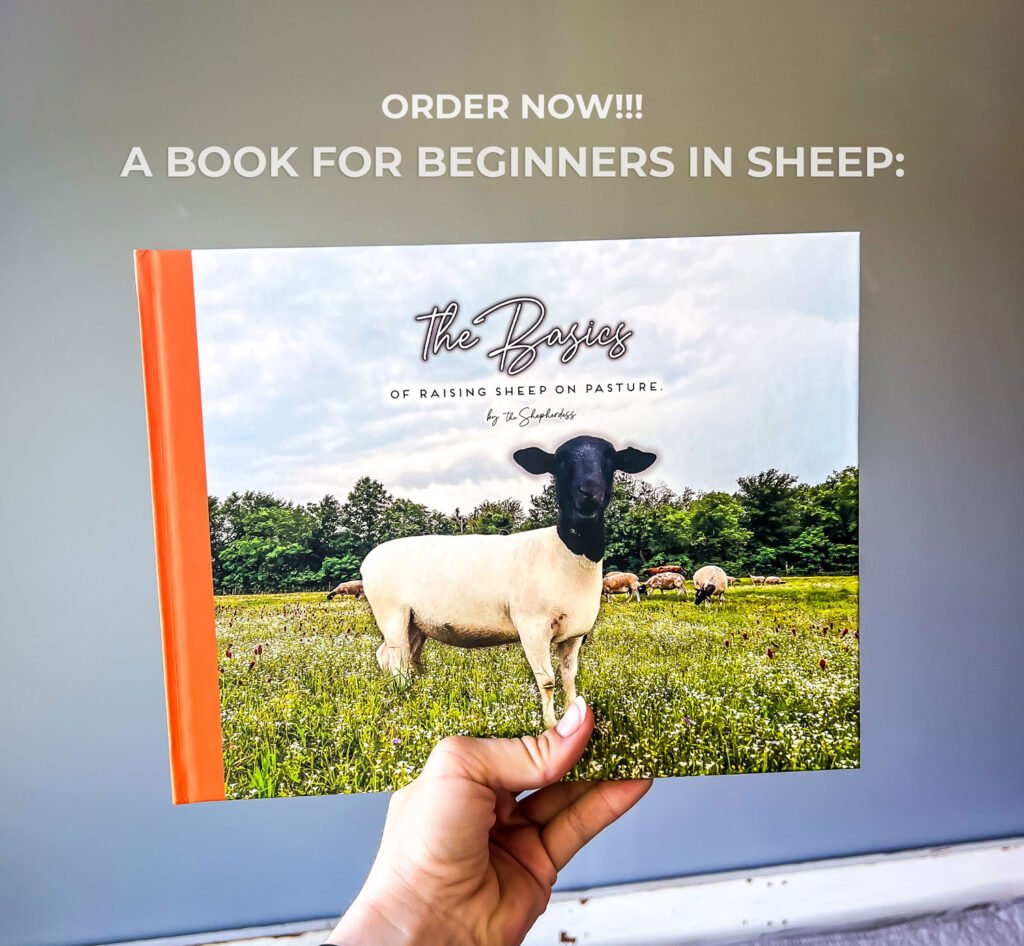
If you’re a beginner shepherd on 30 acres or less, then I wrote a book for you: The Basics of Raising Sheep on Pasture. Available at Shepherdess.com with free shipping. Raising sheep on pasture requires a basic understanding of pasture management, breeding and lambing, and mitigation methods for common disease. I walk the beginner shepherd through each aspect, sharing through this book vivid pictures, easy-to-follow instructions, and personalized stories from my own journey with sheep. Available with free shipping at Shepherdess.com; you’ll find a direct link in the description.
So rainfall at my place is 45 inches annually, which is really the perfect environment in which to practice regenerative pasture management. And that’s exactly what I practice. My system has little or no feed or grain inputs, and little or no fancy seed and pasture planting—beyond the fact that I will sprinkle a little bit of a handful of rye grass or crimson clover on the pasture as, you know, maybe there’s a bald spot. That’s about the beginning and the end of it. My sheep are raised on pasture as close to 365 days as possible. I have a small shed that I’ll take them to for things like freezing rain, extreme snowy temperatures, but it’s 24/7, 365 on pasture as much as possible. And I use electric fencing to rotational graze my sheep across the pasture. And I really do consider this regenerative pasture-based farming system to be sort of the crown jewel of my overall operation and work because if I’m honest, it was these practices that turned everything around for the health and productivity of my flock.
And health struggles before I really implemented this grazing program were pretty steep. We lost a lot of sheep to parasites. Our pasture would be overgrazed in some areas, undergrazed and others, but once I started rotational grazing, the health of the flock just turned a complete 180, and the health of the pasture just turned a complete 180. Overgrazed spots disappeared, undergrazed spots were utilized, and by moving the flock regularly, I became aware really on a close level of which sheep were my strongest, which sheep are more prone to becoming sick, and I was able to make culling decisions better as a result of just being closer to the flock on a daily basis. And that led to the overall improvement as well. And I’m mentioning all of this information up front about grazing and about systems because, if I’m honest with you, I’m getting ready to share some tips with you about breeding, getting the minerals up, and getting your sheep healthy for a good productive system overall. But it really does start with the pasture management, and I always harp on that. And I always want to make it clear: if you are not fundamentally, foundationally taking care of your flock and your pasture, it’s going to be really hard to patch some of the problems. So make sure you’ve got a good system in place or else, if I’m honest, some of this stuff I’m getting ready to mention, it’s going to be like band-aids on a cancer. So make your system is good, and use what I’m getting ready to tell you as value add.
If you guys want some background on me personally, some of you do know my story, but some of you may not. I actually started farming in 2020 with no background in agriculture whatsoever. And it was a situation where I just really felt led by the Lord to invest in some form of low-input food security for my family. And at that point in time, it meant taking 30 acres of grass that was mostly unused and turning it into a grass-fed meat source. Now, before diving into farming, I was in digital marketing and product development in the retail apparel industry. So to say that it was a learning curve to go from fashion basically to farming, and to still be in it six years later, is a massive understatement. And I say that to encourage you as much as anything, because essentially if I can do it, you can do it. If you’re coming from a background where you have no experience, maybe you feel a little lost, you’re in the right place. That’s exactly where I was at.
And I was that place as a beginner where I often felt like going into farming, and sheep farming specifically, and getting information I needed to be successful. I felt like it was kind of climbing a ladder, and the first five rungs were missing. Nearly every resource I found assumed that I knew a little bit of something about farming, which I did not. Oftentimes, I couldn’t even find anything sheep specific. I had to amend a lot of the information that I found for cows. But that’s what I did three years into my journey. But back to the beginning, I was at that place of being without the first 5 rungs, which is exactly what I created my book to be for beginner shepherds. And so with that being my experience, I built out resources for those coming in behind me. And it’s my goal to simply be the first five rungs of the ladder for you as a beginner shepherd by relaying simple firsthand information to beginners in a pasture-based system.
I’m going to go ahead and break this into three sections. I’m going to discuss your ram in section number one: what to look for, little things like that. Number two: I’m to talk about your ewes, how to prep them, and make sure they are sufficiently mineralized, I guess you should say, and make sure you’ve got your nutrition up and going. And then section number three actually really zeroes in on nutrition and timing itself. So we’re going to tackle it in three different sections tonight.
What to look for in a meat ram
Now we’re going to start out with the ram tonight, and more specifically, what to look for in a meat ram. Now a good body type for a meat ram consists of a few important traits: you want to look for a low line animal. What that just means is the line their body is low to the ground. You want to avoid those animals with too much leg. And the reason being is that leggy animals do not convert as well on pasture only. So, you want to kind of think short and stout in terms of a ram with thick hind quarters. And what that means is just a good looking leg of lamb back there. And additionally, a long, deep body. If you see on screen here, one of my best rams is at the bottom and he’s got an excellent, nice, long body. And this is where all of the premium cuts of meat come from in terms of your meat animal. And that is going to be your loin and some of those higher quality cuts, so you really do want to prioritize a long lean body in your ram.
Now, for me, because I raise on pasture, I’m also looking for a ram with strong parasite resistance and good hooves. Those are priorities for me in a breeding ram. And if you prioritize those in your ram, which is going to, again, he’s going to be the father of all of your lambs, it’s going be the best way to upgrade the overall quality of your flock. So when you’re shopping for a ram, don’t just look for the body type. Don’t just for the phenotype. Also evaluate really closely the system from which he came, and make sure he’s not basically been bloated with grain his whole life and then will waste away, essentially, once he goes back to your pasture. So invest in quality, invest in an animal that comes from a system that matches yours. I paid around $3,000 to acquire one of my best rams for my flock, and I traveled about—I think it was 800 miles, 800 to 1,000 miles round trip—to bring him back to my farm. It was entirely worth it. Take your time, find a good one, and buy the best that you can afford. You may not be at a place where you can buy a $3,000 ram right now, just buy the one that you can afford. As an example, just a little bit of the marketing side of it, that $3,000 ram essentially made my investment back in its first lamb crop. He went home, and he bred about 30 ewes. Those lambs immediately had a value that was about 30% more valuable than the previous ram, based on his phenotype and what he contributed genetics-wise—it paid for himself in the first lamb crop.
All right, so this is just some more visual examples. Again, the low line, which is your short legs, your thick hind quarters, which is your back end of your ram. You want it to be nice and meaty because these are your leg of lamb, and then you want a long, deep, body once again. Now, another question that I get is: How many rams do I keep for breeding? Something to know here is that a good ram can actually breed up to 40 ewes per cycle. But to play it safe at my place, and just ensure that no ewe is missed, I do prefer keeping one ram per 30 ewes. And this practice does help me to maintain a tighter breeding window because all of the ewes are basically guaranteed covered. Nobody’s missed because I’m maxing out my ram. So one ram per 30 is my standard. But if you can only afford one really good high quality ram, one ram per 40 is perfectly sufficient, and just stick with that. This is another question I get, and it’s a little bit controversial, but I’m just going to give my input and my opinion on it: do you need to replace your ram every single year, or can you breed a ram to his female offspring? Yes. The answer is yes. You can breed a ram to his female offspring, and this practice is known as line breeding. If your ram is of excellent quality, that quality will be magnified as you breed him to his daughters and granddaughters. However, the exact opposite is true for a poor quality ram: if you’ve got something skinny, you got something less than quality, the more you breed him down, the more those bad qualities are going to be exacerbated.
And this is something to be careful with, but essentially, you want to just watch and make sure that there is enough genetic diversity. If you were running a purebred, make sure there’s enough genetic diversity to where you’re not going to run into problems. But I used to be sheepish to share that I did this line breeding practice, but I was at an agricultural festival and I was positioned directly next to a veteran show sheep breeder. And we were having discussions about this breeding practice in terms of breeding father to daughter, and he said, “Oh yeah. We’ve been in the show sheep business for 20 years, and my dad was in it as well. And we would breed a ram to his female offspring for up to eight generations.” He said, “We had to, at that point, do special blood tests to make sure the genetics were not becoming dangerous, but that’s what we did in the show sheep arena.” Now, eight generations, I’m not entirely comfortable about that, but it made me a little bit more confident in my two generation rule at my farm.
Now a question I often receive is: How often should you replace your ram? Now, a ram will hit its peak fertility at around five years of age, and the average lifespan of a ram is around seven to ten years. So, technically, five years at its prime. Between five to ten years, he may just start slipping a little bit, and you probably want to bring a young guy in there to pick up after him. For example, that ram that I invested in pretty heavily upfront, I’m keeping him. He’s about four this year, and I intend to keep him until he’s five or six. It’ll be too expensive for me to replace him, and I would rather just keep him in my program. Another factor here is that I started with a large group of completely unrelated ewes. So, if you’re starting out with a smaller flock—say you have a ram, and you’re bringing him to breed to ewes, and you do the line breeding practice—you’re going to have a little bit less flexibility than I did, bringing that brand-new genetically separate ram into a flock of 40 ewes. So you may want to change him out a little bit sooner, but for me personally, I don’t really have much of an issue in terms of keeping my ram up into five and six years.
Another common question that I get is: Where do you keep your ram when he’s not breeding the ewes? And when my ram is not breeding the ewes, he will stay in a clean pen with fresh hay, minerals, and clean water. Now, I recommend a minimum of eight feet by eight feet. That’s about 64 square feet per ram. Now if you have two rams, they will keep each other good company, but make sure the space is tight so that they don’t actually fight. I will have rams together, but if the space is tight enough, they will not be able to gain the momentum they need to headbutt and create brain trauma for one another, which is an issue if you have two rams in a large space. What I prefer doing is having a ram and a wether together—which is a castrated male sheep—and that way the hormones aren’t really raging and creating conflict within the pen. So, that is my preference, but if you have two rams (I have two rams together right now), usually one will assert dominance, the other will back down after a bit, and it’s absolutely fine. But if you want to avoid that initial conflict while they establish dominance, make sure the pen is nice and tight, and they don’t have the opportunity to come and try to kill each other, essentially. I think that’s what their intent is. Goats also do make good companionship, but it’s a little sketchy. Goats are a bit different in terms of their personality. Mine are somewhat abusive and will use their horns to make sure my rams to know their boss, and that can be a little bit of a problem sometimes.
Preparing your ewes for healthy breeding
Section number two: we’re going to go ahead and shift our focus from the boys to the girls. Okay, so ewes. Dam is the technical name for a ewe, which is the mother of your lambs. In the sheep world, and when you’re shopping, more specifically, you’re going to often see that phrase used. So if you’re going out and you’re shopping for a ram, you’re going to often see people use the term “flock sire.” If you shop for a ewe, you’re going to often see people use the term “dams.” And that’s just a little bit of a 101 in terms of shopping. I’m going to go ahead and break down the information I’m going to share for you on your ewes into a couple of different categories here: I’m to address body condition; I’m go to address age at breeding; I’m going to address mineral mindfulness—things that you need to make sure you’re providing to your flock on pasture; I’m going to also address light supplementation options; I’m going to address flushing or not; and then I’m to talk about my pre-breeding cull criteria. And keep in mind here, this advice is based on my pasture-based system, which is really simple, and really low-input; it focuses primarily on one lambing per year. A lot of high-intensity systems have a more complex approach, but my method is really simple and really straightforward. If you want some more education on how you can potentially run five lambings per year, google “accelerated lambing” and you will find a lot of information—but tonight is not an accelerated lambling course. This is a simple, low-input, pasture-based lambing course.
So the first thing we’re going to talk about is body condition. This is probably one of the most important factors to consider as you go into breeding. And this is one of the most important factors that will contribute to a successful breeding and lambing. The bottom line is that ewes in good body condition have higher chances of twinning, reduced lamb loss at delivery, better milk production post-birth, and on the flip side, you’re going to have struggled. If you send a ewe in poor body condition into breeding, you’re going to have a ewe that has lower milk production and increased susceptibility to parasites and disease after lambing. Now, if your ewe is thin, you need to consider a couple of options to get her back up into shape. Number one: consider deworming her. Check her FAMACHA score. Make sure it’s not parasites that are dragging her body condition down. If you do identify that it is parasites, you need to probably deworm her to get her back in a good condition prior to breeding. Also consider providing a short-term supplement before breeding. And this proactive approach is going to prevent, again, significant issues at lambing time. Remember the saying, “An ounce of prevention is worth a pound of cure.”.
Now, as a side note here, you see some examples of body scoring. This is an example on the far left hand side of the screen. That is a ewe that is in very poor body condition. You can see her bones essentially sticking out of her rear end. The picture in the middle is that exact same ewe in much better condition. She’s an overall small-frame ewe, so she’s not going to be as thick or chunky as the one on the far right, which is one of my best ewes. But when you are body scoring your sheep, you want to look at the back end of that sheep—not the belly, okay? When you’re looking at sheep or small ruminants in general, most often their belly is always going to be big and round and fat by appearance. But when you’re trying to body score and determine if she’s too thin or too fat or just right, you want to look at her rear end. That’s going to be where you examine for that good condition. You can see here on the far right, she’s one of my best ewes. She’s got really nice, chunky hindquarters. She’s in excellent condition. The one in the middle—overall, she’s a smaller-framed ewe. She’s just generally smaller, but she’s in good condition here. And then the one on the far left, she needs some help before I send her back into breeding.
Okay, another controversial topic: I’m just going to go ahead and give you my opinion on… Actually, probably, it’s not really my opinion. It’s two of the most popular options. So what age should your ewe or ewe lambs be a breeding? So a ewe lamb will actually start cycling as early as four months old. If she’s been on a good plane of growth from the moment she was born, she will cycle and can potentially breed as young as four months old. But the best practice is to wait until that sheep is either 12 months old, which means she’s exited her lamb phase, or until that sheep is half of her adult weight before breeding. Half of her adult weight is usually achievable by about six months. And those are your two options. At my farm, what I do is I run both my ewes and my lambs together in one group. And so what I do is I breed my six month olds. I’ll breed my half-grown ewes. And at that point in time, again, they’re half of their adult weight. And this is typically not a problem for me in my system.
However, I do make a point of monitoring these young first time ewes really closely during their first lambing, as they tend to be the ones that do give me the most trouble. They’ll need the most assistance. They maybe need the most help in terms of bonding with their new lamb, because when they do have that and they’re technically still lambs themselves. So just watch them a little bit closer if you choose to do like I do and breed them a little younger. But if you want to avoid or mitigate chances of trouble, you can definitely separate your ewe lambs out of your breeding group. I just have to be honest, running two groups for me personally, it’s a little bit too much trouble. I kind of find it’s more trouble than actually monitoring those first time moms at lambing. So I just round everybody up, I let them breed at six months, and I just give them extra care at that lambing time.
All right, mineral mindfulness. Now, loose minerals should be available to your sheep all year round. And if you live in a rainy climate, guys, please opt for a covered mineral feeder to protect your minerals from rain. I had a bad season one year—rained like cats and dogs—my minerals were washed out for half of the year, and my flock went into a deficiency. So make sure you invest in one of these covered mineral feeders. I bought this one from my local co-op. It was a bit expensive—it was about $200 to $300—but guys, it’s a bull mineral feeder. It’ll last pretty much for as long as I’m farming. It’s a one-time purchase, and it does an excellent job in terms of durability and coverage. It is worth the investment. Now, what I want you guys to really zero in on in terms of your mineral is selenium, okay? Selenium. At my farm I use a Redmond Selenium 90 mineral salt for my sheep and I will dilute this by about 50 percent. So it’ll be “90” representing the parts per million of selenium in that mineral and once I dilute it it will be about 45 parts per million.
That said, whether you choose a Redmond mineral or you go to your local farm store for a mineral, I want you guys to look at the back of the package, and I want you to make sure that there’s a bare minimum of 30 parts per million of selenium in that mineral for your sheep. Again, you can go up to 45. I think the Purina sheep mineral has up to 60 parts per millions of selenium in it, but I really cannot stress the importance of selenium. And on that handout that I gave to you guys earlier, that PDF handout, I actually have a Redmond sheep mineral linked on there available for sale at Shepherdess.com, and purchasing from that will help to support tonight’s presentation. But I have a Redmond sheep available at Sheperdess.com. It has 60 parts per million of selenium in it. It is excellent. Redmond is basically all that I feed to my sheep.
But let me narrow in here and get a little closer to the selenium issue. Selenium is so important for sheep and their reproduction. And for me personally, in my area of the country, my soil is selenium deficient due to high rainfall. And so the forage that my sheep are consuming tends to be selenium deficient. And as a result, I ensure that my sheet mineral, again, I’m going to be redundant here: my sheep mineral has a minimum of 45 parts per million in it at all times. And again, that Redmond sheep mineral that’s going to be on that sheep supplies PDF has 60 parts per million in it. It’s an excellent mineral. But selenium deficiency, it’ll lead to serious issues such as infertility, meaning that your ewes are going to be cycling but not breeding. So you’ll just notice they’ll keep coming back into heat and not catching that first time. So infertility is a selenium deficiency. Stalled labor is a result of selenium deficiency. My first year, I had a ton of lambs that were just… The head will come out, little bits of the hoof, and then the mom was just… I thought she gave up, but it was stalled labor as a result of a selenium deficiency. Retained placenta is also a selenium deficiency issue. Your placenta should be delivered within about an hour of the lamb. For me, I had some ewes that were retaining it for up to like four hours. I’ve heard of ewes retaining it for days, which is super bad, but that’s a selenium deficiency.
Selenium deficiency also produces weak lambs that struggle to stand at birth, as well as white muscle disease in weaned lambs. I had all of these symptoms in my first lambing season. I had no clue what the problem was until I started to do my research and realized my flock probably went into breeding with an extreme selenium efficiency. White muscle disease, guys, keep in mind, it’s going to produce a really slow growth rate in those lambs, and then you’re going to notice… Well, what I noticed with my lambs is that I was looking out at these little lambs and their heads were just shaking—their heads were just shaking like little leaves. I was like, what is going on? Took me about two days to figure out what in the world it was. I called around, finally got a local rancher to key me in. I think it was a local ranger. That is advanced stages of white muscle disease. If you do not catch it in time, ultimately, that shaking is a nervous system disorder, and they’ll have a heart attack and die.
Calcium—this is also one that I really want you guys to pay attention to going into breeding. And potentially, I might say calcium should be a consideration late gestation as much as anything. And I threw this extra bit of slide in here because I had a couple ewes in the past couple of years that have had hypocalcemia or milk fever approaching lambing, and even shortly after lambing. So calcium is super important as you prep for breeding. If you are supplementing with alfalfa hay or pellets, that’s a very high calcium feed supplement. And if you’re using it regularly, your ewes will likely be getting plenty of calcium. But what I like to do is I like to add a calcium supplement to my mineral as we approach that final trimester. And again, this is not necessarily at breeding. It’s in that final trimester, but I think it’s important to mention to you guys. I add a few scoops of finely powdered limestone to my mineral salt, or I will use the Premier 1 sheep and goat micro-mineral mix, which is 18 percent calcium. And again, calcium deficiencies are commonly present at breeding, but they don’t manifest until lambing. But once calcium-deficient ewes have lambed, typically they’ll start making a lot of that calcium-rich milk for their lambs, and then you’ll notice them just going downhill rapidly. She’ll be droopy, and if you don’t catch it, she’ll pretty much die. But hypocalcemia is something that can be prevented by adding a bit of limestone to your mineral at that breeding time.
Light supplementation—now, I want to address this one. When it comes to supplementing before breeding, my approach will really depend on pasture quality and the overall body condition of my flock. So if my pasture is in good shape and my ewes are in overall good condition, I don’t provide any supplement prior to breeding beyond those loose minerals that we just discussed. But if I’m facing a year where my pasture is over mature, stemmy, burnt, I will introduce a molasses lick tub with a 16% protein into the paddock starting about two weeks before breeding. And I will continue this through the breeding season, and this usually brings everyone up to speed, and it supplements for that really low pasture quality. Now, what happens and how I get this particular pasture quality is that summer drought will often compromise that pasture quality, or the pasture will get ahead of me—I’m not able to graze through it fast enough to basically keep it in check.
So remember that “an ounce of prevention is really worth a pound of cure” in this situation. If you have an over-mature pasture, a burnt pasture, a drought stricken pasture, add a lick tub in there. Make sure the sheep have what they need, and often that lick tub will supplement and bring that forage quality up to speed. This year I actually mowed my pastures, and it brought everything back into a much better quality. I’d never done it before, and I probably won’t do it every year, but this year it worked out really well, and my sheep have just been in amazing condition because that pasture quality was basically brought back to optimum. It didn’t get overgrown. So that’s exactly what I did. That’s another option. That was a bonus, but I had to mention it because it worked so well for me this year in terms of mowing my pasture.
Common mistakes before breeding
All right, let’s talk about consequences. Consequences of breeding a ewe in poor body condition. I’ve got to talk consequences because I have done it before. These are some examples of mistakes I made at my farm. I have bred ewes that are way too thin, and they are not able to add enough weight during gestation to compensate for the absence of condition prior to breeding. And they’re not able to add enough weight and grow that lamb and fill their bag full of milk for it, and what happens is they will end up with hypocalcemia in late gestation. If they’re carrying twins, you’ll often encounter twin lamb disease, which is super difficult to overcome. But more commonly, these thin ewes will just give birth and not produce enough quality milk for their lambs. So their lambs will hit a “failure to thrive” because they just don’t have the quality feed. And what I have to do—if I have made the mistake of sending a ewe into breeding too thin and it carries all the way into lambing—I will just pull the ewe aside after lambing, and make sure she has the supplement that she needs to keep her milk production up and to keep that lamb fed, as well as herself. So you’re going to have to either supplement before or after, but keep in mind: ounce of prevention. Get them in good shape beforehand, because it’s a lot easier to do that than to sideline your ewe after lambing.
Picture this: you are looking out over your 5, 10, maybe 20-plus acres. The sun is setting, and your flock is grazing across a green pasture. Something inside you affirms this is real wealth—at least when it comes to material things. You know how to take care of your sheep, your grazing system is improving your land, and you have a way to direct market each lamb that is born. This is how I feel when I look at my flock, and I want the same for you. So, I put together a free one-hour class that answers some of your most frequently asked questions concerning how I raise, rotational graze, and market my sheep for $480 per head. Go to Shepherdess.com/480, or simply click the first link in the show notes of this podcast to sign up and receive the free on-demand class. What’s more is that I will follow up over the course of three days, providing you with even more free resources—including a free ebook, a free grazing sheep kickstart guide, and a free marketing sheep kickstart guide. This information is worth paying for, but I’m giving it to you for free. Just go to Shepherdess.com/480, or simply click the first link in the show notes of this podcast for how I raise, graze, and market my sheep for $480 each. Now, let’s get straight to today’s episode.
Now, what I do at my farm is I will go ahead and just cull the thin ewes before sending them into breeding. And that’s something I do because my flock is big enough now; it’s not necessarily worth it to me to sideline and bring them up to speed, so when your flock gets a little bit bigger, if you want to follow my example, go ahead and just cull those two or three ultra-thin ewes. Sell them to somebody who can bring them up to speed—maybe they’re more willing to do feed inputs. But if you have a very, very small flock, you can bring that ewe up to speed with half-to-one pound of feed per day until her body condition score is at a 3 or better. Do that prior to breeding. So again, half-to-one pound ration. You can just go to the farm store and get a sheep feed or a general feed mix. Now, I know some people may want to go all organic or this or that, but when it comes to the short-term feed supplement, guys, I’m not too much of a snob. I’m just trying to bring a ewe back up to speed and get her back on pasture. I’ll just buy whatever I can find at the farm store. She likes it, it works just fine, and when it comes to short-term, just use whatever is available locally. But the bottom line is: just make sure she gets in good condition before you put her into breeding.
All right. So, flushing. Flushing ewes is a practice that sheep farmers will do to increase twinning rate. And flushing ewes involves adding a high-energy supplement, typically grain, to your flocks diet before breeding to increase, again, twinning rates. And flushing does really effectively boost twinning, but I do not grain flush my ewes. So, instead of the traditional flushing, I will focus on ensuring that my ewes are in that good body condition before breeding. And I do this by providing them with the best quality pasture available during that breeding window. So my goal at my farm is to manage pasture resources to improve lambing percentage rather than to rely on grain inputs. And this is just a long-term strategy that I have chosen to employ at my farm, but if you don’t have any problem with adding a little bit of grain to your program prior to breeding, you just want to do that within two weeks of adding the ram. So two weeks leading up to the ram going in, do a little bit of a ration of about a half-to-one-pound of grain, and it will increase your twinning rate.
And there’s no judgment for that. Here’s something that I find—just a little bit of input: I find that whatever supplement I add prior to breeding, I also need to plan on following up after lambing with exactly the same supplement. It’s interesting, and I don’t know if anybody else can relate, but if I choose to grain-flush my ewes at a rate of half-to-one pound going into breeding, I need to follow up after the lambs are born, and add half-to-one pound of feed after those lambs are born. And I find that that ends up being what happens for me. So going into breeding, I just do pasture because I’m just like, okay, if they breed on this pasture, I know that they can feed their lambs on this pasture. And it’s been very, very consistent for me, and that’s kind of the rule that I go by for my low-input system.
I touched on this a little bit beforehand, but going into breeding is when you also need to consider culling. Culling involves just removing undesirable animals from your flock to improve productivity overall. I will add that doing so prior to breeding is going to make your whole year a whole lot easier. Again, some of you guys are just working with small flocks of four and six, but once you start getting up to the 20s and the 30s, consider culling two or three of your worst or least productive ewes prior to breeding. And that will just make your year, again, a whole lot easier. Now, when it comes time to cull, I prioritize culling ewes with poor maternal traits, problematic utters, persistent parasite issues, and persistently poor body condition on pasture only. Those are my top four. Number one is get rid of all your bad moms because your bad moms are going to cause you a lot of trouble come lambing, so prioritize getting rid of those. The utters are also equally problematic because no matter how good of a mom they are, if they literally physically can’t feed that lamb, she’s just as good as a bad mom. And then the parasite issue is number three. Removing the problematic ewes will allow you to focus your resources basically on the ewes that are actually pulling their weight, and increase your lambing percentage in those productive ewes overall. And that’s exactly what you want in terms of building a flock with good genetics.
Now, something I want to say here because we have a lot of beginners in the room: when I bought my flock, it was of course much smaller, and I didn’t go through the rigorous culling process in my first year. Instead I decided to commit to every single last sheep on the pasture for 18 months before I made my first round of culling. And what I did was I would just keep very, very close notes on all of those ewes, and three strikes, you know, you’re out essentially, but I wouldn’t make that decision until 18 months later. Here’s why I’m glad that I did that because number one, I was a beginner, and number two, I was encountering problems that were a result of my management. I talked a lot about selenium deficiency upfront. I was able to just make a management adjustment that improved the performance of those poorly performing ewes. It was my fault, and by waiting 18 months and improving my shepherding skills, I was able to essentially fix the problems that were my fault, and identify the true troublemakers. So, if you’re in that first year of shepherding yourself, I would encourage you to do exactly what I did. I was glad that I chose to go that 18-month route before culling a single animal. I kept very close notes. I knew which ones I would cull once the time came, but I didn’t until I committed. I committed. It was a lot of work; I learned a lot. But if you are just starting out and you have about four or five ewes, that’s exactly what I would recommend for you.
Timing your breeding season
Section number three is: timing your breeding. When do you join your ram to the ewe flock to breed them? When do you basically launch your breeding season? So, the best month, rule of thumb, is to join your ram with your ewes for breeding in a pasture-based system—it aligns with the concept of lambing with the pasture. So this means that you need to identify when your pasture begins to come alive, and then count backwards five months. So, if you live in the area of the country—somebody was here from Wisconsin—and you don’t start to get green pastures until… fill in the blanks. Whoever’s from Wisconsin, when does the green pasture come? But let’s just pretend it’s not until May or June. You want to take June and you want to count backwards five months, and that’s when you want to join your ram for a pasture-based breeding season. Now here in Texas, we get spring pasture a lot sooner. So here in Texas, we will join our rams to our ewes in October, early October, and that will put those lambs coming in March when the spring pasture typically is coming alive. Now, I did make a slight adjustment to the concept of lambing with pasture. I’m going to talk about it at the end of this section, but overall this concept of identifying when your pasture comes alive, counting backwards five months and then adding the ram in that month, that’s exceptionally safe in a pasture-based system.
How long do you leave your rams with the ewes? So something to know is that sheep breed in 17 day cycles. So I would recommend keeping the ram with the ewe for at least 34 days. It gives every ewe two chances to breed. At my farm, I typically extend this to 51 days or three cycles to ensure that everybody has been thoroughly bred. But I put a hard stop at 51 days and no longer. And I did this because I encountered problems when I left my ram in there too long. I do lamb twice a year, but in my early days, I only lambed once a year. And I could technically keep the ram in there until the ewes had given birth—I’d keep everybody in one group. But when I did leave my ram there all year long, what would happen is that he would breed some of those younger ewes in December and January. I would end up with lambs during June and July, and these are just really bad months for parasites here in Northeast Texas. So the lambs born in June and July struggled to thrive on pasture, as did those young moms. So, I limit very, very hard to 51 days. And then the ram is out of there and back to confinement. Another thing to mention is that being on lamb watch is really, really mentally taxing. You do not want to be on lamb watch for months and months. Seven weeks is enough, and you can trust me on that. You want to be able to go to town without having to worry about coming back to a surprise.
So, this brings me to another question that I get a lot, and that is: “Why do you not leave your ram with your ewes year-round?” I hinted at it, but I did try it for a couple of seasons, and it just presented too many problems. They would breed ewe lambs that were much too young. I would end up with lambs born much too late. And once again, just being on constant lamb watch is a mental strain. And what was kind of the worst in terms of management for me was that leaving my ram in all year-round, and having lambs born at various periods, was a maintenance struggle, because I was constantly doubling back to treat lambs that were either too young for treatments the first time. Whether I was giving them their first dewormer or whatever treatment I was giving, it was just really hard to keep doubling back to those differently aged lambs. So keep your lambing season really, really tight, and you’re going to thank yourself in July when you’re done working lambs for the year, and you are not out there sweating it out to get the last few treated.
So, keeping a tight breeding window overall—that 51-day hard stop—has improved the health of my operation, and has reduced my time inputs by leaps and bounds. So keep that in mind in terms of a breeding window for yourself. Whether you’re hardcore and you say, “34 days, the end,” or you’re like me and you give them three chances to breed at 51 days, I do encourage you to keep and put a really hard stop. If you have ewes that do not breed in that 51-day window, you probably need to check her for some serious problems because if she doesn’t breed with three chances, she either has some serious mineral deficiencies, or you just need to cull her for her physical deficiencies. So keep that in mind.
All right, so I’m going to go ahead and talk about the unique adjustment that I made to my specific lambing season in my specific context. About two years ago, I decided to deviate from the norm, and instead of lambing with the pasture, I lambed about two weeks ahead of the pasture. I joined my ram to my ewes in September, and this resulted in February lambs instead of March lambs. And in order to address the fact that pasture was still two weeks away from coming into bloom, I did have to supplement with alfalfa pellets and a protein lick tub, in addition to quality hay, in those first two weeks. But this adjustment worked so well for me that it’s one that I have carried forward for the past two years, and I intend to carry forward with a primarily February lambing for my flock. And what are the advantages of this? Well, number one: lambing two weeks ahead of pasture brought several advantages. One being that my lambs gained a lot of weight and their immune systems were fully developed before June and July, which is when the parasite bloom hits hard here in Texas. So they had a really good natural resistance to parasites. And I was giving a lot less dewormer to those young lambs in that summertime period because they were chunky. They were up at 40 and 60 pounds, and they were fighting off disease naturally rather than being these little tiny lambs that were still nursing and still trying to gain their immune system. In that really rough June and July period, they were essentially toddlers of the pasture, and they had a lot of natural immunity.
Another advantage was just a management advantage that came to me, and that was that lambs were born before my spring-grazing program kicked off. So they were safely delivered in my safe and easy to access winter paddock with easy access to the shelter. And this reduced a lot of stress for me during lambing season because instead of trucking to the back of the property to check and see if there were new lambs in the paddock I could just glance out my kitchen window to the winter paddock and do a quick check to make sure everything was okay. They were safely tucked away when I needed them to be and when they were very tiny, and really allowed me to sleep better at night. Also, here’s the big one: peak lactation is 30 days post-lambing, and this aligned with the best pasture quality. So, a little bit of pasture math here: I just said I lambed two weeks ahead of pasture. Thirty days post-lambing is when that pasture is really succulent with those new shoots, high-end sugars, and this is excellent feed for a ewe that is in peak lactation. And this allowed the lambs to grow quickly because their moms were producing a lot of really, really good quality milk. I did not have to supplement those ewes to support their lambs. They were making a lot of milk on pasture only.
And then what is more, is that by June, these ewes were on the downside of their milk production, meaning their milk production was naturally tapering off at a time when it’s most difficult to naturally fight disease on pasture. And this improved the ewes’ natural immunity to parasites and disease during the summer. And making this slight adjustment to lambing just two weeks ahead of the pasture meant way less handling, way less drenching, and way less dewormer with just this one simple adjustment. And a huge bonus is that I finished working all of my lambs by May, right as the scorching Texas heat kind of comes on. I’m able to tuck everybody away, get them all weaned, and get them set in their summer grazing program, so I no longer have to work lambs in the brutal Texas heat.
This is one of those things that ties to probably a bigger lesson that I want to really, really drive home. And that last part may have seemed like a rabbit trail. I think it’s actually going to help a lot of you because I get emails about this all the time, like, “I did what you did, and this was an amazing change for my system.” But I ultimately shared that story to underscore a really crucial point that you need to learn as a farmer, and come to grips with yourself, and that is the point that you just need to learn how to farm for yourself. You need to be in tune with your animals and your land to where you can make those small adjustments for yourself confidently, like I just mentioned. And while I really think it’s essential to seek wise counsel and to apply best practices, it’s equally as important to identify the unique challenges and the unique pain points within your own operation, and brainstorm on the adjustments necessary to mitigate those pain points. Develop a system that works well for you, your animals, and your climate.
I’ve gained a ton of insight from experts like Joel Salatin, Alan Nation, and Jim Garish—that big stack full of books I was holding at the beginning. Those were my bedrock. Those were my baseline. Those things got me off the ground as a beginner, as will The Basics of Raising Sheep on Pasture for you, available at Shepherdess.com. But ultimately, as a farmer learning how to farm in my own specific context, I had to go out on a limb sometimes with some of my decisions and adapt the advice that I was getting from everybody to fit my specific circumstances, and create a unique system that truly worked for me. So I want to give you that advice, and maybe that freedom, in understanding that success in farming will require that you exercise the exact same critical thinking skills within your own operation. You’re not breaking rules, guys. You’ve got to make some for your own well-being. You’ve got to make some of your own rules.
All right, I’m going to go ahead and go to the question and answers, so I’m going to start with JT’s. He says, “Can you inline breed fullbloods?”—meaning breeding father to daughter. JT, yes, you can, and I do. Be watchful of if you have sheep with pedigrees. Sometimes they’re going to come with breeding papers. If you look up the pedigree and you see the same parents on both sides, you’re probably getting into genetics that are really, really close. The fullbloods are a little bit harder to do. I do commercial sheep, so there’s a lot more genetic diversity in the commercial arena. You do need to be more careful with the fullbloods, but a lot of people do it just fine. Chris says, “Why do you dock the tails?” Chris, this is a good question. I would dock the tails in my early days as a way just to keep their back ends a little bit cleaner. Sometimes they would get… It’s called the “spring runs,” and they will get diarrhea when the spring pasture blooms. And oftentimes, flies will burrow in the tails, lay their eggs, and if you dock them a little bit shorter, there’s a less chance of that. All that to say is that I’m a little bit less religious about docking now than I was, and there’s a lot of undocked tails on my pasture right now because the flies that lay maggots in the back end of sheep are not a significant problem for me.
Cindy kind of echoes that. She says, “Not everyone docks. I stopped doing it.” It’s one of those things you kind of have to go with what’s going to work for you. I docked religiously in my first couple of years because that’s what everyone did, and then I realized, maybe I don’t need to do so much. And I just made the choice to kind of lay off it a little bit. I do have to say, it does look a little cleaner. So maybe it’s just an appearance thing, but it’s your choice and you’ve got to make sure that you’ve evaluated it. Levi asks, “When you say you breed twice a year, is that spring and fall crop, or are you breeding the entire flock every eight months?” This is a great question, Levi. So yes, I have a spring lambing and a fall lambing now. No, the entire flock does not breed every eight months. Basically, what happens is that I will have very young ewes that will not catch during the spring lambing, but I’ll put my ram back in and they’ll catch during that second lambing. So basically, my spring lambing is kind of my biggest lambing, and then my fall lambing is kind of a clean up crew. They’ll get everything that was left over or too small to breed for spring, and it’s just kind of a nice bonus there. Occasionally, I’ll get a ewe that breeds back right away. She’s super healthy, super good shape, but it’s more the exception than the rule on my pasture-based system. Usually they’ll just breed one time a year.
Ivor says, “Do you have to worry about parasites on winter pasture? Ivor, yes, but not as bad as spring. So typically the parasites will go dormant over winter, especially when you get those deep winter freezes, essentially. And those will put the parasites in a dormancy phase. You just want to make sure to watch it once those temperatures go up. Because dormancy doesn’t mean non-existent; you kind of have to manage it, understanding they’re just hibernating, waiting for the most opportune moment to attack your sheep. Deborah says, “Can sheep eat fruits and vegetables?” By nature, sheep will graze the… so a lot of people will sow turnips, and sheep will graze the tops off of those turnips that have grown underground. So yeah, I’ve seen them eat turnips. I don’t know that I’ve seen my sheep eat fruits, but vegetables, by nature, yes. If they’re leafy green, they will definitely. AJ says, “When you breed the whole herd twice a year, are you doing anything to prevent the mothers of the six-month-old ewes from breeding again?” No, AJ, I kind of let nature take its course. Typically, if the ewes are still nursing, they will not often breed back. Now, I’m not going to say that’s a rule, but if my ewes are still in peak lactation, they will not often be ready to breed back. So it all works out just fine for me in terms of a spring lambing and a fall lambing. I just have two separate joinings. I have not had any problems.
Garrett says, “If I plan to flush with grain prior to breeding, how long do I do this before I breed, and do I continue during the breeding cycles where I have the ram with them?” Garrett, yes, you want to carry it from two weeks prior to breeding, all the way up into breeding itself—all throughout breeding. Now, this is not something I’m highly skilled at—the grain flushing. So if you guys are in the comments, if you could tag Garrett as to how long after you add the ram to maintain that flushing, do you maintain it during the entire breeding window? That is one thing I would be curious to know if there’s a specific strategy on that. But I know it at least starts two weeks prior to adding the ram. Jody says, “What do you do with your cull sheep?” Depends on the nature of the cull. So sometimes they’re great sheep, but they’re just not great for my system, so I’ll sell them to people and say, “Hey, I’m selling this because it needs about half-to-one pound of grain supplement every day to be a great sheep.” A lot of people are just fine with that, and it gives them the opportunity to start with a great sheep, and they’re okay with grain feeding. Sometimes they actually have problems that I wouldn’t want to pass on to someone else, and I will just butcher them out and enjoy them in the crockpot.
Timothy James says, “Does your pasture have trees for shade, and if not, do you need to have a loafing shed?” Timothy, my pasture has a lot of trees for shade, but what I also did was I have a portable shade structure that I created. And if you go to YouTube and search “portable shade sheep,” you’re going to see my video on that portable pop-up shade structure. Ivor says, “Can sheep graze in an orchard?” Yes, Ivor, they most certainly can. A lot of orchards will hire sheep flocks to keep the sucker roots down. Hope says, “Where did you get the blue covered mineral feeder?” Hope, I got that at my local farmer’s co-op. It’s called a bull mineral feeder. It’s actually for cows and bulls, but I use it for my sheep. Ethan Johnson says, “I am new to sheep and I just got eight Jacob sheep, but they are all about four months old and I was wondering if I should worry about overheating. I’m in Southern Illinois and we are sitting right at about 90 to 95 degrees.” I think the Jacob sheep are wool sheep. So yeah, you probably want to get them shorn prior to that summer heat, I would say. Elisha says, “Why is breeding season so exhausting?” Breeding season is not exhausting. It’s just the lambing season that is typically the exhausting part. And breeding season is non-exhausting if you have your minerals and all your nutrition kind of shorn up. But breeding is not exhausting. It’s actually one of the easier times of the year because everybody’s all together and happy.
Dale says, “What is your cycle time for rotational grazing?” Good question, Dale. Once again, it is going to be available in The Basics of Raising Sheep on Pasture. I’ve got an entire little illustration on the life cycle on page number 50. It is an entire visual illustration and timeline of the life-cycle of a barber’s pole worm, and that’s the worm that you want to outpace in terms of your pasture rotation. Some months you need to rotate faster to outpace the barber’s pole worm. Some months you have some latitude in terms of, you know, you can move them twice a month and still outpace a barber’s pole worm. I’m going to give you an example: in the springtime, I want to be moving my sheep twice a week to out pace the barber pole worm and to keep my pastures clean, because that is when that parasite is the most active and the most quickly hatching. When we are in times of summer, like I am right now, it’s 95 to 100 degrees; the barber’s poleworm really can’t survive those high temperatures for extended periods of time. I could get away with just moving my sheep twice a month and I would outpace the barber’s pole worm just fine.
Timothy James asks, “Was the $3,000 ram registered, and are there registered sheep? And if so, what are the pros and cons?” Yes, the $3000 ram was registered. My flock is primarily commercial though. The cons of registered sheep is that a lot of them are grain dependent. So, you have to be very careful about the system that you choose from if you pursue the registered sheep option. So that’s the con. The pros are they’re just generally more valuable. Papers—people pay for papers. Papers don’t always pay, but people seem to always pay for papers. That’s the pro. So all of that said, though, I found it more profitable for myself to just raise a high-quality commercial flock. Full stop. Kristy says, “Do you separate any lambs before introducing the ram for fall breeding?” Kristy, not in my system, because by fall, a majority of my ewe lambs are ready to go. They’re up to at least 50% of adult weight, they’re chunky, they’re ready to breed for the first time. So, I will not separate anything.
Ethan says, “Would you put down a bedding medium in your winter paddocks? I’m in an area where winter is very wet and altogether unpleasant.” So Ethan, it’s hard to say because my winter paddocks are generally large, and it’s generally a well-drained pasture. So just by virtue of my circumstances, I have not consistently had to put down a bedding medium. All of that to say is that in my lambing shed, I will use junk hay as a medium. So yes, in those places where there’s a lot of traction and a lot of manure and a lot of urine, I will put down on junk hay, and that’s my bedding medium. But in terms of all over the winter paddock, not necessarily, no. But it would be a consideration if it’s unpleasant because it’s really not fun to go out and find a lamb born in a frozen puddle. And so if you’ve got a lot of that around your place, just try to get some backfill in there for the sake of your animals. Leroy says, “I have seven pregnant full-blood ewes due this fall, and they have great pasture. Is it a good idea to feed them grain or is there not a need?” Leroy, if they’ve got good pasture and they’re in good condition, do not feed them grain prior to lambing. I made a mistake one time: fed my ewes up, fed them, fed, them, fed them—they did not need to be fed and they produced lambs that were too hard for them to push out on their own; so I had a lot of overweight lambs and a lot of ewes that needed assistance as a result of overfeeding, so keep that in mind. If they’re fine, they don’t need grain.
Pamelia says, “I was on the understanding that you move your flock every day.” Nope. No, I will prioritize every other day during those really, really bad seasons of parasite struggle. And then I’ll give myself a break when the season is not as conducive to parasites, and I’ll move about once a week. Right now, as a matter of confession—for the audience to maintain full transparency—my electric fence is completely broken. So, my sheep are out there with no paddock right now. So my conscience feels better, but my sheep have no paddock right now, and it’s because my fence is broken. But typically, I’m moving them once a week in these seasons. Judge. You guys can judge me in the comment section, but at least I was honest. All right, Cindy says, “Do you market your sheep individually or do you take them to auction?” Cindy, I market them through my email newsletter list. Andrew says, “What is the best strategy for predators, coyotes, and bobcats?” It’s really going to depend on what area of the country you’re in, and what your context is. I cannot speak for everyone on predators. Some people have to have a whole team of dogs in their flock to keep the predators at bay. For me, I did just have a pretty significant predation issue. Just a couple of weeks ago, they came in and they took all of my 10 pound lambs. So it was just six born off season. But I typically just rely on a strong fence, and careful logistics, and a large pet dog. I don’t have anything that formally stays with a flock. So that’s all that I need where I’m at, but not to say there aren’t those moments when something bad happens. A lot of people will invest heavily in those livestock guardian dogs.
All right. Elisha says, “Why is lambing season a lot of work? Is it the constant watch for lambs?” Yes, it is, Elisha. And oftentimes in lambing season, I have a lot of first time moms like I just mentioned to you. Every year I’ll have, you know, upwards of 10 first-time ewe lambs lambing, and they just need me to watch them, they need me to help them if they are struggling to be a mom for the first time. And I’m happy to do that for them in that first time, so that’s why. It’s mostly those first-time moms. Levi says, “Can you flush with alfalfa instead of corn?” I have heard of some people using alfalfa, but I think there’s a little bit of an issue in terms of alfalfa’s high protein, low energy. And corn is high energy, low protein. So, I think there’s something to having a high-energy supplement versus a low-energy supplement. That’s all I’m going to say on that, but I think when flushing, you want to go a little bit higher energy, like a grain.
“Silent judgment noises from the audience on my broken electric fence.” I know, now that I confessed it, though, it’s going to be at the top of my list to get it back and going. But I had to stand up here and confess—as I was preaching that move once a week—I had to confess that my fence has been broken for… and the reason is broken… Maybe there’s some people out there that could resonate or relate: I’ve done a total circumference check on my fence. Usually it’s wadded up in barbed wire somewhere, and that’s where the short is. But it’s completely out of power. I thought it was a fuse, so I checked the fuse—totally fine. I checked for faults; my fault finder can’t find anything. I think I’m just going to have to go back to the main point of install and work backwards in terms of if there’s a broken wire somewhere. But if anybody has ever had an unexplainably broken electric fence—no charge—and you found something totally random, drop in the comments what you found that was so random, and I’m going to go look for it on my fence. You’d help me get back on my feet a little bit faster. Okay, Lisa says, “Do you use a dog to move your sheep?” Lisa, no, I don’t. “Grace, my sheep are not purebred,” says Cindy. “Do I need to change to a pure breed to do that?” No, not line breeding. If you’re talking about line breeding, you don’t need purebred sheep to do line breeding; in fact, line breeding is probably a little bit safer with crossbreds, because you have more genetic diversity to work with.
Okay, final question of the night and then I’m going to say goodbye to you guys. Question from Alec: “What is the best age to start breeding your sheep?” Again, this is a matter of debate: minimum of 50% of adult weight, and a lot of people will wait to breed until 12 to 14 months. All of that said, most of my ewe lambs will breed at about six months old; they just need a little bit of extra time and check at lambing. Okay, guys, thank you for joining me tonight. I’m going to close it out here. Appreciate you all.
Leave a Reply