 by
by 
Hi friends,
I want to help you avoid the mistakes I’ve made in sheep farming, so I’m opening up about the things I wish I would have known when I first started. Despite many lessons learned the hard way, I also got a few things right early on, and I’m sharing those with you as well.
We’ll dive into the lessons that would have saved me time, money, and a lot of frustration in those early years. From prioritizing quality stock and building an audience from day one, to understanding parasites, minerals, and grazing systems, this episode is packed with practical insights you can apply right away in your own farming operation.
Whether you are in the learning phase or many years into managing a flock, my hope is that something I share in this episode will be a lightbulb moment for you.
-the Shepherdess
TRANSCRIPT
the Shepherdess All right, guys, tonight is a very special theme: it is things I wish I knew—things I wish I knew five years ago when I started. Also going to cover things I’m glad I knew when I first started sheep farming. And tonight, if you are just starting, you’re going to get a massive head start, Lord willing, to your farming journey by learning things that I didn’t when I first started. All right. Let’s go ahead and get started. First up is an introduction on myself, guys. Most of you know it, but some of you are brand new here. I raise purebred Dorper sheep, which is a meat sheep, here on 30 acres in Northeast Texas. I’m not a landowner. I lease the land from my family. I’m so grateful for them making it available to me and kind of letting me string my hot wire all over their creation, but that is what I do. I’d love to be a land owner someday, but for now, I am just maximizing what is available to me. I’m here in Northeast Texas, 45 inches of annual rainfall. I run my system in a regenerative, pasture-based rotational grazing system. But basically, this grazing system means little or no feed input for me. I’m able to manage my grass resource in such a way as to promote the health of the land and promote an increased forage production. And I’m able to budget my pasture essentially year round.
Starting sheep farming with no experience
I started farming in 2020, guys, with no background in agriculture at all. I actually came to farming from a background in digital marketing. I had one pet in my whole life; it was a hamster, and that even ended pretty, pretty badly. It fell off of my dresser, as an eight-year-old, and froze to death in the middle of the night. So my track record with animals was not really even that strong, and I say all of those things not to be silly or frivolous, but to encourage people in basically the fact that if I can do it, so can you. Ultimately, I give God the glory for giving me the wisdom to steward what he’s given me, but I really want to encourage a lot of first-time farmers to get in there, to push past a lot of fears, and just to give it a shot. And that’s kind of why I share my lack of experience going into this, because if you see or are impressed by my work, just know that you have the same capacity to get it in there and do it yourself. My goal is really to relay simple information to beginner shepherds from firsthand experience. I like to share the good, the bad, the ugly, the imperfect, and the progress in hopes of encouraging you all.
Picture this, you are looking out over your 5, 10, maybe 20 plus acres. The sun is setting and your flock is grazing across a green pasture. Something inside you affirms, this is real wealth. At least when it comes to material things. You know how to take care of your sheep, your grazing system is improving your land, and you have a way to direct market each lamb that is born. This is how I feel when I look at my flock, and I want the same for you, so I put together a free 1 hour class that answers some of your most frequently asked questions concerning how I raise rotational graze and market my sheep for $480 per head. Go to shepardist.com forward slash 480 or simply click the first link in the show notes of this podcast. To sign up and receive the free on-demand class. What’s more is that I will follow up over the course of 3 days, providing you with even more free resources, including a free ebook, a free grazing sheep kickstart guide, and a free marketing sheep kick start guide. This information is worth paying for, but I’m giving it to you for free. Just go to shepardist.com forward slash 480. Shepardist.com forward slash four eight zero or simply click the first link in the show notes of this podcast for how I raise, graze and market my sheep for $480 each. Now let’s get straight to today’s episode.
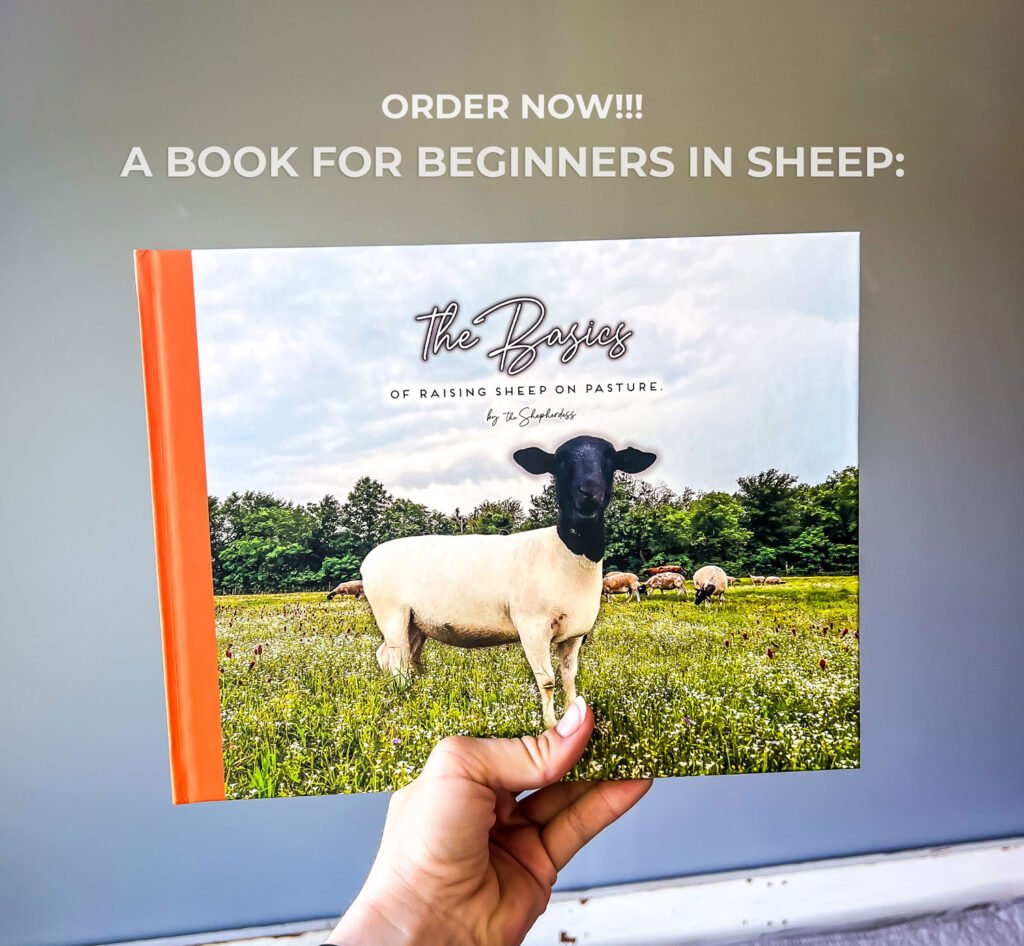
If you’re a beginner shepherd on 30 acres or less, then I wrote a book for you. The Basics of Raising Sheep on Pasture, available at shepherdess.com with free shipping. Raising sheep on pasture requires a basic understanding of pasture management, breeding and lambing, and mitigation methods for common disease. I walk the beginner shepherd through each aspect, sharing through this book vivid pictures. Easy to follow instructions. And personalized stories from my own journey with sheep. Available with free shipping at shepardist.com. You’ll find a direct link in the description.
All right, like I cited, my sheep are Dorper sheep. This is probably one of the most marketable breeds in the country right now. They are hair sheep and not wool sheep. So I don’t have a lot of the shearing maintenance. Basically, their coat falls off come spring and it’s more of a coat like a goat. An additional benefit of raising Dorper Sheep for me is that a lot of the sheepy flavor that people will complain about, and complain about not liking sheep for, is as a result of the oils in a sheep’s wool. So basically my sheep have a better flavor. This breed of sheep—a hair sheep—has a better flavor, more characteristically beef-like flavor, than a lot of your more standard sheep. It makes the meat a little bit more marketable, a little more palatable for the American consumer. I mentioned my rotational grazing program—and again, this isn’t really what the webinar is about, but essentially, if you’re going to get into sheep farming, shepherding, to any extent, I highly encourage rotational grazing. And this just involves using electric fencing to break up your larger pastures into smaller paddocks. So basically what I will do is I will use electric fencing to subdivide my pastures into small paddocks, and I’ll move my sheep at minimum, twice per week. This breaks up the parasite cycle, results in healthier land, healthier sheep, and really mitigates a lot of the health problems that most shepherds will complain about within their flocks. I do not have those, thankfully, within my own flock.
Rotational grazing is the crown jewel of my operation overall. You can kind of see here on the left side is the flock when we bought it, and the pasture when we bought it. There would be spots that were overgrazed, spots that were undergrazed, the flock was suffering with a lot of parasite problems due to the set-stock situation. And there on the right is sort of a revised version in 2024. The health of the flock being improved primarily by the rotational grazing, and really the inputs that shepherding on whole does provide for them. As I mentioned, my background is in digital marketing. And so when I jumped into farming, I did so with sort of a well-rounded business plan. It wasn’t perfectly finished, but I knew that I wanted to go into it to make it a profitable situation. And I came from a background in retail apparel. And the marketing that you do there—it is a very competitive world, and a very competitive market. And so, I shoved all that I knew from marketing in that world into farming—into promoting my sheep, and even into creating a lot of the resources that you guys see on the front end for beginner farmers. And I was able to use a lot of my previous experience in marketing to do that, and really paved the way for a lot of people coming in. And I did this, and sort of my business model evolved as a result of me going into sheep farming and not having a lot of resources at hand for sheep. A lot of the regenerative resources out there available are for raising beef cattle. And I realized just intuitively in reading a lot of those resources, I was like, “This would work for sheep as well.” But I had to adapt, I had to amend, and I really had to experiment a lot in adapting a lot of the regenerative information that was out there for the beef cattle to be compatible with sheep.
Making sheep farming profitable
All right. I’m going to go ahead and start out tonight with what I’m glad I did know, okay? The list is fairly short in terms of things I’m glad I knew going into sheep farming because like I said, I went in knowing not very much at all. But one of the best pieces of advice that I was given… This advice came to me not only from my dad who is not a farmer, but he understands building businesses and giving good advice. He wasn’t really a huge fan of me being a farmer, if I’m honest. He didn’t really see it as a good fit for me in life, but he said, “Okay, if you’re going to do this, make sure you start with the best quality you can afford when it comes to animals.” This was reiterated to me by my friend and rancher, Karl Ebel. He said, “Grace, I started in, and what I wanted to do—I just wanted to get into cows. And I bought lesser quality than I would have liked to ultimately build my entire herd out of.” He said, “If I could have gone back, I’d buy fewer animals at higher quality rather than more animals at lower quality, because it would have put me ahead several, several years.” So this is a piece of advice that I’m so, so grateful that I latched onto early. And that advice is: start with the best quality animals that you can afford, even if you can only afford two of them. Especially when you’re talking about sheep that reproduce so fast. Buy the best quality that you can afford.
Things that I am glad that I knew starting off were that I went into farming for it to be a profitable situation for myself. And I am so glad that I started building an audience early. So basically the moment I started farming, I started also building an audience to buy my farm products. Basically the minute that those animals landed on my pasture, I had started building my audience as well. And by the time that my first lambs were ready for sale, I had about 1,500 people on that email list. And I’ve had a really long waitlist for my lambs ever since I first started. Now, in that first year, it was a little bit harder to get going, a little bit harder to give that momentum, but the momentum started rolling. I have probably had a waitlist that’s outpaced my supply by at least two or three times every time I go to sell my lambs. So keep that in mind: start building your audience early, use that resource that I provided for you, and go for it.
All right, I think this is thing number three that I’m so glad that I latched onto and knew early on in the game. But this is a concept called product sacking and diversification. And it involves knowing your customer group very well, and developing multiple products that will appeal to that one customer group. And what this does is this increases the value of each customer, rather than you having to go out and increase the size of your customer base. But essentially, what you’re doing—if you’re trying to go into farming or homesteading and make a little bit of a side hustle, make a bit of money off of it—is you want to think about the concept: if you want to make $100,000, let’s say, per year farming, then you want to think about how you can get one customer to spend $1,000 with you over the course of a year. And then you’ll only need 100 customers. I mean, think about that. If you can sell one customer $1,000 worth of product over the course of one year, you only need 100 customers to make $100,000 dollars a year. And that is where product stacking and diversification come in, and that’s something that I really started brainstorming early on. Of course, I knew I wanted to sell sheep. Of course I knew I wanted market farm products, but my wheels were turning. I knew that I could sell resources. I knew that I could sell merch. I knew that I could sell a variety of products, so long as I kept my mind focused on making sure that each of those new products I developed would appeal to that one singular customer base. And that’s something that I latched onto early on because I knew I wanted to be profitable as a farmer.
This is the number four thing that I am exceptionally glad that I kept in mind early on: and that is, keep records. No matter how simple your records are, keep them. I love this planner. I’m not an affiliate, and unfortunately I’m not making a lot of money… Actually, I’m not making any money off of these, but I’ve plugged this like four times. This is an at-a-glance monthly planner. I’ve already bought one for 2026 to get my planning process ready for that. But basically, what you see on screen here, it’s got large spots for each day, and I’ll just keep simple records. If something happened in my flock, if something died, if something was born, if something unexpected happened, if something good happened, I just take a simple pen, and I’ll write it down in each of those day to day. And that’s a good way of just keeping simple records because typically if you’re out on pasture and you’re like, “Oh, I’ll remember that later,” no, you probably won’t remember it later, but you’ll probably need to remember it. So jot it down in whatever way that you can. I like to spend a little time with my coffee in the morning and my planner, writing down and keeping simple records, and I love to review them. It’s a very, very helpful tool for review as a farmer and managing your homestead, managing your business, whatever.
Beginner mistakes to avoid with sheep
All right, now we’re going to roll into the things that I wish I would have known five years ago when I jumped into farming. And number one, this is something that is a misconception—in that people think sheep are easier because they’re smaller. Sheep are not easier because they are smaller. We initially bought sheep for our farm, thinking the size equates to ease, and that is just something that’s not at all true. Sheep are a higher-maintenance animal. And if you’re looking for a simple, low-maintenance meat source and you have the land for it, I’m going to tell you right now: stocker cattle are a much lower-maintenance option for meat than a breeding group of sheep. Now, I love sheep, I love raising them, I love all that I’m learning from them, I love them as an animal, but I do not raise sheep because they are the easiest thing to raise. I raise sheep because I love them. And so, if you are looking for an easy way to provide meat for your family, sheep may not be your ticket. Stocker cattle are a much lower-maintenance option for meat than breeding sheep. One thing I do want to mention here, though, is if you have a lot of small children and you are raising them in a family context, the size is actually going to be to your advantage, because what I do is I have a couple of little sisters and they were 8 and 11 when we very first started raising sheep. And really, we had no hesitation bringing them into the pens and involving them in that working process because the animals were much smaller, whereas if we were working them with larger cattle, that would just be something that is not at all feasible. But keep that in mind, the size is an advantage in the context of family and potentially being trampled by them. aBut in terms of ease, sheep are not easier because they are smaller.
Sheep health, minerals, and deworming
All right, barber’s pole worm and cocci require two different types of treatment. This is what I wish we would have known as beginners with sheep. But essentially, in our early years, we did have to deal quite a lot with two different types of parasite-like worms—one being the barber’s pole worm and the other being coccidia. Now, unfortunately, we did not know that there was a difference between the two, and so we just treated everything as though it was the barber’s pole worm, and coccidiosis really got the upper hand in our first couple of seasons, simply because we did not know how to treat it appropriately. But, essentially, you’ll want to check for barber’s pole worm through anemia, and coccidiosis results in things that are like stunted growth, potbellies, and the severe diarrhea. In our early years, we had no clue that there were two different types of treatments. Now I will treat with a dewormer for the barber’s pole worm—something like Prohibit. And then for the Coccidiosis, I will treat with a toltrazuril. And this is an off-label product, not intended for human or animal consumption, but it is a product they use in Canada for this coccidosis, and it works fantastically for me. And when my animals get overtaken with it, I’ll just give them a pop and be done with it.
All right, things I wish I would have known five years ago—can’t remember what number this is—but basically, as I alluded to early on, if you’re getting into sheep, you need to prioritize some sort of grazing rotation immediately. Even rotating just once a week is going to minimize big problems in a significant way. In fact, when we started to rotationally graze our sheep, basically every problem we experienced was either eliminated or mitigated by a significant amount. Number one, the worm problems obviously went way down. Number two, the hoof problems went way down, or just completely were eliminated because they were no longer walking over, you know, mud pits and dirty areas. The third thing was body condition improved because the sheep were constantly being pushed to eat more and more, and that grazing rotation pushed them to do that. So prioritize your rotation immediately. It doesn’t have to be a crazy Joel Salatin once- or twice-a-day thing. Those are great, and those have a great amount of advantages, but when it comes to sheep, even rotating just once a week is going to minimize your worm problems significantly.
One thing I wish I would have known is: watering systems can be very, very simple, especially when it comes to sheep. Now, when you’re talking about sheep, they do not drink a lot of water. So, in the spring flush and when the weather is cool and the grass is at that juicy state, they will barely touch the water trough. They do not hardly need any water at that point in time. In the heat of summer, they’ll drink about a gallon per day, but I’d say roughly a third to a half of a gallon per day is what a sheep is going to drink. And so that leaves you with a lot of flexibility, especially with a small flock, in terms of how you get water to those various grazing paddocks. A lot of people are stunted in their ability to rotational graze because it hinges on setting up a big and complex watering system when you’re talking about cattle. But when it comes to sheep, you can get that grazing rotation going, and you can take a couple five-gallon buckets out there for a small flock, and that is all that they need. In fact, that’s all that I did in the early days. And now that my flock has gotten bigger, I have bought large 250-foot lengths of polyethylene tubing, which if you google search polyethylene tubing, what I like to do is I like to buy the 250-foot length with the simple hose and spigot attachments. And for under $100, I can get that water anywhere across my pasture. But when I first started, it was just a simple roller cart with a couple of five-gallon buckets on it, and that was all that I needed to launch my watering systems.
All right, I think I wish I would have known when I first started—and I really wish I would have known this—but basically, selenium deficiency will cause more problems in your sheep than you can keep up with. Let me say that again because it’s that important: selenium deficiency will cause problems in your sheep than can keep you up with. Symptoms of it include the extreme, like white muscle disease—your lambs are going to grow very slowly. Eventually, I had lambs that grew so slowly, and then they developed these tremors. And if you let the tremors go, they will eventually have a heart attack, and die of white muscle diseases. That’s an extreme. Other symptoms being things like your lambs will be born and they can’t stand. Your lambs will be born, and will have things like curvature of the spine, be very, very slow to get up and nurse. You will have things like retained placenta in your ewes at lambing. You will have things like stalled labor in your ewes at lambing. I’m saying all of these things from experience, because this is exactly what I experienced in my first year of sheep farming as a result of a significant selenium deficiency. And what had happened was that I was just buying a general mineral from the local farm store, and that was, yes, better than nothing, but I turned the package over and there was about 10 ppm of selenium in that general loose mineral from the farm store. Again, better than nothing, but when you have sheep, you want to aim for at least 40 to 60 ppm of selenium in your loose mineral. Otherwise, you’re going to have a lot of problems. I love the Redmond sheep mineral, and I sell that at Shepherdess.com. You can purchase it there to support my work.
All right. This is controversial, but this is something I wish I would have known as a beginner: sheep need copper. Now, yes, copper toxicity is a thing. Too much can kill your sheep. But I got to a place in my flock where my sheep were just suffering with chronic anemia. I had always attributed that anemia to the barber’s pole worm—to the fact that I just live in a really bad area for worms. And so I was just constantly drenching them, like fighting the battle against anemia with chemical drenches. One year—and I don’t know if I heard this from maybe another sheep farmer or not—but essentially, I heard from someone that copper deficiency leads to anemia. And a light bulb went off in my head because I was fighting this battle against anemia every single year in my sheep. And yes, I do believe that the parasites contributed to it, but I also believe that my flock was exceptionally copper deficient. So what I did was I sidelined a test group of 10 ewes, and I gave them all a copper oxide wire particle bolus. These are available at Shepherdess.com, but basically they’re like a pill that you’ll shove down your animal’s throat. You will administer this to the animal as a copper supplement. I did this with that test group of 10 ewes, thinking, “Okay, if they all die, it’ll be a hit, but I can take the loss of 10 rather than the loss of my whole flock.” Not only did those sheep not die after receiving that copper oxide wire particle bolus, but they fought parasites, and they fought anemia way, way better than the rest of my flock that whole year.
The next year, I gave every single one of my sheep in my flock a copper bolus, and I’ve been doing so every single year since. I think I’m in my third year now of giving a copper bolus to every single adult sheep in my flock at the onset of parasite season. And guys, I got to tell you the difference this has made has been incredible. So do your own research. Copper is risky, but maybe do like I did: start with a little test group. See if it makes an improvement. If you’re having chronic issues with anemia, do that. I just had a lamb the other day who was really struggling with that bottle jaw—which is extreme anemia. And I had drenched it because it did need a dewormer. Just was not improving at all. And I went ahead and gave that lamb one of these copper boluses, and its parasite symptoms cleared up pretty much right away. So I think it was dealing with some copper deficiency in addition to this parasite. So, anti-parasitic sheep need copper. Long story short, test it out yourself, whether you add maybe a little bit of copper sulfate. Some people will mix a little bit of copper sulfite into their sheep mineral. That’s a good idea as well. Some people will offer copper sulfate free choice alongside the regular mineral. That’s a good idea as well. For me, I just prefer to force feed my animals one time per year, and make sure that they’re actually getting it. And I do that every year in April. I have to give my goats two or three of these every year. Goats need a lot more than sheep. I just give my sheep one. But there we go. There’s my controversial opinion for the night, but you will thank me. I believe you will thank me.
All right. So, this is something I definitely wish we would have known as beginner shepherds. And again, there are going to be people in here with a varying degree of opinions about deworming or not deworming. I do deworm when my sheep need it. They need it less and less, thankfully, year after year, as I implement little things like copper and proper minerals. But one thing you need to know if you’re raising sheep and you’re using these conventional drenches, is that underdosing is deadly. And this may seem strange, but let this ring in your mind: underdosing is deadly. Let me see if I’ve got the Clemson University dewormer chart. This is a university study that gives you proper dosage rates, but essentially you want to at least double the package dose when you go to deworm your animals. And if you do not, your animals will have half of the worms inside of them killed. The strongest worms will live, continue to suck the life out of them, and infect your pasture with highly resistant parasites, leaving your flock entirely resistant to all chemical options on the market. While that’s going to happen at some point anyways, in animal husbandry, best practice is to not underdose so that you have a longer time period before that happens.
But essentially, as a story from our personal experience, we got our flock, we went to deworm them for the first time, and we used the package rate to deworm. And we were just noticing sheep were still dying of worms. They were still dying of worms even though we were deworming them, deworming them, and deworming them. We called a local rancher friend and we said, “What’s up? We are deworming our sheep, but they’re still dropping dead of worms left and right.” He said, “Well, what is your dosage rate?” And we said, “Well, we’re just following the package instructions.” And he said, “You need to double the package instructions. Double the package rate if you are deworming animals that are severely infected.” The package rate is a maintenance rate. Essentially, that’s something you give just to keep your animals in good condition. But if you’ve got severely infected animals, you need to double the dosage rate for treatment. And that’s what that Clemson University dewormer chart is going to reflect: proper dosage rates. So keep that in mind, because this actually cost us—shame to say—probably this cost us about half of our original flock, which thankfully at that time, I think it was like… Well, that actually sounds awful. I think we lost about 15 sheep because of this poor practice, this underdosing. And I say that doesn’t sound like a lot. My flock is a little bit larger now. Losing 15 sheep would be really, really bad. But basically, it was half our flock when we started. So yeah, it’s that bad. Don’t let our mistake become yours.
This is something I wish we would have known when we first started, and that is: when you go to work your sheep, confine them to as small a pen as possible. When you are working sheep, you want to pack them tight like sardines. Do not try to work your sheep, or catch them to administer any treatment in a large open pen, because you will essentially start chasing. And when it comes to sheep or goats, when the chase has begun, when their fight or flight is triggered, and you have a large, open space, it’s going to make for an exceptionally long day of trying to catch those animals to treat them. And while this may sound absolutely basic, we had no clue. We were first timers in raising animals, and basically we needed to deworm them one day. So we took them to this big 18-by-20-foot pen. It was 20, 25 sheep at that point in time, and we just chased them around the pen until we caught them and we administered their dewormer—whatever treatments they needed. Now, when I’m working sheep or goats at any level, I will pack them into a pen as tightly as I possibly can before trying to catch them at all. And I like to use these Lakeland Farm and Ranch aluminum panels. These are fantastic. I can basically make a pen as large or as small as I need to. I would highly advise you buying a set of these aluminum panels as a sheep farmer. But if you can’t, just at least makeshift with some hog panel. Get your space as tight as you possibly can for working your sheep, and it’s going to be a much, much easier day for you. You will thank me later. But when you get your sheep into a pen and you find yourself chasing them, remember: get some hog panels and pack them as tight as you can before you start the working process.
All right, this is something also that I wish I would have known as a beginner shepherd, and that is: when you are looking at the body condition of your animal or trying to monitor them for condition or health overall, you want to score according to the rear end and not the belly. Their belly is never a good or bad indication of health. A sheep’s belly is going to probably always be big. And sometimes when they’re sick, it’s especially enlarged. But if you’re looking for an animal and you’re trying to make sure that it’s getting enough to eat or maintaining a good condition, then you want to look at the rear end. You want to make sure you see a fleshy back end in order to be an indicator of health in that animal. If you have something where the bones are sticking out, where it’s like a sharp, bony backside, that sheep has problems. It’s either sick and it can’t put weight on, or you’re not feeding it enough, and you need to get it some good supplement and back into condition. But remember that the rear, not the belly, is an indication of health. And never go out and look at your sheep with a massive belly and say, “That’s a healthy sheep.” You need to look at its rear end, make sure it’s fleshed out there. That is an indicator that it’s getting enough to eat and that it has some vitality and condition under it.
Rotational grazing and pasture management
All right, this is funny, and this actually has some context to it. But basically, one thing I wish I would have known—especially when I first started rotational grazing—was that your sheep will not starve to death overnight. So the story behind this is that I got into rotational grazing and I was so concerned about my paddock sizes. I didn’t really know where to start. I did put a formula here in The Basics of Raising Sheep on Pasture for calculating paddock sizes to help you get past this particular phobia. But essentially, when I first started rotational grazing, I had no idea how to size my paddocks for sheep. And what I ended up doing, and what I tell people to do now, is that if you’re totally lost, just put them in something. If it’s too big, there’ll be leftovers tomorrow. If it is too small, do not worry. Your sheep won’t starve to death overnight. But basically, when I first started rotational grazing my sheep, I would be up at night with this fear that I had paddocked my sheep into too tight of a space, they had not gotten enough to eat that day, and I was going to wake up to a pack full of dead sheep that had starved to death. And it sounds really, really funny now because it probably takes at least five to seven days for a sheep to starve to death, but I was for certain that I was going to wake up the next day and have dead sheep that had starved to death overnight because I’d made the days paddock before too small. But just remember your sheep will not starve to death overnight. If you’ve made it a little bit too small the night before, they’re going to have eaten it down into the ground very, very deep, and you’ll know that you just need to make it a little bit bigger the next day. So, if I can alleviate anybody’s anxieties there, I hope that I can.
All right. The thing I wish I would have known is: weeds are okay. Now, at my farm, if weeds overtake my pasture more than 20%, let’s say, I will mow mid-season to beat those weeds back. But a lot of the weeds that people will spray for in my area—that people would put herbicides on and try to eradicate from their pasture… Well, what I did one day was I just bent over and took a closer look. I realized that those weeds that people were spraying with chemicals and toxins to remove from their pastures were actually some of the most robust habitats for pollinators, like the ladybugs that you see here. If you guys can even see the milkweed on this side of the screen, that has some type of beetle—I can’t really identify it—but that milkweed is also a favorite of butterflies and a lot of, like I said, the pollinators. So you need to rethink weeds. What I did at the beginning was I knew I wasn’t going to use chemicals on my pasture, but I would spend my evenings pulling the weeds that I disliked on my pasture, and wasting a lot of time doing it.
But now, I understand that weeds are okay. If they overtake my pasture beyond a 20% extent, or they’re edging into the feed that I need for my sheep, I will mow mid-season, reset the pasture, beat those weeds back a little bit, but otherwise I’m just grateful for the habitat that they provide for the pollinators that we do need. Fun fact, people used to kill milkweed because it’s toxic to cows. Sheep and goats handle them better, but cows struggled with it back in the day. The neat thing is I put my sheep onto a paddock, and they will go and they’ll eat that milkweed first. It’s really neat. It’s like candy to them. I don’t know if that’s every sheep or just mine, but I have barely any milkweed on my pasture any longer. I do wish they would eat this goat weed because I still have not found anything that will eat that woolly croton, but like I said, lots of dragonflies living in that, and ladybugs like you see here. I’m just like, “Okay, it’s doing its thing.”.
The thing I wish I would have known at the beginning is: wasting hay is 100% okay when it’s wasted on pasture. I would post pictures on social media of my hay without a hay holder or a hay rack. I’d post pictures of my hay that I had basically put on pasture—square bales with no hay ring, bale net—and people would criticize me and be like, “You’re wasting so much hay! Go get yourself a bale net, go get yourself a hay ring.” But essentially, every ounce of hay waste that went out on pasture seeded and fertilized spring pasture for the next year. And I really don’t have any problems with wasting hay so long as I’m wasting it on the pasture. If you see here on the left side, this is basically where I fed and how I fed the hay. And on the right side, it took a totally infertile piece of pasture, and what you see growing here is a crabgrass, which is one of the most nutrient-dense, highest protein sources of grass for sheep and cattle. And that stuff popped up like crazy in that same area where I fed the hay without a hay ring or a bale net the year before. So wasting hay is okay when it’s wasted on pasture. Do not let conventional ranchers come by and discourage you over the fact that you do not have a hay ring.
All right. This is something that’s really important to know. And this is something I tried to start out with—I tried to start out doing it all alone, thinking I could be my own woman and a one-woman show. But you can’t do it alone. And one day, I was having a massive day of burnout realizing that I could not do it alone, and my sister Ruth, who is the “chicken lady” on the channel, she came to me and she said, “Grace, I want you to know that I will be your backup whenever you need help.” She said, “Joel Salatin said this and you need to know it.” She said, “You cannot farm alone. So if you need anything, if you need help, I’m here for you.” And just knowing that there would be somebody that would fill that role was a mental boost as much as anything. But whether you just have someone that you can unload on mentally or emotionally when it gets really hard, whether you have someone who’s willing to come and give you a day’s worth of help, whether you have someone who can work alongside you every single day, the reality is that you can’t do it alone. If nothing else, mentally and emotionally, you can’t do it alone. So have somebody you can call. Have somebody that will be willing to come to your farm for a day to be a backup when you do need that help. And thank you, Chicken Lady, for meeting me in my hour of distress—and basically every hour of distress since then.
All right. The thing I wish I would have known when I first started is: lamb first and rotate later. So basically, when I first started my farm, I tried to coordinate the launch of my grazing rotation alongside lambing. And now, I have moved my lambing back one month to where I lamb out, and I get all of that done mostly in a single paddock. So, I’ll leave them in a single paddock for about a month while they lamb out, and then I will start my grazing rotation. It’s a lot easier to do it this way. It’s not impossible to manage a grazing rotation and new lambs, but it is very, very difficult. And so I found that lambing first and then launching my spring grazing rotation works really well. So, I will lamb in February, and then launch my grazing rotation in March, and that is a much easier situation.
All right. We are down to our last three. What I wish I would have known upfront is: you don’t need to plant pasture for sheep. If anything, just hand-broadcast some seeds. And what you see here is just natural pasture. And on top of it, I hand-broadcasted some clover. And those were seeds that I could just put on the ground, let the animals trample them in, and they kind of self-planted. I didn’t need any tillage—didn’t need anything at all. But essentially, when you have sheep, they are a great animal that will basically make a meal out of whatever green is on the ground. And if you’re running a really good grazing rotation year after year, those sheep are going to improve your pasture, guys—and you’re going to see new varieties and new levels of fertility in your land just through that grazing rotation. So my thing is that even before you hand-broadcast those seeds, try to get into a good grazing rotation for a minimum of one year and track what that good rotation will do for pasture improvement.
Another thing I wish I would have known is: give your lambs some transition time after weaning. So when I first started, I did a pasture-based weaning. What I would do is I would wean the lambs off of their moms and I would run those lambs in a separate grazing rotation. Number one, that was a lot of work—that was difficult to maintain. But number two, the lambs were very stressed from being removed from their mom, and at the time I was weaning them, the forage quality on pasture had dipped. And so that stress, plus the dip in the quality of their feed, really didn’t produce a very good weaning situation. What I do now, which produces fantastic results, is I have a weaning pen. It’s a spacious pen that’s very clean, and in that pen, I will leave those freshly weaned lambs for about two weeks. And they will eat a really pure, fresh alfalfa hay—which is very nutrient-dense, very high quality, very high protein—and they’ll eat that for about two weeks while their moms dry off. And then once their moms are dried off, I’ll just return those weaned lambs to the regular grazing rotation. Don’t have to manage two groups, these lambs are looking fantastic because they move from their mom’s milk straight onto a really high-protein feed. It’s a little bit of a feed input, but it’s a really, really great way to work my system. And then once they’re all weaned, the moms are dried off, they can go rejoin their moms. They remember who their moms are. It is so neat to see them all sleeping in a group together, and those big, fat weaned lambs are still right next to their mom. So they don’t have that stress of separation for the long term, and it’s a much easier workload for me. So it takes about two weeks in the weaning pen, and then I put them back out to pasture with the main group.
All right. Learn to tube feed, all right? And whenever you have a lamb or something that you suspect is hungry at lambing, tube it some colostrum, okay? When in doubt, supplement. You’ve got to get a lot of colostrum in those animals. The more, the better in those baby animals very early on. Nine times out of 10, my ewes do it themselves. They’ve got big, full udders, plenty of colostrum, but if at any point in time I am suspicious that that maybe first-time ewe did not supply her lamb with enough colostrum—maybe it was a twin and that twin looks like the other one hogged all the colostom—I will just in a split second, get my tube out, get it some colostrum supplement. Because to supplement is better than to not supplement if you’re ever in question, especially when it comes to colostrum. If you get colostrum in them early, you’re basically setting them up for a lifetime of success. But if they have been in any way shorted in this vital substance at the first of their lives, especially when we’re talking about pasture-based animals who have to have a very hardy immune system—we’re not going to be pampering them their whole life—they’ve got to have this colostrum. They’ve got to have a lot of it. They’ve got to have it early. So learn to tube feed, get them a lot of colostrum if there’s any suspicion that they have shorted as a result of being a multiple, or as a result of just not having enough for some reason or another. Supplement or be sorry.
All right. But the final one is: just take a chill pill, okay? If you’re in your first year of farming, just calm down. And I’m not judging or speaking to anyone in particular here. I’m speaking to myself in my first year farming. But just calm it down because things are going to be okay. And the reality of the situation is that panic never improves a situation. There is always going to be time for a deep breath. The worst case scenario may sometimes happen, okay? But that doesn’t mean it’s game over. That doesn’t mean your story is over. It just means you had a difficult experience, and there’s going to be a next step. You’re going to be able to keep moving forward in some way or another. And that’s a testimony from me. I had a lot of really difficult experiences in my first year of farming. A lot of worst case scenarios happened in my first year of farming. But looking back, my panic, my fear, and my anxiety, never did anything to make things better. Okay? If anything, they stressed out the people around me, and made it difficult for me to keep moving forward. So as a reminder, sometimes the worst case scenario will happen, but it doesn’t mean your job is over. It doesn’t mean your purpose has been squelched. It does not mean you are a failure. It’s what do you do when that worst case scenario does happen? Do you let it make you quit or do you move on, and move forward to what is ahead for you?
Answering common shepherding questions
Okay, guys, I’m going to get some questions answered tonight before we close out. Ruth asks, “Any issues with electric fences and/or electric netting in the winter with ice, snow, or etc.?” I don’t have a lot of snow here. I have not used electric netting in the ice either. I do not have a lot of experience with electric netting. If I’m honest, I have my sheep on two strands of polytape. I will use the electric netting for my goats or in times of emergency, but I’ve not used them enough in the snow and ice to have feedback. The second question is, “Does the off-label use of toltrazuril have to be a withholding time for processing?” Yes, it’s 71 days, which is very, very long. Even though it’s not for human or animal consumption, the company I buy from cites a 70-day withdrawal period, which is exceptionally long. I don’t even know where they get that, but I obey it, because when I’m giving my sheep that treatment for coccidiosis, it is typically when they’re six weeks old. They’re not slaughtered until they’re like anywhere from 6 to 12 months old. So when I slaughter them, they are well outside of that withdrawal period of 70 days.
Another question here is from Ruth as well: “Have you tested your soil to see what copper levels are on your pasture?” No, that’s a very good idea. I considered it, but I’ve never done any soil testing in terms of minerals in my soil. That being because, you know—number one—I just have never needed to. My grass has always been good. But number two, I find soil testing kind of difficult because I have areas of pasture that are just way better than others. And it’s difficult; unless I did like a total cross-section of my pasture, which would involve maybe 10 tests, I would have a difficult time getting a good idea as to what my whole pasture looks like. Cindy: “What creep feed do you use—protein percentage?” Cindy, I don’t use any creep feed. When I do supplement, it’s typically alfalfa. So that’s the hay. I’m pretty much all forage based at my farm with the exception of: I keep a bucket of sheep and goat pellets on hand for anything that’s super sick. And those are just the sheep ones that I buy from Tractor Supply. I’ll keep enough sheep pellets on hand to rattle in a bucket. But other than that, I will just do pasture and then alfalfa hay or alfalfa pellets for any kind of ongoing supplement.
TJ says, “Why do you not cross with Katahdins for hybrid vigor and parasite resistance?” TJ, because my flock has really good parasite resistance now after five years of culling, and being a purebred Dorper that has high parasite resistance brings a premium pricing on the market. So it was well worth it to me to maintain the pure breed, but just cull really hard for resistance. And now I have just this best of both worlds, praise the Lord, in my stock where I have really vigorous animals and really good parasite resistance for the breed. So, that’s why. Glenn says, “What is your process in maximizing your farm?” That’s a pretty broad question, but basically rotational grazing will maximize your pasture usage. So, rotational raising is my process. Nehemiah says, “Do you give the copper bolus only once a year?” Nehemiah, yes. For my sheep, I give the copper bolus only once a year in April. Cale says, “What do your temperatures get down to in the winter there in Texas?” Cale, I’m in northeast Texas, kind of on the border of the Louisiana-Arkansas area. So, I’m a little bit farther north than most people. We get into the 30s in the winter, and we do get some pretty significant ice storms—so 20s and 30s.
Cindy says, “Will your goats eat the goat weed or the nightshade?” Cindy, they’ll nibble at it a little, but they will not graze it down or eat it to any significant extent. I’ve just found them kind of nibbling a little bit. I wish they would. Natalie says, “I have a rental ram coming in a week. My girls are rotated weekly. Should I not rotate them while they are with the ram? I was going to make a large net paddock and separate them into smaller paddocks with tape, but I’m worried about going in with the ram.” Okay, so it depends: if your rental ram is… It should be fine. I would continue to rotate them weekly to be honest. It’s not going to do anything but good. So continue to them weekly if you can. If you run into any problems, go to your backup plan, which is a short-term set stock situation for breeding. But try to keep them rotated weekly. TJ says, “If you have the parasite-resistant Dorper ewes, how do you choose a ram? Do you keep your own in house, or do you just choose a non-related ram and your ewes’ genetic composite?” TJ, I bought a really good-quality, parasite-resistant Dorper ram in 2021. And because I had such a large group of ewes at that point that were unrelated to him, I have not had to replace him yet. The genetic diversity has remained really strong. So what I’ll do is I obviously keep all of the unrelated ewes, all of their ewe lambs; as a result, I can have a massive flock without having to replace that particular ram simply because I brought in that good ram to a large group of unrelated ewes.
Nehemiah says, “Have you ever had to retrain your sheep to the polytape? Mine no longer respect it.” Nehmiah, yes, I have. Now the issue that I typically run into is that the sheep will stop respecting the fence because there’s some kind of compromise in the power. So right now I have a 16-joule Cyclops charger and that will really get them good, and they stay within those two strands. Whenever I have problems, it’s typically there’s a short on the line somewhere, there’s something dragging the power down. So just get your power up. You want something pretty hot for those sheep. I struggled a lot when I had the solar chargers of maybe one or two joules. I struggled to keep my sheep respectful of that until I went and moved up to the 12-joule charger. They really did respect it quite a lot, and they do continue to respect it quite a lot unless they’re super hungry or unless the power has in some way been compromised.
I do have occasionally a troublemaker who just really enjoys being disobedient and stepping outside the line; and if I have deemed that she is just disobedient beyond my management capabilities—meaning that I’ve done everything (I’ve checked my charger, I’ve upped my power, I’ve down everything conventionally)—I don’t hesitate to get rid of her. Now I’m going to give her every effort that I can before doing that, but if she continues to be disrespectful of my rules and my boundaries, and continues to train the rest of the flock to be disrespectful to my rules and my boundaries, I will make note of her, and I will cull her after much grace. But that is also an option. So, Nehemiah, if you note that there is a sheep that is leading the entire flock astray, give her some grace, give her some time to correct herself, but if she refuses, get her out for the good of your flock.
Nehmiah says, “Is this the time of year to use a rental ram?” A lot of people are joining in October and November, so if you’re going to rent a ram, then this would be the time of year for spring lambs to breed. So, yes. Cale says, “What are your heights of the polytape? And do you use Timeless posts?” The heights of my polytape are—I like to think in terms of “too low to sneak under.” So I have one that’s about their nose when they’re grazing so that if they push up against it, they’ll get hit on their nose really hard. And that falls at about 6 to 8 inches above the ground. So it’s too low to sneak under and it hits their nose when they butt up against it. And then the second one I place basically so when a sheep is looking at it, it appears as though it’s too high to easily jump over. So that falls at about 24 inches above the ground. So 6 to 8 inches and 24 inches is about what I aim for with my two strands. But when you’re thinking in terms of being a sheep looking at it, you want it to be too low to sneak under and too high to comfortably jump over.
All right. I think this is going to be the last question that I get. This is Hazel and Hansi in Nebraska. “I’m interested in buying finished meat stock. I’ve retired and have only two acres. I am interested in buying butcher stock, is that in April?” Okay, so if you’re talking about meat wethers, then those are typically available year round. If you’re talking about my stock specifically, I have sold out for the year, and if you want to get on the waitlist for next year’s stock, you can go to Shepherdess.com/newsletter. Thank you for joining me tonight.
Leave a Reply