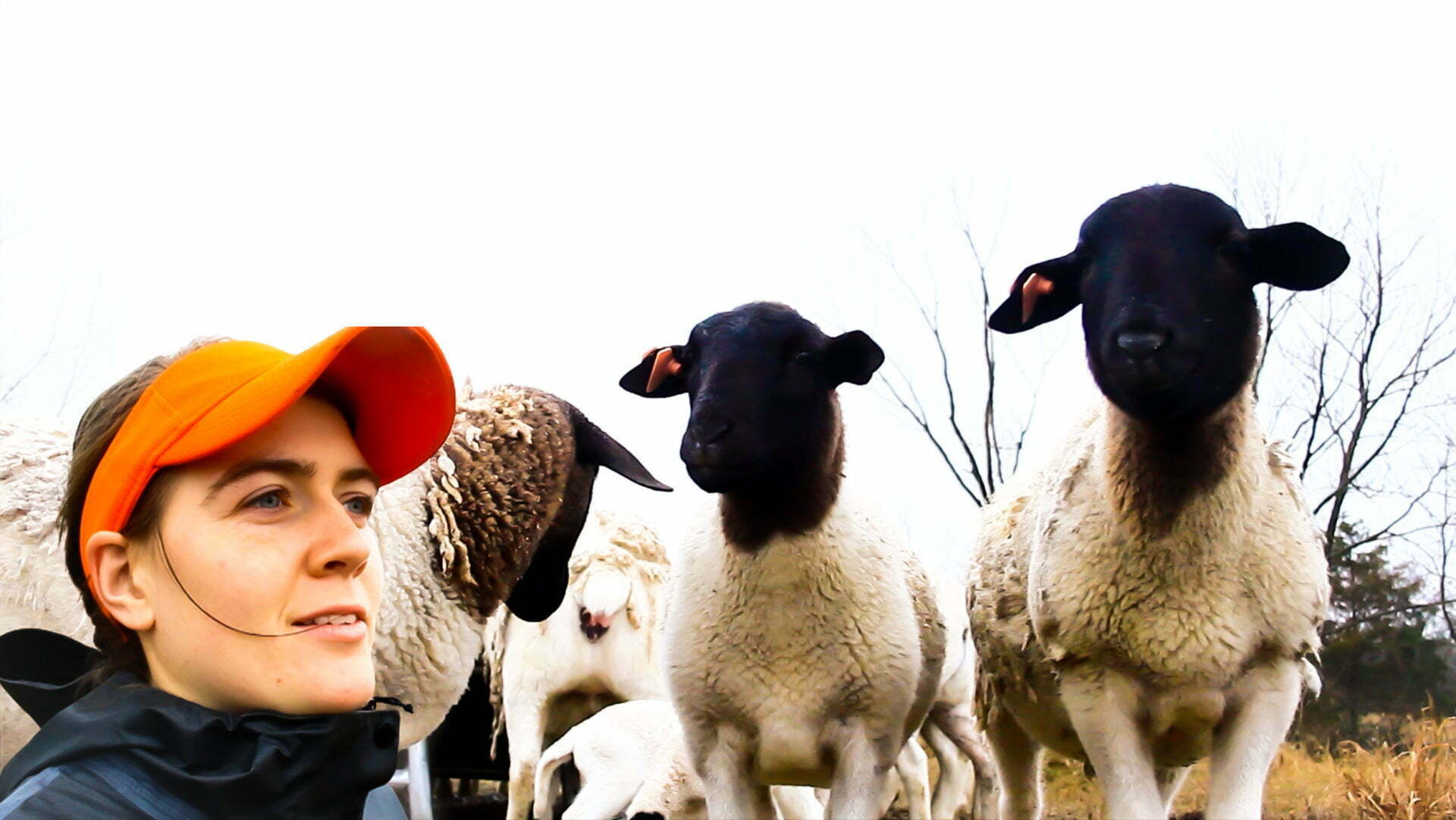
Dorper Sheep Characteristics
Today we are talking about Dorper Sheep Characteristics! For 3 years, Harmony Farms has farmed a small flock of Dorper Sheep in East Texas. The Dorper sheep breed is a result of cross-breeding the Dorset Horn sheep with the Blackhead Persian Sheep. A primary characteristic of Dorper Sheep is their heat tolerance. The Dorper sheep breed is known for producing excellent quality meat in arid climates. Dorper sheep are a self-shedding sheep breed, meaning they do not require any manual shearing. With this post we are going to dive deeper into these Dorper sheep characteristics!
We purchased our small flock of Dorper Sheep 3 years ago. Harmony Farms is located in upper East Texas where rainfall is above national average. This climate is more moderate and balmy than the breed is intended for. For this reason, we must intensive rotational graze our Dorper Sheep during the rainy seasons in order to keep the parasite load down. With intensive rotational grazing management, our flock of Dorper sheep is thriving in East Texas!
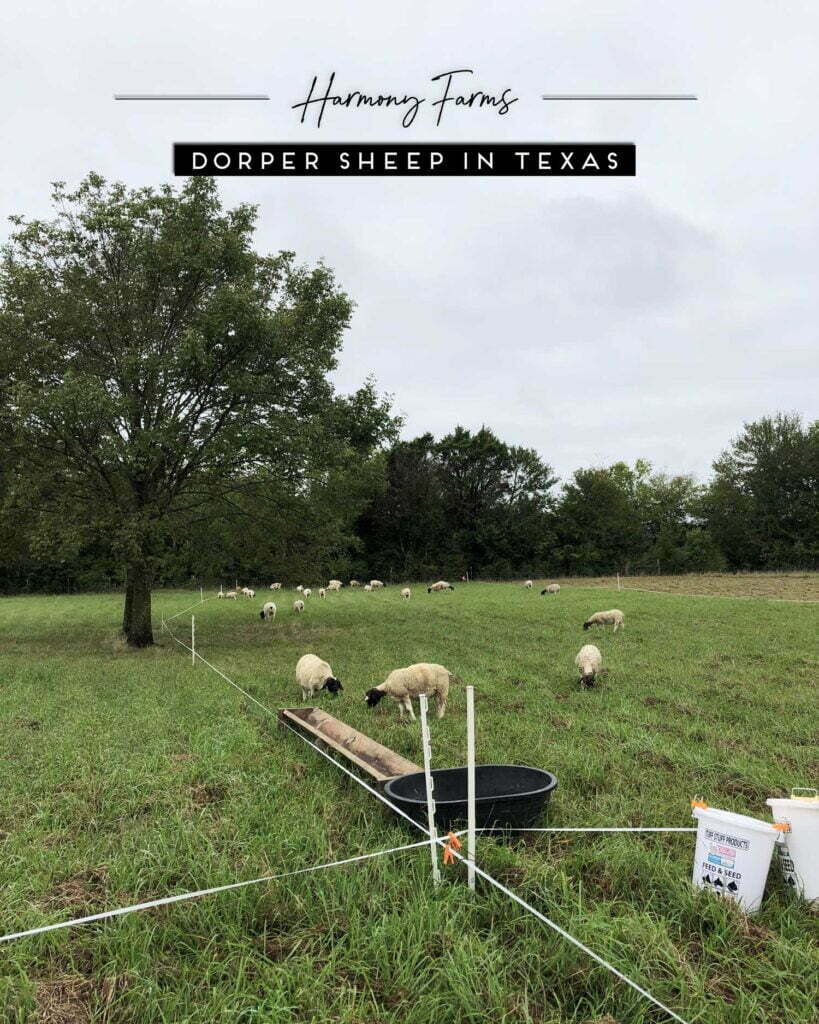
Dorper sheep are a self-shedding, heat tolerant breed:
The Dorper Sheep is a result of cross breeding the Dorset Horn Sheep with the Blackhead Persian Sheep. The Blackhead Persian Sheep is a breed native to the arid regions of Somalia and South Africa. This side of their genetic pool gives the Dorper Sheep their wool-less heat tolerant characteristic.
The Dorset Horn Sheep is the other half of the Dorper’s genetic line and is a breed native to south-west England. The Dorper sheep is typically a polled breed, meaning they do not carry any of the horned characteristics from the Dorset side of their genetics. Dorper sheep do, however, grow a small amount of wool which is shed by the animal in warm seasons.
When shopping for a Dorper sheep you will often see it advertised that the particular animal is an “easy shed”. While Dorper Sheep are characteristically self-shedding, some animals shed better than others, while some retain a layer of wool on their backs. In our flock of 25 Dorper Ewes, we have about 2-4 that are not good at shedding their wool on their own. These ewes retain a bit of wool year round. If you are shopping for Dorper ewes or rams, it is a good idea to ask if they shed all on their own.
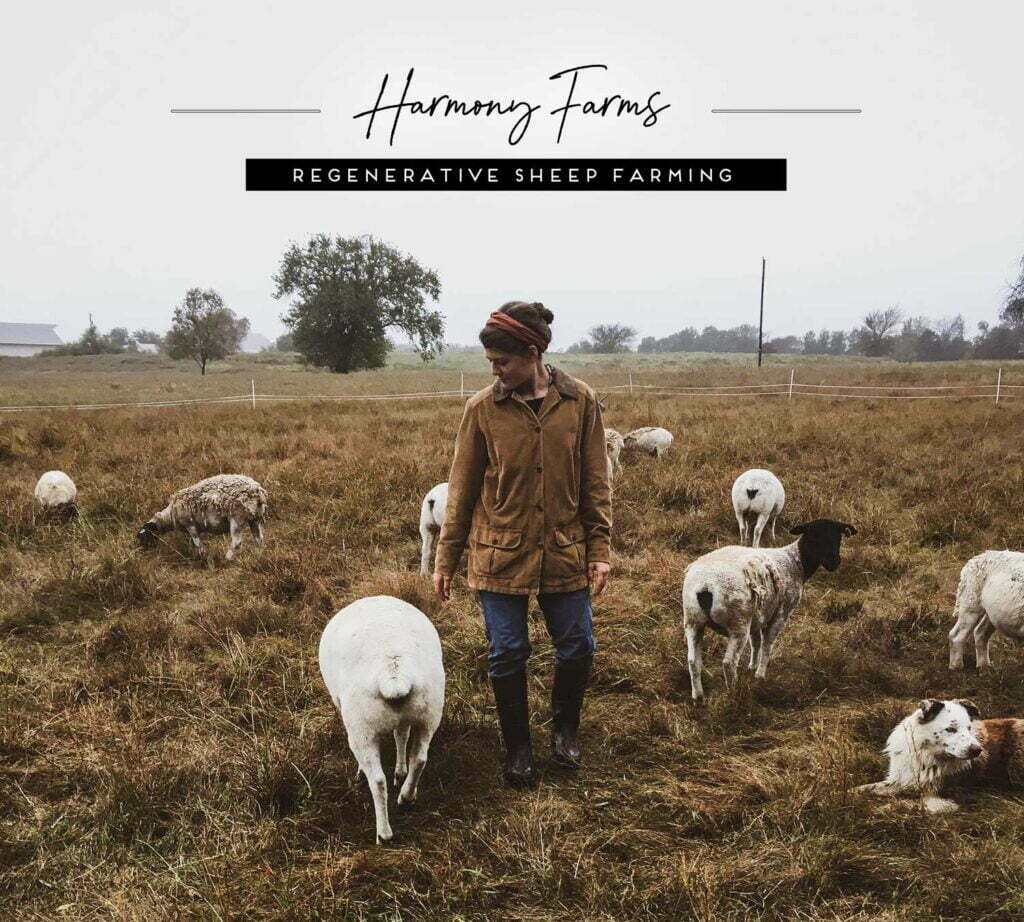
Dorper Sheep thrive in arid climates:
Characteristically, Dorper sheep thrive in hot dry climates. Dorper sheep are able to convert brushy forage (aka: pasture weeds) into excellent quality meat. If you are farming Dorper sheep in humid, wet regions you will need to have a serious parasite management strategy. Since we are farming Dorper sheep in a very wet and humid climate, our strategy involves intensive rotational grazing and the use of conventional dewormers.
Intensive rotational grazing is needful to manage parasites in nonarid climates:
Intensive rotational grazing is our primary contribution to the heath of our Dorper flock. Sheep are characteristically prone to contracting parasites. For this reason, one of your main enemies on a pasture-based system will be managing worms in your flock. With intensive rotational grazing, we move our flock to fresh pasture every 2 days. This moves them away from their manure and on to fresh grass before the parasite’s infectious cycle begins again. By rotational grazing our Dorper Sheep we have seen a significant reduction (but not complete elimination) in the need for chemical dewormers on our sheep farm.
In all, the Dorper sheep breed has a variety of appealing characteristics. They produce amazing meat on sub-par forage. Dorper sheep do not require the back-breaking shearing process that most other sheep breeds do. Dorper sheep are great for arid regions, but with intensive grazing management can also thrive in humid regions. Dorper sheep are also increasing in value, making them a great investment!
-The Shepherdess at Harmony Farms
“The grass withereth, the flower fadeth: but the word of our God shall stand for ever.” Isaiah 40:8
Raising Dorper Sheep in Texas
At Harmony Farms we are raising a flock of pure-bred Dorper Sheep. Harmony Farms is located in East Texas, just outside of Dallas Fort Worth area. We rotational graze our Dorper sheep for the health of both land and animal. Our goal is to produce gourmet grass fed lamb, as well as a superior line of Dorper Breeding stock for other small farms to begin raising their own Dorper sheep in Texas.
Harmony Farms
At Harmony Farms we farm Dorper Sheep right outside of Dallas Fort Worth, Texas. Our small sheep farm is just 30 acres. At this time we run a flock of 25 Dorper ewes and one ram. Our flock lambs every March. We raise our ram lambs for grass fed and finished lamb. Our ewe lambs are added back to our flock to breed out once they have matured.
Pasture Based Dorper Sheep Farming in Texas
Our Dorper sheep farm is located in East Texas. The climate in East Texas allows us to leave our Dorper sheep on pasture year round: spring, summer, fall and winter! We have a small gated corral with a covered shed. We use this structure to perform general maintenance on the flock and administer dewormers. Here in East Texas we receive above national average in both rainfall and sunlight. This provides the perfect climate for raising Dorper Sheep on pasture.
Rotational Grazing Dorper Sheep in Texas
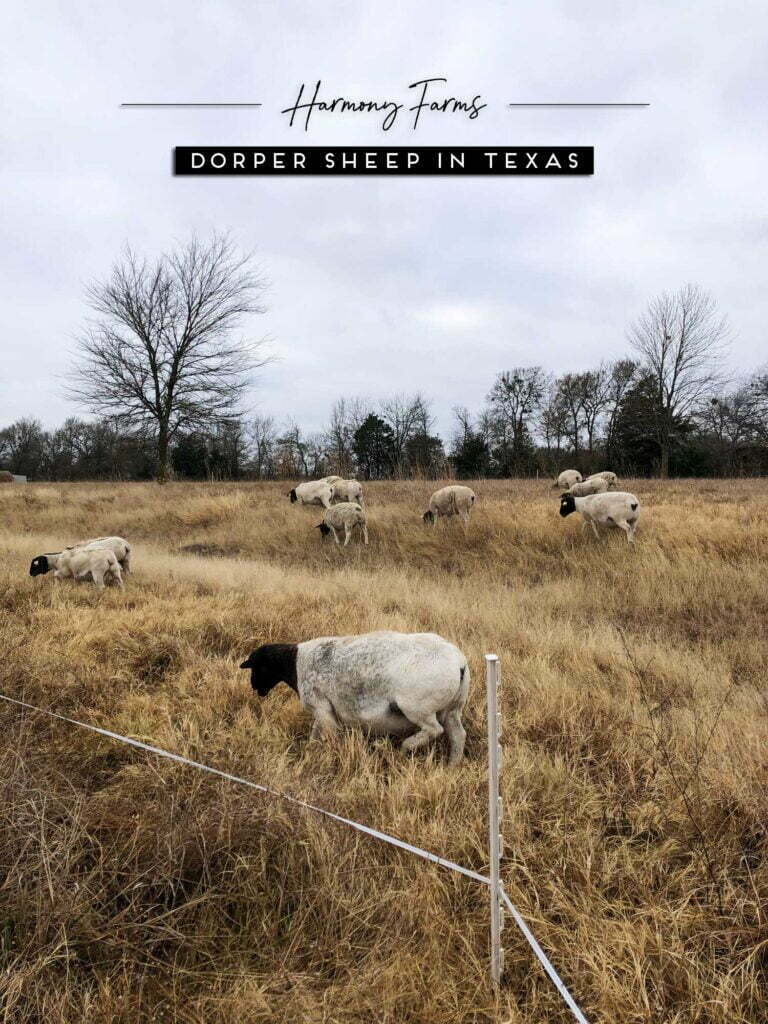
Rotational grazing is a major part of our Dorper Sheep Farming operation. We rotational graze our sheep, moving them to fresh pasture every two days. Rotational grazing is a highly effective way to minimize internal parasites in our sheep. Rotational grazing also benefits our land by providing adequate rest for our grass, and evenly distributing manure for pasture fertilization.
-
 The Art of Natural Cheesemaking by David Asher$40.00
 -
 Pasture Management Starter Set (2 Books)$70.00
 -
 Raising Sheep Book Bundle (3 Books)$107.00
 -
 (E-BOOK) The Basics of Raising Sheep on Pasture$46.95
 -
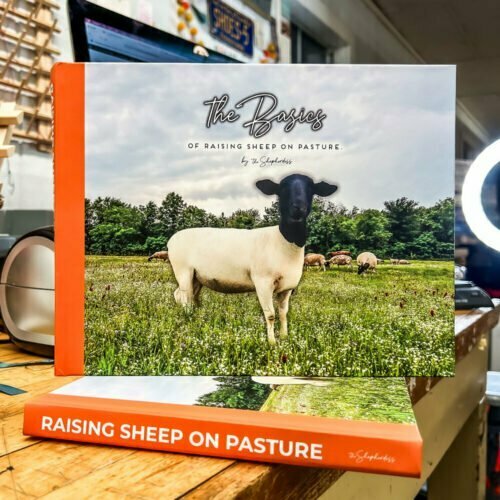 The Basics of Raising Sheep on Pasture$46.95
 -
 The Shepherdess Library Bundle (5 Books)$180.00
 -
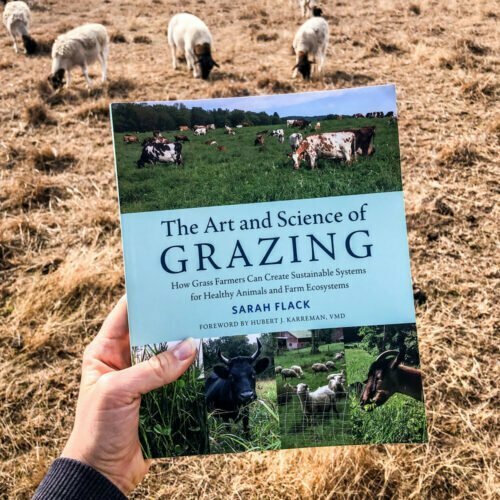 The Art and Science of Grazing Book by Sarah Flack$40.00
 -
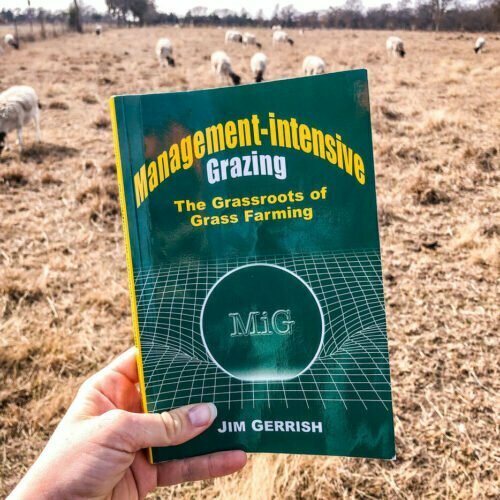 Management Intensive Grazing Book by Jim Gerrish$40.00
 -
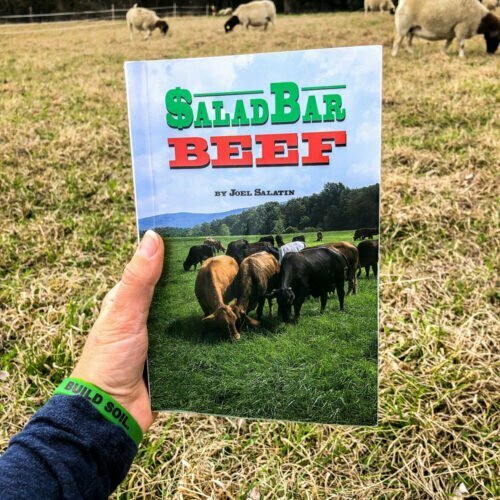 Salad Bar Beef Book by Joel Salatin$35.00
Grass Fed Lamb
At Harmony Farms, our goal is to raise the finest grass fed lamb in Texas. Dorper meat is both tender and flavorful. Lamb is a red meat that provides an excellent source of vitamin B12, B3, zinc, and iron. Being grass fed from start to finish ensure that Harmony Famrs lamb is as healthy as it is delicious.
Dorper Sheep Breeding Stock in Texas
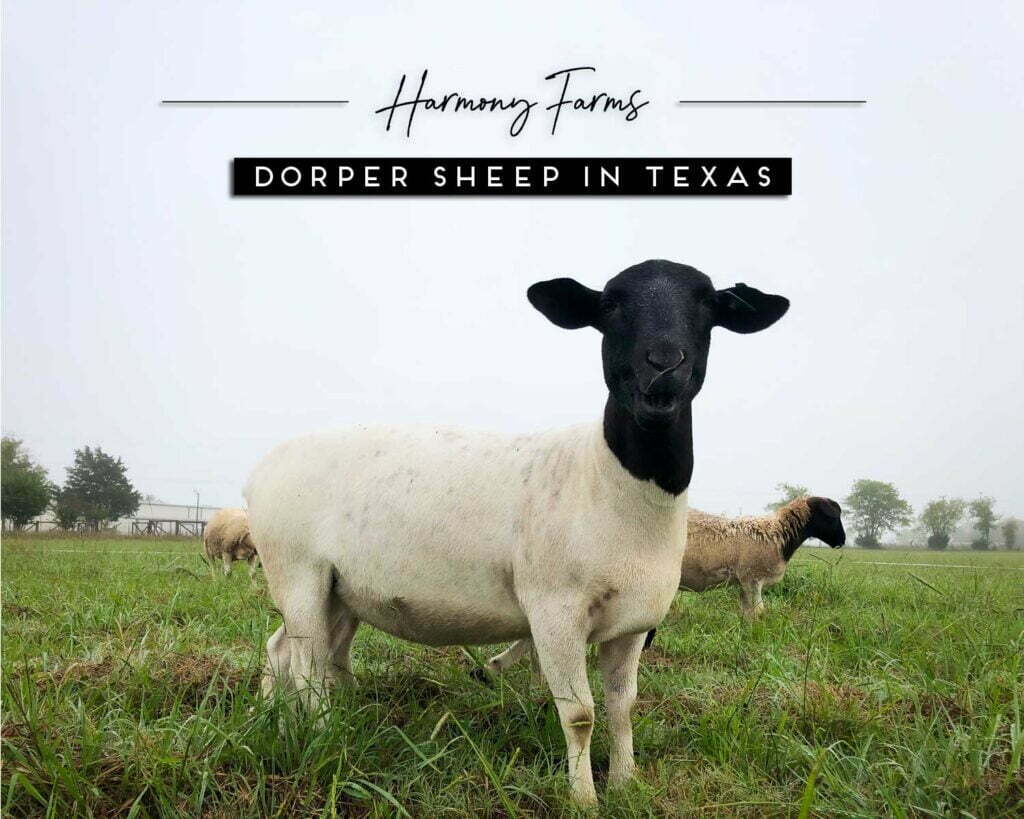
Our secondary goal in raising Dorper Sheep in Texas is to produce a superior line of breeding stock. Dorper sheep are increasing in popularity and value. Because of their heat tolerance and self-shedding quality, the Dorper breed is an excellent choice for sheep farmers in Texas. It is our goal to become a source from which other sheep farmers can purchase quality Dorper Sheep in Texas.
-The Shepherdess at Harmony Farms
“O come, let us worship and bow down: let us kneel before the Lordour maker. For he is our God; and we are the people of his pasture, and the sheep of his hand.”
Psalm 95:6-7
4 Months of Intensive Rotational Grazing Dorper Sheep
It has been 4 months since we launched our management-intensive rotational grazing program for our flock of 25 Dorper Sheep. We started intensive rotational grazing our sheep (meaning we move them to a new paddock every 2 days) as a means of parasite management. Intensive rotational grazing also allows our pasture grasses to recover at break-neck speed. Because our Dorper sheep farm is located in East Texas, we are able to rotational graze our sheep on a year-round basis. Our fencing is a combination of 6″ hog panel perimeter fence and electric poly-tape. Even though our intensive rotational grazing system has only been in place for 4 months, we have seen some amazing results!!
We launched our intensive rotational grazing program for our flock of 25 Dorper sheep on August 15th. We launched this system as a final effort towards parasite management. Sheep are highly susceptible to worms, the Barber Pole worm being the worst threat of all. Typically you can control worms with chemical dewormers. Unfortunately, our flock of Dorper sheep had developed a resistance to these conventional dewormers (ivermectin, cydectin, etc). Because these dewormers were no longer 100% effective for our flock, the health of our sheep was failing. In efforts to improve the health of our Dorper sheep, we implemented Intensive rotational grazing in addition to these conventional dewormers.
Our intensive rotational grazing program for our Dorper sheep involves moving them to fresh pasture every 48 hours. To carry out this rotational grazing strategy, we use electric fence; electric poly tape to be specific. We use the electric fencing to create small paddocks that provide the sheep with just enough grass to graze for 48 hours. For 25 sheep, each 48 hour paddock is around 1/10 acre.
Why does rotational grazing help with parasites in sheep? To explain how rotational grazing helps reduce parasites in sheep, I will explain the life cycle of the parasite. Worms (parasites) exit the body of the sheep via their manure and lands on the pasture. Within 3-10 days (depending on climate), the worms hatch out of the manure and climb up the grass stem. If the sheep is left to graze on a pasture more than 3 days, they will graze grass that is covered in the microscopic larvae of the Barber Pole worm. Through intensive rotational grazing we move the sheep to fresh pasture before they can graze the grass that is covered in parasites. We fence off the previous pasture with electric fencing so the sheep cannot back-track and re-graze the previous paddock.
In addition to being amazing for the health of our sheep, Intensive rotational grazing is also amazing for the health of our pastures! By only grazing a paddock for 2 days, then moving the animals off the grass is given a lot of time to rest and recover. This short grazing period and long rest period allows the grasses to recharge their root systems. This creates deep roots and allows the grasses to fully recover before grazing. Pasture fertilization through even manure distribution is another benefit of intensive rotational grazing. Healthy sheep and healthy pastures makes intensive rotational grazing a win-win!
Our Dorper sheep farm is located in East Texas. Because we are farming sheep in Texas, we can leave our sheep on pasture all year round. In East Texas we do not typically experience harsh winter conditions like snow or ice, so we can allow our sheep to graze through the winter. Sheep farming in Texas is really an ideal situation for intensive rotational grazing program.
Electric fencing is an essential element in our intensive rotational grazing program. We have a strong perimeter fence that is made up of 6″ hog panel around the entire 30 acres of our farm. We use electric poly-tape within our 6″ hog panel perimeter fence to create the small 2-day paddocks. When we rotational graze our sheep, we use plastic step in posts and electric poly-tape to create temporary paddocks. Once we are done grazing an paddock, we roll it up move to the next one!
So what are the results after intensive rotational grazing our Dorper sheep for 4 months? AMAZING!!! For one, our Dorper sheep stopped dying of worms. Before implementing the rotational grazing program in August, we had already lost 3 sheep to parasite this summer. The body condition of our flock has also improved. Our sheep have gone bony and hallow, to plump and muscular. One of the neatest things is that since we began rotational grazing we have been able to reduce our use of conventional dewormers from twice a month to once a month. Some of our ewes are actually able to go 60 days without any chemical dewormers.
At this time we are still using chemical dewormers on our farm. It’s important to do this because our animal’s lives depend on it. It is, however, our ultimate goal to breed out a line of of parasite resistant Dorper Sheep that have no need for chemical dewormers. Lord-willing this will be a reality within 7 years!
I hope this information about rotational grazing sheep helps you! Intensive rotational grazing is tremendously beneficial for parasite management. Intensive rotational grazing your sheep will also improve pasture quality. Because we intensive rotational graze our sheep in Texas, we can leave them on pasture yer round. With a relatively small investment in electric fencing you can launch an intensive rotational grazing program of your own!
-The Millennial Shepherdess at Harmony Farms
“Know that the LORD, He is God; It is He who has made us, and not we ourselves; We are His people and the sheep of His pasture.” Psalm 100:3
How to Raise Grass-Fed Beef: Beginner Guide
Early in 2020, I decided I wanted to raise Grass Fed Beef Cattle for a profit. The problem was, I had no previous experience with livestock… in fact, I had never owned anything larger than a hamster in my entire life. Raising Grass Fed Beef with no previous experience? Crazy, maybe. Impossible: NO! This post outlines all the info I gathered to buy the right breed of livestock for my first shot at raising grass-fed beef! I hope this will help you get started in your grass-fed beef cattle journey.
Good genetics = the first step to raising the best grass fed beef!
“What?? I can’t buy just any old black and white dairy cow and finish it on grass??”
Apparently not.
When shopping for cow or steer that will become your grass-fed beef, you want to make sure your cow or steer is genetically fit for producing quality beef on an all-grass diet.
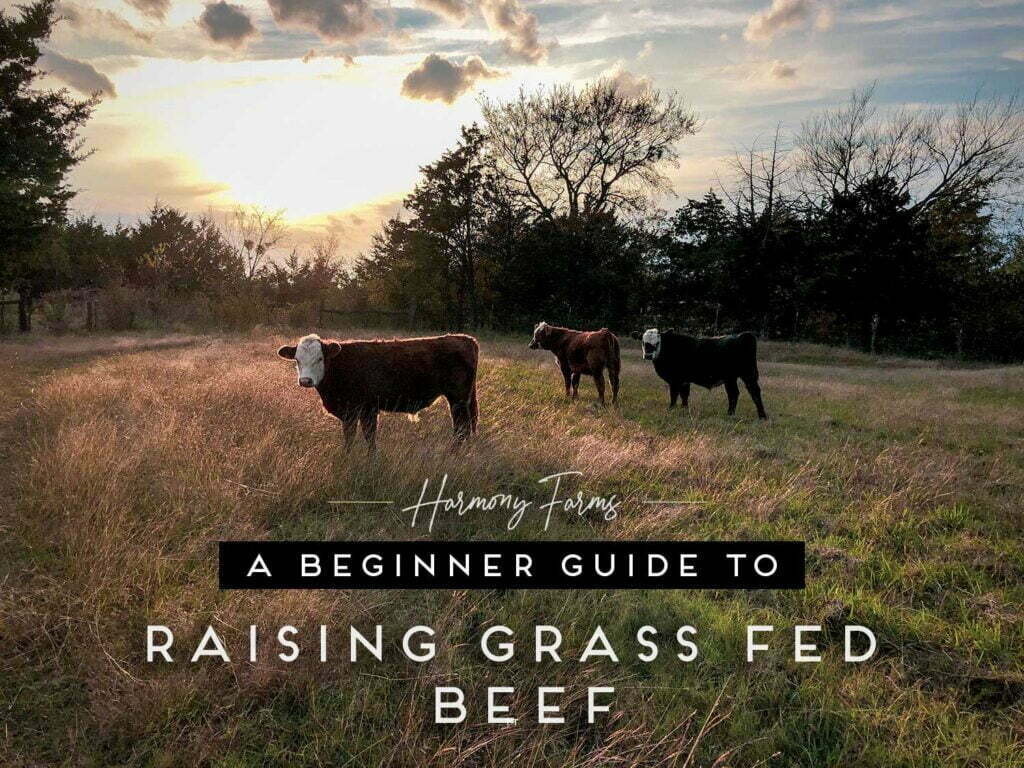
The following attributes make a cow or steer eligible for a quality grass-fed to finish program:
- ✅English Breeds such as Angus or Hereford.
- ✅Small frame.
- ✅Short legs.
- ✅Beefy hind quarters.
- ✅Born in the spring when the grass is best! (because you will be finishing 2 years later on that same grass)
- ✅Private sale where you can visit the ranch and ensure the cattle is on a grass-based diet from birth.
AVOID THE FOLLOWING when shopping for a cow or steer to grass finish:
- 🚫Continental Breeds such as Brahman or Longhorn.
- 🚫Large frame.
- 🚫Long legs.
- 🚫Born mid-summer or winter.
- 🚫Buying at a venue (sale barn) that provides no information on the cattle’s origin or upbringing.
As a first timer raising Grass Fed Beef, Should I buy Stocker Steer or a Cow Calf Pair?
When I began researching how to raise grass fed beef, my question was: “As a first-timer, should I buy a cow-calf pair or a Steer?”
I chose to purchase Stocker Steer as a first timer raising grass fed beef. Here’s why:
Stocker Steer are castrated bulls/male calves that are between 6 and 9 months old. These steers are low maintenance and do not require a long-term commitment. When buying a stocker steer, you do not need much (or any, as is my case) experience in livestock handling. A good quality Stocker steer will come with all of the vaccines and antibiotics already administered. You will need to deworm every 6 months or so, but besides this, there are no major handling needs involved when raising a stocker steer for grass-fed beef.
The stocker steer option was perfect for me as a beginner (and a girl!) raising beef cattle for the first time. Buying stocker steer meant I did not need any experience in animal handling to start raising grass-fed beef! Furthermore, with a stocker, steer the time to slaughter is only around 18 months; versus 24-36 months if I were to buy a bred cow or cow-calf pair.
If I would have chosen a bred cow, or cow-calf pair, I would have to deal with calving, weaning, medicating, vaccinating, and so on. This is a lot of work for a beginner. What’s more is that if I were to choose a cow-calf pair, my time to slaughter would be up to 36 months. Then I would have to deal with things like: what would I do with the mama-cow when the calf is born? How would I breed her again with no bull? What would I do with the mama-cow if I decided that beef cattle wasn’t a good fit for me?
Buying a stocker steer was the best option for me as a beginner raising grass-fed beef.
And that’s what I did! I bought three Herford-Angus steers to raise grass-fed beef for the first time. These steers were born in May which means that when I am ready to finish them, my grass will be growing like crazy… which is super important for a grass-finished beef (obviously!).
I bought my steers from a regenerative-rancher, Mr. Karl Ebel, who lives about 15 miles from my farm. Mr. Karl Ebel is the owner of Ebel Grasslands Ranch. These steers were born and grazed on Ebel Grasslands Ranch which is actually a Native Tall-Grass Prarie Conservation.
Harmony Farms Grass-fed beef is born and grazed on Native Prairie: I don’t think I could have asked for a better start to my grass-fed beef operation!
“With men this is impossible; but with God all things are possible.”
Matthew 19:26
Special thanks to Karl Ebel of Ebel Grasslands Ranch for his time and consulting throughout this process. Much of the info above is from this consultation.
America’s Food System is Broken, is the “Dumb Farmer Stereotype” to blame?
I am a farmer.
When I started my journey in Regenerative Agriculture I loathed that label. I am on the young end of the Millennial age bracket… just a few months shy of Generation Z. Despite my growing interest in regenerative agriculture, I did not want to be labeled a farmer.
The modern world has cast a stereotype on farmers. Small farmers are shirtless hicks who can’t spell, count, or latch their overalls… right?
So at the onset of my journey into farming and Regenerative Agriculture, I would introduce myself using a myriad of alternate terms.
“I am not a farmer, I am engaged in multi-species grazing management.”
“I am not a farmer, I am a sheep rancher.”
“I am not a farmer, I am a permacultural grazier.”
“I am not a farmer. I am a regenerative agriculturalist.”
“I am not a farmer, I am just into rotational grazing.“
While those are all accurate statements with respect to my role at Harmony Farms, they were really just covers for the reality that I was being jaded by modern stereotype.
Then I started farming. I started sweating. I began encountering firsthand the heartaches, the disappointments, the tremendous joys, and the need for relentless fortitude.
And then I realized…
Farmers are strong. Farmers put their life on the line every season in hopes of a blessed harvest. Good Farmers work night and day to grow healthy food.
Then the question hit me hard…
Why are we belittling an industry that every human being relies on for 3 meals a day?
Farmers work hard to create a product that is essential to the life of every human being: food.
By casting unappealing stereotypes on the agricultural industry, we have potentially turned away an entire generation of enthusiasm. Why would a 20 year old want to be a farmer when the spotlight is on the glamours of Silicon Valley?
In the 1950’s 16% of the American population farmed on one scale or another. Today that number is down to 1.3%. Yet our need for healthy food is growing fast, much faster than our need for iPads or software development.
Here is an interested excerpt from Living History Farm, from which I gathered my stats on the declining US farm population:
“Baby boomers born on the farm didn’t stay there. In 1900, more than half the U.S. population lived on farms, 46 million out of the 76 million total population. By 1950, only 16 percent of the population – 23 million people – lived on farms. By 1990, there were 3.87 million people living on farms, only 1.6 percent of the total population. Also, that farm population was getting older on average. In 1920, the median age of the farm population was 20.7. By 1940, it had risen to 24.4. By 1970, it was up to 32, and by 1980 it was up to 35.8. There were fewer young people left on the farms.”
LivingHistoryFarm.org
If you Google “US Farming Population Decline” and you will see a myriad of alarming articles regarding the massive decline in the US farming population. In the 1950’s, 16% of the US population lived on farms. Today, the number of farmers in the United States has dipped to 1.6%. In 1935, there were 7 million farms in the United States. Today that number has shrunk to 2 million.
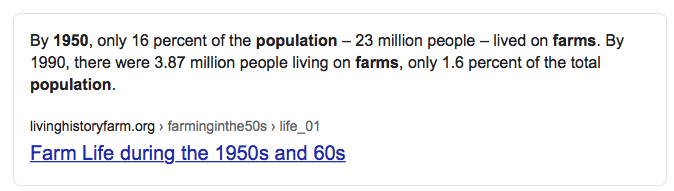
But why is this when the US population has nearly TRIPLED since 1930? The need for food has only increased, yet the number of small farms is on the decline. What is going on?
The US food system has been centralized.
In the past year we have seen that centrality equals fragility. We cannot afford fragility when it comes to a system that 353 million people rely on.
Further expounding on the centralized nature of the US Food System is for another post, so I will leave it here:
I am a farmer by the grace of God. I’m working hard and praying hard to be a good one. I have the blessed opportunity of working one-on0one with the Lord’s creation. I am striving to steward it in a way that honors and points to Him while producing the healthiest food on the planet.
Maybe in the meantime I can help to reshape the farmer stereotype. Maybe I can make farming fashionable. But I won’t wait for any of that to claim my title: I am a farmer.
-The Millennial Shepherdess at Harmony Farms
“He that tilleth his land shall be satisfied with bread: but he that followeth vain persons is void of understanding.” Proverbs 12:11
Further Reads and Citation:
9 Mind Blowing Facts About the US Farming Industry
✖️HONEST REVIEW: Sacred Cow Documentary
HONEST REVIEW of the Sacred Cow Documentary: the Nutritional, Environmental, and Ethical Case for Better Meat
I watched the Sacred Cow Documentary last night, just hours before the free viewing opportunity ended. The Sacred Cow Documentary labels itself “the Nutritional, Environmental, and Ethical Case for Better Meat”. This documentary was produced by Diana Rodgers and is a companion to the book that she authored alongside Robb Wolf: “Sacred Cow: The Case for Better Meat”.
Sacred Cow documentary interested me because Regenerative Farming has been my intensive focus for the past year. I have been awakened to the need for a radical de-centralization of the US food system. If we cannot ignite a large set of small-scale farmers to grow food in a way that promotes soil health, US agriculture is doomed.
Unfortunately, as I watched the Sacred Cow Documentary, it left me feeling empty. It moderately addressed life-threatening issues in modern agriculture, lightly touched on the disaster that is centralized slaughter housing, tip-toed around the dangers of PETA’s confused agenda, and left with a few shots of regenerative farmers as they rotationally grazed their cows.
But why was I left with such a shallow feeling after watching such a highly praised documentary as the Sacred Cow?
The answer hit me hard: the modern regenerative agricultural movement is ignoring the elephant in the room. The real problem is this:
We have denied our Creator.
“Because that, when they knew God, they glorified him not as God, neither were thankful; but became vain in their imaginations, and their foolish heart was darkened. Professing themselves to be wise, they became fools…” Romans 1:21-22
Much of modern agriculture is denying Creator-God. Unfortunately, much of the regenerative movement is doing the same thing, then making documentaries that address the symptoms and not the disease. Any (good) physician will tell you that it is bad practice to treat the symptoms and ignore the disease.
Modern Agriculture is behaving like a disrespectful teenager. It is shoving off the Creator’s wisdom and going about to reinvent the wheel.
Modern agriculture has shoved off of God’s design. It is actively denying the existence of the Creator and claiming that this marvelous world chaotically erupted out of nothing.
Modern agriculture has removed animals from the ecologies they were designed to promote. It is taking animals off the field, and transferring them to factories; it is promoting the growth of food via chemical baths and pesticides.
Less than century later we are seeing some alarming fruit.
Mono cropping, factory farming, and a highly centralized food systems are imploding, leaving us with the question: “who will feed our children?”.
As a nation we rely on billions of bushels of crops that cannot grow without genetic modification, chemical fertilization, and cancer-causing pesticides.
We have factory farms that are riddled with coli food poisoning, mad cow, MRSA, and salmonella.
We have mismanaged soil that is being aggressively stripped of its independent ability to produce the food our nation needs to avoid starvation.
We have a problem, and it needs a solution.
But if, as regenerative agriculturalists, we try to heal the cancerous wound that is modern agriculture, without removing the cancer… without addressing the heart issue that got us here… there is no healing.
There is no power in regenerative agriculture to heal humanity. That power is Christ’s.
“For by Him were all things created, that are in heaven, and that are in earth, visible and invisible, whether they be thrones, or dominions, or principalities, or powers: all things were created by Him, and for Him: And He is before all things, and by Him all things consist.” Colossians 1:16-17
To begin this land-healing resuscitation of agriculture, we must acknowledge Christ, the Creator.
I am seeing a disturbing trend in Regenerative Agriculture: the leaders in this movement are capitalizing on intelligent design and symbiotic blueprints from the Creator, without giving Him glory or thanks.
“Because that, when they knew God, they glorified him not as God, neither were thankful; but became vain in their imaginations, and their foolish heart was darkened.” Romans 1:21
Regenerative Agriculturalists credit nature, animals, permaculture, sustainability, anything at all to avoid mentioning the One by whom all things consist.
In today’s world this is called plagiarism and it is, in many cases, punishable by law.
To be truly successful in Regenerative Agricultural we cannot serve the creature more than the Creator.
“Professing themselves to be wise, they became fools…. Who changed the truth of God into a lie, and worshipped and served the creature more than the Creator, who is blessed for ever.” Romans 1:22-24
I believe that if we, the Christian farmers and agriculturalists of the world, take a stand and acknowledge Christ as Lord and creator; if we observe, respect, and steward the ecological patterns that He has authored, giving Him glory for it, we will see radical changes in our communities, our states and our nations. Changes for the good and changes far more powerful than that which could be produced by any political leader, religious organization, or court of human law.
-The Shepherdess // Harmony Farms