 by
by 
Hi friends,
If you’ve ever felt discouraged by parasite losses in your flock, I want you to know there’s hope. For me, it came down to rotational grazing. It’s the single change that made the biggest difference in my flock’s health, and it’s close to a silver bullet when it comes to managing parasites.
In this episode, I share why I believe so strongly in rotational grazing and walk through the practical framework I use on my own 30 acres. Then I’m tackling a batch of your questions on everything from fencing to minerals.
If you’ve been wanting to get rotational grazing off the ground on your own farm, my hope is that this episode gives you the confidence to finally make it happen.
-the Shepherdess
TRANSCRIPT
the Shepherdess All right, guys. Good evening. I am so excited to be with you tonight. We are going to be discussing all things grazing sheep tonight, specifically rotational grazing sheep. I’m going to be walking you through my system, giving you a bit of a 1,000-foot view on things like fencing, cross-fencing, electric fencing, and permanent fencing. We’re going to be talking paddock rotations—how frequently—and answering some of your most frequently asked questions. They’re all coming up today in this grazing sheep overview. But my goal is to pack as much as I can in for you to learn on grazing sheep. And there’s also going to be a Q&A afterward.
All right. Grazing Sheep 101 here. One of the things I want to do is just introduce myself here. A lot of you do know me and a lot of you are familiar with my story, but I jumped into flock management after the sheep had been on our place for about two years solidly. And lamb losses to parasites in those early years was probably one of the biggest discouragements for us, but grazing management and getting a rotational grazing system in place was like… There really is no silver bullet, but it was close to a silver bullet as could be found in terms of managing parasites, mitigating parasites, and eliminating parasite losses. And that’s really where my passion for agriculture came in, oddly enough. It came in not necessarily in the realms of sheep or in the context of raising sheep or livestock, period. My awakening and my love for agriculture came as I discovered the principles of rotational grazing, and understood that you’re looking at a resource. When you look out on a pasture, you’re looking at a resource, and you’re working with that resource to evaluate it and to figure out what livestock is going to pair best to most efficiently utilize that resource. And the big light bulb moment for me when I went into farming was that realization and that reality.
And so as I go into this Grazing Sheep 101, that is why I am a shepherdess—because I have such a passion for grazing management. And I saw firsthand within our own flock how that grazing management just cut death losses down like crazy in terms of the internal parasites, and how it really improved pasture quality. So as much as I’m a shepherdess who raises sheep, I’m a shepherdess because I love shepherding in the context of this grazing management. It’s really beautiful because the grazing management I’m getting ready to unpack for you isn’t just ideal, but it is really necessary if you go into raising sheep because the rotational grazing management really mimics what shepherding is in its truth: it’s moving and shepherding your flocks across a landscape, whether you have a small property like mine—30 acres, which is small in the context of most ranchers in the world—and some of you guys are working on even smaller parcels. People with two and three acres are implementing the system I’m getting ready to unpack for you. But this grazing system is critical to being a shepherd because it is shepherding in its very essence. It is moving animals across the landscape in tandem with forage availability, and matching their needs to your resource.
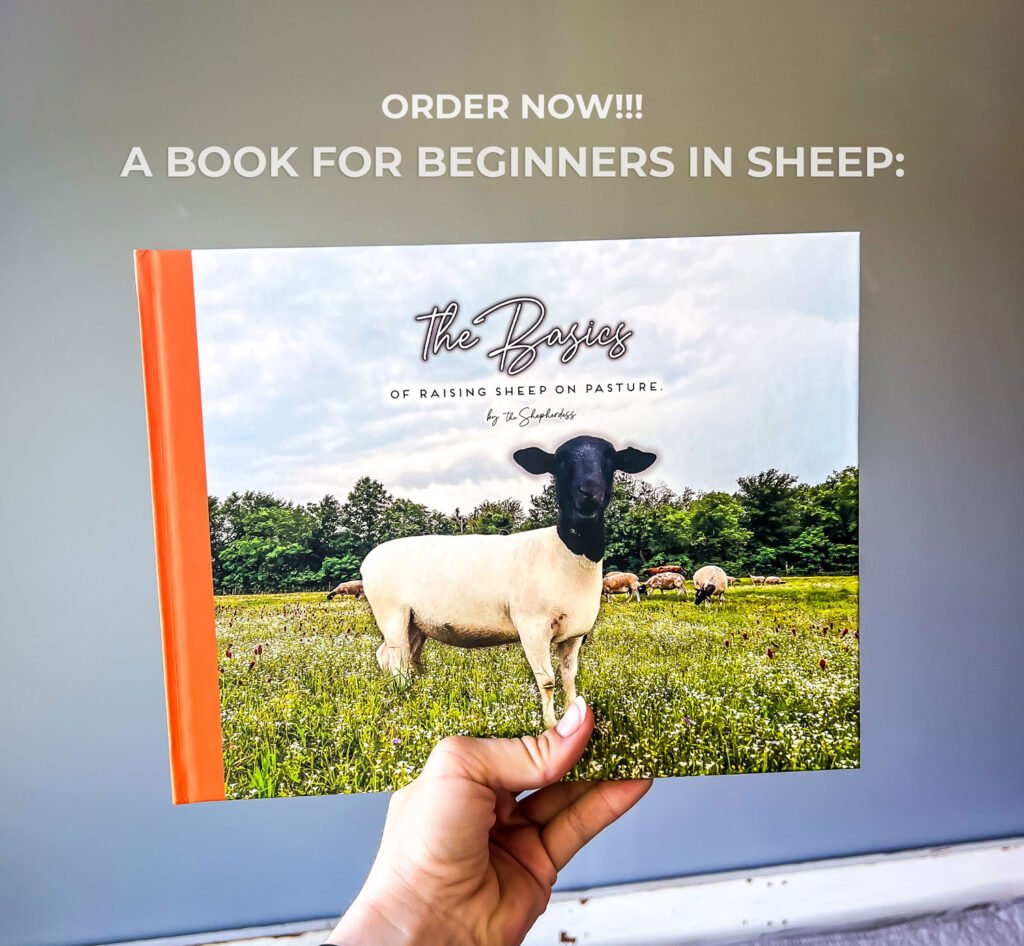
If you’re a beginner shepherd on 30 acres or less, then I wrote a book for you: The Basics of Raising Sheep on Pasture. Available at Shepherdess.com with free shipping. Raising sheep on pasture requires a basic understanding of pasture management, breeding and lambing, and mitigation methods for common disease. I walk the beginner shepherd through each aspect, sharing through this book vivid pictures, easy-to-follow instructions, and personalized stories from my own journey with sheep. Available with free shipping at Shepherdess.com; you’ll find a direct link in the description.
How food insecurity drove my commitment to land stewardship
So upcoming are just a couple of facts about me. I raise purebred Dorper sheep, which are a meat sheep. And I raise them on 30 acres of leased land in Northeast Texas. I’d love to be a landowner someday, but for today I’m just leasing 30 acres of family land here in Northeast, Texas where the rainfall is about 45 inches annually. So it is a subtropical climate. And people are surprised when they hear that about Texas, they think Texas tumbleweeds, probably West Texas kind of stuff. But essentially I am closer to the Louisiana-Arkansas border than I am to the typical Texas climate, so I am really grazing in high rainfall. I manage my sheep, most obviously, in a regenerative pasture-based rotational grazing system. I love this system because it means little or no feed input if I manage my pasture properly and profitably. I have enough excess to get me through most of the winter in terms of grazing only.
I started farming actually back in 2020. I’m in my sixth, almost going into my seventh year of farming, and I started with no background in agriculture. Just a super deeply rooted conviction that stewardship was something I needed to undertake with the resource in front of me. There were 30 acres of family land, largely unutilized or underutilized, and I realized as I was beginning to learn these principles of grazing, land stewardship, and regenerative management that there could be a lot more that could be done with the land that was in front of me. I felt compelled for the good of my family and for the good of the community at large to make the most of the 30 acres that were in front me—to produce a food source and to establish a food source in the wake of a lot of what we did see in 2020 with respect to food insecurity.
A little bit of a side rail here: I launched these meetings—these live streams—in the wake of my understanding and my existing conviction that food insecurity is a real problem. We are up against probably another wave or another time, another set of circumstances that we will see like we did in 2020—just a massive amount of food insecurity. I don’t say that to scare you guys, but I’ve been running these live streams for six years straight. I’ve been producing videos on YouTube for six years straight. I’ve been engaging with my email community for six years straight. Yes, because I like sheep, yes, I’m passionate about land management, but also because I recognize that we are in a generation that is not only experiencing, but promoting food insecurity through the fact that we’ve just neglected and left behind a lot of the lifestyles and a lot of the practices that our grandparents and great-grandparents considered just a way of life for them. So in that context, 2020 was a wake up call for me personally. And I kept having this feeling in 2020, like this is a drill, this is drill, this is the drill. And I don’t say that to be eerie or anything of that nature, but I knew that we were being given a glimpse at what really could have been a much bigger problem than it ended up being. But it was essentially just the opportunity for us to see and have no excuse if we do enter the next season or the next crisis as unprepared as we were in 2020.
So my goal in all of this really is just to relay simple information to beginners—the beginner that I was back in 2020—from firsthand experience. I share the good, the bad, and the ugly. I am committed to sharing my mistakes and my failures as well as my successes because I know that that is a lot of times the way that we learn from one another. But why rotational grazing? I’ve explained a lot of the advantages already, but essentially, rotational grazing was the key change for flock health. What you see here is one of my favorite visual illustrations just to show people how essential rotational grazing is for flock health. On the left-hand side, you see here we have lambs that are just absolutely overtaken by what is coccidiosis, as well as the barber’s pole worm. They just had exceptionally bad diarrhea. We could not get rid of it, but this is a result of the parasite cocci. It’s actually a protozoan, but it functions essentially as a parasite. It just bores holes in the intestine of the sheep. And if you can rotate your animals onto new pasture frequently enough, a majority of your coccidiosis is going to be mitigated. What you see on the right-hand side is just 18 months later. It’s another lamb crop—same genetics, same pasture. The only thing that’s different was pasture rotation. Very, very diligent pasture rotation. And you can see the backsides are clean, and carcasses are nice and fleshy. These lambs were something I was very pleased with.
Why rotational grazing number two is simply just pasture health. There are two types of forages on pasture, at least two categories, and the first category is perennial forages. The second category is annual forages. Perennial plants are permanent plants. They’re plants whose root systems get deeper and deeper and deeper every year. If they’re well managed, they’ll produce forage for up to 30 years. Annual forages are forages that are planted once and they complete their whole entire life cycle in just a single year from seeding, germination, fruit production, and seed production to death in a single year. And rotational grazing enables your perennial plants to grow root systems that continue to dig deep into the ground, that continue to stabilize the soil, that continue to retain water, and that continue prevent erosion—things that we are struggling with across the landscape widely—and by managing your pasture rotation, you’re continuing to strengthen those perennial root systems and build soil, as well as provide a very, very stable feed source for your animals. Rotational grazing also promotes annual forage production because what happens is you rotate your animals through and they will graze the annual forages, but they will not overgraze them.
When it comes to annual forages, you always want to leave some residual in the pasture because they will go to seed, they will reseed the pasture for the next year, and then you will have a crop of really nutrient-dense annual forages for the next year. But if animals are left to continuously graze and basically overgraze a single area, they will eat out those annual forages and there will be no annual forages to go to seed and build into that seed bank for the coming year. Pretty soon your pasture will become depleted and will no longer have the stores of annual forages that your livestock really need to thrive. Something to mention is that the annuals are very, very much more nutrient dense than the perennials. And so you really want to cultivate a good balance. But essentially, if you leave your animals in one area, they’re going to go for that candy first. They’re going to go for those annual forages. They’re going to eat it out, and pretty soon you will not have as nutrient dense of a pasture. And that is one of the benefits of rotational grazing, is that it promotes the production of healthy annuals as well as perennials.
So with those little bits of why, let’s go ahead and jump into the meat of tonight’s presentation. Grazing Sheep 101—just one more why here: it minimizes feed costs because you will have basically a grass surplus. It’s called stockpile, and stockpile grazing is a practice of its own that is so worth going. Getting an understanding of how to build a stockpile of pasture—which is essentially standing hay—will feed your animals over winter without you having to use hay machinery or haul in hay yourself. Rotational grazing is one of those essential practices for building a stockpile of feed surplus over winter. One of the things that I also want to be clear about here is that a lot of people see my pasture and they’re like, “Oh, you’re probably seeding it. You’re probably planting a lot of seeds.” And what you see in my pasture is primarily what grows on its own, and what is grown as a result of rotation and rest. I do not do any fancy broad-based pasture plantings. I don’t do any disk seedings. Occasionally, I will hand broadcast ryegrass and crimson clover. And I’ll do this on a bald patch, maybe something that’s not producing or growing as dense of a forage stand as I like. But for the most part, especially what you’re seeing here, this is what grows on its own through proper rotation and rest.
Another thing I want to address here is something I get from people a lot, and that is: “I can’t rotational graze. I simply don’t have the time to do it.” And with the system I’m getting ready to show you and break down for you—which is my system—when this system is up and rolling, it takes less than an hour per day to set up a temporary paddock and move sheep to fresh pasture. When my grazing rotation is good, my animals have less health problems, less hoof problems, and less worm problems than they do otherwise. So basically the time pays for itself back. I feel like I’m actually farming a lot less than the average rancher because of the absence of health problems that really comes with a good grazing system. This is another advantage here, guys, when you are managing your livestock and moving them according to forage availability, you’re basically forcing your animals to eat everything that’s on their plate—not just the things that they like. My feed costs for my flock are at a bare minimum. Not only is more grass growing, but they’re utilizing every single part of the pasture because I’m forcing them to.
This here is a look at one of my favorite before and afters that really represents how sheep go after every single kind of forage. This is basically a thick stand of weeds, forbs, and grasses, but within 36 hours, they had cleaned out this pasture paddock entirely. And because, number one, I’m able to utilize all of the forage on pasture, and I’m able to stockpile for winter grazing rather than hauling in a boatload of hay, these factors equal less feed input in my system and more dollars in my pocket at the end of the day. So not only does rotational grazing pay for itself, you almost can’t afford not to do it. When I slack on my grazing rotation, my mortality rate directly goes up in direct correlation with how diligent I am—or rather, am not—in my grazing rotation. It is so critical for flock health.
Deciding when to move the flock and how long to wait
I’m going to go ahead and answer some frequently asked questions connected to my grazing rotation. All right, one of the most frequently asked questions that I receive is: “How frequently do you move your sheep to a new paddock?” And the answer is, ideally, in the growing season—which is spring and summer when the pasture is just exploding—it is ideal to move them every 48 hours. And that’s also a great thing to do for the parasite cycles and to keep your sheep healthy. That said, the minimum is once per week. If you only have a Saturday morning to rotate your sheep and get them into a new pasture paddock… If you’re one of those people with a full-time job, you’re exceptionally limited, you can’t do it every day, every two days, try to allocate Saturday, or Friday night, or one day a week to move your sheep to a fresh pasture paddock. The more frequently, the better.
Once a week at minimum will have two primary benefits: number one, it’s going to benefit pasture health exceptionally well, and number two, it is going to do what you need in terms of breaking that parasite cycle. So at minimum, once a week. If you can move them once a day or once every other day, that is fantastic as well. There are some people who move their livestock twice a day. I am not one of those people, but it’s all to say the frequent rotations and the denser stocking rate is very, very advantageous, but I’m talking to a lot of people in here who probably also have a full-time job alongside of their farm and they cannot move twice a day. But yes, once a week at minimum is my recommendation. Every other day if you can afford it time-wise.
Question number two that comes most frequently is: “How long does a paddock rest before you graze it again?” And a paddock needs to rest. You need to consider two things when you’re resting your paddocks. And this is not a prescriptive answer. There’s no canned answer. I’m going to give you a canned answer. Okay, 45 days. Okay, there’s your canned answer, and 45 days would be my recommendation in terms of minimum rest period for a paddock. But that is very prescriptive and sometimes it will work to rest a paddock that long. Sometimes it will not work to rest a paddock that long. But there are two things that you want to look for or be aware of in terms of rotation in your paddock. Number one, you want to watch for pasture recovery. And I’m going to go ahead and pull out my book here, which is The Basics of Raising Sheep on Pasture. This is another resource that I have made available to you. But this is going to have some guidelines in terms of raising, grazing, and a lot of the rotational grazing stuff in here as well.
But in terms of pasture recovery, as we are discussing it, I’m going to go ahead and show you one of the indicators that your pasture is ready to graze again. So when you take your sheep off of your pasture, it’s obviously going to be grazed down probably to somewhere like a two or three-inch residual, just depending on the season. That would be an early spring residual for me. It would be about three inches. A late summer residual would be four or six inches. And when I say residual, that means how tall the grass is when I move the sheep off of it. But when I am looking at a pasture and evaluating it for the return of the sheep, sometimes that could come as early as 21 days after I’ve taken the sheep off of it. And how do I know that it’s okay to return the sheep to the paddock only 21 days after I’ve removed them? That has a lot to do with pasture recovery. Counting tillers is probably one of my favorite ways in terms of gauging pasture recovery and knowing whether or not I can look at a paddock that I have been in.
Let’s say if I want to return to a paddock 28 days later. The rainfall has been really good, and conditions have been really favorable to let that paddock recover in just 21 days. What I’m going to do is go across the pasture and I would probably pluck something like seven blades of grass from one end of the paddock to the other. And I will count the tillers on those blades of grass, and those tillers will be an indication to me of pasture recovery. On this particular plant, there were 10 tillers. And every plant that I plucked up off of the pasture that was there had anywhere between five to 10 tillers. Once a plant has three or more of these tillers, that tells me that I am OK to return my sheep to that pasture to graze it again. And when a plant has gone to seed, that is edging up on a little bit too late in terms of nutritive value. You’re always going to have a combination of plants that have gone to seed, plants that are growing, popping out all those tillers, and plants that are maybe too young—you’re always going to have a general combination. But if a majority of your paddock has gone to seed, that’s at the tail end of its growth phase. It still has a lot of nutrient density, but it’s not going to be as digestible and the protein is not going to be as available. So pluck up grass blades and count the tillers in order to know that it is acceptable and appropriate to return to the pasture again. This is going to be page number 53 in my book, The Basics of Raising Sheep on Pasture: How Long Do You Give the Grass to Rest?
And I say all of that because, again, that prescriptive answer is 45 days. All of the parasites or majority of the parasites will die off. And so for animal health, 45 days is a great way to rotate your animals and a prescriptive rest time. But shorter rest periods—like 21 to 28 days—are going to come on a healthy pasture at the onset of spring, and you are going to be able to rotate your animals faster through those paddocks. But you need to do your due diligence and look for indicators of pasture recovery rather than just that prescription. And you’re going to gain a really good eye for that. Probably if you’re diligent to move your animals once or twice a week—like I was up to three, four, five times a week for the first three years—within a year or year and a half, you’re going to develop a super good eye in terms of pasture recovery. Some of it’s going to be as a result probably of doing it wrong the first time, maybe overgrazing a little bit, but you’re really going to get a good eye exactly for when to take your animals back. But prescriptive, as I know probably some of you guys are taking notes, a minimum of 45 days before returning to the paddock. And for some of those other shorter return periods, you’re going to just look for indicators that your grass has recovered, which will be available through visual illustration in The Basics of Raising Sheep on Pasture.
Choosing the right fence chargers and planning winter stockpiling
“What electric fence charger do you use?” All right. So this is a very, very good question. And this electric fence charger is going to be basically the biggest part and most important part of your grazing rotation as a shepherd. And I’m going to just say really quickly what I use and why I use it: I use a Cyclops Super charger. And this is a unit that plugs into the wall. It’s not a solar unit. It’s a 12-joule output. So this guy packs a big punch. And this is on my 30 acres. This is really enough for 50 or 70 acres especially if you’re doing cattle—you could probably service hundreds of acres with this—but for sheep, it is so important that you choose a charger that packs a punch. And that is what my Cyclops Super does for my sheep fencing. I had a big struggle in my early years with respect to my sheep disrespecting the fence, and It was primarily tied to me using a charger that was just not commanding their respect in the way that it should have. So I was using some very small chargers. I think my first one was 0.25 joules, and it popped them on the nose a little bit and they were scared for a while, but pretty quickly they realized they could get past it with enough effort. This 12-joule charger—they hit it with their nose, and it probably feels to them like a 9 mm just hit them in the face. And I don’t like that for my sheep, but they only need it once and they are very respectful of the fence.
So do invest in a really good charger and your sheep will respect you more as a shepherd, and your job as a shepherd will be much less. So that is my input there. It is an AC unit, so it’s permanent. It plugs in and it is attached to the wall, so unless the power goes out or the fence is down somewhere, you don’t have to worry about it going down like a solar charger does. With all of that said, as a backup, I keep the Gallagher 4-joule solar charger on hand in case, for example, we just had a big series of rain storms come through. It blew some trees down on my electric fencing and it was down for a while. And so I was able to pull out the Gallagher 4-joule solar charger as my backup, and that is my backup standard. This is 4 joules. Again, it’s kind of an expensive unit but it has lasted me a very long time. And again, time is money when you’re chasing your sheep around the pasture because they just disrespected a charger that did not pack enough punch. That’s when you’ll probably wish you would have paid a little more upfront.
Picture this: you are looking out over your 5, 10, maybe 20-plus acres. The sun is setting, and your flock is grazing across a green pasture. Something inside you affirms this is real wealth—at least when it comes to material things. You know how to take care of your sheep, your grazing system is improving your land, and you have a way to direct market each lamb that is born. This is how I feel when I look at my flock, and I want the same for you. So, I put together a free one-hour class that answers some of your most frequently asked questions concerning how I raise, rotational graze, and market my sheep for $480 per head. Go to Shepherdess.com/480, or simply click the first link in the show notes of this podcast to sign up and receive the free on-demand class. What’s more is that I will follow up over the course of three days, providing you with even more free resources—including a free ebook, a free grazing sheep kickstart guide, and a free marketing sheep kickstart guide. This information is worth paying for, but I’m giving it to you for free. Just go to Shepherdess.com/480, or simply click the first link in the show notes of this podcast for how I raise, graze, and market my sheep for $480 each.
So that’s all just me speaking from experience. I started with a 0.25-joule charger and found it in my parents’ garage. It worked to help me to know that rotational grazing would work, but pretty quickly I recognized I needed to invest in a little bit of extra power. All right, James asks, “How many sheep are you rotating on 30 acres?” Carrying capacity at my place is about three sheep per acre given the rainfall and given the forage availability. And that is in Northeast Texas with 45 inches of rainfall on really good pasture. Edmar says, “How do you plan the process of stockpiling feed for winter?” This is a really good question, Edmar. It is something that begins about July. So it’s something I really don’t think about until July here where I’m at. And in July, I will start to allocate—I’m going to talk about it here upcoming—I will allocate one of my three cross-fenced pastures. So I’ll allocate maybe a third of my pasture and just let it grow from July forward. Sometimes I can start as late as August, but I’ll let it go for about two to three months. Once that first frost hits, that’s when our grass pretty much stops growing—not entirely, but for the most part, the growing season’s over with the first frost—and so from August forward, I will allocate about a third of my pasture to be stockpiled that I will not graze until after the first frost. It’s as simple as that. It just takes a matter of watching.
And the term stockpiling is really a good term because while the practice can be more complex than what I just cited or what I’m getting ready to cite, basically, when you’re stockpiling pasture, you have to just think about how you’re stockpiling anything. Look for surplus anywhere, whether it’s just a two-acre spot here or a three-acre spot there. Once you hit about July or August, you want to just look for a surplus that you can start not grazing, that you start setting aside, that you can keep your animals off of. Think about that surplus as something you’re tucking away for after the first frost. That is stockpile grazing, simply stated, but maybe it’ll help you to get sort of a concept or a simplified idea, in terms of what stockpile grazing is and how you need to approach it, at least from a mental standpoint and prepping for it. That’s for you, Edmar. Just think about putting back surplus pasture anywhere you can starting in July or August, and then you can rotate your animals through it after that first frost.
Managing multiple livestock species and setting up secure boundaries
Margaret says, “Tillers?” All right. In case I did not explain it thoroughly enough, essentially a grass blade is going to start sprouting these tillers once it goes to maturity. Not all of them, but a majority of them—at least enough of them to be able to gage pasture recovery. Robin says, “Can I rotate sheep and horses together or do they need to rotate separately?” Robin, you can rotate them together. The only problem I ever had was I had a mini horse in the paddock with my sheep, and it had a bad attitude so it was kind of bullying the sheep. But aside from a poor temperament, there’s really nothing I observed in terms of negative side effects from grazing my sheep and my horses together. KT says, “I’m only able to rest my paddocks about 28 to 30 days in order to keep it palatable this time of year, thanks to Johnson grass. How do you factor breaking up the parasite cycle in this shorter return period?” KT, that’s a really good point that you brought up and that’s really what you’re looking at in terms of disadvantage in returning your sheep so quickly to a paddock. That 45 days that I cited is really kind of the minimum in terms of majority parasite die-off. If you return your sheep any sooner than 45 days, the parasite exposure, or the parasite residual, is one of the cons that you’re really looking at in terms of that.
Think of it this way: the reality is we want to make sure that the parasite loads within our animals are low enough to where they’re not dumping thousands and thousands of eggs on the pasture. So if my animals’ parasite loads are low overall, I’m not too nervous about rotating them back into a paddock 20 or 30 days later. I want to avoid doing that too much over spring because it builds up really, really fast. They drop a lot of parasites, and those parasites lay a lot of eggs. So it’s a good point to bring up, but it’s just one of those things you need to start conditioning your mind towards in terms of when you weigh out the pros and the cons of returning an animal to a paddock before that 45-day time period. And if the advantages outweigh the disadvantages, sometimes those are the risks you have to take. All right. Mary says, “How do you separate your rams from the ewes on pasture?” And the answer to that is I don’t. So my rams, once they’re done breeding the ladies, they have a suite and it’s just a pen and I will keep them in there separated with dry hay confinement until their next use. I tried to run a separate rotation for my rams one year and just too much energy and time. So now they’ll just have a pen that they’ll stay in and they will not rotate.
“What fencing do you use to set up your temporary grazing paddocks?” And the fencing that I use is poly tape. I will use two rows of poly tape. One typically is positioned at about 18 inches off the ground, and the other one is anywhere from 24 to 30 inches above the ground. My goal and mindset in setting my lines is I want something too low for them to comfortably sneak under. If they try to sneak under it, they’ll get it in the forehead really hard, or they’ll get it in the nose really hard. So that’s my goal in setting the first line. And the second one is too high for them to comfortably jump over. My sheep are short and stout. They’re not like goats or mountain climbing breeds. So they’re very short and stout, so they cannot jump comfortably very high. So that’s about 24 to 30 inches for my sheep. And I will use a poly tape after a failed attempt with poly braid. Our first attempt with rotational grazing and using electric fencing was that poly wire. And while a lot of people have had great success with poly wire and sheep, we did not initially, so I upgraded to the poly tape. It’s about a half inch or five-eighths of an inch wide, with five times the visibility and five times the contact surface. And this was ideal in terms of my sheep, and it was a great fit for me.
Another thing I want to address is the netting. The netting is great and very, very effective in terms of containment, but it is very hard to lug around. And for me personally, unless I’m leaving my sheep in one area for a very long period of time, it’s just simply not worth setting up the netting. So this poly tape is my solution in terms of ease of putting up a paddock and taking it down multiple times a week. Another common question that I get coming through is, “What is your perimeter fence made up of?” And my perimeter fence is a 6-inch woven-wire perimeter fence. It is 6-by-6, like I said. And I get questions all of the time like, “I want to buy sheep, should I first put in a perimeter fence like yours?” The only answer I can give to you is basically an answer from our own personal experience. And that is that we bought sheep without having the hard fencing on the perimeter. And essentially our sheep were just on the highway or in the neighbor’s yard until we did get some hard containment for them. Keep in mind, we were not rotational grazing. I was not using the electric fencing for containment at all, but essentially, I’m glad that I have the hard perimeter fencing. It makes the daily rotations a lot faster and allows me to sleep better at night.
And here’s one thing, guys. This is just a bit of a personal testimonial: this hard fencing is really going to probably keep you in the sheep farming game a lot longer than you otherwise would if you were just simply running on electric options. And the reason being is that there have been seasons in my life over the past six, almost going on seven years, whether it’s been a family emergency, whether it’s been just things that have caused me to pause my rotation for two or three weeks at a time. And as much as that sounds potentially like heresy, in the context of tonight, you’re going to get into sheep, and that’s probably going to happen for you. There’s going to be a funeral, there’s going to be a wedding, there is going to be a life event that’s going to take you away from prioritizing your daily moves for maybe up to a month, maybe more. But having hard fencing in place, for me at least, has kept me in the sheep farming game because when I am unable to rotate my animals as frequently as I’d like, my fencing is still going to keep them in. And I’m not relying entirely on the electric options which may go down, which are harder to maintain, and which require me to be on top of them almost every day.
Adjusting the system for specific health issues and paddock layouts
So take that and everything that I’m talking about here in the context of making your own decisions about a perimeter fence. But that would be why I would advocate for one—a sleep well at night, it keeps my sheep out of the neighbor’s yard, and it allows me to stay in the sheep farming game in those months where maybe there’s a family emergency and I simply have to allocate my time to that, and not rotating my sheep every day. They can just be like 80% of the other sheep in the world and not rotationally grazed. So that’s just a bit of practical, realistic perspective there. All right, that is the end of that specific information. I’m going to come over here to the question section. Timothy says, “Can I run five ewes on a quarter of an acre in eight paddocks?” Timothy, you’re going to run out of pasture really fast if you’re running five ewes on a 1⁄4 of an acre. If you’re talking and saying your paddocks are a quarter-of-an-acre each, I’m going to say that’s going to be just fine. It’ll be far, far too big for eight ewes unless you’re going to be leaving them there for 5 to 10 days, or unless your pasture is very sparse. Five ewes do not need a quarter of an acre unless you are going to probably be leaving there for a week or two straight. But if you only have one quarter of an acre for five ewes, you’re going to run out of grass really quickly and you probably need more land for that.
Margaret says, “What about using lime or diatomaceous earth on pasture for killing the parasites?” Margaret, I have heard someone say—and this was connected to the lye as a livestock dewarmer conversation—that what they did was they mixed up a ratio of lye… And again, this is not me recommending this whatsoever. Don’t do this because lye will kill your animals. But one testimonial from a sheep farmer was that he mixed up a ratio of lye in one of those weed sprayers, on one of those tanks, and he just sprayed an acre of pasture with it. Not as a means of killing the parasites on the pasture, but when the sheep grazed it, they were ingesting a measure of lye, which killed the parasites inside them before they could take hold. So while that’s just a secondhand story, that is really the only story I’ve ever heard in connection to the kind of question you are asking here. Robin says, “Do you think the poly tape will work with horses? I have horse panels around the perimeter so that the horses north of the sheep can get outside on the pasture.” Yes, so from my experience, the poly tape worked just fine. It was a miniature horse. So, you know, he was very low to the ground and couldn’t jump super high, but my poly tape did work for my horse. May he rest in peace.
Marina leaves a testimonial here. She says she has a full-size horse with two goats. They will eat together and it definitely depends on the horse’s temperament for sure. Also would add that she found horses do add so much more to the pasture size necessary for grazing. Daniel says, “What are your thoughts on the proposed data centers coming to the Sulfur Springs area?” Daniel, I’d say I’m not happy about it. It’s going to do a lot for various parts of the economy. Let’s see the good news there. But in terms of the water reserves, there’s been a lot of information, to the negative, going around in terms of how it’s going to mess with the water. It’s going to mess with a lot in terms of the small town culture with a lot of the people that they’re going to be bringing in to run it. So, not super pleased, but I haven’t done enough research to spit out facts to make an argument. Thomas says, “Even when following this rotation of at least 45 days, do you still deworm the sheep or only if they show clinical signs?” Thomas, I only deworm on a sheep that needs it. So, yes, I only deworm if they show clinical signs. I don’t deworm prescriptively. If they’re showing signs of anemia through a FAMACHA score inspection, that’s when I will deworm. It’s just when I’m not careful to give that paddock enough rest, they’re going to start showing those clinical signs a lot faster because the infection will just come in.
Douglas says, “So one lamb had what might be CL. What are you doing?” I have not had a lamb that’s had CL, but with respect to CL, it’s caseous lymphadenitis. It is a chronic disease that impacts a lamb or infects a lamb through the mom’s milk because the mom has it. It creates and results in pus-filled abscesses on the lymph nodes, and it sometimes results in the carcasses being condemned at the butcher because those lovely abscesses will actually build up around the internal organs. This is a disease you don’t want in your flock. If you suspect it, I would have the animal blood tested because I did have a sheep that I suspected had CL, and I had her blood tested. I had a swab tested. I had it tested two different times because this is serious enough to cull animals for relentlessly. But there are also a lot of other reasons that animals may develop abscesses. So if it’s CL, cull it out of your flock. If it is not, I mean, obviously don’t, but do make sure that you go through the diligence of making sure it is because there are a lot of different reasons why a sheep might have an abscess.
All right. Dusty says, “A good perimeter fence, hard fence, or field fence will work to keep animals in and out. And when the power goes out, or you have poor ground contact, it is insurance. This is what I’ve concluded at least. And if you’ve ever chased animals around without a perimeter fence, good luck.” Very, very good point there, Dusty. And that’s a very good point in terms of keeping predators out. Because we have that really tight fencing, our predator problems, unless they dig a deep hole under or jump over, which some have, they’re not getting in. So it’s really twofold. I just went to Africa and there were some ranchers out there managing hundreds of thousands of acres, and their primary predator prevention was fencing. One of the ranchers I visited had just installed 124 miles worth of this jackal-proof fencing, which was very similar to what I just showed you. And they did it just to keep predators out. So what Dusty is saying here in terms of that fencing being good, if nothing else for keeping predators out, that is what a lot of ranchers do if they don’t have a livestock guardian dog. Which, again, if you don’t have the fencing to keep those dogs in, they are wanderers as well, so that’s something to think about.
Ted says, “What size paddock do you recommend for 28 sheep?” Again, Ted, in The Basics of Raising Sheep on Pasture, on page number 83—which you can buy at Shepherdess.com—it has a formula for creating paddock sizes. And ironically, Ted, your 28 sheep is actually the exact number that I use for a formula that I created a paddock size for in the book. But in my book, basically, I was working with about… It ended up being 4,300 square feet for one day for 21 sheep. I know you just said 28 sheep, but that was about what I started working with—a 4,300-square-foot paddock for one day on a pretty good patch of grass. And that can be something you start with. You could start a little bit bigger and adjust up or down, but let’s just say 5,000 square feet for one day on your 28 sheep. Make it bigger if they eat into the ground, and make it smaller if they didn’t eat it all. Dusty says, “Minerals and pasture health testing—do you test for anything on your pasture as far as soil health?” And Dusty, the answer is no. I did run a soil test when I very first started grazing, but I’ve not done anything since. I just go by visual indicators of soil health.
And that would be, again, a healthy stand of annuals and perennials, pasture diversity, and quick recovery—you’re not looking at bald spots that are taking forever to recover, which indicates poor health. So in terms of soil tests, I go by visual indicators. I do, however—and this was a deficiency I came upon as a result of my sheep having a deficiency—but this is going to probably happen to you: if your pasture is deficient in something, you’re going to start picking it up in your animals, but my pasture is essentially deficient in calcium, which is amended by putting lime on your pasture. It’s an agricultural lime. A lot of ranchers do it around here. But essentially, I picked up on pasture deficiencies through seeing my sheep have them.
And then the second question from Dusty is, “I don’t know if you offer free choice minerals, but if you do, have you seen a reduction in the mineral consumption over time?” I see a fluctuation seasonally, Dusty. So in terms of my mineral salts, they’re just eating them like crazy right now. It’s summer, it’s hot, and I almost always see one at the salt bucket. Things like, say early spring, as they’re coming out of winter, right before they have their lambs and their nutritional needs aren’t high, again, their consumption will dip. So I see fluctuations over the course of a year rather than over time in general. All right, Brynn says, “If you have to be gone for a month, do you open a month’s equivalent of paddocks?” Yes, Brynn, if I have to take a month off, for example, my sister just got married in April. The family was kind of crazy and needed more of my attention than grazing did. What I did was I just moved them every two weeks, so there was still a rotation. And so what I did was I just used that electric netting and made them a two-week paddock, and that worked out really well. It kept them contained, I was still able to rotate and rest the rest of the pasture, but I was able to give myself some space to be there for my family in that time of transition.
Okay, I think I’ve got almost everybody’s questions here. Mo says, ‘Hi. Did the lye with the goats work for parasites? If you use the same ratio, why would it not work for sheep?” Mo, if it works for goats, it typically works for sheep, but I did just do that particular experiment on goats, because that’s what I did. So I don’t have any information in terms of direct parasite fecal egg count reduction for sheep, only goats, so I can’t share much more with you on that. Lye is caustic and may kill your animal, so every time I talk about lye, I need to say that as well. It’s an at-your-own-risk thing, but check out YouTube: “Lye as a livestock dewormer for sheep and goats,” because I did do a vet-tested fecal run on that. Timothy says, “I have two acres with a 4-by-4 perimeter fence. If I can, what I want is to either have 8 quarter-acre paddocks.” Okay. That’s making a lot more sense, Timothy. He wants to have 8 quarter-acre paddocks moving every 7 days, or 16 eighth-acre paddocks moving every four days.
Timothy, go ahead and just start out with 8 quarter-acre paddocks, moving them every seven days. I would do that. Increase the speed of your rotation and reduce the size of your paddocks as you are getting in the rhythm and as you can do it bi-weekly. But I would at least go ahead and do the 8 quarter-acre paddocks at 7 days because 8 times 7 is 56. It’s a slow math, but I think 8 times 7 is 56, so you’re going to have your parasites die off in that timeframe and plenty of pasture recovery and then just make adjustments. Watch your pasture. The Basics of Raising Sheep on Pasture has tons of visual indicators of how I watched for pasture recovery as a beginner, and it’s going to help you to do the same thing. Buy the book at Shepherdess.com. And grab all the information I wish I had as a beginner. “Herding dogs?” I do not have any herding dogs, Jedidiah. I have too small of a flock to consider that. Herding dogs are pretty expensive, and I’ll just get one of my little sisters out there to help me. Okay, thank you for being here tonight. Have a good night.
Leave a Reply