 by
by 
Hi friends,
Rotational grazing, worms, lambing seasons, fencing, marketing, livestock guardian dogs… we are covering a little bit of everything in today’s sheep farming Q&A. I sat down and answered some of the most common questions I receive about raising sheep on pasture, including what has worked well on my own farm and a few hard lessons learned along the way.
From building strong grass-based genetics to managing parasites and selling sheep direct to consumers, this conversation is packed with practical advice for shepherds trying to build a healthier and more profitable flock.
-the Shepherdess
TRANSCRIPT
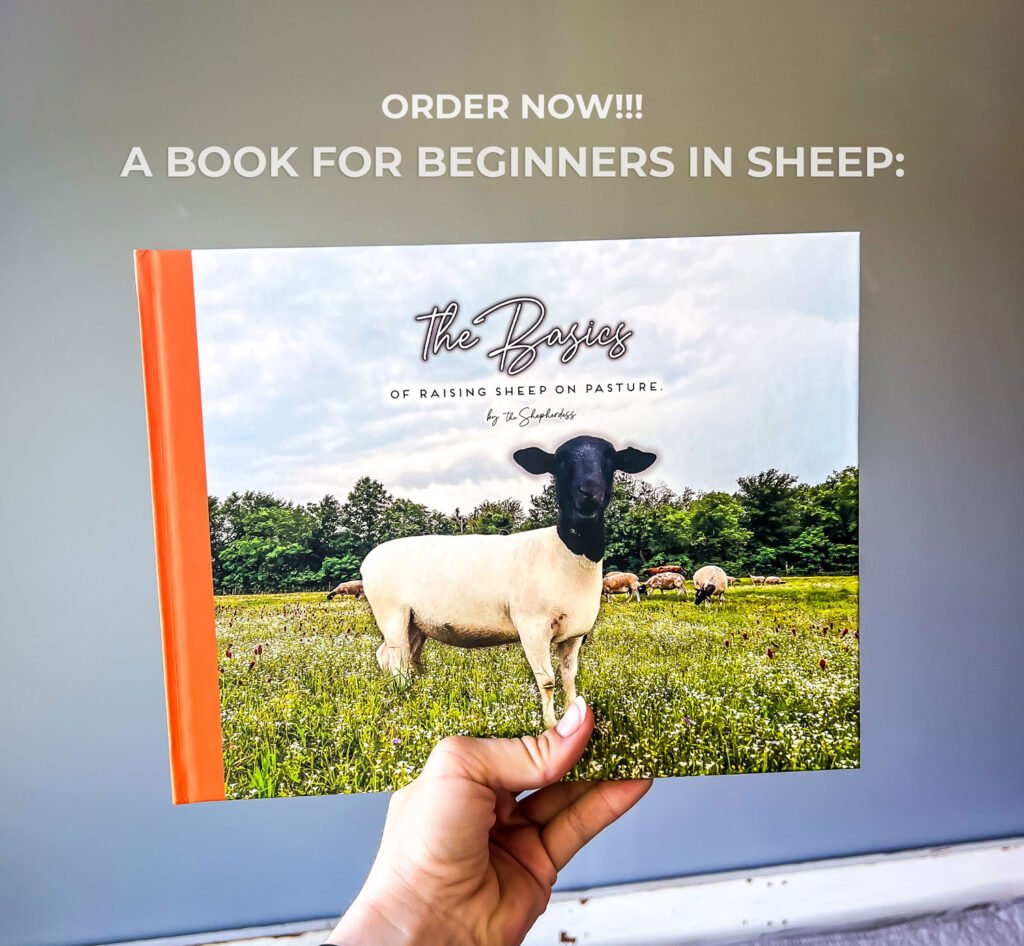
the Shepherdess Guys, I got a mega load of questions this month. I probably have 40 or 60 questions here pertaining to sheep farming, even some marketing, some business stuff with respect to sheep, and maybe even monetizing your farm, that I’m going to try to power through tonight. But I am so incredibly excited to be here with you. I’m going to specifically talk about, tonight, The Basics of Raising Sheep on Pasture. A lot of the questions I’m getting ready to answer are embodied in this book, which is available at Shepherdess.com. It’s also just packed full of, basically, The basics of Raising Sheep on Pasture. You get 250 pages, full color, of answers to questions that I had when I jumped into sheep farming as a beginner. I’m also going to be talking about this resource, which is Butchering by Adam Danforth, guys. Every homestead library really, really needs this. And I might be getting a little bit salesy upfront, but these two books are worth having on your shelf. Butchering by Adam Danforth really does the visual picture job of walking you through taking a live animal and putting it on a plate for dinner. So guys, these are the two books available at Shepherdess.com, and you can purchase them there with free shipping. I’m going to be talking a little bit about them tonight.
If you’re a beginner shepherd on 30 acres or less, then I wrote a book for you: The Basics of Raising Sheep on Pasture. Available at Shepherdess.com with free shipping. Raising sheep on pasture requires a basic understanding of pasture management, breeding and lambing, and mitigation methods for common disease. I walk the beginner shepherd through each aspect, sharing through this book vivid pictures, easy-to-follow instructions, and personalized stories from my own journey with sheep. Available with free shipping at Shepherdess.com; you’ll find a direct link in the description.
Building a grazing system: paddocks, fencing, and water
All right, first question of the night, I’m going to be answering Angie. And Angie actually emailed me. I couldn’t really get to all of these questions within one email, so I promised her I would address her questions first thing in the meetup tonight. I think she mentioned she had 20 or 30 acres that she’s getting started with a sheep farm. So this is a question I get a lot. Angie says, “Assuming we can create enough paddocks to allow for full recovery on pasture of 30 to 60 days, what is the longest you would recommend leaving sheep in a single paddock?” So, right now, I would recommend—at a minimum—moving them about two times per week during the growing season. The growing season is, for me, March through November. Try to move them a minimum of two times a week. For me personally, once the wintertime hits, I am leaving them stationary just a little bit longer—10 days, 14 days. I do try to rotate them a little bit over winter, but because, kind of, once the grass is gone, the grass is gone, and I’m a little bit less pressured to move them.
Question number two is: “Given the water situation, do you have any recommendations for getting water to these various paddocks?” Grazing Sheep Kickstart Guide, and that Grazing Sheep Kickstart guide, the PDF, it’s going to have three individual resources for you. Number one is paddock sizing worksheet, number two is all of the supplies I use within my grazing system, and then number three—what is the third one?—bonus. It’s related to grazing sheep, but it’s fantastic, if you ask me. Anyways, you’ve got three in there, but the one that you want to look at for that, Angie, is the supplies list. And you’re going to want to find on that supplies list polyethylene tubing. I use that, and I have that all over my property. I will use 500-foot lengths, so like $100 to $150 for that 500-foot length, and I get water all over the place. We have hose spigots up close to the house, and I will use those extra-long polyethylene tubing lengths to get the water to where I need it to go.
All right, question number four: “As far as the temporary paddock fences, what would you use to create them?” I use poly tape, which will, again, be referenced on that Grazing Sheep Kickstart Guide supplies list. I use poly tape because the netting is absolutely exhausting. What I have to do to keep the sheep contained—because sheep are super, super sneaky, constantly testing that fence—I have got to pair that with a 12-joule fence charger. And that’s an AC unit; it’s not a solar unit, and I did that after having a season of sheep just really testing the fence time and again when I was using solar chargers that were a little bit weaker. So keep that in mind. I use a collaboration of that poly tape and a really good fence charger. That is what works for me. Question number five from Angie is: “Do sheep need a shelter?” And the answer is yes. Now that shelter can be a tree or a really good hedge of trees. For my sheep that’s what their shelter is. Most of the time they’re on pasture, rotating around pasture, you know, eight days out of ten, four days out five, and that is what they use as just a tree to have shelter from rain, from heat, etc. Now when it comes to winter time, we do have a two-sided shed and that blocks them from that really sharp north wind. It gives them cover overhead from rain and the very occasional snow and ice that we do get. But I do highly advise that you have a shelter of some type that you can bring them into.
I also am going to drop a link here, guys, to my resource, which is a portable shade structure. And a lot of people have raved about this helping a ton with respect to their rotational grazing program when they don’t necessarily have… It’s actually in the book here. And in the book, the entire first chapter is devoted to the nine things that you need to start a sheep farm. And this shade structure is a portable DIY shade structure that I teach you how to build here. Cannot take credit for this. This was my mom’s idea, a fantastic idea of hers. And I have a QR code with a video of assembly, as well as the supplies that you need to create that. If you want to cheat, you can go to YouTube and get a video on how to make that. I won’t gatekeep on that if you want to go to YouTube and just get a free version. Question number six is another really good question. I get it a lot as far as guardian dogs. She said she previously had a livestock guardian dog, but wonders if a donkey would do just as well. This is going to go back to a question I asked a sheep farmer who had been in it for 20 years. He said, “I had donkeys at the onset. They did okay for a while, but they got lazy. And we started to lose lambs left and right.” Listen to what I’m getting ready to say: he said, “I realized at that point in time that you have to fight predators with predators.” A donkey is not a predator; a dog is. So if you’re fighting predators, you need to fight predators with predators. That’s stuck with me, and I would never recommend a livestock guardian donkey over a dog. All of that to say, make your own decisions, but that is what I always tell people.
Question number seven from Angie. And then, guys, I’m going to make sure to scan the live chat. So keep leaving your questions there if you are already. But I’m going to get through Angie’s. Got about eight questions, nine questions here. I’m going to get through them and then go over to the live Q&A. Number seven, Angie says, “A neighbor currently has sheep on the biggest pasture that we are moving to. He manages his flock conventionally in a set-stock grazing situation. Should we let that pasture rest before putting our new flock on there? And if so, how long?” The answer would be: I would allow it to rest long enough for the parasites to die off on that pasture. I’d give it about 45 to 60 days of rest before putting the sheep back on there. And that’s going to allow a lot of the parasites that built up as a result of a conventional set stock grazing situation to die off, and create just a cleaner, fresher pasture for your new flock to go to. Because guys, if you’re raising sheep for the first time, one of the biggest struggles you’re going to have is with internal parasites. That’s why I harp so hard on having a good grazing system. That’s why I really harp a lot about it on The Basics of Raising Sheep on Pasture, which is available at Shepherdess.com. I have an entire chapter dedicated to not only grazing management, but how to set up a grazing system, how to plant pasture by hand without heavy machinery or equipment.
A big part of this book is dedicated to getting you guys into a good rotational grazing system for your sheep, because it’s just that important for their health, for the health of your land, and to make you successful with sheep, I firmly believe you’ve got to have that grazing system in place. So give that pasture 45 to 60 days to rest and sanitize, and then get your sheep on there. Another good question here: she says, “I know a UTV is a bit of a luxury item, but it’s been on our list for almost 10 years.” She is deliberating and wants to know if she should invest in that UTV, or suck it up and try to haul all of her watering system and her grazing supplies by hand. Do you guys have input on this? Leave in the comment section: should she invest in a UTV? What she’s seeing is between $8,000 and $10,000 in her area. And do you guys have creative ideas as far as Angie with respect to getting in on a UTV at a good price? For me personally, we do have a UTV. We’ve had it since the beginning of our farming journey and, guys, it has saved a lot of time and a lot of effort. I didn’t have a tractor when I first started. I didn’t have any heavy machinery or equipment, but that little thing really helped me to zip around, and saved my back on a lot of occasions. We got a really good deal on it. It was something my dad bought and he actually traded some things for it. So Angie, if you could think about scanning Craigslist, putting the word out with friends, kind of going that way in order get the price down for you, but I would say shop for it. And I do know that a lot of people just do the work with a four wheeler. So that’s also an option. I do think the four wheelers are maybe a little less expensive. Am I right, guys? Maybe a little bit less expensive than a UTV.
Question number nine is: “Were your sheep always pasture-based, or did you transition them to that when they started to graze at your place?” She says, “I ask because we could have an opportunity to buy some of my neighbor’s sheep when he downsizes his flock later this year, but since he utilizes grain so heavily and we’d like to use as little of that as possible, I’m not sure if they would thrive on a grass-based system.” So doubling back to that question: “Were your sheep always pasture-based?” I’d say, yes, our sheep were always pasture-based for the most part. They came to the farm. We did use a little bit more grain supplementation when we first started than we do now. Again, I cover that—going to plug the book a ton tonight, but a lot of questions I get on a regular basis, I actually created this book for. I’m going to open up to the page for you guys that talks about supplementation. But basically, my answer to that question is Rome was not built in a day, and neither are grass-based genetics. So in short, when you guys start with your sheep, you are going to possibly be supplementing a little bit more than you would like. But what you do for that is just year after year, you cull or you remove the sheep that you see losing body condition—which I’m going to get you a picture here of body condition and how to score it on a sheep. But essentially, you watch the body condition on your sheep and you note the ones that are doing really well and staying really fat. And you also note the one that are becoming really, really thin on the supplement you are providing. And you cull—which means you get rid of—those skinny sheep from your flock, and before long you’re going to have a flock that thrives on minimal supplementation.
When to treat, support, or cull within your flock
I still have a ewe or two every year that I just have to get rid of because she’s too skinny. She’s too skinny on pasture only. She needs supplement and it’s still a culling process as far as I go. But I cover things like loose mineral, what kind of loose mineral to give in that supplement. I cover how to supplement on really poor quality pasture. Again, guys, this book covers it all. And I cover the body condition. I want to specifically show you the body condition thing, guys, so give me some patience as I get to that because that’s what you ultimately want to watch for as you’re building your flock and ultimately building what is grass-based genetics. Here are some body scoring picture examples. Again, buy this book at Shepherdess.com, guys. It supports my work a ton when you do. So when you’re looking at body condition, you want to watch the rear end of a sheep. A lot of times sheep will have really bloated bellies and that has nothing to do with how healthy they are. The belly is a very bad indicator of the health of a sheep. You want to watch the back side. So you can see the one with the X underneath it. She’s scoring about a one. She is way too thin. In fact, that sheep actually ended up dying of disease the next year. She died of parasites because she was just too thin to fight them off on her own. But the outliers here—that’s what you want to look for in a sheep. This one’s scoring about a three and a half, and the one on this very far side is scoring a four. Those are healthy ewes that produce lots of good lambs on pasture only.
All right. Question: “Can sheep and goats be raised together in a herd?” The answer is yes, they can be, but the goats have, from my experience, been a little bit harder to contain. They will not stay in the single or the double row of poly tape like the sheep will, so if you’re going to run goats, I just highly advise that you run poly netting. Another question is here: “Should I provide a lick tub for my sheep and which one do you recommend?” The answer is I do provide lick tubs to my sheep, and the two cases in which I will do that is when they’re grazing stockpile, which I also, guys, cover that in my book. Going to just give you some pictures from my book here. But again, that’s in the supplemental feed section. I’m going to show you an example of pasture on which I would advise you putting a lick tub out for your sheep. Something like this: which is mostly just burnt ryegrass, it’s got a lot of ragweed in it, it’s got a lot of cockleburs. Basically, there’s little or no grass. And this is an example of a pasture that really warrants supplemental feed, in my opinion. The sheep are going to do a great job of eating these weeds, but a lick tub, which is a molasses-based protein supplement, is going to keep them in good condition and kind of fill in some of the gaps where that pasture is lacking. I’m going to show you guys what a lick-tub looks like. I personally have Hudson Livestock Lick Tubs on my pasture when my sheep need it. And they are kind of a Texas-based company, but I’ll use the Hudson Livestock Multi-Species 16% Protein Lick Tubs when my sheeps do need them. It’s a great way to utilize things like pasture full of weeds, pasture full of maybe lower quality grass, pasture full of maybe over mature and stemmy grass. It’s really a way to use that forage resource, but also provide a safety net nutritionally. With that lick tub so the sheep can simply get and stay healthy.
Direct marketing and farm revenue
A question not related to sheep: he says, “We have a plague of grasshoppers. Any idea how to get rid of them?” Thanks to my sister, the chicken lady, we don’t have too many grasshopper problems. Now I can’t say it’s ever been a plague. I think we’d probably just buy more chickens: raise chickens, build soil, eat grasshoppers. “How many rams do you keep for breeding?” is another question. And I keep one ram per 30 ewes. So two right now. “Is Gallagher fence better than Premier netting for semi-permanent paddocks?” And Gallagher fence being what you’re going to roll up on the reels. My answer is yes, because it’s way easier to set up than the netting. The netting was exhausting for me. I just never got into it for good. I’m going to segue into some of the questions on marketing. I get a ton, and they are: “What’s been your best income stream this year as far as sheep goes—sale barns, meat direct to consumer, or live animal sales from your own flock?” I sell all of my sheep through Shepherdess.com. The best income stream has been breeding stock. If I’m 100% honest, all of my sheep the past couple of years have gone out as breeding stock. I run a pure breed, and people are crazy about starting their own flocks, so all of my sheep have gone out alive and gone out to start or improve other flocks. That’s been my best income stream as far as the sheep goes, and that is my answer for that.
Have you seen an increase in your sales since the cattle market mess? One thing I want to be really clear about here—and this is what I highly advocate for anyone who’s going to go into agriculture—is that I do not rely on sale barns or commodity markets as a means of selling my products. So most of the time, unless I’m doing a research product, I am not aware of any sale barn commodity market messes because I’ve created a direct stream through which I sell and access a consistent market, and that direct stream is my email newsletter list. Three tips to building a profitable newsletter—I think I’ve got the right one here—Three Ways to Gain Newsletter Subscribers. This is probably one of my most valuable PDFs from my perspective. This is information I probably should be charging for, but it’s going to be some of the best information you can ever implement if you want to go for profit on your farm or start generating some profit on you farm. My best marketing stream has been my email newsletter list. It’s allowed me to sell products at a premium, sell a diverse variety of products to the same people, expand my income on farm, and create a hedge for myself against the bad stuff that does happen in the livestock world. For example, last year was a horrible year for parasites. I lost a lot of the ewes that I intended to sell this year. It was just a bad year. And I was able to diversify last year, make up some of the gaps that came as a result of losing more sheep and not having the ability to sell those sheep this year, but I was able to do it through the same tool that I would use to sell my sheep—my newsletter list.
And I just want to encourage you guys: get that handout, begin building your email newsletter list, and begin to build in that stability on your own farm. I’m even going to link a YouTube video here that talks about how I keep in touch and build a relationship with this email community month after month. Because what happens is you’re going to get newsletter subscribers, but then you have to make a relationship with them over time. So this is going to give you my newsletter strategy in that video. If you’re listening in replay, look on YouTube: How I Sell My Sheep for $480 Each. Then there’s another one on YouTube, it’s called My Monthly Marketing, and this talks about everything I do on social media on a consistent, monthly basis. Just go to Shepherdess YouTube and binge watch that if you’re struggling in the marketing arena. It’s one of the biggest questions that I get. And ultimately, guys, I want to acknowledge that really God gives the increase in business and in anything. Just ultimately, he will be the one that will teach you how to profit in your unique situation. I don’t want to get so into sharing my methods or this or that, that I just fail to acknowledge that. That would be the biggest mistake on my part. I’ve had a lot of businesses, some of them have failed, where I put in tons of effort, and at the end of the day, I just have nothing, and it’s always brought me back to a place of humility. I never want to go back to a place of self-sufficiency in that arena. So just always stay at a place of humility of just seeking the Lord for unique ways to profit in your unique situations. And I hope to provide you guys with the tools and just relay as much information I can from my experience, but I always want to point you back to that reality.
Picture this: you are looking out over your 5, 10, maybe 20-plus acres. The sun is setting, and your flock is grazing across a green pasture. Something inside you affirms this is real wealth—at least when it comes to material things. You know how to take care of your sheep, your grazing system is improving your land, and you have a way to direct market each lamb that is born. This is how I feel when I look at my flock, and I want the same for you. So, I put together a free one-hour class that answers some of your most frequently asked questions concerning how I raise, rotational graze, and market my sheep for $480 per head. Go to Shepherdess.com/480, or simply click the first link in the show notes of this podcast to sign up and receive the free on-demand class. What’s more is that I will follow up over the course of three days, providing you with even more free resources—including a free ebook, a free grazing sheep kickstart guide, and a free marketing sheep kickstart guide. This information is worth paying for, but I’m giving it to you for free. Just go to Shepherdess.com/480, or simply click the first link in the show notes of this podcast for how I raise, graze, and market my sheep for $480 each.
This is another question I get quite frequently: he said, “I purchased a 20-acre farm. It was row crop, but I’m growing pasture instead. There are no hard fences around the property. Will I be able to keep my sheep contained?” If you have no hard fences around the property, you will not be able to keep your sheep contained. Your sheep are going to wander until there is a hard barrier that they run into. For some people, they talk about how they use all electric for sheep. For me personally, I advocate for a really strong, tight perimeter fencing, especially on small acreage. So invest in the perimeter fencing, and then use the electric fencing within that. And that is 100% my consistent advice. Is that to say that there are people out there who have not had success just getting started with Premier One electric netting? There are a lot of people that have done that. But take those and do that particular system at your own risk. Just know you don’t have that insurance of the hard fencing if your sheep do get out of the netting, and depending on how close you live to neighbors or how close to the highway, that may or may not pose bigger problems for you than the next person. So keep all of that in mind.
Planning breeding and lambing around pasture
All right. Another question is about breeding, which is something I get questioned about a lot: “Assume your August-to-October ram breeding is based on seasonal temperatures in your zone. What are you thinking, temperature wise, to target for lambing time?” All right, I don’t necessarily breed based on temperature. I breed based on pasture availability. And this year, what worked out really well for me was to breed in order for them to start lambing about three weeks ahead of spring pasture explosion. So for me, some of my best lambs are coming out of my February born set. And I will be lambing in February from now on—from here until it poses a problem—because my best pasture comes in the middle of March. So I’m going to be lambing in the last two weeks of February from now on. So, I hope that that helps you. Kind of think about when your pasture starts to explode, rewind three weeks, and for me personally, that’s been my best success as far as lambing goes. A lot of times people will say, “Lamb with the pasture.” That’s a pretty good idea too, but for me personally, lambing a little bit ahead of the pasture allowed my lambs to grow faster, and get a little bit meatier before the parasite bloom came on. So let me know if that is resonating with anybody out there. If you guys are in the comments section and you have had lambing, give a little bit of insight from your perspective. Have you tried the late, late winter lambing and have you liked it? I did. I loved it. It was so good this year.
Another good question is: “How much hay do your ewes go through per week in the winter?” And my ewes will eat through one 50-pound square bale per week in the winter. So, if I’m overwintering a flock of… Well, it’s one square bale per ewe per week. Very, very simple. They’ll sometimes eat a little bit less than that, but just kind of gauge it. So if you’re going to feed for seven weeks straight, make sure you have seven square bales for that ewe. Okay, “I have a neighbor who has a Dorper ram and is willing to let me breed my two Dorper ewes to him. How long should I let them be with the ram? I would say 34 days, minimum. Either have him on your property for 34 days, minimum, or send the ladies over there for 34 days, minimum. That will allow them to be in with the ram for two breeding cycles and they’ll have two opportunities to catch. “Have you had success with any natural dewormer methods?” Not as a means of treatment, no. As a means of prevention, yes. Those things are effective and when we’re talking about natural de-wormers, we’re talking about garlic, diatomaceous earth, pumpkin seeds—I’ve even heard people talk about pumpkin seeds. Those are things that are not effective when your sheep is severely infected with the barber’s pole worm.
I pull this out all the time—I’ve got a picture here in my book that I’m going to get for you guys of a sheep that is severely infected with the barber’s pole worm. All right, I always do this and it’s very much worth repeating because I get this question all of the time, and this is something I have very personal experience with so I always take my time to answer it: this is an example of what’s typically called a FAMACHA scoring process. It’s typically done with a FAMACHA card, but this is real-life examples of real-life sheep, which by the way, guys, buy the book at Shepherdess.com—it supports my work a ton when you do, and allows me to produce a lot of these free resources for you. This is a healthy sheep and she has no need for dewormer. You can see her eyelids are bright pink, she is in good health, she’s not anemic, and she’s not overly infected with parasites. This is the ewe that I would give diatomaceous earth, apple cider vinegar, garlic—all the stuff to keep her healthy. Use that stuff then. But if you’ve got a ewe that has gotten here: very pale eyelids, mostly white—you see a little bit of pink in there—she is severely infected with worms, and you need to use a treatment. You need to administer something that’s going to get rid of those worms very quickly, or you’re going to end up here: you’re going to end up dead. This is the eyelids on an animal that just died of a barber’s pole worm overload.
So keep that in mind. When we’re talking about natural supplements and if we’re talking about them from our experience and we’re in an area with very high rainfall where worms are a big issue, you do not want to use pumpkin seeds, diatomaceous earth, garlic, apple cider vinegar on a sheep like this, or it’s going to die really soon. Use them to keep your sheep healthy. When your sheep are severely infected like this, my recommendation is to get it a real dewormer. That’s my big passion. We lost half of our flock up front to worms because we were really understandably very holistically minded. We didn’t like chemicals. We still don’t like chemicals. But we use dewormer. I use it without apology, and I make sure to tell people what happened when we tried to use a lot of the natural stuff for treatment. And what happens, guys, it’s the same thing as with that grass-based genetics and the body condition—if you’ve got a sheep that’s just constantly needing a drench, cull that sheep. Get rid of that sheep. I’m having the best year yet—as far as parasites and minimal drenching—because I took some time over winter to just cull out some of my worst sheep. And so just cull them out, but in the meantime, it’s really painful to watch a sheep die, slowly, of worms on the pasture. I’ve seen it enough, and I will tell you: use a dewormer.
This was not a question, it was a statement, but I thought it was pretty funny: “We are terrible at marketing.” And I’m just going to refer you guys back to getting started with that PDF handout that I just sent. It’s going to teach you how to get booted up with a newsletter, and then search YouTube for Shepherdess Marketing, and you’re going to find all of my marketing videos on there. “How do you sell your sheep usually? Where do you go to sell your sheep?” And again, I’m going to use this to reinstate: I’ve never sold or relied on a commodity market to sell my sheep. I’ve sold them all through Shepherdess.com using my customer base that I built up in my newsletter. So, I sell them all direct. “Why did you select the Dorper sheep as a breed?” This is a question I get a lot. Ultimately, the Dorper was not something I selected, but it was something that was selected before me. My parents bought the flock and they wouldn’t call themselves farmers, but they are big connoisseurs of quality. So they really bought some good quality sheep despite how much we struggled with management up front. So I’m really grateful for that. That said, Dorper is the most marketable sheep in the country right now in terms of hair sheep. And it has got the most promising carcass of all the hair sheep, meaning that you will get a lot of meat off of a Dorper, a lot more than Katahdin and a lot, lot more than St. Croix. I do not recommend St. Croix for commercial meat production. St. Croix is a good homestead animal, maybe a low maintenance homestead animal that you’re probably going to maybe butcher out on property, but you’re going to be disappointed with meat yield on those guys.
Using small pens and panels for routine sheep care
Michael had some questions on handling systems that worked well. My best handling system for sheep: I do have a big fancy handling system and I’m grateful to have it, but my best handling system for a sheep is a really small tight pen. Again, I’m going to reference the book, The Basics of Raising Sheep on Pasture. If you guys would stop off at Shepherdess.com and buy a copy after the show tonight, it supports my work a ton when you do and it is, in my opinion, going to be worth your investment. But my best handling system, and my most frequently used handling system, is just a really small tightly packed pen. And I do enjoy the chute system that I have, but I find myself using a really small pen more frequently. I use the Lakeland aluminum easy panels to create that really tight space, and I find that when my sheep are packed together really tight, I can flip them, I can do a lot of drenches and just the kind of the standard maintenance on them in that tight pen. So, I hope that helped. All right, Teresa said she actually has had some really good success with pumpkin seeds in their worm load. Last checked by the vet was at zero. So, hey, that is super, super good. She said she does, however, make sure that she does deworm once a year, and then she supplements with the pumpkin seeds. So yeah, she uses that.
Angie says, “We used to lamb in March and it went pretty well. The neighbors lamb in January, usually, but had a rogue ram and ended up with May and June lambs. The May and June lambs struggled with grass tetany this year. Anyone else had issues with this?” Angie, no, not grass tetany, but my May and June lambs were just dying of parasites last year. So the later born ones are just really, really tough to keep alive. Laura says, “Do you put apple cider vinegar in their water and then free pumpkin seeds and diatomaceous earth?” I put apple cider vinegar in the water when it’s really, really hot and I need them to drink more. That’s the only time I’ve really used apple cider vinegar in the water. All right, we’ve got eight more minutes, guys. I’m not going to get to all 60 questions, but I’m going to make sure to prioritize your questions in the live chat here, and then answer a few more off of my list here. If you guys want, I do have a video that I recently posted on YouTube called Answering 30 Questions About Sheep. Some of them are on that video, so if you are curious as to what those questions that I may have missed tonight were, go to YouTube and click under my latest live stream.
Mike says, “You mentioned Cydectin. Is that a drench or an injectable?” That is a drench, Mike. I use Cydectin drench. Laura asks, “How do you weigh your lambs or other livestock?” So Laura, for the lambs that are under 25 pounds, I will use a hanging scale. You can buy it on eBay. It’s about 30 bucks. It’s really great. And I’ll use a little hammock to weigh the lambs. Once they’re over 25 pounds, I do have a Lakeland Farm and Ranch Direct weigh scale. I’ve been using a ton this year and it’s come in handy, but you may be able to find a weigh scale maybe through Craigslist locally, but that’s the scale that they step into, my Lakeland one, and it’s been so, so helpful. Adi says, “Are you liking your Lakeland? Is it worth the investment?” Adi, I would say I do like my Lakeland a lot. It’s a bit overkill for a small flock to have the whole chute system, but I worked with Lakeland to create what’s called the Shepherdess Starter Kit, and I would definitely recommend that to anybody just kind of getting in and has maybe some physical limitations, and the Shepherdess Starter Kit with Lakeland is just a bunch of these panels. It’s about 10 of those aluminum panels, which I use almost every day. And then also, what’s in the starter kit is the spin trim chute, and that’s going to allow you to lock the animal in and flip them over. A lot of people who are starting on this, maybe they’re 60 or so, and they just don’t want to kill their back flipping sheep all day, I would definitely recommend that. So check out the Shepherdess Starter Kit if your flock is under 50. Once you get up to the 50s and 100s, then I would consider the full chute system. But don’t approach that from an investment standpoint until you’ve got a bigger flock.
Teresa says, “Get the book if you don’t have it. There’s a lot of carryover for goats.” Thank you, Teresa, and thank you guys for supporting my work by buying a book. Tons of help there. It allows me to continue to really create a lot of free stuff for you guys. Grace says, “I have a ewe that has had triplets for many years and she always rejects one. I don’t really want a bottle lamb. Do you think I should sell her?” If she’s had triplets for many years and she’s feeding two, and you just have one, I would not sell her. She’s super fertile and her genetics are really good. If you don’t really want a bottle lamb, put it on Facebook. If you have classified ads on Facebook, people would just eat that up. They’d come pick up that bottle lamb if you just advertise free bottle lamb. They’ll come pick it up and take care of it. People are always watching, but I wouldn’t sell her, she’s a good ewe. As long as she raises those other two just fine, and she doesn’t have problems with them. All right. Dan says, “How much apple cider vinegar per gallon of water?” Dan, I would do two or three tablespoons per gallon of water. That’s a little low, I’m sorry. I’d probably do a third of a cup per gallon of water, but two or 3 tablespoons if you’re filling like a whole trough.
Brandon says, “I’m concerned about the government overreach regarding RFID tags.” Guys, the RFID tagging thing—I’m just going to echo what Congressman Thomas Massie said through his Instagram page. Congressman Thomas Massie said, “I will not comply.” Okay, I’m on his side. He says that is one of the biggest overreaches, and it needs to be met with mass noncompliance with respect to government mandating us to put RFID tags on our cattle, okay? So I’ll just defer to Congressman Massie. He’s a member of the U.S. Congress, and I will say, I’m going to follow your lead on that one, sir. I’ll be with you in the noncompliance. Hope that helps you guys. Look into it yourself, and make your own decisions. Don’t blame the Shepherdess, but if you go to prison for not RFID tagging your animals, I’m going to probably put a story about you on my YouTube and try to get you some support. All right. Three minutes off here, guys. Okay, going to answer two more questions, guys, because we have three more minutes, and then we’re going to close it out for tonight. Appreciate you all so much for being here.
This is a very good question. I get it a lot, and it is: “What would you charge for your sheep, and what kind of weight threshold does that require?” So this might be a little bit of a confusing question. I’ll start with the weight threshold for slaughter question, so I’m going to work backwards. I want my lamb to be 90 to 100 pounds before I send it to slaughter. Once all of the guts are out and the hide is off, that lamb is going to hang at about 50 or 60 pounds. Once all of the bones are out and that lamb is in cryovac and ready to put in the oven or on the grill, there’s going to be about 40 pounds worth of meat there. So when I’m looking at something that’s going to have 40 pounds of meat worth in the package, if I’m going to sell them by halves and wholes, I want $10 to $12 per pound based on that 40 pounds in the package. And that comes out to selling that lamb for about $150 to $200 per half—$150 if you’re going to have the buyer pay for processing because you’ll cut some of that cost out because you don’t have to pay it, and $200 if you are going to pay for the cost of processing. That’s, personally, where I would be at as far as selling a sheep for meat in whole or half. And Nathan says, “You might mention HB 467, which allows raw milk sales in Louisiana.” Yes, Nathan has been keeping me abreast on that. And it was just signed into law: Louisiana raw milk sales are now legal, bringing it down to just five states in the United States that have outlawed raw milk, which is really, really good.
All right, guys, one more question. I’m going to try to squeeze it in here: “What is a sheep’s favorite grasses?” Answer is: my sheep eat pretty much anything that’s green. If I were to say they have favorites, they like rye grass, they like crab grass, they love clovers, and yes, clovers are just fine for sheep. I’ve never had one bloat on clover yet. So there you go, but sheep are an amazing advantage in that they will eat all of the weeds and all of the things. Appreciate you guys so much. Do not forget to buy the book in support of my work, as well as all of my other favorite books, which are listed at Shepherdess.com. If you guys are looking for a resource of any type, as far as books go—Sheperdess.com. I really only put books there that have personally benefited me and my farm. So you can know that when you buy those books, it’s not just some random book I found and I thought, oh, that’d be fun to put on my website. Those are books that have directly benefited my operation. Butchering by Adam Danforth—every homestead bookshelf needs this, and you can find that and support my work by buying it at Shepherdess.com. Appreciate you guys so much, and I look forward to seeing you next month, fourth Thursday.
Leave a Reply