 by
Hi friends,
Feed is one of the biggest expenses on a sheep farm, and most of it can be avoided when your pasture and flock are running on an effective rotational grazing system. In this episode, I’m walking through how I feed my sheep on a low-input, pasture-based farm in Northeast Texas, including how much they eat, how much protein they need, and the five things I feed throughout the year.
You’ll hear why I never feed mineral blocks, how a little protein helps your sheep get more out of dormant pasture, and why I skip fodder systems. My hope is that this episode gives you a simple plan you can use this winter.
-the Shepherdess
Transcript
the Shepherdess All right, guys, welcome to tonight’s small farmer virtual meetup. I am so excited because tonight I’m going to be answering the question: What do sheep eat? Going to answer the question: What to feed sheep, but in a very, very simple way, because this is a topic that people spend years at college researching and pinning down. But tonight’s just going to be a really, really simple look at what to feed sheep from my perspective as a pasture-based sheep farmer who does have pasture go dormant and does need to come up with a winter feed program. And that’s what it’s going to be tonight. So tonight I’m going to walk you through a sheep’s nutritional requirements. And then at the very end, I’m going to walk you through just the five things that I feed my sheep in a pasture-based system and how I am preparing for winter this year.
Feeding Sheep 101. Just a quick little intro on myself and my farm here: I am farming purebred Dorper sheep in Northeast Texas. I’m on 30 acres, so my operation is small scale. And like I said, I’m located in Northeast, Texas, but we are not typical Texas. I’m actually closer to Louisiana, Arkansas—that kind of weather—than I am to some of the deep Texas weather that people sort of expect. So I get a lot of rain, I guess in short, is what I’m trying to say. We get about 45 inches annually. And so I run a regenerative pasture-based rotational grazing system with my sheep. It’s very, very low input. So that’s the context of tonight’s meetup in terms of what to feed sheep. I’m going to be giving you a lot of information, but I run my operations so that I don’t have to feed a whole lot because whatever comes out of a brown paper bag is coming out of your pocket, and it gets really, really expensive after a while. So while I’m going to give you some pointers in terms of what you can feed sheep when you need to feed sheep. My biggest goal on my farm is not to have to feed my sheep anything but grass for as long as possible throughout the year.
So I started farming in 2020 and I had no background in agriculture, but my goal with that, and being there myself, is to simply relay as much information to beginner shepherds from both firsthand experience, as well as time spent with just some of the best people in agriculture. I’ve been really, really blessed to be able to interview, spend time with, ask questions from a beginners perspective of people much farther along than me, and it is my goal just to run the fastest relay race with that information to help as many people as possible come into the industry because we really need a lot more people in agriculture and entering agriculture than we have right now. In fact, agriculture itself as an industry is aging out at a very alarming rate. I think the average age of the farmer was 56 about six years ago when I jumped in. I think it’s only getting older.
But typically when an industry hits a median average age over something like 35, that industry is said to be deteriorating and going into extinction somewhat. And as a young person, I wanted to combat that to sort of stand in that gap in some small way. Now I’m very small scale, but I do believe the solution to our national and to some extent, international agricultural crisis, is a million small farms rather than 1,000 extremely large ones. And so a lot of the people that are probably here, go ahead and drop in the comments in terms of are you large scale or small scale. But a lot of the instruction I give is from a small scale perspective, but can also be scaled up to larger operations as well.
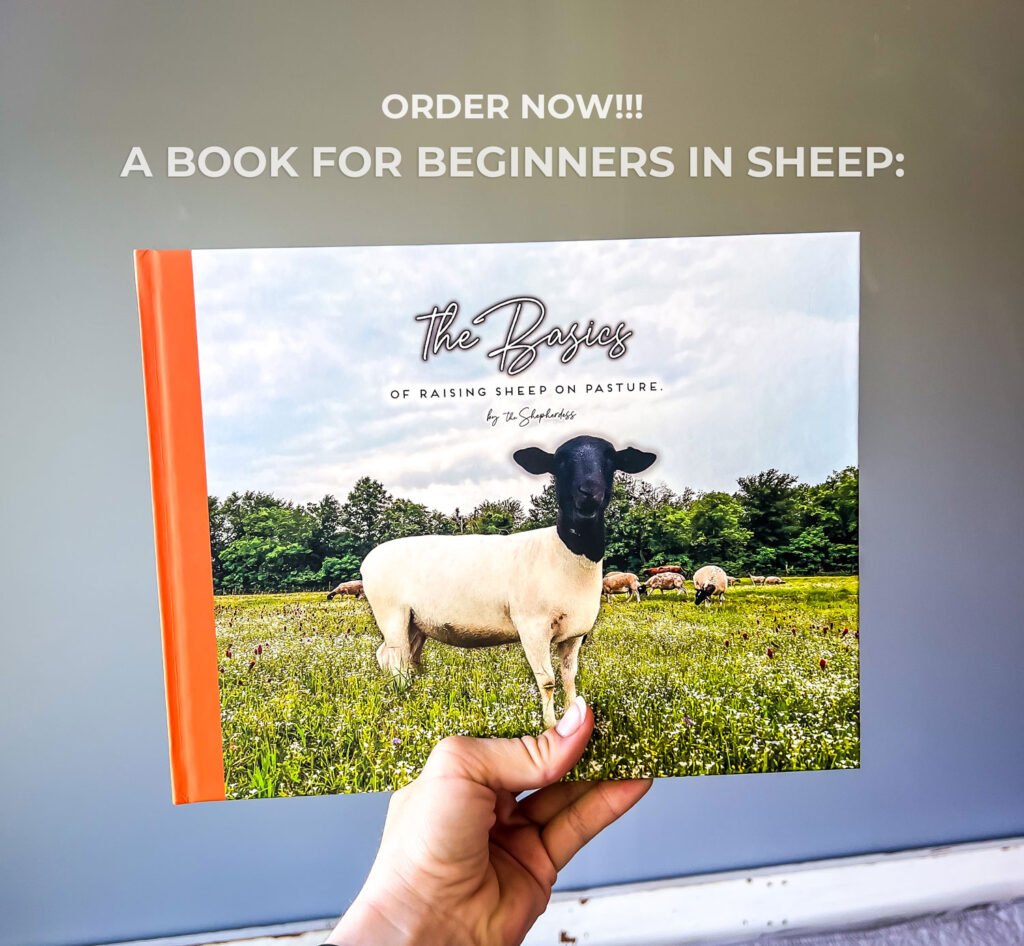
If you’re a beginner shepherd on 30 acres or less, then I wrote a book for you: The Basics of Raising Sheep on Pasture. Available at Shepherdess.com with free shipping. Raising sheep on pasture requires a basic understanding of pasture management, breeding and lambing, and mitigation methods for common disease. I walk the beginner shepherd through each aspect, sharing through this book vivid pictures, easy-to-follow instructions, and personalized stories from my own journey with sheep. Available with free shipping at Shepherdess.com; you’ll find a direct link in the description.
All right, so tonight I’m going to be really tackling the topic of what to feed sheep or feeding sheep 101 from sort of three perspectives. And that is I’m going to give you a really sort of baseline idea of what a sheep needs in terms of nutrition, and some basics in terms of answering questions connected to feeding sheep. I’m going to cover seasonality and when you are going to be expecting to feed more, and what you can feed during those seasons. Then at the very end, I’m going to be talking about five things that I am feeding at my farm as a low input system. It’s a very simple feed program, but very effective for me, and I’m excited to share.
Understanding sheep’s nutritional needs
I’m going to give you some very, very basic information about sheep starting out. Sheep are most obviously herbivores. They’re plant eaters. They’re in a class of really incredible creatures that takes forage, leafy greens, and derives all of the protein, carbohydrates, and nutrients they really need to thrive from them. They’re the original vegans, so I guess with the exception of milk. Do vegans eat milk? But I always say that my sheep went vegan so I don’t have to. Some people think it’s funny, some people just really don’t appreciate it, but that’s what I say. Sheep are also ruminants, which again, most of you guys probably know that, but that just simply means that they chew cud. And they have a four part stomach and these factors really allow them to digest and extract nutrients from plants that single stomached creatures simply cannot. They turn those plants into the most incredible meat and milk that provide food for people.
Now this little graph here is probably going to be helpful for you. So if you’re at your computer or watching this in replay, just snap a picture of it because sometimes when you feed or you feed too much, or you feed too much grain, certain of these stomachs will bloat. And that is going to be something you have to deal with if you overfeed or feed the wrong thing. So while it may seem absolutely basic that I’m sitting here telling you that sheep are ruminants, the reality is understanding sheep anatomy just a little bit is going to help you in case that you do encounter anything a little but strange in terms of having fed too much of one thing or another. But this forage basically filters through three different chambers. You’re going to have that first chamber, which is the rumen. That’s where the sheep will just initially stuff itself and sheep do stuff themselves. They will eat to a fault. And then it goes into the reticulum and it moves through the omasum and the abomasum through the small intestines out the large intestines in the back.
When I say bloat, abomasal bloat is something that you want to watch out for, and that’s typically as a result of overfeeding exceptionally rich feed without tapering your sheep onto it. I’m dealing with that right now in a small lamb. She was doing poorly on pasture, so I sidelined her to supplement her and bring her up to speed, but I transitioned her way, way too quickly onto that rich feed supplement from a very low quality pasture, and she went down with bloat. Now, I was able to identify the beginning phases of it: she would not come to her food, which was step number one. She did not come to her food, she was standing sort of in a hunched, very uncomfortable appearance, and her head was down. I recognized that that was probably the beginning symptoms of some type of bloat and began to treat her for that condition. This is probably something good to have on hand if you are feeding sheep or transitioning them on to feed from pasture. And what I fed her was, a half cup of mineral oil, a half-cup of water, and a full heaping tablespoon of baking soda. I drenched her with that once yesterday, once today, and I was able to catch it really early, so I think she’s going to make a recovery. But keep that in mind when you are transitioning sheep onto rich feed. You’ll want to watch for that if they’ve been previously eating pretty low-quality pasture.
All right. So we are going to tackle the question: How much do sheep eat? And the simple answer is that sheep eat about 2 to 4% of their body weight in dry matter. Now, if you’re taking notes, note dry matter—2 to 4% of their weight in dry matter. So using a 140-pound ewe as an example, she’s going to eat between 3 and 6 pounds per day of dry matter depending on where she’s at, whether she’s feeding a lamb, whether it’s a little bit colder outside and she’s spending more energy staying warm. This is going to fluctuate between 2 and 4%, between 3 and 6 pounds, just depending on what she’s doing as a ewe.
I want to make a note here because I said to take note of dry matter, and this is going to be really important when you’re feeding sheep or calculating feed rations for sheep over winter. Dry matter is what remains after all moisture is removed. So if you grab a handful of fresh grass, it may only be anywhere from 10 to 20% dry matter. So a sheep needs to eat quite a lot of fresh grass in order to get its dry matter requirements met for the day. Now, these are examples of what would be almost 100% dry matter. I know people are going to be technical and say there’s some moisture in them, but essentially pellet feed is an example of almost 100% dry matter. Hay is going to be dry matter, and grains are going to dry matter. So when we’re thinking of that 140-pound ewe and if we were to have to feed her 100% with inputs, we’re going to need to use a combination of hay and feed at between three and six pounds per day to meet her nutritional requirements.
This is another aspect that I pay really close attention to, and that is protein. How much protein do sheep need in their diets? And the answer is between 7 and 14% protein overall within their diet. Now, this is going to, once again, depend on what kind of sheep and what particular life stage that they are in, but when we’re talking about 6 and 7% protein, the very lowest end of the needs, we’re going to be talking about sheep that are dry (sheep that are not nursing their lambs, sheep that are maybe in early gestation or early mid-gestation) and we’re going to be talking about adult rams. Those are going to be the animals that are going to do just fine on 6 to 7+% protein. Very, very minimal nutritional needs in this particular point of the life cycle of your sheep. When we’re talking 14+% protein, where those kinds of numbers are necessary, we’re going to be talking about a lactating ewe. It’s going to be a ewe that is supporting one or two lambs. You’re going to want her protein to be up to 14% or more. We’re going to be talking about growing lambs. Those are going to be the ones that’ll need that 14% protein or more.
And then you’re going to be wanting to supplement with 14+% protein to a ram or a ewe that is in an exceptionally poor condition. You see here on the right side of the screen, this ewe actually just weaned twins herself. And so before putting her back into breeding, I would need to supplement her with something along the lines of 14% protein if the pasture is not in that protein content, and I need to get her back up to speed and in good condition before I bred her back, or I’m going to have some serious, serious problems come lambing time. All right, Justin confirms that vegan is no animal products whatsoever, which means my sheep are not even vegan. Oh well. I think they convert. They convert to veganism once they’re weaned, so maybe that works.
All right. So those were some technical things that are constantly swirling in the back of my mind when I am evaluating my flock and considering any feed inputs whatsoever. But to be honest, it kind of summarizes into three key points that I’m always monitoring: mineral intake, forage availability, and protein. And I’m supplementing based on animal needs in relation to what my pasture is providing. So if my pasture’s doing just fine and I’m identifying some high-protein forages out there, and the sheep’s body condition is looking good, we are coasting, we are sailing, everything’s absolutely fine, no need for supplementation. And that’s really the beauty of it, is that when you are managing your flock and your grazing system on whole, in sync with nature’s blueprints, nutritional requirements are really naturally met.
How pasture quality changes throughout the year
Spring pasture contains annual grasses, clovers, vetches and more. It’s an explosion in the spring. And pasture protein content in the spring ranges anywhere from 14 to 20+% naturally. I will sometimes plant the red clover that you see in here, which again, is super high protein. It’s between 18 and 22%. Otherwise I let what grows grow naturally. And spring is just typically a very high, high protein and high nutrition timeframe for the pasture, which correlates perfectly with the fact that the ewes drop their lambs, and those lambs are nibbling alongside their moms and getting that protein content and that nutritive value. And the moms are eating as well, and producing milk that is rich off of this rich spring pasture. In summer, pasture does begin to decline in quality, but this also correlates with the fact that you’re going to wean those lambs off around July. Then the physical demands on that ewe will be much lower and thus her need for that high nutrition pasture is going to wane as that pasture becomes lower in quality.
So something like this that you’re looking at on screen, anywhere from 8 to 12% protein is what this pasture is sort of evaluating at—I’m shooting from my hip on that—and that is absolutely fine because the ewes have weaned and are recovering. The lambs are weaned, and I wean them into a pen with alfalfa hay. That’s a little bit of a side note here is that when I do wean my lambs, I will wean my lambs into a pen, and I will feed them dry alfalfa hay for between two to five weeks as a transition off their mom. And that is something I do because, like I just mentioned, that pasture quality dips and then that lamb is being weaned off her mom’s milk, and she’s going to go on to that dipped pasture quality. She may struggle just a little bit.
So I noticed, and I’ll just speak firsthand, I noticed that when I weaned in July, I took that lamb off its mom’s milk, and she went straight onto that pasture quality that was just around 9 to 12%—she’s still growing as a little lamb herself and really needs a little more—I noticed when I did not add a little bit of alfalfa hay in that phase of her life, she would really slow down and really fall behind. So as a practice now, once those lambs are weaned, they’ll wean straight onto a very premium alfalfa hay that’s about 17% protein, and that does them very well. They’ll be on that for about two to five weeks, just depending on how they’re growing, and then I’ll put them back out on pasture once they’re about 50 or 60 pounds. And they do very, very well, sort of in that simple weaning system.
And winter pasture is when nutritional requirements are going to be naturally the lowest in your sheep’s life cycle. Like I just mentioned, by winter, all of my sheep are dry. My ewes are dry and in very early gestation, my lambs are weaned and up on their feet, and my rams are absolutely fine. So in the winter time, 6 and 7% protein is about all that is necessary, and it correlates really, really well with, again, the natural cycle of winter pasture being the lowest or winter feed inputs in terms of grass hay just naturally being a lot lower. And then it cycles back around in spring and it just really beautifully mirrors… It’s just something that is really encouraging to me because I really firmly believe that if you are committed to a rotational grazing system, and you really manage in sync with the blueprints that are in creation, you can launch a successful livestock operation and a successful grazing system even as an absolute beginner.
And I speak that as an absolute beginner who just moved in, and was committed to rotational grazing, to moving my animals to lambing with the pasture, and things went exceptionally well in just a very, very simple system. And this is really why all good stockmen will say that they’re grass farmers first. Because managing your animals in balance with your natural resources is going to mitigate feed inputs and really maximize your profitability in farming and ranching. And that’s why I have an entire channel dedicated to pasture management. So as much as I needed to talk about it in this one, I will move on. But it is so, so important.
I want to give you sort of two ways to stay attuned to the nutritional content of your pasture and really manage supplementation when it is necessary on pasture. There are two things that I really do as a personal practice. And one thing I do is I get to know my pasture. I will walk it daily. I will pay attention to forages. I will take pictures of them, then I’ll go back inside, and I’ll Google them. And there’s a massive amount of forage resources and articles out there. Basically, any forage that I can find on my pasture has been documented by the Natural Resource Conservation Center. I think it’s the NRCS. And they have entire articles on the protein content of these forages at various times. And so I have an app that I really like to use, and it’s called Picture This. And I will just take a picture of any plant. It helps if it has a seed head on it because then the app will recognize it a little bit more clearly. But that Picture This app will identify pretty much any plant on my pasture. And from there, I’ll just jot it down and I’ll go do further research and identify how much protein is in each pasture plant.
And that way, in any given season, at any given point in time, I can walk and do a cross section of my pasture and say, “Okay, that’s Dallas grass and a good summer lush, and it’s a 9% protein right now based on what I understand of it.” We’ve got this red vine dock here, and this is actually coming up really well right now. This is that 15% protein here. All right, these southern dewberries are all over this hillside. This is 18% protein. And if I can get my sheep in a pasture that has a cross section of all three of these, I know that here in the fall, here in autumn, my sheep are going to do just fine in that pasture with no supplementation. So get to know your pasture, start a little bit of a grazing journal. Use your phone, take a picture, use the Picture This app, and really get to know your pasture. I enjoy it so much. Just evening walks and identifying new things all the time, and then having the ability to see something or just see a patch of pasture and know exactly what kind of protein, you know, cross-section that we’ve got. It is, to me, a really fun experience. So I think that you will grow in the same way.
Another thing is to monitor body condition. When you’re on pasture, you don’t have that defined feed ration of six pounds of what have you, dry matter. You’re just watching body condition. So monitor it on pasture, and use that body condition to maybe let you know that they might need a little bit of protein. They might need a little extra something. If they look like this lady in the middle here, she needs some help. She’s not getting everything she needs on pasture. Now, you may also want to check her for parasites, because to be honest, if an animal is loaded down with parasites, they’re going to struggle even on the best quality pasture. So make sure that the body condition is not poor as a result of parasites, and jump in and supplement a little bit. It may mean that your pasture is falling a little behind on this for this particular ewe.
So with some of that more technical information given to you guys, and in terms of protein content and percentages of body weight and so forth, I’m going to just go ahead and share with you my super simple feeding plan for winter. Now keep in mind I’m sharing this from Texas, so if you are in an area of sub-zero temperatures or snow piling up all day every day for months on end, just get with a local rancher in your area and just ask a few questions of him. But even as I put out this super simple feed program that I have for my sheep, I’ve been getting emails from people in much colder temperatures saying, “Mine’s basically the same. I just feed a little bit more. I just give them free access to the hay rather than trying to ration it.” So, while the temperatures are different in different areas, it may just mean that you feed a bit more and you can feed the things.
Five things my sheep eat
Five things my sheep eat. So, loose minerals all year. Someone asked about minerals. My minerals are Redmond Sheep Mineral. Now, this is a really, really great mineral. You can do the Redmond Sheep specific mineral, and once again, it has everything in there that you need. Sometimes I will also do just the Redmond Selenium 90, and I’ll dilute it by about 50% with plain stock salt. If the Redmonds is, you know, maybe too expensive for you or you want to dilute a little bit, do the Redmond Selenium 90, and then just go half with cheap stock salt. But the sheep mineral is so good. And when it comes to minerals, I really would never advise you to cut corners, even though I just gave you a tip for doing so. But anything Redmond is excellent quality, and it’s going to put your flock way, way ahead. Before I move off the mineral, make sure it’s granular and that you never feed blocks. The blocks are going to really be hard on your sheep’s teeth, and at a certain time, it’s going to be very, very hard and they may lose them prematurely if you do feed the blocks. So make sure it’s always a loose granular mineral that they can lick up very, very easily. So it doesn’t stress out their teeth and they lose them prematurely.
Fresh pasture. Fresh pasture from March to first frost. This is a no-brainer. Somebody was just asking about when to put hay out. Fresh pasture is basically all my sheep want from March to the first frost. First frost dates are going to be different for everyone everywhere. Some have probably already had it. I’m here at the end of October. We have not had ours yet, and we are expecting it probably the first week of November. But from March to the first frost, my pasture is growing and I am rotational grazing. From the first frost to January, I graze stockpile pasture. I’m going to go ahead and give a little bit of information on it because it is so important in my opinion.
All right, so stockpiled pasture. If you’re new to the concept, I actually have a whole video on stockpile forage and it’s called My 50¢ Cows. You can Google that and you’ll probably come up with my article on it. But in short, instead of cutting hay and baling the grass on my land, I just let it grow. I let it accumulate or stockpile in the pasture, and then I graze it over winter. And the biggest benefit of this is cost savings. By allowing my sheep to really graze the grass themselves, I eliminate the expense of cutting, baling and storing that hay. And it also saves me the daily labor of hauling feed out to the sheep, hauling the bales out to flock. It’s also really good for the soil because that stockpile will sort of protect and hedge new growth from even that first frost that we get. So I typically have a little bit of a longer growing season when I have a good store of stockpile on my pasture because I’ll get new shoots coming up through that old grass.
Now there is a trade-off when you do stockpile because unlike hay, which is typically cut when it is highest in nutritional value and protein content, stockpiled forage remains exposed to the elements. So it’s going to gradually lose its nutrition as it stands there, especially protein. So to make up for this, I provide my sheep with a small protein supplement when they’re grazing that stockpile. And I will typically graze stockpile forage from that first frost through January. So I’m not feeding hay in my system typically until the end of January thanks to this stockpile grazing method. But when it does come time to feed protein supplements, I’ll typically put out a protein lick tub. I like the Hudson Livestock Forage Extender 20s, but I’ll put out a protein supplement in late summer and leave it out until the stockpile is gone in January. And the protein supplement, like I said, that I use is the Hudson Livestock Forage extender 20 lick tub. I get questions about it all the time. But the 20 means 20% protein.
And lick tubs are not the only way to add protein supplement to the pasture when you’re grazing stockpiled forage. In fact, some farmers will use small rations of dried distillers grains. Others will use pellet feed. When I’m running cattle, I will use cotton seed cubes. Cotton seed cubes are toxic for sheep, so I wouldn’t recommend that. But for cattle, it’s a great option. And for my sheep, like I said, I’ve settled on using lick tubs as protein supplement when they’re grazing stockpile forage for two reasons. Number one is convenience. It’s really convenient to leave this weatherproof tub in the pasture 24/7 rather than toting out a bucket full of supplement every single day. And there’s no adding an extra step to my daily routine. It keeps management really, really simple to have these tubs in the pasture.
Picture this: you are looking out over your 5, 10, maybe 20-plus acres. The sun is setting, and your flock is grazing across a green pasture. Something inside you affirms this is real wealth—at least when it comes to material things. You know how to take care of your sheep, your grazing system is improving your land, and you have a way to direct market each lamb that is born. This is how I feel when I look at my flock, and I want the same for you. So, I put together a free one-hour class that answers some of your most frequently asked questions concerning how I raise, rotational graze, and market my sheep for $480 per head. Go to Shepherdess.com/480, or simply click the first link in the show notes of this podcast to sign up and receive the free on-demand class. What’s more is that I will follow up over the course of three days, providing you with even more free resources—including a free ebook, a free grazing sheep kickstart guide, and a free marketing sheep kickstart guide. This information is worth paying for, but I’m giving it to you for free. Just go to Shepherdess.com/480, or simply click the first link in the show notes of this podcast for how I raise, graze, and market my sheep for $480 each.
The second reason I really like these tubs and advocate for them and have chosen them for my system this year is the self-regulated consumption element. When a paddock contains higher quality forages, my sheep tend to eat very little from the tubs. But if the forage quality is low, they’ll consume more. So they sort of level themselves out in relation to what is on the pasture and what is not. And this way, I also avoid feeding and wasting protein supplement when the pasture doesn’t actually need it. It just sits out there, they’ll eat it when they need it, and they’ll avoid it when they don’t need it. Okay, I wanted to share this little nerdy bit of info. I say it’s nerdy, but guys, this was some of the most important information that I was introduced to as a beginner. And again, it was from my friend, Karl Ebel. Go ahead and raise your hand if you are ready for this or if you already know a little bit about the rumen microbial function. I’m going to give you a 101. If you can take notes and if you can really, really let this sink in to where you’re at, it’s going to save you a lot, a lot of money.
I had a question about when to start feeding hay: “I don’t know if I should start feeding hay even though there’s stuff on the ground still.” Listen close to this little bit of a portion. So, so important. So I learned this from my grazing mentor again, Karl Ebel. He’s been grazing natural pasture and grasslands here in Texas for 25 years. But as we talked about in the beginning, this four compartment stomach of the sheep, there are in those four compartments, billions of tiny organisms called microbes. They primarily abide in the rumen, but I believe they’re throughout the process. But regardless, these microbes—they’re called rumen bugs, is kind of a slang term for them in grazing culture. These microbes or rumen bugs multiply and they work inside the digestive system of a ruminant to really convert those tough plant fibers into actual nutrients that the sheep can absorb and use for energy. And without these microbes and without a healthy population of them, a sheep or a cow could not get nearly as much nutrition from the forage that they consume.
And where this comes into play in conjunction with a protein supplement is that feeding a little bit of protein as supplement feeds the rumen microbial function and allows the sheep to get more energy and more nutrition out of the forages that is left on the pasture. So, when a forage is really young and really succulent in that early spring and the pasture is very rich, the nutrients and the protein in that forage is really easy to access. It requires fewer rumen microbes to unlock the protein that is in that forage. But as the forage dries and matures, the nutrients become very, very difficult to access, and they’re locked up by things like lignin. It requires more rumen microbial activity to digest and to unlock all the nutrients from that forage for the sheep. But adding just a little extra protein to the sheep’s diet feeds this microbial population and grows it so that those microbes can extract more nutrients from over mature, dry or old forage.
And like I said, I became aware of this about six years ago when my friend Karl Ebel came over and he was helping me sort of as a beginner in rotational grazing, getting my grazing programs launched. And we came to a portion of the pasture that was really burnt, stemmy, and it was over mature. It looked like what you see on screen here. It was actually fall and it was leftover grass that had grown during the early summer, so it was burnt. And I thought to myself, this is junk. I can’t make my sheep eat this. My sheep won’t get anything out of this. And he said, “Yes, you can.” He said, “This is still very valuable. But when you graze this pasture, just feed a little bit of protein, a little of protein supplement to get those rumen bugs activated, and allow them to do the work on this forage in your animal’s rumen. It’s going to be able to pull the nutrients out.”.
So basically with that little bit of supplement, that little bit of protein, we are not trying to recreate a baseline by feeding massive amounts of protein supplement. We are just feeding enough to jumpstart and activate those rumen microbes so that those microbes can then extract and unlock a more complete meal from each pound of forage that they’re grazing off the ground, even if it looks as dead as this late summer forage that’s been on the ground for months now. So for me, my sheep eat just a quarter pound of day protein from this lick tub, and the remaining 5 to 10 pounds of forage may come from grass that looks like this—very, very low quality. But because of that little bit of protein my sheep are extracting, wait for it… They are extracting from 7 to 21% more nutritive value out of this stockpile pasture than the sheep that are not eating this small protein supplement. And the protein supplement actually pushes them to eat and consume more of this roughage, and those rumen microbes are working to convert that roughage into a valuable feed source.
It’s basically free food. It almost sounds too good to be true, but it’s not. It’s the same as the human gut. Raise your hand if you’ve done any study or any research on human gut microbiome and the activity there. But if you do not have a healthy microbiome in the human gut, you’re not absorbing the amount of nutrients out of your food that you would if it was healthy. It’s the exact same sort of concept. You want to feed the microbial activity in your sheep’s rumen so that it can extract every last bit of nutrition out of a lesser quality forage. And again, it’s not because you’re feeding high volumes of protein, but because that little bit of protein feeds those microbes and those microbes are able to pull all of the nutrients out of the forage. So understanding this is sort of like a gold nugget in terms of management and making the most of your pasture because now when I see maybe an acre or half acre of overmature forage that I would have, you know, several years ago thrown away as junk, I look at it and I say, “Okay, if I can add a little bit of protein, my sheep will go a long way on this.”
Alfalfa hay and other feeding options
So the last of five feed supplements that I’ll feed throughout the year is an alfalfa hay. I will feed this from February to mid-March. And the answer is yes, I do feed premium alfalfa square bales instead of grass hay and round bales. It’s a lot more expensive than grass hay and round bales, but there’s a couple of factors that make it worth it for me. And the first one is I lamb in February. If you don’t know why yet, I covered it in a video on this channel, simply titled lambing, and I explained as to why I lamb in February there, so go over and watch it. But basically, in February, because my ewes are nursing lambs, before the spring pasture really explodes in the first week of March, they need extra nutrition to support milk production. And alfalfa provides 14 to 17% protein and is really naturally rich in calcium as well. Both of which again are especially important during lactation. Grass hay has typically way, way less protein between 9 and 12% and provides very little calcium.
And the second reason that alfalfa hay is worth it for me is because it’s an all-in-one feed. So alfalfa provides enough protein and calcium that I don’t really need to worry about purchasing the additional protein tubs or feeding protein tubs alongside it. I don’t need to feed pellets while feeding it to my flock. It’s all in one, so this really simplifies my feeding routine. It’ll be alfalfa hay, loose minerals, and water for, you know, the duration of what I’m feeding, and it really offsets the higher cost of that premium hay because I don’t really need to feed anything alongside it. And so that is the plain and simple.
I am going to go ahead and get to a question that I have had coming through quite a lot, and that is, “What about fodder systems?” And I actually really like this question because when I first started, I was captivated by the concept of fodder systems and about the concept of growing grass on shelves. I did a little bit of research into it and will give you a little explanation if you are also captivated by the fodder system, and I will also let you know why it disenchanted me. So little explanation here: when people say fodder systems, they’re usually referring to sprouting grains, typically barley or wheat, into thick mats of green shoots. So they’ll take two pounds of grain, they’ll soak it, sprout it, and then they’ll have a seven pound mat out of this two pounds grain. And it seems too good to be true. You know, I just got seven pounds out of two pounds input. And growing fodder can honestly look like a miracle, but it’s not.
Because remember back to what I told you about dry matter at the beginning? A sheep’s daily intake and daily needs are on a dry matter basis. So all you’ve added to that fodder is water. Plain and simple. The extra weight that kind of magically appeared is just water. There’s no additional nutrition. In fact, when it comes to fodder systems, as the grain sprouts actually take a lot of nutrition out of the grain itself to facilitate that sprouting process, it burns some of its stored energy to grow. This means that the finished fodder actually contains less total dry matter and energy than the original grain you started with. So you’re not creating more feed out of thin air. You’re just adding water to feed you already had. So if you are considering fodder, know that in my opinion, if you’re asking my opinion as somebody who was previously very enchanted with the concept of myself, I see very few nutritional advantages to feeding fodder over the original grains. I just do not. Give your opinion in the comments, but for the amount of work it takes to sprout it, for the fact that you’ve got labor equipment costs, the risk of mold, and a loss of some of the grains’ original energy content, I’m not going to be setting up a fodder system anytime soon.
They do it in Africa quite a lot because they just don’t have pasture over there and the animals need a little something fresh to eat. So I’ve seen it a lot in countries like that, but just know that it does not take two pounds of feed and magically turn it into seven. If anything, it simply just waters down dry matter. So that is my take on fodder and I hope I didn’t kill anybody’s dreams but I had to let you know because I was that person that I was about to convert my entire garage into a fodder system because I thought it was a magical way to turn two pounds of grain into seven pounds of grass. And that’s amazing but there was a great video on YouTube and you’ll probably find it if you search it. She steered me in the right direction because she was the same way and then got into the fodder system and realized it was not the most economic idea for her, so keep that in mind.
I think I answered the minerals question, and I also want to say that I use a bowl mineral feeder. If you guys have the book, The Basics of Raising Sheep on Pasture, you’re going to find pictures of four different mineral feeder options under the What Sheep Eat section. If you do not own the book, The Basics of Raising Sheep on Pasture, you can buy it at Shepherdess.com. It is a photo educational resource, but it’s free shipping at Shepherdess.com and has photos as well of the mineral feeders that I love to use. Yes. Okay, Mary asks a really good question. She says, “In your book, you say not to use mineral blocks, but to use loose minerals. However, protein blocks are okay.” And the answer is yes, because the protein tubs, they’re actually tubs and it’s a molasses. So it’s got a little bit of softness to it, and they’re not really chipping away at it with their teeth aggressively; they’re licking it. And the more they lick it, the softer it becomes because it stimulates saliva production and it’s softening under the saliva. So it is a whole other animal in terms of blocks versus protein tubs.
Then you asked if there’s a specific protein block I recommend, and as I stated, Hudson Livestock. Kithlito says, “Do you face any risk of disease in the winter?” I don’t think there’s any winter-specific diseases that I’ve encountered. I need to make sure that my sheep are not too skinny or they’re just going to overall struggle to stay warm and well, but I have not had any disease outbreaks specific to winter. Jessica Jones says, “What about nitrogen blooms in the spring, especially after a drought? We think one of our rams developed a serious inflammation of the colon.” I do not have any information to offer you specifically on nitrogen blooms, unless that’s in direct association with just the reality that pasture is exceptionally rich. But once again, do some research on the CDNT vaccine, and see if it would subdue the inflammation in the colon.
Again, the CDNT vaccine—it’s not like the coronavirus vaccine or any untested ones of that nature. It’s not like the genetic mRNA stuff. This is something that’s been around for a really long time. It tackles tetanus and overeaters disease. I do not give it to my flock because those two problems are not really, really prevalent, but it may be worth doing research and considering it for your own flock. If you’re going to be grazing them on super rich pastures or if you’re going to be feeding them a lot of grain, it’s going to really keep the eater’s disease and the bacteria in their gut in check. So do your research on the CDNT and see if it might be an answer for you in terms of some of the gut bacteria related questions I’m being asked in the comments. Ramona says “I’m struggling with acorns and keeping my sheep away from over consumption.” It’s a good question, Ramona. I do not have any acorns here in northeast Texas, but maybe somebody will tag you in the comment section and give you some guidance.
OK, Doug asks a really good question that a lot of people have written me and asked about, and I’m going to actually give you some new information connected to lye treatments. So, I did lye treatments as a dewormer with incredible success in my goat herd last summer. It brought the fecal egg count down to almost zero in my goat herd, once again, with just two administrations of lye one week apart. I have the ratios inside of my video: How I Used Lye as a Natural Dewormer for Livestock. I want to say first and foremost, it’s never hurt my animals in my experience, and I’ve never experienced negative side effects in terms of the lye harming my sheep whatsoever. But I did a test group of sheep this spring and I gave them lye, not twice but three times, and I did it over the course of two weeks. So about three times in two weeks was when I administered this. There was absolutely no change in their fecal egg counts. I don’t know if these guys just had an iron gut and they were able to protect the parasites with their iron gut while the lye passed through, but I sure did give them plenty of lye and the egg count just did not go down like it did for my goats.
To be honest, I paid for vet-inspected numbers and counts, so it just got so expensive that I couldn’t keep doing it. But I went for three different tests, and those numbers did not budge. They did not lower under the lye treatment. So Doug, in terms of my sheep experiencing any harm with the lye, no. Even having given it these two rams three times in two weeks, no. However, it didn’t reduce the egg count. And I don’t know if there’s a difference, you know, anatomy-wise with sheep and goats, even if it’s minor to where it would be effective on goats but not sheep. But it had me puzzled. And I want to be able to get enough of a budget together for a second test run, maybe on a couple of different animals in my flock. So, I haven’t posted it yet, but it’s really interesting to me. But, I get that question a lot. I want to give you that update there.
Parasite management, pasture safety, and feeding questions
Okay. Kithlito says, “Are there any poisonous plants in your area and what would you do?” I just put them in a paddock and as long as they’re not starving to death, they really self-regulate on the consumption of poisonous plants. They’ll eat a little bit. They eat a few leaves but nothing to a toxic extent, and they have been absolutely fine thus far. That said, I have heard people say that it is worth mowing or plucking them out of the paddock before the sheep will graze on them because they have actually had sheep die from certain poisonous plants. So that is an option of mowing them or removing them from the paddocks before you let the sheep graze them. Casey says, “What do you use for deworming and are you concerned about the dewormer killing the good microbes and insects?” Casey, that’s a great question. So I use it for the de-wormer right now, Prohibit. And whether I’m concerned about them killing the microbes and the insects, I do think it probably does impact their gut microbiome because what doesn’t that is put in there? So I can’t deny the truth of that.
But in terms of the insects or the activity I’ve seen on the manure, no, the manure breaks down thanks to the help of insects just as quickly, with or without dewormers. So I haven’t seen it impacting any of the insect life on the outside. Internally, it probably is realistic that it is, you know, kind of killing some of those microbes, but the barber’s pole worm would kill my sheep pretty quickly if I didn’t manage them with a little conventional management. All right. Timothy says, “Free minerals means they always have access to it and they will eat it when they need it?” Yes. Timothy, like I said in the book, The Basics of Raising Sheep on Pasture, I give three options for mineral feeders. They’re out there all the time. Crystal says, “We had a hard frost, but then it warmed up to the 60s again.” Yeah, Crystal, there’s a frost and then there’s a killing frost. I should have said that that’s a distinction, but often we’ll get a frost that will warm back up fast enough to where it’s not going to kill the growth, and then we have a killing frost where it’s just so cold and so hard that ranchers know that was the end of the growing season.
John says, “How did you do in the really bad drought that Texas had?” John, thankfully what I did was I just applied the stockpile method to summer. So we had a really good spring and so I was able to stockpile a lot of grass for summer, and we sailed right through the drought just fine. I had plenty to eat. We just used that stockpile method and protein supplement and got through. Harrison said, “What is the main protein in the lick tubs?” I believe it is molasses. It’s molasses based, which is also really good for iron and brings basically your sheep out of anemia as well. The molasses is also sugar, so it’s got a little bit of an energy supplement to it as well, so that is the base. And then I believe that they do… It’s a meal of some sort that adds the protein in there.
But, okay, Crystal says, “Do you add any protein if you’re feeding cut hay in the winter or only for stockpiling?” So I do not add protein alongside cut hay unless they’re nursing a lamb or they’re in poor condition. So if they’re in poor condition and just on hay, I will add that protein tub. But if they are in great condition and everybody’s still either not late pregnant or nursing lambs, the hay of a good quality is just fine. It’s free choice though for my hay. It’s basically all you can eat. And again, I talk about that in the book here, The Basics of Raising Sheep on Pasture, available at Shepherdess.com. But when I do feed the grass hay over winter, I don’t supplement with it except for minerals, but it’s all you can eat. So if they need 10 pounds one day, they can have 10 pounds. If they only eat 5 pounds one day, they only need 5 pounds. If they were to eat 15 pounds one day, they can eat 15 pounds. When I put out grass hay for my sheep and I don’t provide them any extra pellets or grain or anything, it’s just all you can eat grass hay. So that’s my feeding rules for the grass hay in winter. But in the past couple of winters, I’ve been converting over to the alfalfa hay just simply because of the lambing. I do the lambing the February. That’s when I start feeding hay.
Okay. Eric says, “What about planting a green field to put the sheep on after the grasses have died down? I plant wheat, oat, rye, cow peas, and put them on it later.” That is an excellent idea. And Eric, I would, but human resource, meaning my time and energy, and then the budget for that, I just don’t have it in me right now. So the stockpile method that I use with just a little bit of the protein supplement is more economical, and I’m able to use just the native pasture that grows of its own. So I love that. It’s a really nutritious planting and they’re going to do exceptionally well on that, but it’s just not what I do right now. Wendy says, “When you set the lick tubs in the pasture, do they lick as they want?” Yes, they do. Sometimes they lick more and sometimes they lick less.
Levan says, “Have you offered low protein hay during the spring flush to let their sheep balance their own protein levels?” That’s a great idea, Levan. And I’ve heard that is a great option. For my issue where I had the ram lamb that died from that overeating, it was more my fault of leaving him in an area with the flock and not rotating him quickly enough off that rich pasture. Usually when I put my sheep into a spring pasture there’s a little bit of growth left from the previous season, so there’s still some of that old lower-quality growth in between the new green flesh. And that’ll balance it out in the same way as a bale of hay will. So that’s kind of the advantage. I’ll start grazing them on it when it’s young and fresh, but there’ll still be a little bit of residual left from the previous year that they can graze. So it kind of functions in the way.
Harrison says, “How do you feel about rolled roasted soybeans as a supplemental protein?” Harrison, I think that soy is a super, super high protein, and I was concerned about toxicity with my animals using that. I think they’ll eat it up just fine because I did buy a little bit when we were in drought several years back. I was experimenting with a variety of proteins, and they ate it and liked it just fine, but did not use it long term. Harrison asks if my hay is 100% alfalfa, and the answer is yes. Jessica says, “Can supplementing alfalfa hay be the protein supplementation?” And the answer is yes, but when you have the hay, you do have a little bit of waste. And when I have the lick tubs, there’s essentially no waste and a higher concentration of protein. Lick tubs also are weatherproof, so they can get rained on and be just fine. And then the other benefit that really won me over to using the lick tubs was the fact that they are fortified with some vitamins and minerals as well in them.
So for example, right now I have some ewes that are in late gestation. I will be lambing a little bit in November, and I put the lick tub out there and it gives me some peace of mind because they’re licking off of it and they’re getting a lot of vitamins and minerals as they approach their due dates. And so that’s a little of an added benefit there. Johnny wondered if there was correlation between new human mothers experiencing improved lactation with alfalfa pills as well as for sheep. I know that alfalfa is very high in calcium and that’s what ladies need as well, so I would say it’s more than likely one of the benefits. Angelica says, “We want to move from mixed grain feeds to pasture and hay only. We’re spending so much on feed. Help!” Yeah, just make a slow transition as much as possible. Start a rotational grazing program. It’s going to push them to eat more of the pasture that they’re probably not going to be very attracted to having been on a full grain ration. That’s the problem because grain feed is like candy to a sheep, and that pasture is like salad. So just getting them onto the pasture only is going to be a transition, but if you’re rotating them through, then they’ll eventually get with it. It doesn’t have to be overnight. You can continue the grain ration a little bit on pasture and just wean them off.
All right, Ramona says, “Get the book. It’s a lifesaver.” Thank you. Caleb says, “Vaccines won’t make my future sheep glow in the dark?” Unfortunately not. All right, a couple more questions, I think, and then we’re going to close it out tonight. Jason says, “Are you going to do a live on rotational grazing? I’m new to it and having trouble with making sure I’m doing correct sizes and how often I should move them.” Jason, go to the Shepherdess Live YouTube channel where I do upload the replays here, and you can find one there. It’s Grazing Sheep, and I was answering some questions about grazing sheep, so you’ll see it there. Yeah, Hoeggers has something great. Make sure the tub says for sheep. Most multi-species have copper. And the Hudson Livestock tub that I just referenced is for sheep, goats, and cattle, so it’s checked on the copper. There is no added copper. But do make sure that you’re asking about the added copper because copper toxicity is an issue. Thank you for that. I think I’ve got everybody answered. Have a good and a happy Thanksgiving. Thank you all so much and appreciate you all. Thank you and good night.
Leave a Reply