 by
by 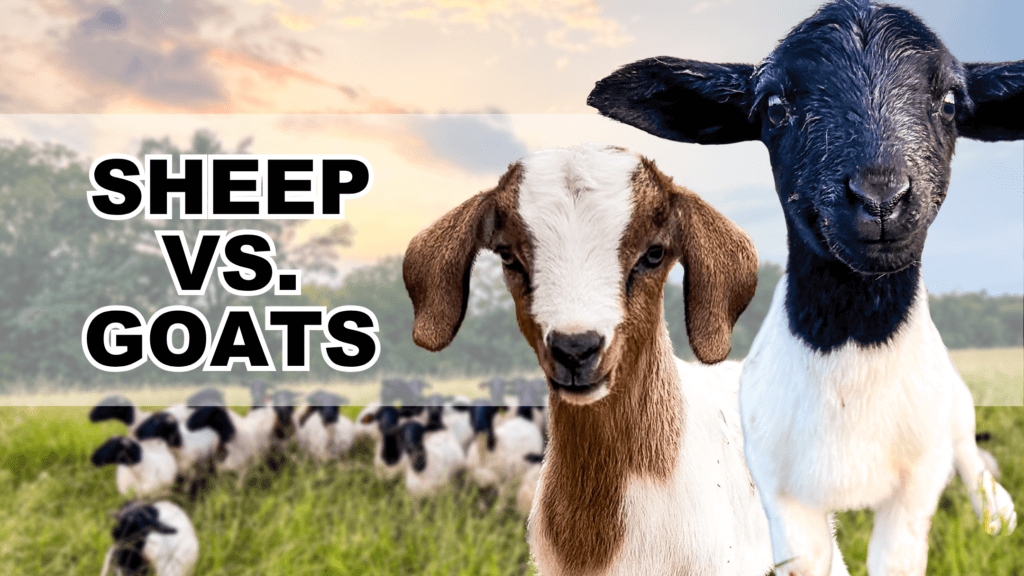
Hi friends,
If you’ve wondered whether to raise sheep, goats, or both, I wanted to walk you through how I’ve made these decisions on my own farm. I currently run purebred Dorper sheep as my primary enterprise, but I also keep dairy goats for my own personal use.
In this episode, I’m breaking down how sheep and goats behave differently on the land, their different mineral needs, common health issues, and the best meat and dairy breeds for each. I’m also sharing why I prefer sheep for meat and goats for milk.
Whether you’re just beginning your farming endeavor or deciding if it’s time to diversify the livestock on your land, my hope is that this discussion gets you started in the right direction.
-the Shepherdess
TRANSCRIPT
the Shepherdess Thank you so much for being here tonight at Sheep vs. Goats. Tonight’s theme is Sheep vs. Goats. I’m going to be breaking down from my experience and from my time raising both some of the differences—some of the pros, some of the cons, and some of the reasons why you might choose one over the other for your farm or homestead. If you’re in the decision-making phase thinking, should I raise sheep? Should I raise goats? Should I raise a little bit of both? Tonight we’re going to be discussing it from four different angles. We’re going to be talking about sheep versus goats in respect to health, in respect to your land base—what is the best fit for your landbase—and even at the end, we’re going to be discussing some breeds for both milk and meat sheep.
Building a livestock system with scalable principles
So thank you guys so much for being here. Tonight I’ve got a very specific theme which is sheep versus goats, but there are a lot of veterans in the comments section. This is really a networking event, so if you have a question connected to anything farming or homesteading, we have a lot of really experienced people here who are very interactive in the comments section. So drop your questions throughout, whether it’s connected to the slideshow that I’m getting ready to pop up regarding sheep and goats or not. And if I can just ask the people that are watching: be watching for comments that you can respond to. Be watching for questions that you can answer yourself. I’m going to be staying pretty focused on the content. I’m going to be focusing on getting through the slides, so if you could help me in the comment section by answering those questions, that would be great.
All right, Sheep vs. Goats for a homestead or farming operation. I’m going to be breaking it down for you tonight in four different sections.
Number one, I’m going to be talking about sheep versus goats on the land from my experience—what they eat, what they utilize, and what land bases or what areas of your land fit sheep better and what fits goats better. Then section number two, I’m going to be tackling nutrition—talking about some specific nutritional needs connected to each species. And then in number three, I’m going to be doing the same thing with health—talking about common health issues you may encounter and some variances between sheep versus goats. And then at the very end, I’m going to be talking about breeds: meat sheep breeds, meat goat breeds, milk sheep breeds, and milk goat or dairy goat breeds. So we’re going to really be covering it all tonight. And if you have any questions throughout, just make sure to leave them in the live chat, and I will do my best to get to you.
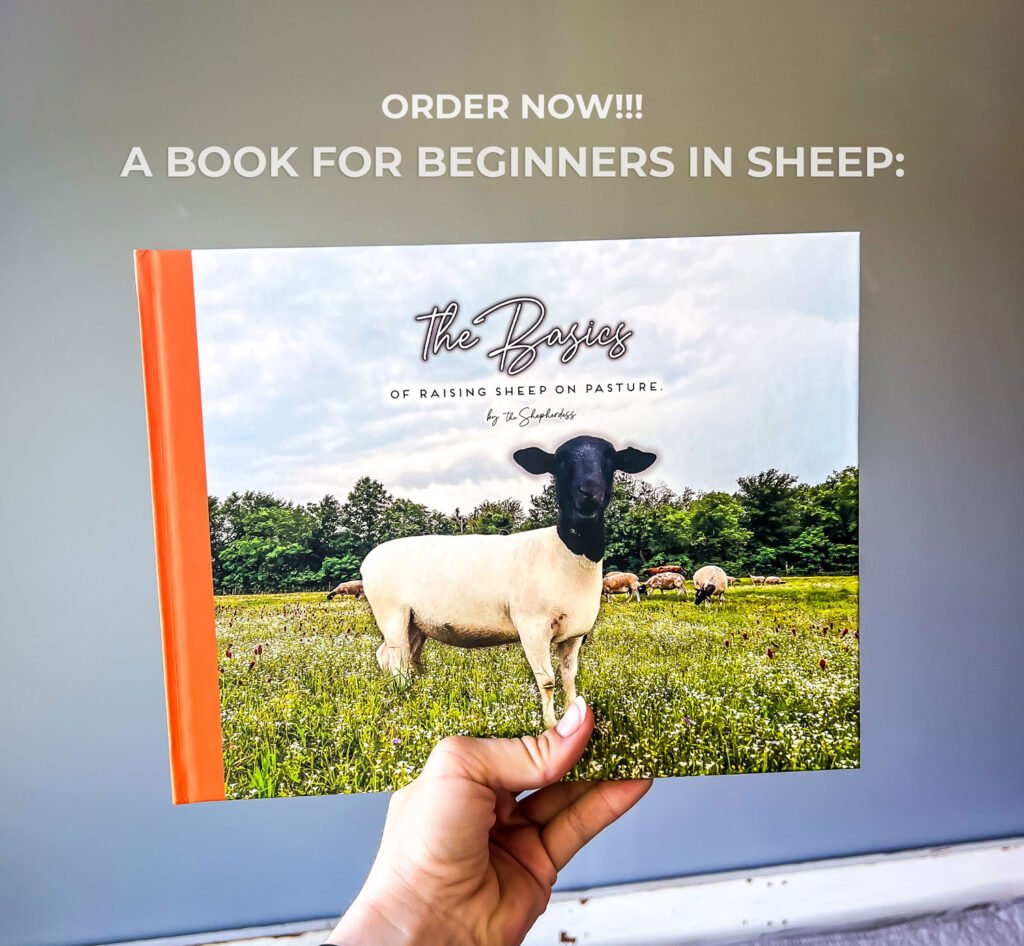
If you’re a beginner shepherd on 30 acres or less, then I wrote a book for you: The Basics of Raising Sheep on Pasture. Available at Shepherdess.com with free shipping. Raising sheep on pasture requires a basic understanding of pasture management, breeding and lambing, and mitigation methods for common disease. I walk the beginner shepherd through each aspect, sharing through this book vivid pictures, easy-to-follow instructions, and personalized stories from my own journey with sheep. Available with free shipping at Shepherdess.com; you’ll find a direct link in the description.
But a quick about my farm. A lot of you guys have been with me for quite a long time, but some of you are new in the room. As a primary enterprise, I raise purebred Dorper sheep, which are a meat sheep. But on the side, I do have a small herd of dairy goats. I use these primarily for personal use and for sort of small scale land clearing needs as we’re going to get ready to talk about in the slides upcoming. Goats are really unique and powerful in terms of how they utilize certain parts of the land. I am working small scale on 30 acres of leased land. Which is small scale for most, but larger scale for a lot of you who are in here. Some of you guys are working on maybe two, three, some of them as little as one acre, seven acres, and it’s really my goal to present principles that are scalable, meaning principles that can apply to whether you’re working on 300 or 3000 acres, or you are working on as little three acres. A lot of the principles and a lot of the things that I present in my live streams are what is called scalable, and that they’ll apply really no matter what scale that you are working on.
But I’m working on 30 acres of leased land and drop in the comment section, guys, what is the size of your land base that you’re working on right now? I’d be curious to know what we’re looking at tonight. But I am here in Northeast Texas and we have about 45 inches of annual rainfall. It is a subtropical climate. So I love the rainfall, I love the resource, but it also does come with some of its own challenges in terms of managing parasites and being really careful with the grazing rotation to keep animals healthy, hooves healthy, and parasites at a minimum. I operate within a regenerative pasture based rotational grazing system for some of those previously mentioned reasons, and also, this system means for me little or no feed input. That’s really my goal overall in farming is to have as little input as possible—working as close to the land resource as possible so that I don’t have to feed my animals out of a brown paper bag because in my experience, once that starts, it becomes very hard to make any money at farming at all.
Beginner learning curve and finding mentors
So I started farming in 2020, and at that point I had absolutely no background in agriculture. I was actually coming from a background in digital marketing and retail management, but I really felt compelled to get back to the land. I sort of challenged myself and I wanted it to be a full-time gig, but I told myself that no matter if it became an opportunity to earn a full time income or not, I needed to generate some sort of food source for myself, for my family, and to really focus on food security. So at the base level, that is my heart. That is my motive. And as a beginner, I hit a lot of learning curves. I think as a beginning and especially going into agriculture, you’ve got a lot of people coming in from four and five generations back. And a lot of the things that are known are coming as a result of generational knowledge.
So when I jumped into farming, I felt like I was trying to climb a ladder but the first five rungs were essentially not there. People in agriculture just assumed that I knew too much. They were unwilling to explain things to me, for the most part, at the very, very base level. I have to say I found a few really amazing friends and wonderful mentors who were able to kind of baby step me in those first five rungs and provide that education for me. But when I jumped into creating resources online for people, it was my goal and my heart to just be the first five rungs of the ladder to help people into this arena because we need more farmers. That is really, really what I believe. I actually wrote a book: The Basics of Raising Sheep on Pasture available at Shepherdess.com, really intending to be the first five runs of the latter for anybody jumping into sheep. And as a side note, the book, a lot of it also applies to goats as you’re going to find out. You can buy the book at Shepherdess.com. I am signing the first 10 copies that sell after the live stream tonight, so make sure to jump in if you have not already bought the book, and get a signed copy tonight.
But that is a bit of an intro on me. And Eric says he’s working on 35 acres. Cassie is just shy of four acres. Veronica is working on 300 acres. William is working 80 acres in Texas. Lois is working on three and a half acres. Brad is working 508 acres. This is excellent. We’ve got a good broad spectrum here. All right. Timothy says, “How did you find a mentor?” I just really have to give God the glory for putting those people in my life. My mentor literally came to my doorstep. And I share a lot in terms of my testimony as a Christian in agriculture, and somebody jumping into this believing that it was what I was supposed to do but not knowing how to do it. The first mentor that really was someone who pointed me in a regenerative path was a book, and it was Joel Salatin’s Salad Bar Beef. I went to Google and I looked up how to raise grass-fed beef. Because when I first started—it’s a bit of a rabbit trail, I’ll get back on topic here soon—but I wanted to raise grass-feed beef. So I went to Google and searched how to raise grass-fed beef, and found the book Salad Bar Beef by Joel Salatin.
The second mentor that I had was my neighbor. Literally, he was 15 miles up the road, and his wife and his son just came to the door. We had just moved here, and came to the door and had a welcome gift for us, and we exchanged numbers. I knew he raised cattle, and he found out that I was a young person who had an interest in livestock, and he just immediately started pouring into me. Not in a rude or imposing way, but every time I had a question, he was there to answer it. And so that was the second mentor, a neighbor. And then from there, Timothy, anytime I heard that people raised animals—whether they raised them regeneratively or not—I just go and find a way to sit at their feet, ask them questions, and I didn’t discriminate in terms of what the systems were they were working in, whether conventional or regenerative. I’m very regeneratively minded in my systems, but that was how I started. I just asked questions of anyone and everyone who would give me their time, so that was it.
A bit of a long story, but I know there’s a lot of beginners in here. And then that was really the heart behind a lot of the resources that I started to create myself, just knowing that there was a gap. The first five rungs were missing, and I tried to be that as much as I could. I told my sister the other day—again I’m going to jump into the slides I promise—but I feel like what I’m doing is I’ve just tried to run a relay race. So as soon as I receive information, I try to make it available to others as a means of sharing. So I’m going to get back to it. Thank you guys for being here. We are going to go ahead and jump back into the slides. But here’s a little bit about my goats. A lot of you guys may or may not know that I do raise goats alongside my sheep. The goats are really just for personal use, but my goats are a French Alpine base. They are dairy goats, and I love to have the raw milk source for myself, my family, and the orphan lambs as well. Any extra goats will be slaughtered for personal consumption. Sometimes I will sell the extra kids as live animals as well, just depending on the season.
And every generation, I will cross a new dairy breed into the flock. It’s not necessarily a deliberate strategy. It’s essentially based on what I have available to me in terms of male goats in the area, but the hybrid vigor that this has contributed to the herd has made my goat herd very, very hardy. They’re not purebred by any means, but I do try to keep it dairy entirely, and so that is the context in which I am speaking from experience. And I am sharing based on personal experience here. Every context, guys, is going to be different, and you’re going to get into goats, and it may look different for you. You’re going to look different if you jump into sheep. But really tonight, my goal is to provide insight on sheep versus goats from my farm. And I want to give you a launch pad for your own decision-making process with some of what I share here, because it’s very generic and it’s a very broad spectrum application. Again, live question and answers will be at the end, so leave your comments and I will be answering them throughout.
Grazing habits, land clearing, and containment
All right, so section number one is goats on the land. I’m going to be talking about preferred forages, grazing habits and patterns, as well as containment that I use at my farm. So in my experience, sheep are very heavy grazers and moderate browsers. So if you’re thinking on a spectrum, you have cows, which are almost exclusively grazers. Then you have the sheep, which are a sort of a half and half. They will graze very heavily and they will browse very, very moderately. Goats, from my experience, are exceptionally heavy browsers and very light grazers. When I put my goats into a new paddock, the first thing that they’re going to do is they’re going to find invasive bushes or trees like this and they’re to strip them. As high as they can reach. They’re going to eat those things out of the paddock first. They’re going to go to things like blackberry vines, they’re going to do things like fence lines, clear the fence lines. And they are going to then graze after they have stripped everything else out in terms of the woody, browse-y substance on your pasture or on your fence lines.
And when I say browse, I’m referring to bushy weeds and really dense wooded areas. So you can see in this photo, this is a paddock that I created for my goat herd. It is exceptionally dense with bushes, shrubs, and vines. I could get in here with a chainsaw and clear this out, but it would take an awfully long time to manually clear this out, so I put my goats on it. And within just about a week, they had stripped every piece of green vegetation from the ground floor to what they could reach. A couple of them were actually standing on each other’s backs to reach the leaves at a higher level. But that’s just how aggressive they are, and that’s why I love to keep goats alongside the sheep. The sheep with enough pressure will probably—I’m going to say based on my flock—going to eat about 70% with enough pressure. The goats, as you can see, have probably eaten 98%. I mean, I would say 100, but nothing’s ever 100. That is really the advantage of goats on really brushy, really woody landscapes.
So I actually do not graze my goat herd and my sheep flock together. I graze my goat herds separately from my sheep, and I use them to put really intense pressure on brushy corners and edges of my land base. Brush piles like this. They’ve grazed all the green vegetation. If I want to continue to clear it, I can probably burn their residual wood there. But I will just use them to clean the fence lines, clean the corners, and graze the brushy areas. I absolutely love them for that. Sheep are very good, but again, they’re very balanced in terms of they really like their pasture, as well as their browse. So I will pressure my goat herd using electric netting. So again, I love this before and after once again, of how they’ll just absolutely strip everything. In this paddock particularly, there is a lot of, I think it’s called smart weed where I’m at. I don’t know if that’s like a slang term for it or not, but this is just a really invasive weed that comes in in boggy areas.
My goats went in, again, stripped everything from top to bottom, and I pressured them using electric netting. At my farm, that is very much a necessity. When I’m going to pressure my goats to eat everything on their plate, I’ve got to use the netting because they become very much desirous to move on, but the netting keeps them contained until I am satisfied with what they’ve done. The only thing, ironically, that my goats do not eat 100% of are the goatweed. It’s called wooly croton, nightshade in some contexts. Unfortunately, that’s just a weed I can’t get anything to eat except for bugs, but that is it. So, in summary of what we just looked at in terms of a land base, on pasture, if you have a lot of open pasture—rolling hills, not a lot trees, not a lot of brush, not lot of browse—your sheep are going to do really well on a pasture with maybe a little bit of weed pressure, maybe a bit of browse. But if you have dense brush, and you have a lot of brush encroachment, goats, from my experience, are going to absolutely clean you out of that brush and really, really thrive on that kind of a land base and in that kind of a context.
All right. I’m going to slip over here to the questions. Brad says, “Do you have issues with coyotes?” Brad, yes. So my 30 acres is cross fenced into three different pastures, and basically the pasture that is furthest from my dwelling is where I will have the coyote pressure. Typically it is in seasons where the coyotes do not have bunnies and wild things to eat. So in the dead of winter, I really have to avoid keeping my sheep back there or predators will start to encroach. I also refrain from using that pasture when lambs are very, very small. So my sheep are grazing back there right now because we’re mid-summer, there’s not a lot of predator pressure, and my sheep and my lambs are much larger. And in general, that is my rule. I should have a livestock guardian dog bye all estimations and by all suggestions, but I have tried the livestock guardian dog route a couple of times. I live pretty close to a fairly busy highway, and I’ve unfortunately lost too many dogs to the highway, and I’m not ready to commit to another dog until I can make sure he’s not going to get run over by a truck.
So that is that. I just manage my predator pressure by strategically keeping my animals in safe zones and using those riskier areas when it’s a better idea. All right, Lisa asks, “How many goats would it take to clear that in a week?” So I think you’re referring to this back here. Lisa, this was about one week, and I think it was around, I want to say 10 goats, but that was including the babies as well. So it really does not take a lot of goats to do work like this. And again, if you had a larger acreage, you could easily scale up this kind of land clearing just with a few more sets of electric netting and obviously a few more dozen goats, but they just are absolutely incredible. All right. Another thing that you want to be really considerate of is that when goats are browsing over grazing, it really mitigates the parasite pressure.
We’re going to talk about it in the health section, but with goats and sheep, small ruminants in general, parasites are going to be one of your primary management challenges. But with respect to goats, if you can keep them on a lot of browse where their head is up and grazing on things up above their shoulder level, they’re not eating on their parasites. Parasites come out of manure, and manure lays on the open pasture and crawls up the grass blades there. But when you have browse and you have goats and sheep eating a lot of browse, the parasite pressure is going to go down with that. So it’s something to keep in mind that if you put your goats on a pasture, if you opt for goats even on a more pasture oriented land base, you’re going to have to watch for parasites a little bit more than if you were to utilize them on a brushy or a woody area.
I want to talk a little about containment in this section. Again, in the context of my farm, I have a very tight perimeter fence that really keeps sheep and goats in both. It’s a six-by-six inch woven wire perimeter fence around my 30 acres. I mentioned predators just a bit back, and really this is so tight that it keeps a lot of my predators out. Not all of them, they can dig under, but essentially, if it keeps sheep and goats in, it keeps a lot of your predators out, and that’s what we found at least. But this is the perimeter fence of my 30 acres. It’s six-by-six inch woven wire, and we just installed it incrementally as our budget allowed. We did our first pasture, which was 10 acres, our second pasture, which was another 10 acres, and as we could afford it, we did our third pasture. Eventually all 30 acres were fenced in for sheep and goats.
In terms of the portable fencing for goats to move them around and utilize those brushier areas and pressure them into eating, electric netting is my go-to for goats, especially when I’m going to be putting a lot of intense pressure on them, like I have shown in those previous photos where they absolutely cleared that brush out. For me, it has to be electric netting. I’ve seen some people have success with maybe three strands of electric wire for goats. I’m not one of those people, but to me it’s absolutely worth it to set up some netting in order for them to get the job done. For my sheep, it’s a different story: I have them trained to two strands of poly tape, and that’s what I use for my sheep paddock. With these poly tape paddocks, they are much easier to put up and take down. I put one at about 6 to 8 inches, which is essentially in my mind—I like to think like a sheep when I’m laying these—it’s too low to sneak under or they’re going to get it in the nose, and too high to comfortably jump over. So for my sheep, that’s about 24 to 30 inches. So 8 inches, and 24 to 30 inches approximately on these two lines. And for sheep, two strands of poly tape typically does it for me.
And that is because in my experience, sheep have been much, much easier to contain than goats. That’s a major pro in terms of my sheep. And this is both in the context of electric fencing and hard fencing. There have been some days where I have found my goats out—if I’m honest, in the neighbor’s yard or on the road—and I’m like, how in the world did you get out? And my sheep would have never found the hole or climbed over the patch of fence that my goats did. So in the context of containment, when it comes to hard and electric fencing, my goats have been harder to contain than my sheep. For those who have raised both species and can confirm or deny my assessment there, comment in the comment section with what your experience has been. But for me, at least, I’ve got to basically put my goats on lockdown wherever they’re at.
Picture this: you are looking out over your 5, 10, maybe 20-plus acres. The sun is setting, and your flock is grazing across a green pasture. Something inside you affirms this is real wealth—at least when it comes to material things. You know how to take care of your sheep, your grazing system is improving your land, and you have a way to direct market each lamb that is born. This is how I feel when I look at my flock, and I want the same for you. So, I put together a free one-hour class that answers some of your most frequently asked questions concerning how I raise, rotational graze, and market my sheep for $480 per head. Go to Shepherdess.com/480, or simply click the first link in the show notes of this podcast to sign up and receive the free on-demand class. What’s more is that I will follow up over the course of three days, providing you with even more free resources—including a free ebook, a free grazing sheep kickstart guide, and a free marketing sheep kickstart guide. This information is worth paying for, but I’m giving it to you for free. Just go to Shepherdess.com/480, or simply click the first link in the show notes of this podcast for how I raise, graze, and market my sheep for $480 each.
All right, I’m going to scan here and see if I’ve got any questions before I jump into the next section. Theresa asks, “How do you balance the copper requirements between goats and sheep?” Great question. It is actually coming up in section three. I’ve got the full scale answer there. Christina asks, “Will the land that the goats cleared grow back, and will you repeat the grazing process?” Yes, and Christina, that’s a great question that actually brings up a really good topic connected to goats and the browse. Browse is not as resilient in the face of intense grazing pressure. So if you want to beat back the browse on your place, you take the goats in and strip it. And very, very shortly thereafter, take them back, and strip it. And very, very shortly thereafter, take them back, and strip it. So where you want to give pasture adequate time for rest and recovery, if you want to mitigate or eliminate browse and bushes and weeds and woody areas on your farm, you overgraze it with your goats. You just overgraze whatever you want to get rid of.
But when it comes to using goats to clear land long-term of these browse-y woody species, take them back. Hit it again and again and as fast as you possibly can. And the browse-y woody species really do not respond well at all to overgrazing. It’s very easy to beat them back just through continuous grazing pressure. It’s not something you want to do on a regular pasture, but for those bushy woody areas, that’s exactly what you want to do. You want to overgraze it until it’s entirely been beat back. Slade asks if I have concerns about screwworms. Not yet. Michael asks, “What about donkeys as livestock guardians?” No donkeys for me. I had a really good word from a veteran shepherd. He had been raising sheep for 20 years. He said, “I had donkeys for a while, and they got really lazy and I started losing lambs.” And he said, “In one season, I lost, you know, 10 lambs overnight and realized my donkeys had gotten way lazier than I was happy to admit. I realized at that point in time, I needed to fight predators with predators, and I have not gone back to donkeys. I got myself two livestock guardian dogs, and didn’t go back to donkeys.” That was his advice to me. He said, “You have to fight predators with predators.”.
So that was very, very good advice. I had a miniature horse with the sheep for two years and, to be honest, he kind of abused the sheep. I would just see him out there biting, harassing, and messing with the lambs. And I think there’s even a viral video of a donkey actually picking up a kid in its mouth and just shaking it around. So donkeys do get aggressive kind of towards your livestock insofar as I’ve experienced with my mini horse and seen on the internet, and I’d rather take the advice and invest in a predator to fight predators. It’s not to say there are no success stories though, but that is my take on it. Jackie asks, “Do some breeds of sheep eat more weeds than others?” Absolutely yes, Jackie. I can’t say this from firsthand experience, but I’ve heard a lot of people say that heritage breeds like St. Croix, and there was one other, it’s on the tip of my tongue, but essentially they are better and heartier browsers. And breed to breed will have different browsing strengths, but generally sheep are less aggressive browsers than goats on whole.
Okay, Levi says, “How hard are goats and sheep to maintain versus chickens?” Levi, let’s say if chickens were level one, goats and sheeps are something like level three or four in terms of how much you’re going to step up in workload, management, and effort there, as well as fragility. If you don’t know what you’re doing, you can get chickens and they’re pretty hardy, pretty resilient; you’re not going to lose a lot of them very fast. But if you get a lot of sheep and goats and you have no clue what you’re doing, at least in our experience, you’re going to have losses and they are less forgiving than a chicken. All right. Lois asks, “What if any food supplement do you use?” I’m going to go ahead and get back to the slides because you guys are asking some really good questions that I’m actually going to answer upcoming which is section two: Feed and Nutrition. I’m going to be talking about nutritional needs unique to both sheep and goats.
Nutrition, minerals, and parasite management
All right, top of the list is copper. Now, sheep and goats, as I’m going to reiterate here soon, are very similar in terms of their nutritional requirements. Very similar. But there are some key differences you need to pay attention to if you’re going to raise one or the other or both together, and copper would be at the top of the list. A goat’s need for copper far exceeds that of sheep. For example, I will give each of my dairy goats copper bolus about two to three times per year. Now that has a lot to do with my region as well. I believe we’re a little bit copper deficient here where we’re at, so two to 3 boluses per year. Some of you guys may need only one in your area, but look for symptoms of copper deficiency to know when you need to supplement your goats and do it as necessary. I do give my sheep, my Dorper hair sheep one copper bolus per year as a matter of something I decided to do. It’s a whole different story, but just as sort of a parallel and an example here, my goats need about two to three per year. That’s just how much they need copper.
And I will administer these boluses with a balling gun. Let me get a real life example here for you so that you can see. Meanwhile, raise your hand if you already have used one of these in your flock or in your herd. I’m going to try to get a little close up for some of you who are watching. So these are what I will give. These are four gram Copasure Goat Boluses. I actually have these available for sale at my supply shop at Shepherdess.com. I also have the balling gun available for sale at my supplies shop at Shepherdess.com This one’s definitely had a few miles put on it, hence the teeth marks. But this is going to be something that you administer orally. And you need to be prepared to do this for your goats unless you’re heavily supplementing their minerals, and even then, you can often face deficiencies and they’ll need a bolus like this. But this is just a little pill or quite a large pill actually. It’s full of copper particles, and I will give it to my animals using a balling gun. And I’m going to put it down the left side of the mouth and it’s going to go just straight in.
And as you can tell by the marks here, they like to chew on it a little bit as it goes down, but just put it far enough back in there just to kind of go over the tongue with it. And then you want to squish it out just like that. And that was the demo live. But you can find these at Shepherdess.com. I also give these to my sheep as an anti-parasitic measure, also due to the reality that black sheep do need more copper, characteristically than the wooly white versions. It’s just a breed thing that I started doing for my flock and it’s helped a ton with parasites. But that is a great way to get your copper in. Carla says she also uses a piece of a banana to get those copper pills down her goat’s throat. All right. Minerals are another difference between sheep and goats. Typically, the minerals for goats will, again, have a much higher copper content than sheep.
And what I do for my flock, since I am running a mixed flock and providing one mineral to all, I just feed a sheep mineral, and I will supplement for additional copper needs with those copper boluses. So my goats get a sheep mineral, and my sheep get a sheet mineral to avoid excess copper for the sheep. And if my goats need extra copper, I will just give it through an extra bolus. This is a personal management decision that I have made, so make your own decision for yourself. But this works really well because if you’re raising sheep, copper toxicity is a thing, and feeding the minerals with really high levels of copper in it probably could end up in some dead sheep. So for the minerals, if you are raising only goats, it’s very advisable to make sure you get a goat specific mineral. I use Redmond for sheep, and then they have a really excellent goat mineral as well. So keep that in mind. Those are your options for minerals, but copper is a consideration in the minerals for sheep and goats.
Otherwise, similar feed requirements for both breeds. Aside from the copper and that browse versus forage preference in grazing, goats and sheep’s nutritional needs are very similar. In fact, I actually feed my goats and sheep the same when I do have to provide feed supplements for them. Another thing I will mention just really quickly: I mentioned I am forage based, but occasionally I will buy a feed supplement if it’s an emergency situation. Just know that, again, a lot of goat feed is going to have a lot of copper in it, and it will not be suitable for sheep, and you need to pay attention to that. Make sure your feed is sighted as suitable for sheep and goats, or else you could hit some toxicity issues when you are feeding.
All right, so here’s a bit of a caveat: feed requirements are the same, but because my goats are dairy goats, they will receive a supplement at the stanchion. So my goats will receive, when I’m milking them, about three quarters to a pound and a half of feed supplement in addition to the pasture that they’re grazing. And they’ll be given this at the milking stanchions. It helps them to stand still. It also keeps them in good condition so that they continue to provide an abundance of amazing milk for me. This mix, this three quarters to one and a half pounds of feed, it is a mix of 40% goat feed pellets, 40% alfalfa pellets, and 20% black sunflower seeds. That’s my personal dairy mix, and this is in addition to the full-time access to forage. This just really has to do with the reality that dairy animals do have a much higher nutritional requirement. If you do forage only, your yield is going to be a lot lower, and your animal’s body condition—especially for those high yielding dairy breeds in the goat arena—will potentially wane. So it’s going to your decision. If you want to go forage-only, you can do that, but I do choose to supplement my dairy goats at the stanchion. But for my sheep—they are meat sheep—they do not receive any supplement as a rule. My flock lives on pasture, eats grass, and is supplemented only in case of an emergency.
All right. Katrina has a question here. She says, “If the land you have is predominantly pasture, is there a way to do this successfully without the preferred browse option?” So Katrina, if you have predominantly pasture, you may be looking at a land base that is better suited for sheep than it is for goats. But if you want to raise goats, they will eat grass. You’re going to have to watch for more parasite problems in those goats because, again, like I mentioned earlier, when they’re browsing, their heads are eating above their shoulders, so they’re not grazing on their parasites. When an animal’s head is to the ground, eating off the ground, it’s going to be eating parasites. So keep that in mind. Your parasite pressure is going to be higher. A lot of times people will also say that the sugar content in grass can mess with the goats hoof structure and quality of the hooves long-term. So keep all that in mind. It’s not that you cannot raise goats on predominantly all pasture. It’s just that sheep are a better fit.
And my friend, Karl Ebel, who was my first mentor, he launched into ranching raising goats because he had nothing but woody, brushy land. And he said, “My goats eventually ate themselves out of a habitat.” And he downsized his goat herd because they had eaten and beaten back that brush to an extent where his pasture was opening up. And he also started to encounter more health problems with those goats once they had eaten all the brush off of his land. They started grazing more and he started having really, really big problems with parasites. So what he did was he downsized his goat herd and increased his cow herd, which was his plan all along. But once they ran out of the browse, their health problems started to elevate. So that was a bit of a testimonial from my rancher friend there that may help you make your decision, Katrina. Timothy says, “I thought I saw on your website that there was a price for one hour of consulting, but I don’t see it now. Do you do that anymore?” I never did offer that, no, and still don’t. I try to provide these live streams, but at this time I don’t offer any one-to-one consulting.
Levi says, “Would you say that you’re happy with your dairy goats, or would you want to get a dairy cow after raising 10 plus dairy goats?” Levi, I’m actually so happy with my dairy goats, and it’s for reasons I’m going to explain at the very end. But I’ve considered getting a dairy cow, but there’s too much milk in a dairy cow for me to use. A dairy cow puts out somewhere between two and four gallons a day. I know that’s a lot of milk to handle. My dairy goats put out anywhere from a quarter to a half gallon a day, it’s a much more manageable amount. So while I’ve considered it, I just don’t think so. And plus if I was to get a dairy cow, it’s a much larger animal. If it starts to have health problems, I would need special equipment to handle those things. If my dairy goat has a health problem, I flip it on its back, I treat it, I get it up and going. So it’s just a much more manageable animal size-wise. And the way that I process the milk now, I mean, it is so good. Now, the first time I tasted goat’s milk and experienced the full fledge of it, I did want to kind of throw up, to be honest. So everybody who’s sitting there saying it tastes rancid, you’re right to an extent, but I’ve gotten my processing down and it is absolutely sweet and delicious. I love goat’s milk, so we’ll be talking a little bit more about it at the end, but that’s your answer to your question there, Timothy.
All right, so we’re going to talk about health here. When it comes to health between sheep versus goats, both goats and sheep are susceptible to the same parasites. The same worms. The two primary worms that you want to watch out for are the barber’s pole worm and coccidia. Those are going to be your two primary challenges. As a technicality, coccidia is an oocyst and not a parasite, but it’s treated and managed much the way. So when you’re dealing with sheep and goats together, they share parasites, and they trade parasites. They are not at all helpful to one another in terms of parasites. I know that a lot of people will graze cows behind sheep to minimize the parasite loads. Sheep and goats really have no benefit to one another when they’re grazing together. Now, I have often heard that goats are more sensitive to parasites and coccidiosis than sheep. And what I have found personally firsthand, is that as a rule, if my goats are on a pasture-only setting—again, no browse—they are more sensitive to parasites than sheep. However, with plenty of browse and when I use my goats really as land clearing in those woody areas, they thrive and I don’t have a lot of parasite problems in them above the sheep at all.
Meat and dairy breed selection
Another thing is that my goat herd is really, really hardy as a result of essentially just being mutts, so as a rule, they’re hardy because of all the hybrid vigor that is in them from constantly cross breeding. Hoves on sheep versus goats. I will trim my goat’s hooves annually, and I will turn my sheep’s hooves maybe once in three years. My sheep’s hooves really don’t need a lot of maintenance, thankfully, at all. My goats do need that once a year trimming. And keep in mind, this is because I do supplement them at the stanchion. They are dairy goats and so that grain and the feed that I do give them there, I suppose does increase that hoof growth because that’s really the only factor between my sheep and goats that is different. But hooves are something you need to consider, especially if you’re going to be giving feed supplements. Okay. We’re going to round the corner here. Section number four, to breed and product. We’re going to be talking about breeds, and the two products we’re going to be dealing with here are meat and milk. So we’re going to be talking about breeds for meat and breeds for milk when it comes to sheep and goats.
So when it comes to dairy goats, common breeds are French Alpine, Nigerian Dwarf goats, Nubian, and Saanen. Now these are four really, really well developed breeds here in the United States. These are not the only dairy goat breed available, but these are the dairy goat breeds where the genetics are plentiful, well developed, and really, really good. I mentioned personally, I have French Alpine as my base, and I have crossed in Nubian. If I’m a hundred percent honest, I first crossed in Boer goats in that first generation simply because it was the only buck that I could find, and I actually really liked the kids out of them. The does produced a lot less milk, but it was super high butterfat content and it was actually pretty good milk overall. But I wouldn’t necessarily advise crossing a meat goat over a milk goat if you want a really high-yielding milk breed. But, I did it and it’s great.
Common meat goat breeds are the Boer, the Kiko, the Savanna, and the Spanish goat. These are going to be ones you want to take note of in terms of doing your research for bringing meat goats into your operation. Again, these breeds are really well developed, and really well utilized here in the United States. One of the things that was really fun for me in terms of that first generation—I crossed the Boer goat over my dairy herd simply because I did not have bucks available in any dairy breeds—but those kids were absolutely the funnest personalities ever. The Boer goat is just the funniest personality in terms of animal. Just so, so funny. So when I brought it all back to dairy and I had those kids out of the pure dairy, I mean, they were just not as fun. So, I don’t know if you guys have noticed that in terms of the Boer goat just being a fun breed to raise overall. A little bit of a side note.
All right, if you are shopping for meat sheep, common meat sheep breeds will be the Dorper, the Katahdin, the St. Croix, and I have left out the wool varieties. There’s a lot of really well-developed wool varieties that are great for meat. And some of those would be things like… I want to say the Cheviot would be a good one. The Merino sheep—that’s primarily for its wool. With the wool breeds, most of them have been bred for wool production, as well as meat production. Not all of them. It would be too broad sweeping to say that. But a lot of times, and especially nowadays, the hair sheep are getting popular if you have no use for the wool whatsoever. All right. Common dairy sheep breeds. I did not want to overlook this one. Common dairy sheep breeds that you can access genetics here in the United States would be the Finn sheep, the Awassi sheep, and the Lacaune sheep.
The struggle with the dairy sheep in the United States is that the gene pool is very, very narrow as of yet. You can find some really good genetics in the Finn sheep and the Awassi, but the Lacaune, which I think I’m pronouncing correctly, it’s very narrow. A lot of Canadian genetics, but it’s difficult to find them here in the States. Harmony Heritage Farm is a farm out of Washington State, and she has some of the best looking dairy sheep I think I’ve ever seen. So if you are looking for dairy sheep, get in touch with Lydia at Harmony Heritage Farm. I have a video on my YouTube channel featuring her. She ships all over the country. And given that it is very difficult to find dairy sheep of excellent quality, Lydia’s would be worth shipping to your farm.
A question I get a lot is: “Why do I raise dairy goats instead of dairy sheep?” And there are four reasons. Number one, genetics. As I just mentioned, the genetics in terms of dairy sheep are a bit narrow, especially in relation to the broad gene pool and options that we have in terms of the dairy goats. So, essentially, I have more options when I’m looking at dairy goats. Number two is shearing. The goats have that hair coat, and as of yet, all of the dairy breeds for sheep have wool, so that’s a maintenance issue. Number three is milk yield. As of yet, again, dairy sheep have a much lower yield than dairy goats. Dairy goats are bred for production. So you can get some top genetics where you’ve got bucket-busting dairy goats where one can provide you anywhere from half a gallon to a gallon a day. The dairy sheep, we’re still looking at maybe a quarter of a gallon, maybe more, but still the yield is much, much lower.
Number four would be the nutritional profile of sheep milk versus goat’s milk. Sheep milk is the highest fat content milk of any dairy animal. Not any mammal, period, but if you’re thinking cows, sheep, and goats, dairy sheep milk is high, high fat. Which is excellent, it’s great, but it’s not necessarily what I prefer. The nutritional profile of goat’s milk very much matches. It is very high in vitamin K. Its fat content is a little bit higher than cow’s milk, but not exceptionally higher. So just for me personally, these are the four reasons, and nutritional profile is one of them. And fun fact of the night—but major disclaimer is that I do not want you to try this at home—but dairy goats and dairy from goats is as close to the nutritional profile of human milk. So I do know where this picture came from. It is not AI. This is not an AI photo, but it’s a photo of someone supplementing an infant, which looks like in South America, with goat’s milk. And this is and was a very, very common practice to just keep goats on hand and utilize the milk as a supplement for human milk. But the nutritional profile and digestibility of goat’s milk is very, very close to that of human milk.
And again, do not try this at home. I was just fascinated by this photo and thought, wow, would it be worth keeping a goat or two on hand in case you ever had an orphan dropped off on your front porch? I don’t know. Maybe I’m the only one that dreams of those kinds of things. Anyhow, that concludes it all. I’m going to go ahead and jump over here to the question and answers, and try to get you guys answered tonight before we close out here. We are at one hour, but I’m going to make sure and get your questions answered. Leonardo says, “I’m trying to buy my first Dorper sheep, but I do not have a reliable source.” Leonardo, just keep shopping. Visit the farm in person. If you can’t visit it in person, make sure it has a good Facebook page that is transparent. It’s just a really hard market in terms of livestock in general right now. Cattle prices are going through the roof, and as a result, sheep and goat prices and availability are kind of following it up because a lot of people are going for sheep goats as a cheaper option, but it’s still driving the prices and demand up. So I don’t have a lot of answers for you. Just keep shopping and don’t quit.
Timothy asks, “Do you have to milk the goat every day like you do a cow?” And the answer is yes. When I am milking my goats, I’ll make sure and do it every day. The caveat would be a kid sharing situation like you would leave a calf on the mom. You would leave the calf on the mom. You guys know what calf sharing is: essentially let the calf drink the milk and skip the milking, but if you do calf sharing exclusively and you’re not consistent with the milking, the yield will go down. So the answer is yes. When you start milking that goat, you need to be consistent with it until you dry her off. Pauline says, “Do you do raw milk?” Pauline, yes, I drink raw milk myself from my own goats. I do not sell it or offer it for sale, whatsoever. It’s personal consumption only at my farm. Timothy says, “I’ve been hearing a lot about the Australian white sheep. Is it all hype?” Timothy, I have a video on YouTube about the Australian White sheep, and I definitely would check it out because it has a lot of information about it. This woman raises them and has a direct to consumer meat sales business with her Australian White sheep, but she did start with a Dorper base. So it’s really honestly a cross between Dorper and Australian White, but they’re really beautiful animals.
Okay. Carly says, “Is there a dairy goat breed that does well in the heat of southwest Florida?” Carly, I can only say what does well for me, and basically my Alpines do really well. I crossed them with Nubians, and that cross did really well. And I’m in a very similar climate—very, very humid and hot northeast Texas. April says, “Goats and sheep’s milk have saved many babies whose mamas died.” Yes. Again, that is not a recommendation or I’ll probably get somebody after me, but I did hear that goat’s milk is the recommendation as the replacement and supplement for human milk. So it’s pretty amazing to think about. Larry says, “Thank you for providing so much valuable information in condensed time. I appreciate you sharing your experience.” Thank you, Larry, for coming tonight. Carla asks, “How often do you shear your sheep?’ Carla, my sheep are hair sheep. I’ll give them a little haircut every once in a while if somebody builds up a little bit of wool on their back, but technically you should not have to shear your hair sheep.
Andres says, “What brand of equipment do you use for your sheep’s electric netting?” I’ll use the Premier 1 Electric Netting. I use the cheapest one that they offer with the larger squares, and those seem to work out really well. Cindy says, “What’s your process to process? And do you make cheese?” Cindy, for now, I just drink it all as straight milk. I’m working on the cheese thing, but not a lot of success yet. If I had more milk than I probably would, but for now it’s what it is. Lisa says, “As a preemie, the only thing I could drink was goat’s milk.” Robert says, “With your high grass, do you have problems with ticks and chiggers? Chiggers, yes. Ticks, not as much this year as I expected. There’s been a lot of people reporting ticks epidemic across the country. I’m thankful that I don’t have a lot of ticks. I found maybe one or two on my sheep, and I’ve been checking diligently on myself and have found none yet. So that is that. Thank you guys so much for being here tonight. Again, don’t forget The Basics of Raising Sheep on Pasture is available at Shepherdess.com with free shipping. I appreciate you all so much. Thank you, guys.
Leave a Reply