 by
by 
Hi friends,
One of the most important decisions you will make in sheep farming happens before you ever buy your first animal. The breed you choose will affect everything from parasite resistance and carcass quality to how well your flock performs in your climate long term.
In this episode, I am answering your sheep farming questions and walking through the pros and cons of several popular hair sheep and wool sheep breeds. I also share what to look for when purchasing breeding stock and why quality genetics matter so much if you want to build a profitable pasture-based operation.
We also dive into practical breeding and lambing management, including why I strongly believe in lambing with the grass, preparing your ewes before breeding season, and building a mineral program that supports flock health from the ground up.
-the Shepherdess
TRANSCRIPT
the Shepherdess Thank you so much for being in the room tonight. Tonight is a small group meetup, and I’m really excited because these small group meetups kind of allow me to have real conversations with you guys. I love the farmer meetup, so I’m excited about these small groups so that I can get your questions answered. If you guys are having any questions about the curriculum, the classes, or the nine-class bundle. Which, by the way, thank you so much for purchasing it and participating in it. It supports my work in a huge way to have these paid classes, because it allows me to really continue to invest at a high level on everything I do. So thank you for being a part of my work through supporting that.
Tonight, again, guys, I’m just going to answer your questions, but I’m also going to talk about breed selection. Some of you may already have selected your breed. But tonight, if you are still in that planning phase of planning your flock, of deciding what the next step is that you’re going to take, I have six breeds on the list tonight that I’m going to walk you through. These are just going to be from a personal perspective. I’ve got two categories. Number one is the hair sheep, which you all know that I have gone for the hair sheep, and then category number two is wool sheep. And I’m going to walk you through three of each of those breeds for your consideration. I’m going to also be pulling a lot of information from Storey’s Guide to Raising Sheep on these particular breeds. If you guys have a copy of this, I will leave the page references so that you can go read up a little bit more in depth. If you don’t, you can buy your copy at Shepherdess.com. I’m going to be talking about breeds tonight, and I’m also going to be sharing a general overview about breed practices. If you’re new in the room, guys, I’m taking your questions tonight, so leave them if you have any questions about the curriculum.
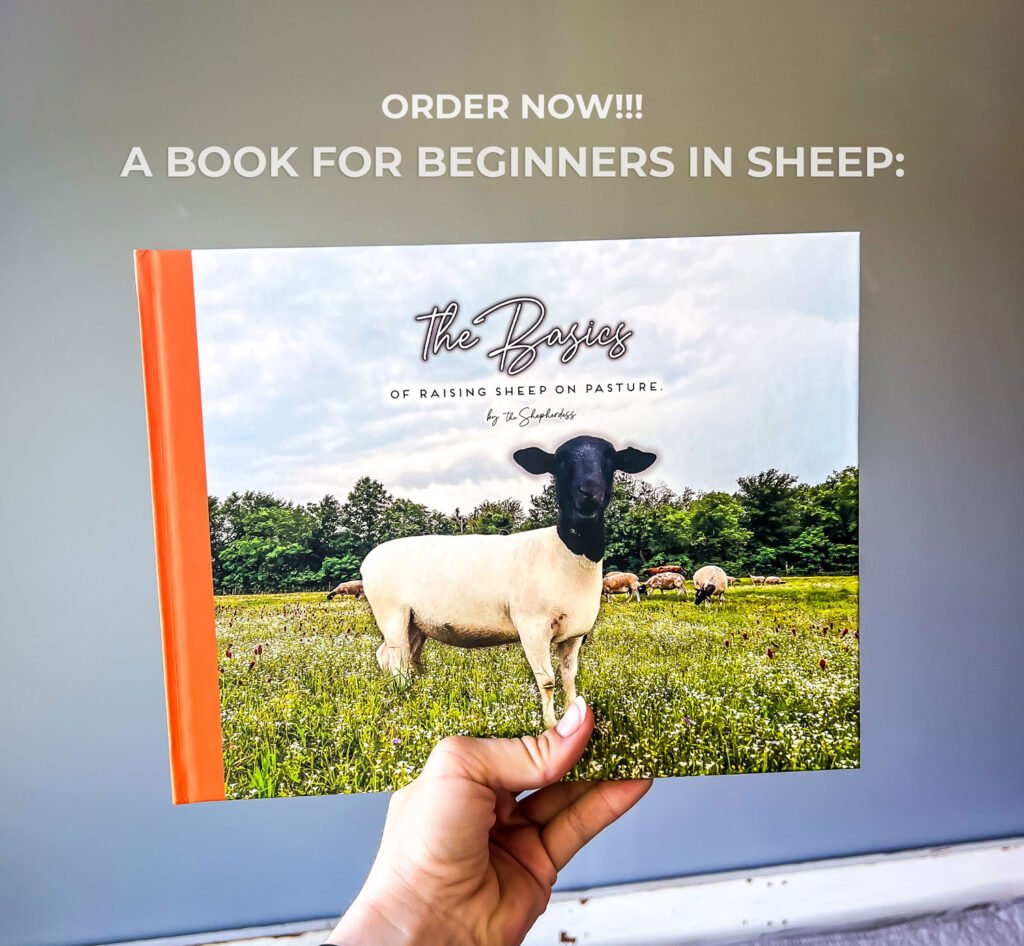
If you’re a beginner shepherd on 30 acres or less, then I wrote a book for you: The Basics of Raising Sheep on Pasture. Available at Shepherdess.com with free shipping. Raising sheep on pasture requires a basic understanding of pasture management, breeding and lambing, and mitigation methods for common disease. I walk the beginner shepherd through each aspect, sharing through this book vivid pictures, easy-to-follow instructions, and personalized stories from my own journey with sheep. Available with free shipping at Shepherdess.com; you’ll find a direct link in the description.
Choosing the right breed of sheep for your climate
I’m going to roll right into it really quickly here on the breed selection. When you are going with respect to breed selection, I am running the Dorper sheep. And a lot of people ask me, “What is the best breed of sheep to run?” And my answer is, number one: whatever you have researched based upon your climate and based upon local availability. And number two: whatever suits your goals the very, very best. Now I’m going to speak a little bit from a personal perspective here and we have the Dorper sheep. My goal is to create a desirable finished product on all grass. Being a meat sheep, the Dorper has got the best carcass of all three of the hair breeds I’m getting ready to talk to you about here. But one thing that is different about the Dorper that I am getting ready to counsel you on is that the Dorper is honestly not the best fit for my climate. We are at a really good place here four generations in. I’ve got an excellent flock. We have culled and the flock has really culled itself into a really beautiful place, and I have a flock of sheep that has really good resistance in a high rainfall area. But initially, should I have gone back maybe five years, it may not have been the best initial choice.
Hair breed sheep comparisons
I’m going to segue straight into the three hair breeds that are available. Number one is the Dorper sheep that has the best carcass for meat but the very lowest parasite resistance. So depending on your desire to use dewormers or not, I’m going to say with the Dorper, you’re going to have to use the dewormers to some extent on your farm. Breed number two—which is mid-range in the carcass size range—is the Katahdin sheep. And the Katahdin is also an excellent meat sheep. It is a hair sheep and it has a little bit more parasite resistance. I’m going to ask you guys a question tonight, and that is: What phase of the game are you in? Are you in the planning phase? Have you purchased your first sheep yet? Are you still shopping? Are you still planning? Are you in your first year? So the Katahdin sheep probably would have been initially a better fit for my climate. Now, I have to say this, you guys: even though the Dorper was not the best initial choice, it’s become kind of a blessing to have this stock that initially struggled, but we culled through those problems, and now we have a really strong breed and really strong genetics. It was a slower start. I’m going to be very honest with you—it was a slower start for us. It took about two or three years to really gain traction with the good animals that fit in our climate. But I’m very, very glad to be running this breed. And I’m really sticking tight to it.
But the Katahdin is a really good breed for a high rainfall area. You’ll see a lot of Katahdin sheep in Alabama. You’ll see a lot of Katahdin sheep in Louisiana. You’ll see them in Arkansas and the Midwest, and that is a really great fit for a little bit of a wetter climate. And it still has a really decent carcass. A lot of times what people will do is they will take a Dorper sheep and cross breed it with a Katahdin sheep to get that meat carcass plus the parasite resistance. So keep that in mind. The third hair sheep that is really well reputed in the industry right now is the St. Croix. And one thing I’m going to say about the St. Croix: it is more of a heritage breed. And when I say “heritage breed,” it is a breed that is very low maintenance. It is one of those breeds that if you are dead set on no dewormers ever, you’ll probably have the best chance of lowest losses on that kind of a program with the St. Croix. The only con or one of the cons with the St. Croix is that the carcass yield is not suitable for commercial production. Number two is the carcass yield is very small in all. One of the things you need to consider if you are going into this as a for-profit situation is the cost of processing.
I’m going to give you just a little scenario here to kind of maybe harp in on why you need to focus a little bit more on the carcass size. When you have a sheep, a good carcass will yield about thirty five to forty pounds of meat in the package. You can hit that pretty easily with a Dorper sheep. When you take that animal to the processor to be processed, it will cost you anywhere from $100 to $160 to have that animal processed. So let’s do the math here: a good carcass size is 40 pounds, and processing cost is $100—let’s average it out and just say $120—which, guys, that’s probably on the low end. That’s $4 a pound, even at a good carcass size. So if you’re looking at something like the St. Croix and you’re maybe only going to get 20 to 25 pounds worth of meat off of that, the cost of processing goes up to $8 per pound. So keep that all in mind if you’re going to this, again, for a for-profit situation. A lot of people that will raise the St. Croix will do an at-home processing to really avoid that cost.
I’m going to come over here to the comments really quickly: Mariah says, “My story isn’t as exciting as someone with a flock of sheep. I’m getting into American Breese Chickens. I’m so excited. Tomorrow I’m going to another state to pick up two of these chickens for $70 and some eggs for $90. It’s going to cost me about that much in gas money and eight hours of driving, but I am thrilled. These chickens are expensive because they’re one of the best dual-purpose breeds for both meat and eggs, but their bloodlines are excellent.” Mariah, you will never regret money spent on good breeding stock and good starter stock. I always say—you know, obviously I’m being a little bit hyperbolic here because you don’t want to go spend all your money—but to be honest, it’s very hard to overpay for good stock because it pays you back so fast. So, very well done Mariah. I traveled about a 3,000 mile round trip to bring in new stock to my flock the summer before last, and I do not regret it for a minute. It was one of the best decisions I made to actually pinpoint what I wanted in genetics, and be willing to travel the country for it and bring it back to the farm. So, it’s already paying for itself.
Wendy is in the planning and researching phases working on property perimeter fencing. Eric says that in his area, it’s about $150 to process a sheep. So keep that in mind, you guys: you want to hit that good carcass weight so that you do not have all of your profit margins swallowed up in the processing fees. Mariah says, “Until I get the land, I’m raising chickens for eggs and meat (even in my circumstances) because my neighbors support my endeavors. I’m going to start with meat rabbits and breed and sell them as well this year, Lord willing. Researching sheep—love the black-faced Dorpers.” All right, Fran says, “Second year with Wiltipolls. Thirteen so far; it’s a hair breed. Here, it is reputed because it is a good carcass sheep with a sweeter-tasting meat than Dorper. They respect fences, are easily handled, are good mums, and have good feet for wet, damp conditions. I have two Dorper wethers, and in comparison to the Wiltipolls, I have found them to be the goats of the sheep world: very curious and persistent to test fences.”
Finding quality breeding stock
All right, so we have breezed through. I’m going to give you guys the sources. If you are interested in any of these three breeds and diving a little bit deeper into them, I suggest doing two things. Number one: I’m going to the breed websites. For Dorper, it is DorperSheep.org. For the Katahdin sheep, it is Katahdins.org. And for St. Croix sheep, it is StCroixSheep.org. To further delve in—say you’re shopping—I would also go to Facebook as well. Each of these breeds will have that website that I just mentioned, and they will have a breeder directory on that website. I would find a breeder in your local area. The breeder directories are listed state to state. So go find one, number one, either your area or in a region that mirrors your climate. For me personally, when I was shopping for my Dorper stock to add into the flock that I already had, I ended up traveling to Missouri. Now, it’s not Texas, obviously, but in this particular region of Missouri, the rainfall mirrored my climate in my county in Texas. So I said, I’m going to have a high level of success bringing that sheep back to Texas. And so you want to either look for a regional fit, as in very close to where you are at; or number two, look for a region that mirrors yours as far as rainfall, annual temperatures and so forth. Primarily you want to look at rainfall with sheep.
One of the things that a 20-year sheep veteran told me—she says, “When you’re buying sheep, that sheep is going to have an easier time going from a high-rainfall climate to a low rainfall climate than the reverse.” So if you’re bringing a sheep—let’s just use myself as an example: if I’m going to West Texas, where the rainfall is only 23 inches of rain per year, and I am bringing that sheep back to East Texas, where the rainfall is 47 inches per year, I can expect that sheep to have a difficult time adjusting. Whereas if it was on the reverse side—if I was bringing a sheep from East to West—it’s going to have a much easier time. A lot of that has to do with internal parasites and I will not be shy in telling you guys that is going to be one of the biggest things that you need to manage for the health of your flock.
Wool breeds in today’s market
All right, let’s go for wool breeds: hair sheep versus wool sheep. There is a huge chasm between the two. And I’m going to say this about wool breeds right up front: wool in the past 50 or 75 years—let’s just be fair and say 30 years—wool has become more of a liability than an asset, and I’m going to give you some history as to why. In 1995, the US government ended wool subsidies, which means every sheep farmer up to 1995 was getting a check from the government per sheep for raising wool sheep. It was a wool subsidy. You guys can go do a little bit more research on it on your own, but in short, that subsidized the wool sheep market. When that ended in 1995, the bottom essentially fell out of the sheep market until hair sheep breeds were brought into the United States and developed. And that once again brought a level of profitability back to sheep farming because wool breeds and wool sheep—the process of shearing became more of a financial liability than an asset. The cost of shearing those sheep and finding a market outlet for that wool is more than you’re actually going to sell the wool for, and that’s just with the rise of synthetic fibers.
Now, that said, I want to be very careful because I have a lot of very good friends who have done something absolutely incredible: they have flocks of about 50 or 60—they shear them themselves and they process the fibers and direct market them through their websites. I’m going to just go ahead and give a shout out to three of these people here. But that’s what you need to do. If you’re going to go for a wool breed here and now, you need to find a niche market, you need to create a market for the wool products, or else the labor it takes to maintain and shear those sheep may burn you out and run you out financially. Number one I want to give is Busy Ewe Farm and Fibers. She runs Teeswater Sheep and does an excellent job of hand spinning that yarn, hand dyeing it, and creates an incredible product. Another one is Harmony Heritage Farms. You will find her on Facebook, and also at HarmonyHeritageFarm.com. She makes excellent, beautiful craft products and direct markets the end product. The third one will be my friend Kamden. She is a young shepherdess—she is about 15 years old—and she really impresses me. Her website is PrairieShepherdess.ca, and she runs Navajo Churro and Icelandic sheep. And again, those are wool sheep. But she will shear them and she will process them. She sells dryer balls, felted soap and hides—which I’m most impressed with. She processes all of her own hides and will sell these beautiful Icelandic hides. But that’s the mindset you need to have if you’re going to choose a wool sheep over a hair sheep today. If you’re in a for-profit situation, you need to think of how you can process that wool yourself and get it to market. Because again, in the commodity market—as a commodity—the unfortunate thing is people wear more polyester today than wool. And it’s just a declining market, unfortunately.
Picture this: you are looking out over your 5, 10, maybe 20-plus acres. The sun is setting, and your flock is grazing across a green pasture. Something inside you affirms this is real wealth—at least when it comes to material things. You know how to take care of your sheep, your grazing system is improving your land, and you have a way to direct market each lamb that is born. This is how I feel when I look at my flock, and I want the same for you. So, I put together a free one-hour class that answers some of your most frequently asked questions concerning how I raise, rotational graze, and market my sheep for $480 per head. Go to Shepherdess.com/480, or simply click the first link in the show notes of this podcast to sign up and receive the free on-demand class. What’s more is that I will follow up over the course of three days, providing you with even more free resources—including a free ebook, a free grazing sheep kickstart guide, and a free marketing sheep kickstart guide. This information is worth paying for, but I’m giving it to you for free. Just go to Shepherdess.com/480, or simply click the first link in the show notes of this podcast for how I raise, graze, and market my sheep for $480 each.
So with that precursor, that answers a lot of frequently asked questions that I receive in respect to hair sheep versus wool sheep. There are three wool sheep that I’m going to talk about tonight, and these are sheep that have been developed really well for meat production. One would probably fall more under the category of a heritage breed—better for homesteads, a little bit smaller carcass, etc. But the first one is the Cheviot. If you guys have a Storey’s Guide to Raising Sheep, you’ll find it on page 57. I have found a pretty significant number of breeders if you want to go for a wool sheep. The Cheviots—I’ve often role played with myself personally and thought if I was to raise a wool sheep, and if I found an advantage in that, I would buy and bring in Cheviots. And the American source for finding stock on that line is Cheviots.org. The second one is the Rambouillet and that is very well developed here in the United States. You want to go to the Facebook page, American Rambouillet Sheep Breeders Association. And the third wool breed that I would recommend researching is the Navajo Churro. And you can find out more about them—they are a heritage breed—at Navajo-ChurroSheep.com.
When you go looking for stock to purchase yourself, if you go the route of looking at Facebook—I highly recommend watching Facebook for shopping for sheep. I do—however, what I want to tell you to do is spend 30 days watching those Facebook groups. Do not be trigger-happy when it comes to purchasing anything from a Facebook group. Find a good one for Dorper Sheep: it is Dorper Sheep USA if you want to go look for stock on Facebook. On Dorper Sheep USA, spend 30 days before purchasing anything and watch. Pretty soon you’re going to get an eye for the good breeders versus the junk. A lot of the breeders will share their pages on there. Try to find a breeder page—an actual fan page for a specific breeder—and use Facebook as a background check. Use Facebook to background check these operations, and try to get pictures of their day to day operations. If pasture based is a priority for you guys, make sure that their Facebook page shows animals being run on pasture. It’s very simplistic.
But if you go to a Facebook page and you see a bunch of sheep on a dry lot and you intend to run them on pasture, you need to ask some questions before bringing those sheep from the dry lot to the pasture. If you go to a Facebook page and those sheep are being run on pasture, message the breeder. Ask him a lot of questions, okay? And this is for two reasons: number one is because you need to know things, and number two, if that breeder at any point becomes irritable with a lot of questions being asked of him, that is a big red flag. There was a breeder that I purchased from. I’m exceptionally happy. He allowed me to ask him question after question after question. And he said, “Please ask me more. Ask me more.” And he spent probably, I would have to say, several hours answering my questions. So just understand that that will be a litmus test. One of the worst things you can do is start your flock with stock that is not good. It’s going to make it a very difficult process at the onset, but it is equally, and even more so, as bad to add bad stock to an already good flock. So just make sure to ask a lot of questions.
Guys, “What acreage are you working on right now?” is another question for you. How many acres are you working on? The systems that I outline in Grazing Sheep 101, most specifically, are geared towards 50 acres or less. I started working on a 7-acre pasture with them. And the principles scaled all the way up to 45 acres. That’s the maximum that I have worked with. So the principles are geared towards small scale, and they will scale anywhere from 3 to 50 acres and smaller because it primarily shows you step by step the electric fencing installation and the supplies for rotational grazing on any scale. Mariah says, “The yard is 0.75 acres but I’m using the front yard as well.” Mariah, you can get a couple sheep on there pretty easily, but I’m very excited for you as far as how you are starting with the chickens as well as the rabbits. That seems like a really, really good fit.
Breeding and lambing on pasture
All right, guys, I’m going to move on to breeding practices and answering some frequently asked questions that I receive along those lines. Some of you guys have emailed me these questions, and I’m just going to go in depth a little bit with the answers that I typically provide for you. For breeding—you’re going to find a lot of information in the class Lamb for Life in the Shepherdess Masterclass bundle. It’s going to be the first class that you encounter. And there’s a lot of information that primarily surrounds lambing. A lot of people will ask me questions like, “When do you breed? When do you lamb? When do you wean?” etc. And I’m just going to run briefly here before we end out on best breeding practices. The context that I’m offering you this information in is in the context of success on a pasture-based system with limited shelter. I have found the most economic way to go about lambing is to lamb with the good weather. For me, that starts in about March. Lambing with the weather allows me, number one, to have the grass that the animal needs to thrive and continue to support that lamb and, number two, the good weather to keep that lamb from just essentially freezing to death on pasture.
The interesting thing is this year I had five lambs born off season. It was an accident. I do keep my ram on property all year round, and he broke out in early July and he bred about five ladies off season. Now, thankfully the weather was really good this year and the lambs did survive for the most part. But what I’m noticing out there is that those five moms are becoming really, really skinny. They do not have the pasture to remain in good condition. The lambs are growing really well, but they’re sucking the life out of their moms. So in order for the mom to maintain a decent condition and the lambs to grow well as well, you got a lamb on the grass. That, again, doubles back to low or no feed supplementation. And that’s going to be the highest nutritional requirement in the ewe’s lifespan—from the time that lamb is born until 30 days. Her lactation peaks at about 30 days which means, by day number 30, she is making the maximum amount of milk that she ever will, and it just tapers off from there. So make sure that you time your lambing with the grass. That is about March if you’re in Missouri, or in a freezing climate—that’s going to be probably May or June. I know somebody in here was in Colorado, but consider May or June. I think probably in Colorado, you still get snow storms in May, if I’m right.
But unless you’re working in just a chronically snowy area, typically by May, the snow is dried up and the freezing temperatures are gone. In the Midwest—I actually moved down from Kansas City, Missouri about eight years ago, where I spent my childhood, and I moved to Texas at about 18—May is when I would lamb up there. Down here in East Texas, I can lamb in March. That’s when our grass comes in really strong. Number three is to really be deliberate about your mineral systems pre-lambing as well as pre-breeding. I want you guys to kinda let that soak in. When the ram goes in, you want to have done your work in advance, about four weeks in advance. You want to make sure the minerals are all in check, you want to make sure the worms are also all in check, and basically you… Go to lamb for life. The care that you give that ewe pre-lambing—it’s about the same care that you need to apply pre-breeding. So keep that in mind that you want your ewes to go into breeding in excellent condition. All right, John says, “Yes, definitely can get snow in May in Colorado.” Wendy says, “I am going to eventually have a stationary coop, but also a chicken tractor to move around the property.”.
All right, guys, we are going to close out here if you have no questions—I want to make sure to answer them tonight. Fran says, “May have done this in the past, but could you go over the types of minerals needed? We can only get mixed blocks here rather than separate.” Yes, great question. All right, so the minerals—just in a general lineup, what sheep need, you can get this in a mineral mix, but make sure the mineral mix has Vitamin E, selenium, iodine, cobalt, iron, and molybdenum, zinc, and copper. You’re going to get a replay of this so you guys can review those, but typically if you go to your local farm store—I personally have a local farm store that does a sheep mineral mix—they’re going to mix it up with those essentials in mind. So look for a sheep-specific mineral mix and go from there. Just make sure it is dry. Make sure it’s out free choice year round, and make sure it is a loose mineral. A lot of people will caution you away from the mineral blocks for sheep because of their teeth, and so be considerate of that. All right, let’s see here—Wendy: “I heard if you’re spending money on one sheep, do it for a good ram, and then sheep or ewes. Your thoughts? Wendy, that’s actually really good advice. Make sure that ewes are not cheap because they’re sick, but yes, that’s one of the best ways you can breed up your flock on a budget—to buy a really good ram and breed up a set of moderate quality ewes.
The ram is 50% of your genetics, and so if you’ve got a ram—on a scale of 1 to 10, he’s a 9—and you’ve got a set of ewes that score a 5, well, their first set of babies is going to be a 7. You’ve just immediately brought your flock up from a 5 to a 7, just by adding an excellent ram. So yes, that is very good advice. Just make sure the ewes are not cheap because they’re sick. That’s my only advice to you. All right guys, thank you so much for joining me this evening. I’m going to close it out here if you do not have any other questions. And you can email me at [email protected] for any questions, comments, etc. I am just an email away, and I appreciate your support so incredibly much. Have a great evening, guys.
Leave a Reply