 by
by 
Hi friends,
One of the hardest parts of sheep farming is that eventually something will go wrong, especially during breeding and lambing season. Over the years, I have dealt with everything from parasites and prolapses to mastitis, selenium deficiency, difficult births, and newborn lambs that needed emergency intervention.
In this episode, I am talking through 20 actual health problems I have personally encountered on my farm, including the symptoms I look for, what typically causes these issues, and the treatments and management practices that have helped me prevent them long-term.
If you could use a few more tools in your shepherding tool belt, my hope is that this episode helps you feel more prepared and less overwhelmed when health problems arise on your farm.
-the Shepherdess
TRANSCRIPT
the Shepherdess All right, guys, I am so excited to be with you tonight. Just a little bit of a preface tonight, guys: nothing upcoming is chronic disease or ongoing problems. These are just things that probably either you have already faced on your own sheep farm or you will face in breeding and lambing. And there’s also a few zingers in here that I never, ever expected. So potentially tonight we’ll have the capacity to save you a few lives on your farm. At least that’s my hope. Let’s go ahead and get started tonight for the 20 bad things.
All right, so quick thing about my farm—if you guys are new here, we’ve got a lot of people in the room, some of you might be new—but I raise purebred Dorper sheep. That’s a meat sheep and it’s a hair sheep. They don’t grow wool. I am raising them on 30 acres of leased land here in northeast Texas. And I get about 45 inches of annual rainfall, which is quite a lot. It’s kind of perfect for a pasture-based system in that we’ve got a lot of rain to keep the grass going. I am raising my sheep regeneratively, pasture based, and in a rotational grazing system. So as much as possible, I keep them out on pasture. In fact, I could probably count on my 10 fingers, the amount of time that I actually house them. I try to keep them on pasture even when it’s cold. I’ll house them for things like freezing rain and snow, but that’s about it. Little or no feed input is my overall goal with the pasture-based system. I don’t do a lot of things like grain or sheep feed. My sheep are grass-fed. Now, that’s all to say that I don’t starve my sheep. If something is suffering or if something is raising twins or triplets, I’ll gladly give it a little boost, but for the most part, we are pasture and pasture only.
I started farming in 2020 with no background in agriculture. So I kind of came face forward to a lot of the gross things that we’re getting ready to talk about in tonight’s presentation as somebody who was so not conditioned to this kind of a thing. I say that hopefully to give you some hope. If you’re jumping into farming as a first timer, you’re going to be just fine. You can do it. And I also have to say thank you to my family. You’re probably going to see my dad in a lot of these pictures with respect to the gross things because they always have my back and they’re willing to get knee deep in it with me as well. And my goal with all of the resources that I provide online and through these free meetups is just to relay simple information to beginner shepherds from firsthand experience—the good, the bad, and the ugly. So that’s really my premise and purpose on the internet.
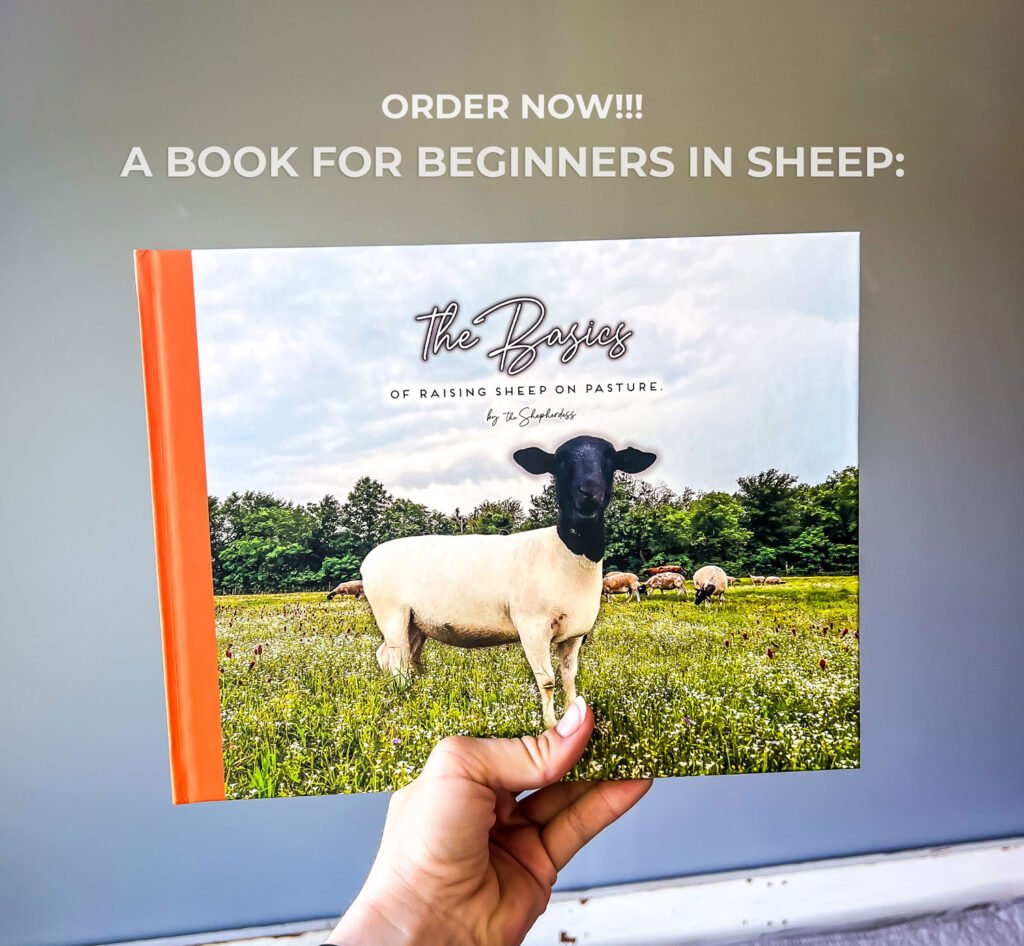
If you’re a beginner shepherd on 30 acres or less, then I wrote a book for you: The Basics of Raising Sheep on Pasture. Available at Shepherdess.com with free shipping. Raising sheep on pasture requires a basic understanding of pasture management, breeding and lambing, and mitigation methods for common disease. I walk the beginner shepherd through each aspect, sharing through this book vivid pictures, easy-to-follow instructions, and personalized stories from my own journey with sheep. Available with free shipping at Shepherdess.com; you’ll find a direct link in the description.
Just another fair warning, guys, there will be actual pictures—blood and guts upcoming. Just tune in next month if you’re not ready for blood and guts. I try to be careful how close or how big I made the pictures, but I’m just going to explain problems to you and solutions and it’s going to get interesting. I’m also not a veterinarian and the upcoming is in no ways intended to supplement or replace professional or veterinary counsel. Always consult your veterinarian as the final authority. Disclaimer number two is that chemical solutions are referenced in the upcoming presentation. I don’t want to offend anyone, but I do use conventional solutions. Thankfully, I don’t need to use them very often, but I keep a toolkit full of everything my vet recommends. And my vet’s not a holistic vet, so if you guys are offended by conventional solutions, I’m sorry, they’re going to be coming up here. The context is problems and solutions. And hopefully you don’t have to use these things very often, but it’s really important to keep them in your toolkit for when you do have to use them. With that, I’m going to go ahead and drop a button to a sheep first aid kit that I have actually assembled and sell through Shepherdess.com, and those kinds of purchases really help me to make these free meetups and offer this free information for you.
But I’m going to be explaining the problems from really three angles so that we ultimately end up with solutions. So I’m going to talk about symptoms, sources, and quick fixes. Symptoms being what these problems look like and how I picked up on the fact that things just weren’t normal, which is kind of easy, but sometimes it helps to have a specific outlay of symptoms. And then I’m going to pinpoint the sources. Every problem and every symptom has a source, and we want to really trace the symptom back to its root source for long term prevention so that we can put management in place that will mitigate these things long term. But these quick fixes are in the context of you’ve got to just help this animal right now in the moment to keep it from dying or to keep you from suffering. So those quick fixes or the supplies, like the kit that I just dropped for you. And that kit has 32 products that I really wish we would have had on hand as beginner shepherds. I’ve had people say that this is probably one of the most important investments that they’ve ever made. This is one of the easiest things that I have to sell. In fact, I feel like I’m doing people a service by letting them know that I had it. Because I had somebody ask me and they said, “Do I need everything in this kit?” And I’m like, “I really hope you do not need everything in this kit,” but having everything in this kit on hand will potentially save you a lot.
Let’s go ahead and get to it: 20 bad things—problems and solutions straight from my farm. Now, I mentioned this a little bit earlier, but I want to do it again: when we have problems, we always need to be thinking and looking for solutions. For every problem you encounter, research the source and implement long-term solutions. Yes, it’s important to have supplies on hand for emergency treatment, but if you adopt a preventative mindset that really focuses on sourcing and implementing solutions, you will soon have a farm and a flock with very few problems. And to be honest, guys, a lot of the stuff I’m getting ready to mention to you, this happened in the first two years of farming. I’m in my fifth year of farming now, and I really don’t have a lot of these problems anymore.
Common sheep health problems every shepherd should recognize
So, first on the list is pink eye. Now, the symptom is, for this particular lamb, her eyeball was growing increasingly foggy and white, and it became swollen. And ultimately, she walked around and she was just squinting that one eye and it began to weep—her eye was kind of oozing stuff. Anyways, it may also progress to where the sheep actually loses its eye. That’s a very extreme case of pink eye, but that’s kind of where it goes if it’s left untended.
Now the source of this is hay particles lodging in the eye, or maybe they’re grazing and they’re constantly being poked in the eyes by the forages. This little lamb was somewhat of an immunosuppressed lamb. She was a bottle lamb and she was in the bottle lamb pen where they were being fed hay, so I think that her low immune function combined with the conditions produced the pink eye. Now this is a fix for pink eye that is extra-label. I don’t know that your vet would recommend this, and to be honest, I don’t recommend this, I’m just going to put up a disclaimer, but it worked great for me. So not a recommended solution, but what I did was I used ToDAY for mastitis. And this was on the basis of a recommendation from another shepherd. ToDAY is an antibiotic that you typically apply into the udder of a sheep with mastitis, but what I did was I just squirted, for about two or three days straight, a bit of this ToDAY directly onto the eyeball. And I had a gloved hand and would kind of just gently massage it around and make sure it was fully on the eyeball. After about two or three days, she really turned the corner and her eye was safe. She is on pasture and she is doing great. Ashley says, yes, she’s had pink eye, but with cattle. And the interesting thing about pink eye is that you can apply antibiotics internally, but there’s really not a high success rate. So the topical antibiotic here, which is what this mastitis treatment is, was what did it for me. I just squirted it straight into the eye and she was good.
All right. So I have also had abscesses on my farm and basically the symptom is the growth grows larger and larger. Sometimes it ruptures on its own, but sometimes you actually do need to rupture it yourself. Sources would most typically be CL, which is Caseous Lymphadenitis, but there are also a variety of other reasons that a sheep can develop an abscess. A quick fix for this is simply just lance, drain, and sterilize. Now, one thing to say here, guys: Caseous Lymphadenitis is a pretty serious issue for farms. So, what I did was I tested this animal—I tested her by swab testing and blood testing as well to make sure she was not a carrier for this particular disease. Thankfully, she came back negative and this abscess, the source, was not infectious. But be aware that if you have a lot of abscesses on your farm, you may want to look into getting it tested for Caseous Lymphadenitis.
Okay, this one’s very, very gross: nasal bots. Essentially the symptom is that the nose becomes increasingly swollen—it will just grow bigger and bigger. They kind of start to look like Rudolph without the red nose, and if you’re like me, you’ll wonder what it was. Essentially, the source is a fly laying eggs in the nasal cavity of your sheep. It’s incredibly gross. Just a couple of lambs get it every year. I don’t know that there’s a way to prevent this, but it’s really not a big deal. They usually just heal up on it on their own. But basically, if you notice that the sheep is becoming exceptionally uncomfortable, you can pull it aside and once again, lance, drain, and sterilize. The middle photo is kind of a representation of what it’s going to look like once you give that a good lance, and then you want to go ahead and follow up with some iodine treatment to, you know, follow up and disinfect after that whole process. Yes, you’re very welcome. And just as a little bit of a warning: if you do go through this whole process, and then all of a sudden the lamb sneezes and sneezes out the actual larvae, apparently that’s pretty normal, and a sign of them being completely relieved of the issue because it happened. It happened to my lamb. All right, guys, warned you this was not for the faint of heart.
Emergency treatments and first aid for sick sheep
All right. So this is one that is not really gross, but it is something that probably has happened to more than one of you. But essentially the symptoms are that a heavily pregnant ewe just lies down and is reluctant or refuses to stand, she has really distinctly bad breath, and the source of this problem is she is more than likely expecting multiple lambs. It’s also called twin lamb disease, and it’s just where her body cannot keep up with the needs of her growing lamb, as well as herself. And she starts to go downhill really fast. It’s a metabolic issue, but it’s typically a result of just not having adequate feed. This is a lot of times why, in larger operations, they will scan their ewes and figure out whether they’re having multiples so that they can separate off the twins and the triplet moms, and make sure that they get a lot more of a nutrient-dense diet. So that is the source, and if you find yourself just repeatedly having pregnancy toxemia at your farm, you probably need to improve your feed program—make sure you’ve got some more nutrient-dense feed going into those twin moms so that they can support their growing lambs, as well as themselves.
But a quick fix for this, for me, has been a propylene glycol drench at a rate of 60 cc twice per day for two to three days. Simultaneously, you might want to sideline her and improve her feed quality and quantity. You want to do this as quickly as possible, so when you see them go down, you want to start in on that treatment right away. And just as a reminder guys, the propylene glycol and this drenching tool will both be in that supplies kit that I dropped a link for tonight. Basically all of the supplies that I reference tonight except for the antibiotics and stuff that you have to only get from your vet will be in the kit. So essentially this ewe, once I administered this particular treatment, she’ll be up on her feet, but you’ve got to catch up pretty quick. Now, here’s the thing, and a lot of you guys are actually mentioning it in the comments section: the symptoms for pregnancy toxemia and hypocalcemia are the same. You sometimes don’t know whether the ewe has gone down with hypocalcemia, which is milk fever, or whether she’s gone down with pregnancy toxemia.
So in these cases, I treat for both. This is based on advice from a sheep-farming veteran. He says, “The treatments are not harmful and they do not conflict with one another.” So basically give them both. If you see a ewe going down, give them both. So the symptoms of milk fever is, once again, a heavily pregnant ewe or a ewe that has just given birth to a lot of lambs. Once again, she’ll lay down and she’ll be reluctant or refuse to stand at all. The source of this is a calcium deficiency. She’s making a ton of milk either leading up to giving birth to those multiples, or she is feeding those multiples and doesn’t have enough calcium in her diet to supplement. So a quick fix is 60 cc of calcium gluconate injected under the skin. So you see me giving this injection here at the rib cage. I will give half on one side and half on the other. And once again, I will do both of those treatments. When a ewe goes down, I’ll do both of those treatments, but the way that you will know that it is milk fever and not that pregnancy toxemia is that within about a day of having this calcium treatment, they’ll get up. Toxemia usually takes a little bit longer to see results, but if it’s milk fever, they’ll get up pretty quick.
All right, this is something that was really interesting and this happened to me last year: an umbilical cord bleed. And simply, the symptom was the umbilical cord was not dry within 12 hours. In fact, what you see here on the first picture of this swollen, bloody umbilical cord—this was after 24 hours. And after 24 hours, guys, an umbilical cord should be pretty well shriveled up and dry, but apparently here it was not. So what happened was the cord was either stepped on or it was extremely long at birth, and it just dragged the ground and caused a little bit of a pull away from that body cavity and it bled. Let me know if you guys have ever had an umbilical cord bleed on your farm. So a preventative for this would have been me just spotting that extra long cord and clamping it at birth. But I don’t clamp my cords on my lambs at birth because they’re pretty much all born on pasture. And we’ve had hundreds of lambs born on pasture. This is the first time it had ever happened. So it’s not a super, super prevalent problem, but hey, it does happen.
But essentially what I did was—I did not have an umbilical cord clamp on hand, that would have been the best solution—but I tied it off with some dental floss and sprayed it down with the Vetericyn antimicrobial wound and skin care, which is in that sheep supplies kit that I constructed for you guys. You can also do iodine as well, but the point is you want to make sure and get a disinfectant on it as you tie it off. And within about two weeks it was dried and popped off. I was concerned about tetanus as well because I don’t vaccinate. I haven’t vaccinated for about two or three years, so I was watching this little guy for tetanus because of that umbilical cord having struggles after birth. Thankfully, he did not have any issues with tetanus. He’s still not vaccinated, so just a little bit of a gratitude there.
All right, so this is another great product I just wanted to make you guys aware of: it is the Nutri-Drench Goat & Sheep. Basically, if I have an animal or any situation where a ewe or a lamb is lethargic, and I just don’t know the source yet—it’s potentially a lamb that was just born and it’s a little bit sloppy and floppy and lethargic and I don’t have a specific diagnosis—I’ll just get some Nutri-Drench in it really quick. I’ll immediately give it some Nutri-Drench and then try to do a little more research and get to the bottom of the issue because this Nutri-Drench is a vitamin: it’s a vitamin, molasses, and—like I mentioned previously—propylene glycol. It’s just like an energy-vitamin supplement. It really can’t hurt to get some of this inside of your sheep when you’re just not sure what’s going on. And then do your research and get them more specific treatment, but this is like your go-to. Like, your vitamin—can’t hardly go wrong with it. So keep a bottle of this on hand.
Parasites, bottle jaw, and coccidiosis in sheep
All right. This is a little bit more of a common problem, guys: it is bottle jaw. Yes, it is an issue and the symptoms are the jaw line becomes extremely swollen and very sloshy to the touch. As you can see here, it just looks like swollen welts, and the source is severe anemia, typically brought on by advanced stages of the barber’s pole worm infection. So obviously, if your sheep are overloaded with barber’s pole worm, you know, you could have a plethora of things causing that. So to avoid that into the future, you want to make sure you’re in a good grazing rotation. That sheep just may be extremely susceptible to barber’s pole worm, so consider culling it. But here’s what this particular sheep was struggling with: she was struggling in early lactation, and that early lactation is when their bodies are the most stressed out. And I just did a poor job of timing my breeding that year. So I had a lot of ewes giving birth when parasite season was at its peak. Therefore, they were a lot more susceptible to parasites. So since then, I have moved my lambing season back to where I’m not lambing when the worms are the worst. I’m lambing when the worms are at the lowest risk. And so that has been my long-term fix and the bottle jaw is not a chronic issue. So, the quick fix in the moment is get your sheep a dewormer. And what I follow up with is what I call a rescue treatment. Again, this is an extra-label product. This anemia injection is just for pigs, but it works well for my sheep. And if they are severely anemic, then I will follow up with a little bit of Anemic 100.
In addition to this, I will also give them Nutri-Drench because Nutri-Drench is full of molasses and that is also an iron-boosting thing. And then I’ll also do a vitamin B supplement to get their bodies naturally replenishing those red blood cells and pull them out of that anemia. So I’ll deworm, and then I give this three-part rescue treatment. All of the supplies are available in the kit. And this has pretty well pulled all of my sheep out of this bottle jaw phase. Now, once you see these symptoms of severe barber’s pole worm infection, you really do need to pull out the big guns or you probably will lose this sheep. And a lot of times people have the theory of just letting it die. Okay, sometimes that will work for certain systems, but it’s also an economic liability if you have a ewe that’s raising a lamb and it dies, because lambs cost about $150 if you’re going to feed them milk all the way to weaning. So, my theory is that if a ewe is supporting a lamb and you’re able to bring her back out of this bottle jaw, she’s able to finish her job of raising that lamb. So I would try to bring the ewe back just long enough to finish producing milk for that lamb, and then you can decide to cull her if you would like. That’s kind of my two cents worth. It’s an economic decision, and then you couldn’t cull her if you don’t like how low her resistance is.
All right, so coccidiosis is another one. Really gross, but also really common. Persistent diarrhea is the symptom, and it’s going to be diarrhea that is this really specific shade of black, which is very black. You’re also going to see potbellies and you’ll see the spine kind of curving a little bit. And that’s just from its gut being clenched up so tight with pain from the cocci infection. But my favorite treatment is Total Toltrazuril. And this is, once again, an extra-label product—so not intended for human or animal consumption—but this is a product that is approved in Canada and New Zealand. And then here in the States, they just sell it as a regular product and you can choose whatever you want to use it on. So that’s what I use it for, and it works, for me, really, really well. But yeah, you’ve just got to use it at your own risk and whatever happens, happens. But again, like I said, it’s been approved in Canada and New Zealand, they’re using it over there. The only other FDA-approved option for us here in the United States to treat coccidiosis is Corid. You have to give a massive amount of that particular medicine to the animal. It’s like a three or four day dosage period. And then that Corid is really bad about depleting the animals vitamin B reserves, so it sometimes results in seizures. To me it’s just not a really good product at all.
But the Toltrazuril, which I use at my own risk, has never given me any problems whatsoever. This is a 5% and it is a drench, and it’s something that I will give if a lamb… Right now I actually give it as a preventative treatment at about six to eight weeks. So I’ll just give them a preventive dose and that’s usually all they need for their life. Another problem I had with the Corid in the water was, number one: it kind of turned the water sour and maybe it’s my sheep are snobs, but they just stopped drinking the water when I put the Corid in it, and they were not getting enough of it to run the treatment that they needed. Again, it’s not for human or animal consumption. You just have to purchase it and decide what you want to do with it as an independent person, but I do sell it on my website. The Toltrazuril has a very long withdrawal period for meat—about two and a half months. So I give my Toltrazuril at six to eight weeks. They don’t get it again, so that’s not a problem for me because I’m slaughtering at about 9 to 12 months. So it’s plenty of withdrawal time. You just need to understand that with the Toltrazuril, it is a two-and-a-half-month withdrawal if you do choose to use it on your animals. And so plan that accordingly and probably give it earlier in their life if you choose to administer it to your sheep that you’re going to eat.
So, worms in manure. I’ve had a couple of people email me and be like, “Whoa, this just happened. I just saw this on pasture,” and it is kind of disturbing. It is kind of gross, but essentially it’s visible worms in the manure of your animal. What you see on the top is a roundworm and what you see on the bottom is a tapeworm. And again, the source is: they’re accumulating these in their system from grazing on pasture. My quick fix is Valbazen. That is a drench that specifically covers the roundworm and the tapeworm. And that is my quick fix. My long-term fix… Typically this only happens to me when it’s really, really, really wet. So leave your comments in the comment section as to whether you routinely treat for these, but I don’t. It’s sort of if it’s a bad year, then I will, but Valbazen is typically the one you want to use for these things.
Picture this: you are looking out over your 5, 10, maybe 20-plus acres. The sun is setting, and your flock is grazing across a green pasture. Something inside you affirms this is real wealth—at least when it comes to material things. You know how to take care of your sheep, your grazing system is improving your land, and you have a way to direct market each lamb that is born. This is how I feel when I look at my flock, and I want the same for you. So, I put together a free one-hour class that answers some of your most frequently asked questions concerning how I raise, rotational graze, and market my sheep for $480 per head. Go to Shepherdess.com/480, or simply click the first link in the show notes of this podcast to sign up and receive the free on-demand class. What’s more is that I will follow up over the course of three days, providing you with even more free resources—including a free ebook, a free grazing sheep kickstart guide, and a free marketing sheep kickstart guide. This information is worth paying for, but I’m giving it to you for free. Just go to Shepherdess.com/480, or simply click the first link in the show notes of this podcast for how I raise, graze, and market my sheep for $480 each.
All right, foot scald. So here, we’re going to segue out of the worms and go into some foot issues. So what you see at the top is not necessarily foot scald, but typically sheep with overgrown hooves—or dirty, caked-up hooves—will develop foot scald. The hoof on the top is not what you want. The hoof on the bottom is what you want. So those are just some examples of a healthy, well-kept hoof, versus a hoof that’s a little bit in need of some maintenance. So the symptoms will be moderate limping, and it will be swollen and pink between the hooves. You’re going to see the difference between foot scald and foot rot here coming up—I’ve got foot rot coming in the next slide. But scald is sort of a predecessor to rot, so you do kind of want to get it taken care of when it’s in that very, very early phase. And for me, this Hoof & Heel product—which again is going to be in that Shepherdess Sheep Supplies Kit for you—has been an absolute wonder. I will treat foot scald and within just one application, it is almost completely… I mean, the limp is gone, basically. It’s just taken one or two applications, squirts between the hoof with this Hoof & Heel, and it is fantastic. Overall, when you’ve got that foot scald, and you have something like you see on the top here, get yourself a pair of hoof shears, but if you’ve got that foot scald, go ahead and just give her a pedicure. Make sure she gets cleaned up and that her hoof is in the best shape to perform at its best.
Here is foot rot, and thankfully, I didn’t have a picture of foot rot from my farm. I have had a few cases, so I have had it on my farm, but it’s not a terrible issue at all. Thankfully, my sheep have really good feet. But basically, foot rot is right up between… I know it’s the hoof. I like to call them the two toes. I know that’s not technical, but right between her toes, essentially, it starts to get really raw and infected. It can get very extreme at some points in time—even start to ooze and create really bad situations to where the sheep will not even stand on it. That’s rot at its most extreme. And when your sheep has foot rot and an active infection, it is not advisable to cut into that hoof until you have that infection under control. So get with your vet, but my vet typically will prescribe an antibiotic that will help the foot rot infection to subside, and then once that foot rot infection has subsided with antibiotics—and again, with that Hoof & Heel product that I really love, I’ll give them both at the same time—once that foot is cleared infection-wise, then I’ll go in and I’ll get her a pedicure.
So the source of foot rot is, a lot of times, you’ll just have a sheep with bad genetics and you want to kind of mark the ones that will get foot rot. If it’s a bad year in terms of standing water on the ground all the time, that is one reason that they might get foot rot. But if you have a sheep with chronically bad hooves, just mark her and cull her from your flock because foot rot will pass from sheep to sheep. If you have one that’s more susceptible and a carrier year after year, just it’s not worth it—just get rid of her. But again, this Hoof & Heel application is great. And once again, just a reminder of what good hooves look like here. Make sure that your sheep are taken care of in the hoof department. And ironically, this is a hoof here that has never been trimmed. It’s on a yearling that has not been fed any grain—she maybe had a handful or two—but this is grass-fed sheep, and hooves just don’t grow as severely.
Lambing complications and selenium deficiency in sheep
But this is a situation called retained placenta. Now, obviously what you’re seeing on the screen here is a placenta that is not retained, but basically when you see a sheep that has just given birth, and you see that new lamb or two just freshly popping around, you want to see this placenta dropped on the ground within, I’d say, about an hour. A healthy birth, it’s coming out 30 minutes after the lamb, but within a maximum of an hour. But if it takes any more than an hour or two for that placenta to be delivered, then you’ve got a retained placenta. This is typically a symptom of selenium deficiency. Thankfully, I have never had a ewe retain her placenta any longer than four hours. I think I had one that waited four hours, but it is indicative of a selenium deficiency, and you probably want to increase the selenium content of your mineral. So in that Shepherdess Supplies Kit I have the Redmond sheep mineral and that has a great level of selenium. I love Redmond minerals. That’s what I give to my sheep and that is what I recommend in terms of avoiding selenium deficiency.
All right. So this is, again, a selenium deficiency. This is something that I had in my first lambing and it is just, basically, a lamb is born crippled and it won’t stand and it won’t suckle after birth. If a lamb is born, you should see it up on its feet within 45 minutes. I mean, 45 minutes would be a long time. A healthy, vigorous lamb should be up within 15 or 20 minutes. But, that max—you want to give it 30 or 45 minutes to get on its feet. If it has not, and if it appears to not be able to stand, I will administer a selenium oral gel into the lamb’s mouth. And that is a great solution in terms of this particular problem. Nutri-Drench, once again, is also a great option for this lamb. Now for this lamb, particularly, I did not have the selenium on hand, so I just kept giving it Nutri-Drench until, basically, it stood. You don’t want to give it too much. You want to follow the back of the bottle dosage rate, but I gave it maximum dosage rates of Nutri-Drench, and it finally got up on its feet and went. But I do keep the selenium gel on hand now for this particular problem. And then once again, just making sure that you have that mineral. That’s going to be your long-term preventative—have that mineral that has a good selenium amount.
When I was experiencing selenium deficiency in my flock, I went to the minerals bag and turned it around, and there was only 10 ppm selenium in that mineral. Now a good sheep mix needs to have a minimum of 30 ppm. Something more like 45 ppm is what I use. And then that sheep mineral mix, I think from Redmond, it has a great selenium level in it. I do avoid the injection of selenium for very, very tiny lambs. I know that a lot of people have given it successfully and do give it successfully, but I overdosed one year with selenium on a newborn lamb, and I think I killed it, which was not a very good feeling. So I don’t do the selenium injections on newborn lambs, I just give the oral paste. This is once again, another issue that’s going to come up with selenium deficiency: this is a white muscle disease. The symptoms are that the lamb develops tremors. They appear to be shivering. So if you watch them, their heads are going to be tremoring. And eventually this lamb got to such a point that she was unable to even stand at all. And I didn’t know what it was until about a day later. And finally selenium, again, popped up. I did not know what white muscle disease was. I did my research overnight. Again, got her some Nutri-Drench to keep her and tide her over overnight. And then I gave her selenium paste the next day. She was cured within hours. She had stopped tremors.
The issue with white muscle disease is that it actually eventually attacks the heart. So the animal will have a heart attack if you don’t get it the selenium supplement that it needs. So keep that in mind. And again, that selenium oral gel is in the Shepherdess Supplies Kit that is available to you guys. And once again, the long-term fix, the long-term preventative is just making sure you’ve got a good loose mineral with selenium. I love Redmond. They’re not paying me to say this. It’s just what I use for my sheep. I love eating Redmond mineral myself. I don’t know if I have my little miniature Redmond bottle, but I really like this salt. My sheep have done really, really well on it. And it is what I used for my sheep. I always make sure that my minerals are dry. So I live in a really rainy area, which is why my soil and my forages are selenium deficient. But I always make sure that I have my minerals available in a covered mineral feeder so that they are not washed out by the rain.
All right. So another issue is just a ewe that has tiny udders. Basically, I just keep a good colostrum replacer on hand for this particular issue, but symptoms are underdeveloped or small udders. A healthy ewe really needs to be looking as though she could be housing a golf ball in either side of her udder. From my farm, in my experience, that’s what I’ve experienced. And if she’s looking as though she’s any smaller, I will make sure that that lamb gets at least a colostrum supplement. And I’ll do that by tube feeding, which both the colostrum and the tube feeding kit are in that Shepherdess Sheep Supplies Kit. Both of those tools are. But the reason that I will get the colostrum in by tube is that if it appears as though the mom is friendly and ready to feed her lamb, I’ve had situations where the mom’s milk production will pick up in the few days after birth, and so that she’s able to support her lamb long-term. But in that immediate, I make sure that the lamb does get the colostrum it needs up front in the supplement.
All right, so assisted lambing is something that you also need to be prepared for. In that kit, I have the arm sleeve gloves, I have the black gloves as well, and then I have a lambing rope for you guys. But essentially, the symptoms are a ewe has labored with no progress for two hours or more. The sources are malpresentation, potentially a first time ewe, and then again, selenium deficiency can cause stalled labor. I had a lot of stalled labors in that first year of lambing when a selenium deficiency had really run rampant. And one thing that’s not on screen here—I probably should have put it on screen, but it is in the kit—and it is mineral oil. You want to make sure to lube up your hands as you go into the birth canal. And it just allows for an easy sliding in and out and makes it easier on the ewe when you do assist.
Mastitis, prolapses, and difficult sheep births
All right, mastitis is another one. Okay, so symptoms here: the ewe has basically stopped grazing, she’s limping when she walks—she’s limping on her back feet, but she does not have any hoof problems—she will sometimes sit down, lay down, and refuse to stand. And like I mentioned earlier, half or both sides of the udder (if both sides are infected) is extremely enlarged, inflamed, hard, and red. Sometimes in extreme cases it turns purple, which is not good at all. But the source is typically dirty housing conditions or other causes. This particular ewe contracted mastitis on my winter paddock, so I had them parked for a while, and they were indeed returning to the same general area for bedding down at night. So my thought is that I just didn’t provide them with enough clean space and she got bacteria in her udder. So, I do a whole thing for mastitis. Yes, I do keep this antibiotic syringe application on hand, which is the ToDAY. And this is an intramammary injection. It goes straight into the teat, and you kind of put it in there deep and then you squeeze it out into the udder. While I do this, I will also give her 30 cc of Garlic Barrier as an oral drench; 30 cc might actually be a lot. I don’t know if that would even agree with garlic, but it’s worked for me. Anyhow, 30 cc of Garlic Barrier. Guys, give your opinions on whether that’s too much or not, but I always give 30 cc when my animal has mastitis and so far it’s been fine.
And then I will give a peppermint oil rub to the entire udder after I’ve administered that. So she gets a whole treatment, a whole thing. And then, guys, mastitis is one of the things that I cull really hard for. Thankfully, I don’t have a lot of it on my farm, but a really long time sheep farmer said to me, he said, “If I can give you any advice with respect to mastitis, just get rid of it. Even if she’s your best ewe. What happens with mastitis is that the lambs will suckle on that infected udder. The bacteria stays inside of that lamb’s mouth, and then because the ewe’s milk production is compromised, that lamb is going to go and try to steal milk from other ewes and pass the bacteria that’s in their mouth onto that other ewe’s udder.” So if you are not hard on mastitis, then you’ll notice year after year, your cases increase. But if you are really hard on it, you’re going to notice that you really don’t have it very often. So this treatment is in the context of, again, getting that ewe back into good enough shape to where she can finish out raising that lamb, and then I will ultimately just cull her.
All right, so this is toxoplasmosis. I talked a little bit about it earlier in the presentation; this is why ladies who are pregnant or may become pregnant. Do not need to be part of the lambing process. Do not touch it. Do not be in it. But basically, toxoplasmosis—this ewe has just given birth to a mummified lamb. The lamb has been mummified in its own placenta. That’s what this particular condition does. And it causes miscarriages in ladies. So, basically the source of this is a ewe had been grazing or eating where cats had littered. And that particular cat had eaten a rat that was infected with this bacteria. It’s so strange because it goes from rat to cat to sheep, and the feed stuff—whether it’s the hay or the pasture—was infected with that particular bacteria. I thought it was just the placenta, something weird with it, and I got a little closer and I actually put gloves on and dissected it. And it was, in fact, what I just said: a mummified lamb. Pretty gross. But also keep in mind that this is why ladies should not be part of the birthing process. And also be careful of your cats, guys. If you’re pregnant or may become pregnant and you have cats, just know that this is a cat issue. This is not a sheep issue.
All right. Pneumonia—the symptoms here are coughing, wheezing, and foaming at the mouth. The source—specifically for this guy—was bad weather and aspiration. He’s also immunosuppressed because the aspiration was a result of him being a bottle lamb. The quick fix is really strong vet-prescribed antibiotics, and moving that animal to a warm, dry condition. Prevention is the best cure when it comes to pneumonia. It’s one of those really, really difficult things, and if you do want to bring an animal through it, you really have to pull out the big guns. This guy did not make it. I did not give him an antibiotic. He just was too far gone and he died, but pneumonia is another bad thing. Oh, should have given you a heads up on this one. This was gross. My dad actually helped me with this one, so thank you dad. But this is rectal prolapse. This has only happened one time. Thankfully, I’ve never had a uterine prolapse on my farm, which is a birthing issue. But this was a rectal prolapse, and this is essentially where a portion of the intestine emerges from the rectum when the animal is lying down. There will also be a little bit of bleeding because that intestine is kind of pulling away from the inside. This was pretty gross. So what I tried to do is I tried to cleanse it and push it back in and see if it would just stay. I even put a stitch in her backside, which I am so sorry for that ewe, but I was trying to do my best.
Anyhow, I put a stitch on her backside and it didn’t work. Nothing worked. And I just took her to the vet and the vet, for about $170, put a rectal ring in. Basically it cut off that excess portion of the guts that was coming out of her, and she’s perfectly fine. She’s still giving birth to beautiful lambs. The reason I went to the vet and paid to have her fixed was that this particular issue has a very low level of heritability. In fact, this is an issue that is typically caused by intestinal damage at a young age. This particular ewe had a really bad infection of coccidiosis as a lamb, and my suspicion is that her intestines were damaged because of that. So, I think this was a result of just a difficult childhood. But I had her fixed and she is still giving birth to lambs at my farm. The quick fix is veterinary care. I’ve heard of people having success with the stitch like I tried to do, but it was not a success at my farm. It was worth paying the vet to do it right. All right, Candace asks, “If you see an older lamb that is constipated, what are likely the causes?” I’ve had it one time, and it just was not getting enough milk. So my lamb was constipated, but it was simply just not getting enough milk because the mom had mastitis. I cleared the constipation and got it supplemented with more liquids. So dehydration, I’d say, in my case. All right, Ramona asks, “Is there a higher instance of rectal prolapse with cutting the tail too close?” I do not cut tails, I raise meat sheep. So no, I did not find any of that in my research. I did find some suggestions that could contribute to the vaginal prolapse, but I don’t think that was the case for my particular ewe here.
All right, ringwomb is one of the issues that I’ve had twice, actually, on my farm. The ewe goes into labor, but she is not dilated. And this is typically accompanied also by little or no udders at all, and it’s a hormonal disruption within the ewe. So it has happened. I’ll just tell you what kind of issues have preceded this condition in my ewes. So one ewe—she was, again, severely infected with coccidia as a lamb. She bred really young and she developed ringwomb as a first-time lamber. The other one—she was, again, infected really badly with coccidia as a youngster. Did not grow to size. She bred before she was really an adequate size. There is no amount of pulling you can do that will get a lamb through the birth canal on this one. Again, you see my dad in this video. It took my dad, my brother, and myself. We did not know what ringwomb was for our first experience with it. So I worked for two hours trying to massage the opening of this ewe’s cervix trying to get it bigger—whatever I could do. The most I could get out of her was two hooves and it was just not budging. My dad came out to help and just tried to pull. My brother came out and tried to pull. We had to put that ewe down because we did not know, number one, what we were dealing with, and we could not get that lamb out. It was the middle of the night and there was no way that we were going to be able to get to the vet, so we just had to put that ewe down. It was a pretty bad situation. The second time, I knew what it was, so I just took the sheep to the vet, and had a c-section. That was the most expensive lamb I ever had, but it was born alive. That was an ethical choice, not an economic choice, but she did just fine.
Brenda says, “Feed kelp for iodine deficiency.” That’s actually a really good tip there, Brenda. Bob says, “This has to be the most informative webinar I’ve ever attended. Thank you for taking the time.” Thank you, Bob; that feedback helps. Brian says, “What’s the best way to put a sheep down quickly?” And you guys are obviously the hardcore audience here. I would not probably broadcast in front of children, but we just shot it. I’m very sorry. We just had to shoot it. We live outside of city limits and way out in the country, so you can use your guns out here. Brenda says, “Did your C-section ewe live?” Yeah, she lived just fine. Actually, she’s still on my pasture. She bred back really fast and she produced a lamb; now she’s bred again and she produced another lamb. I was going to cull her, but she bred back. I’m kinda glad she did because she bred back, she delivered absolutely no problems, and she’s been fine. Now, I’m not going to say that’s best practice. If you’ve got a ewe that’s got ringwomb or something that really is making it a complication, you do need to make some serious decisions as to whether you ought to cull it or not. But it was just a lucky thing for me that she did not have any complications, and she’s still producing really good lambs.
Denise says, “My first ringwomb, I called the vet and he gave me a syringe to administer, and she lambed within 24 hours.” Wow. I would be very interested to know what was in that syringe and what they gave her to dilate. Okay, I think I’m almost done. Yep, this is the last one. Thank you for being here tonight. Orders at Shepherdess.com support these free broadcasts, and I have a complete supplies kit with almost all of the quick-fix treatments I cited. This is from you, Judah. This is some of your feedback. I hope you don’t mind that I pulled it, but he says, “Thank you for putting together the sheep starter kit. I just had to treat one of my ewes for worms, and it was so amazing just being able to walk out there and know that I had everything that I needed. Having the kit has saved me stress and time, and I’ve actually even had retired vets say that they are shocked at how prepared I am with all of these supplies.” Thank you guys for sticking around in overtime. I appreciate you guys all so much. Appreciate you all. Thank You.
I love your web page and all the information you give out for free. We are just a hobby farm with 3 ewes and a ram. We are doing our best to get it right but it is not always easy and the information you share is a real help.
Have you ever heard of giving apple cider vinigar with the mother to sheep or lambs. We buy 1/2 angus/1/2 holdstine. We get them at 1 week – 3 weeks old and to prevent scours we were advised to give them 2 cc’s when we get them home. We have never had a calf with scours since we started that. I am not sure if it would help with the sheep or not. Just a thought.